• Kokadjo

    Posted on by Brian Dubé

    I had finished my meal and had exactly one piece of Tandoori roti left, untouched. I really wanted to offer this to the couple sitting next to me, but I needed to remember, this was not my home nor Kokadjo.

    On a summer vacation some years ago, my folks decided to book a room on Moosehead Lake, Maine’s largest and a well-known attraction for centuries. Their quest led them to a lodge on the lake. I had decided to accompany them, however, the lodge’s room rate at the time was quite pricey and did not seem to be a great value. Some research was quite fortuitous. A beautiful hillside estate home in Greenville, Maine, with a verandah and lake views, was just nearby and, as I learned at check-in, had only just been converted to an inn. I was the first and only guest at Blair Hill Inn and was given the royal treatment.

    The innkeepers were a young couple from Chicago and were quite enthusiastic. Asking about restaurant options, they recommended Kokadjo. Although not fancy, they assured me that it was a lot of fun. Perfect. It was just what we wanted.

    On picking up my folks at the lodge, however, I encountered their innkeeper. When I told him where we were going and asked his opinion, he retorted, “It’s fine if you don’t mind cigarette ashes in your food.”

    As soon as we entered Kokadjo, we knew our innkeepers were right, and cigarette ashes in our food became a distant memory. Home videos of moose were playing on the TV, and the place was just alive. We would become regulars here.

    My sister had ordered a lobster, and we noticed a man some distance away, appearing quite agitated. He finally blurted out that he was a lobsterman, that my sister’s poor skills were driving him crazy, and did she mind if he came and helped her do this right? Which he did. Another man eating pizza alone made a general announcement that he had a few slices left, told what type of pizza he had, and did anyone want them? There were takers.

    Food waste is a terrible thing, and although many will take restaurant leftovers home, there are a myriad of reasons why many do not, even those who are not inclined to be wasteful. Perhaps the amount left is too small, is not suitable for reheating, or after-dinner plans would just make it too inconvenient to drag around a doggie bag. Some are just too embarrassed to ask.

    Many New Yorkers eat all or most of their meals out. There is an enormous number and range of restaurants in New York City at every price level. For those who want to eat inexpensively, there are many excellent choices, often no more costly than a typical fast-food establishment.

    Eating in restaurants, however, is just not an efficient activity – untouched bread, unfinished drinks, or condiments are discarded. Entire meals are returned uneaten because the customer did not like it. Portions are often too large. Waste is endemic – waiters will sometimes take food away without asking if the customer wants to take it home.

    It is estimated that 40% of food served in New York City restaurants is thrown away. That’s a lot of food. Of course, offering food to strangers or accepting and eating others’ victuals obviously has a lot of problems. But when I see uneaten food on my plate or yours, I just can’t help thinking of a less wasteful world and Kokadjo 🙂

    Note: Statistics range widely, but it is estimated that 15% of food in the US is thrown away untouched or unopened. A Department of Agriculture study in 1997 found that more than 96 out of 356 billion pounds of edible food was lost to waste by retailers, restaurants, and consumers yearly. Surprisingly, the large amount that ends up in landfills is now the largest contributor to methane gases released into the environment. An interesting blog about food waste (WastedFood.com) is run by Jonathan Bloom, a journalist from Durham.

    Posted on by Brian Dubé

  • New York City’s Brand

    Posted on by Brian Dubé

    If you were in Midtown Manhattan on a spring day, it would be easy to find no signs of spring other than air temperature and changed light. But as far as birds, bees, grass, flowers, trees, and any other living testaments to nature’s seasonal exuberance, you need to look further afield from the concrete jungle that my high school guidance counselor was apparently quite familiar with (see Jungle Lovers here).

    There are parks where nature reigns – Central Park, Prospect Park, Van Cortlandt, et. al. And there are neighborhoods and streets where nature shines. But, like most other living things in New York City, certain plants (and people) do much better than others. So, in aggregate, the city has its own brand of nature, often dominated with plants that are hardy survivors, such as the London Planetree, or the Callery Pear seen in today’s photo on lower Fifth Avenue in Greenwich Village looking north to the Empire State Building.

    A city and its people define its environment. And here, even Mother Nature yields to New York City’s brand …

    Related Posts: Spring Madness, Verdant Oasis, Spring Fever, Conflicted, While It Lasts

    Posted on by Brian Dubé

  • Friendly Extortion

    Posted on by Brian Dubé

    Like most activities, there has been an evolution in street performing. Historically, one of the difficulties has been to get audiences to take working on the streets seriously and not see it as begging or panhandling. In New York City, I believe this stigma has been largely overcome – many people do understand that street performing is a legitimate art form and a way that many artists begin their careers, supplement their income, or support themselves entirely.
    One of the elements that has evolved dramatically has been the money collection process and focus. This has been honed to an art and science by some, refining the techniques that work best.

    A seasoned street performer realizes that, left to their own, many audience members will walk away at the end of a show without making a donation, irrespective of whether of not they understand that this is a means of livelihood – perhaps they believe that somehow this show was otherwise funded or done for fun. So how is the performer to remind them of their duty as patron of the arts?

    There are many techniques to collect money from an audience, with varying degrees of aggressiveness and effectiveness. The method of choice for optimum results on acts with dramatic finishes is to hold back the finale and collect before it. Often, the collection becomes part of the act itself, with a variety of comedic solicitations. This can escalate to mass manipulation by some acts. One group I know of routinely spends as long as 25 minutes collecting money before their grand finale.

    The tumbling and acrobatic act in the photo is a typical, classic example. The act’s finale, where Tylon Moore (Hip Hop Acrobat) performs an incredible forward somersault over seven audience members, is set up with deliberation. Audience members are chosen to stand in a line, lean over, and hold this position while the money-collection process begins. There is certainly an element of pressure to donate and guilt for those who do not – this is manipulated to varying degrees, sometimes explicitly.

    With other acts, I have witnessed a virtual bidding induced style of collection, where a New York City borough competition is created with announcements being made as to the donation amount and the residence of the donor. Challenges are then made to other borough residents to up the ante. Properly handled, exceptional amounts of money can be generated this way, in something we could perhaps call friendly extortion 🙂

    Posted on by Brian Dubé

  • Fourth Anniversary

    Posted on by Brian Dubé

    NAVIGATION NOTE: Each of the images below is linked to the original posting.


    Much like the clichéd married spouse who is amiss and forgets their wedding anniversary, I, in spite of some thinking in advance, let the day of the Fourth Anniversary of this blog slip by. New York Daily Photo started on March 17, 2006 – there have been 1220 postings to date. Please accept my belated anniversary gift.

    As in the previous three anniversaries (see links below), I have put together a collage of 48 photos from the last 12 months, featuring many favorite postings of mine and visitors to this site. I have assembled a wide a spectrum of photos in keeping with the spirit of this website – street life, festivals, architecture, special people, food, vistas, music, nature, local businesses, the unusual, the lesser known, and the whimsical.

    In the last year, I have increasingly woven more personal stories and unique experiences from my life both here and outside of New York into my writings, with this site becoming not only a guide to New York City but also a place to share the view from my window. Thanks to all of you for visiting and reading 🙂

    Anniversary Postings: First Anniversary, Second Anniversary, Third Anniversary

    Posted on by Brian Dubé

  • White Sauce

    Posted on by Brian Dubé

    One of the extraordinarily fascinating facets of New York City life is the ethnic concentration that you often find in various businesses and enterprises. And one of those enjoyed by all is the cuisine. This is what makes New York a literal smorgasbord of delectable food from all corners of the globe and one of the biggest allures of the city to visitors.

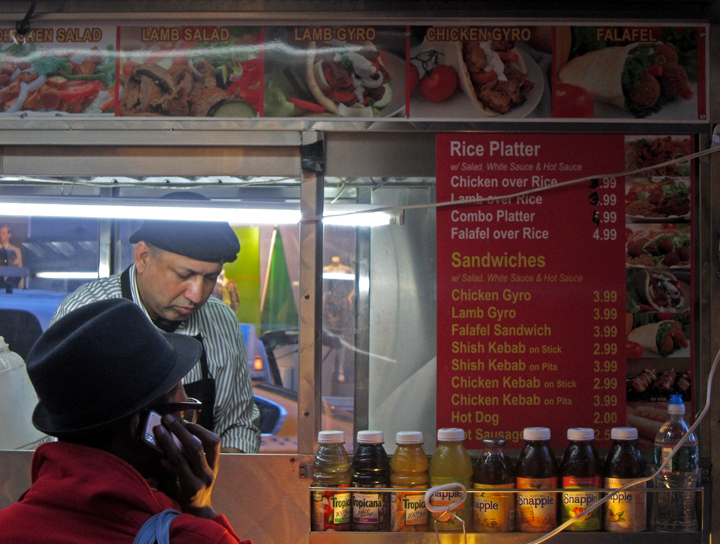
    Halal food carts are to be found everywhere in the city. I was perplexed at the large number featuring a cuisine governed by Islamic dietary stricture- Halal is a term meaning lawful or permissible according to Islamic law, and, as applied to food, is analogous to kosher dietary laws. The number of Halal carts would seem to be disproportionate to the number of potential patrons, but, like many things in this city, the explanation is as much, if not more, about the nature of the vendors than it is by customer demand.

    New immigrant groups come to New York City in waves. One barometer is taxi and car service drivers who, in recent years, have been predominantly Bangladeshi (see Lahore here). These drivers account, in large part, for the initial success of the Halal carts. An article from The New York Times explains the evolution:

    Sidewalk wisdom holds that Muslims took over the street-cart business in the 1990s from Greeks, who had themselves inherited it from Italians and Germans. Census data broadly supports this chronology. In an analysis of data from 1990, the Queens College sociology department found that 306 first-generation German and Italian New Yorkers identified themselves as members of an occupational category that included the job “street vendor”; by 2005, that figure had dropped to zero. During that period, the number of Greeks in the field rose to 200 from 120, while the number of Egyptians, Bangladeshis and Afghans surged to 563 from 69.

    Of course, hungry New Yorkers and visitors are happy to adapt to any new well-prepared cuisine. The Halal cart at 53rd and 6th Avenue is now legendary, with lines as long as 2 hours. They have been finalists in the annual Vendy awards. Initially patronized by those of Middle Eastern and South Asian descent, this cart, like others, is now frequented by many others.
    What’s particularly nice about Halal food carts is that they offer complete meals, such as chicken and rice, not just a snack item such as the ubiquitous hot dog from small pushcarts. See a Halal menu here.

    And then there is the mysterious, semi-secret white sauce, which has spawned discussions and articles – see here. New Yorkers love this kind of thing – what’s better than a secret, mysterious, ethnic, delicious white sauce?

    Posted on by Brian Dubé

  • Solid as a Rock

    I have written a number of times about the very rough side of New York City – you see this in living conditions, the street, businesses etc. In a city with such a wide range of resources and income with the people and businesses, you will see plenty of appropriation, improvisation, and salvage. It often can be surprising or even shocking what can be seen in a place like New York City (see Very Practical and The Dark Ages).

    Many New York City neighborhoods are in transition, often with a mix of of old and new. In time, gentrification usually rules the day and a transformation ensues. Occasionally, there are surviving holdouts due to special situations – long leases or building ownership. But even in the case of property ownership, the lure of big money by cashing in on the real estate becomes too great, and owners ultimately sell. A good example is Grand Machinery Exchange, the last of 40 dealers of machinery in the SoHo/Canal Street area. Sale of their buildings brought a small fortune.

    In today’s photo, the Chess Shop at 230 Thompson Street managed to scavenge discarded chess table tops in concrete with a steel banding from Washington Square Park, still under renovation in Phase 2. See the chess playing area here, prior to demolition. It is surprising how often one can see something quite edgy like this, often juxtaposed with the much more upscale.

    Add piles of cinder blocks for bases, and you have some very durable chess tables for a long time to come. I asked the shopkeeper what they do with these after closing, but I had forgotten that there is no closing – the shop is open 24 hours, so there is no need to bring the tables in from the street.

    Of course, a chess shop is not the type of business with the income to indulge in lavish furnishings, so this solution to their al fresco chess playing needs makes sense. No worry about damage, vandalism, or theft. The tables may not be pretty, but like the Manhattan schist that this city is built on, they’re solid as a rock 🙂


  • Come Together

    When one thinks of Europe or New England, as well as many parts of rural America, churches do come to mind. Traveling through New England, where I grew up, the center of many a small town, as well as its most architecturally significant and prominent structure, is a church.

    Churches are not the first thing that comes to mind when one thinks about or visits New York City – a place which is a national and international locus for so many activities and industries. On January 4, 2010, I wrote We Got Religion, and, of course, we have to have churches too. But a surprise to many is that New York City is home to two of the world’s largest cathedrals and churches: Riverside Church, seen in today’s photos, at 392 feet, is the tallest church in the United States (26th in the world), and the Cathedral of St. John the Divine is the world’s largest cathedral. These are not often seen by the visitor or resident, as they are located quite off the beaten path.

    Riverside Church prides itself on its interdenominational, interracial, and international congregation with a long history of activism, progressive causes, and political debate. It is affiliated with both the United Church of Christ and the American Baptist Churches. From their website:

    The Church commits itself to welcoming all persons, celebrating the diversity found in a Congregation broadly inclusive of persons from different backgrounds of characteristics, including race, economic class, religion, culture, ethnicity, gender, age, sexual orientation, family status and physical and mental abilities.

    Past speakers at Riverside have included Martin Luther King, Jr. voicing opposition to the Vietnam War, Nelson Mandela after being released from prison, Fidel Castro during one of his rare visits to the U.S. in 1999, and Kofi Annan, Secretary-General of the United Nations after the September 11, 2001 attacks.

    The Gothic structure was commissioned by John D. Rockefeller, Jr., in 1922 and designed by the architecture firm Allen, Pelton and Collens. The Gothic design is based on the 13th century Chartres Cathedral in France. The huge single bell tower is modeled after one of the towers at Laon Cathedral. The Carillon’s 20-ton Bourdon bell is the largest turned bell in the world. Church construction was begun in 1927 and completed in 1930. Riverside Church received New York City Landmark status in 2000.

    The church is located at one of the highest points of New York City in Morningside Heights, west of Harlem, between Riverside Drive and Claremont Avenue, between 120th and 122nd Street, overlooking the Hudson River.

    It is nice to see that whereas the dogma of organized religion is often divisive, Riverside Church has an articulated mission of getting people with very different perspectives to come together 🙂


  • The Hamptons

    Passion for living in New York City is perhaps only bettered by the passion of many residents to get out come summertime. At one time when I was taking music lessons, I was forewarned by my teacher (a Manhattan resident) that she refused to be in the city in the summer – if I really wanted to, I could travel to her summer cottage outside the city. She had stressed that it was not fancy at all, but it was out of the city.

    I have heard many extol the benefits of being in New York City in the summer – that it is easier to get tickets to many activities, things are less crowded, and there is an enormous number of summer events throughout the 5 boroughs. This is all true – I have spent most summers here, many without the occasional weekend getaway.

    But there comes a time when it is so hot and humid that all this chatter about the benefits of summering in the city seems like cheap talk. I recall one summer night after an opera performance standing on a subway platform. It was so sticky that it made my skin crawl, and clothes just seemed to be an insult to injury. Yes, I had procured great New York City opera tickets easily and inexpensively, but those who were enjoying ocean breezes certainly must have made a better decision.

    Getting away for the summer is not unique to the city – our suburban and rural brethren often take to the hills or the beach. And summer homes for the urbanite is a practice going back in time around the world. A good case in point are the Medici villas around Florence, Italy.

    In New York City, the Hamptons (along with Montauk and Fire Island) are virtually synonymous with summer getaways. However, having made a decision where to go and the financial means to do so is only part of the solution. Getting there becomes another hurdle. For those who have selected the Hamptons, traveling 100 miles from Manhattan is now the challenge. There are a number of travel options: car, bus, train, plane, or helicopter. Few can afford flying, and traffic congestion on the limited number of roadways out can be a nightmare.

    In 1974, Hampton Jitney was founded with a single van by James Davidson, a resident of the Hamptons. Train service was and still is available from New York City but has limited frequency, with delays and service complaints. On the other hand, the Hampton Jitney has service as frequently as every half hour, leaving from multiple locations on the Upper East Side. I have never summered on the East End, but if I did, I think the Jitney or train would be the way to the Hamptons 🙂

    Note: The Hamptons are a group of villages at the east end of Long Island. The area is a long time seaside resort known for its affluent residents and celebrities from New York City and around the world. You can read more about them here.


  • The Duke Lives On

    It is hard to believe, but in 1997, when this statue of Duke Ellington was erected, it was the first-ever New York City monument to a black artist and the first memorial in the U.S. to Ellington. The project, originally conceived by American cabaret singer and pianist Bobby Short, took 18 years to come to fruition. Money was not the issue – the $1 million dollars needed was raised rather quickly. It was permission from the various city agencies, commissions, and community boards that became a quagmire.

    Short was inspired by a visit to Paris. From the New York Times:

    The project had its beginning in a stroll Mr. Short took in 1979 through a park in Nice, France, five years after Ellington’s death.

    ”I simply came across this very modest bust of Louis Armstrong and I thought, how strange that here, in France, they have found time and space for a tribute to a black American jazz musician, but in New York I could think of nothing like that,” Mr. Short said. 

    His initial idea was to get friends to put up the money for a similar modest bust of Duke Ellington somewhere in the city.

    Mr. Short formed a nonprofit organization, the Duke Ellington Memorial Fund, and went looking for an artist. The search led him to Robert Graham, a California-based sculptor whose work includes the Olympic Gateway constructed for the 1984 Olympic Games in Los Angeles and the Joe Louis Memorial in Detroit.
    It was Mr. Graham who felt that a bust of Ellington was not appropriate. ”He felt it should be something grand and elegant, the way he perceived Duke Ellington to be,” Mr. Short said.

    A number of sites were considered, eventually settling on Frawley Circle at 110th Street and Fifth Avenue, at the Northeast corner of Central Park – a symbolic gateway to Harlem, where Ellington spent most of his life. An 8-foot-tall statue of Duke Ellington and an open grand piano stand atop a disk supported by three pillars – each pillar comprised of three nude caryatid figures representing the muses, nine in all. The entire 25-foot-tall memorial is done in a black patinated bronze.

    The intersection, renamed the Duke Ellington Circle, was redesigned as two semicircular plazas and forms an amphitheater for musical performances. Now, in memory, music, and bronze, the Duke lives on…


  • A Place Called Home

    When I drove a New York City taxicab in my college years, West End Avenue was just WEA on my trip log. A quiet, safe destination, with easy, traffic free driving along the wide, 4-lane, two way boulevard, and lots of big buildings.

    If you read about West End Avenue, you will encounter words and phrases like “quiet”, “convenient”,” stable”, “safe”, “community,” or “Park Avenue of the West Side.” This grand boulevard is an extension of 11th Avenue and runs north-south from 59th to 107th Street on the Upper West Side, parallel to Riverside Drive (and Riverside Park), which lies one block West. Upper Broadway, with its plethora of shops and transportation, lies one block east – hence the “convenient” part of the equation. The tenancy is very stable, with many families living here from generation to generation.

    Like its East Side analog, Park Avenue, West End Avenue is strictly residential, with virtually no businesses or commercial traffic except for trucks making local deliveries. There are no attractions here, and located so far west that very few, other than residents, ever find themselves here.

    The neighborhood, however, was not always the genteel place it is today. From the New York Times:

    For nearly 60 years in the middle of the 20th century, parts of West End Avenue were ”déclassé,” Mr. Salwen said. S.R.O. hotels, prostitutes and drug addicts became common on some cross streets. But by the 1980’s, the street had begun to recover its grandeur.

    Like Park Avenue, the street is dominated by large apartment buildings. Most buildings here are prewar and over ten stories tall, dating back to the early 20th century.

    From the Wikipedia entry for WEA: “The street is noteworthy for its almost unbroken street wall of handsome apartment buildings punctuated by brief stretches of nineteenth-century townhouses and several handsome churches and synagogues.”
    I agree, but do find the “almost unbroken street wall” of these large apartment buildings rather imposing. Having spent all of my adult life downtown in Greenwich Village, I find these hulking structures to be somewhat intimidating.

    However, prewar apartments are typically larger than average – once inside these solid buildings, the spaces are quite comfortable and make very pleasant, quiet residences. And although the buildings feel so out of scale with humans, a home is more than just a space in a building – it’s a personal place created by people. New York City has tremendous variety of residential structures, and whether small or large, short or tall, bright or dark, lavish or lean, in the Village or on WEA, inside every building in every apartment, for someone, there’s a place called home 🙂


  • Kids

    I was invited to be a speaker for career day at a New York City public school – PS 124, the Yung Wing Public School at 40 Division Street in Chinatown. This was both exciting and harrowing – I had never been in a public school in the city, and I also had never spoken before a class. I had written notes and a rough agenda, which were soon abandoned for a more organic approach.

    The teacher who invited me was a former employee who, in May 2008, brought her class to my business for a field trip. That visit was filled with screams and squeals of joy. It was mutual adoration day. You can see that story and photo here.

    Yesterday was a very different experience. It has been a long time since I have been in any school, and, good students or not, the kind of playfulness I saw on the field trip was reigned in by the school/classroom structure and atmosphere.

    I made 3 short presentations to 4th graders – classes were rotated while presenters were stationed in various classrooms. Afterwards, I stayed and observed one of Judy’s classes with second graders. Maintaining discipline and focus is a daunting task – constant vigilance is needed. Many of the kids were distracted, and controlling the talking seemed to be an unending battle. I can see why teaching children appears to be the domain of the young. Teacher burnout is a well-known phenomenon for many good reasons – poor school resources, low pay, workload, student discipline, and high expectations for test scores and from parents.

    A fascinating piece of technology was the SMART Board interactive whiteboard, which uses touch technology to detect user input and a projector to display a computer’s video output, including Internet access. Digital pens and erasers replace traditional whiteboard markers and erasers. I used it to display one of my blog postings and also to simultaneously write a few words. Judy used the Smart Board in her class to display a countdown clock from the Internet for their 25-minute quiet reading period. The level of sophistication is very high – when I asked if anyone was familiar with Netflix video streaming, almost all raised their hands.
    I was particularly impressed with the children’s poetry work and the list of things that could be found in a poem – you can see it here in my complete gallery of photos.

    I think I was quite unrealistic about my expectations – I suffered the idealism of a new teacher. As I left, I passed by the lunch room – the din was just incredible. It occurred to me that I had forgotten that these were good kids, just doing what kids do 🙂


  • Sleep Paralysis


    Have you ever woken up from sleeping but your body felt paralyzed? Your mind was awake but your body still asleep? The ensuing terror and panic in those seconds or minutes that feel like an eternity can easily be understood, as one finally wrests free and fully wakes up.

    Welcome to sleep paralysis , an enigmatic condition that has been documented for hundreds of years in a myriad of cultures, steeped in folklore. I have had this condition off and on since childhood, and, like many others, I thought that I was unique and that it was a sign of a serious disorder.

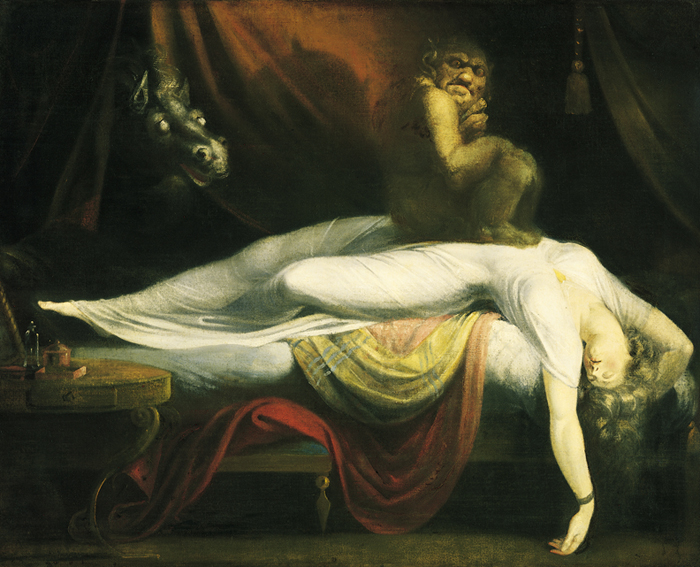
    Studies show more and more how common this condition, REM atnonia, actually is and how much folklore has been attributed to it. Some scientists now attribute alien abductions and encounters with ghosts to sleep paralysis. The demon on the body of a sleeping woman in ”The Nightmare,” by Johann Heinrich Füssli (seen above), is typical of one type of sensation described by people who suffer from sleep paralysis.

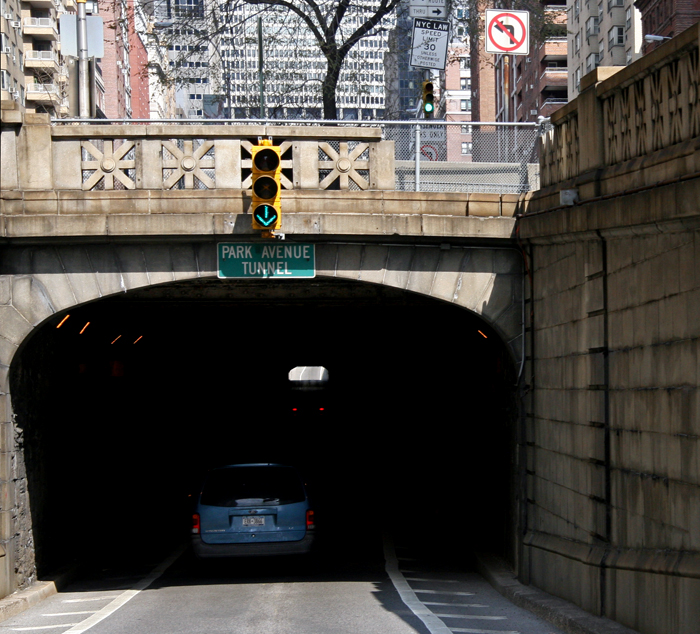
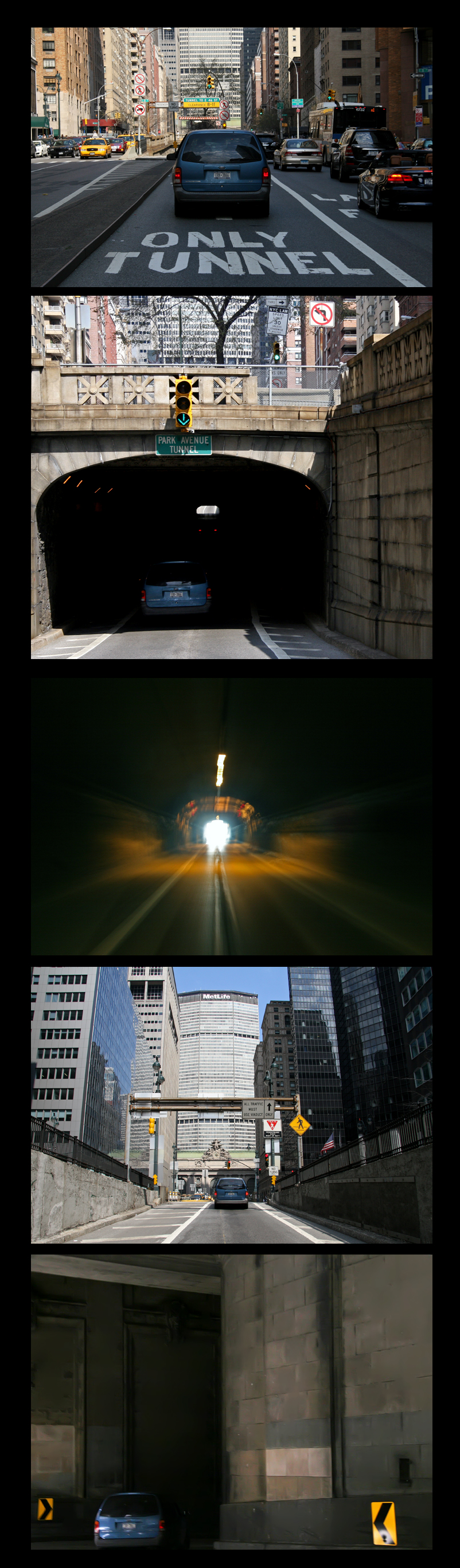
    Like claustrophobia, sleep paralysis is not the type of condition well suited to a New York City resident. To be stuck in a tunnel can feel a little to close to REM atonia. Today’s photo is of the Park Avenue Tunnel – one of only two such underpasses in midtown Manhattan, the other being the First Avenue Tunnel near the United Nations.

    I have always relished the opportunity to drive through the Park Avenue Tunnel. Going north, the tunnel starts at 33rd Street and exits at 40th Street, connecting to the Park Avenue viaduct. This elevated roadway goes directly towards Grand Central Terminal, wraps around the Terminal and MetLife buildings, and descends through the Helmsley Building to reconnect to Park Avenue at 46th Street. Read more about the tunnel here.

    Many drivers take the opportunity to indulge in a rare moment of being an automobile racer – tires screeching as cars snake around the buildings’ roadway are sounds often heard. See the entire journey with my photo gallery here.

    It has always been a freeing experience and one of New York City’s small thrills to travel this length of road (23 blocks) with only one traffic light. Luckily, I have never been trapped in a traffic jam, and I hope never to get stuck in that tunnel or viaduct. With my vehicle not moving and my mind awake, it’s a little to close to the trapped horror of sleep paralysis…

    More about Sleep Paralysis: This condition afflicts normal individuals and those with conditions such as narcolepsy and cataplexy. During sleep, the body essential turns off, a form of sleep atonia. In sleep paralysis, the mind awakens before the body. Read a New York Times article about it here.

    Frightening twist: Among the Hmong, an Asian ethnic group from the mountainous regions of Vietnam, Laos, Burma and Thailand, sleep paralysis is known as “dab tsog” or “crushing demon.” A number of American Hmong have died in the United States from Sudden Unexpected Nocturnal Death Syndrome (SUNDS), a term created by the Centers for Disease Control. This condition is now believed to be a genetic disease, known as Brugada Syndrome, not sleep paralysis.


  • Living With Legends

    Virtually every New Yorker has heard of the Hotel Chelsea, more commonly known as the Chelsea Hotel. The hotel is most well known for its roster of well known long-term residents – many living at the hotel for years. The hotel has been a home to writers, artists, actors and film directors.

    A short list includes: Mark Twain, O. Henry, Dylan Thomas, Arthur C. Clarke, William S. Burroughs, Arthur Miller, Quentin Crisp, Gore Vidal, Tennessee Williams, Allen Ginsberg, Jack Kerouac (who wrote On the Road there), Simone de Beauvoir, Robert Oppenheimer, Jean-Paul Sartre, Thomas Wolfe. Stanley Kubrick, Ethan Hawke, Dennis Hopper, Uma Thurman, Elliot Gould, Jane Fonda, The Grateful Dead, Tom Waits, Patti Smith, Dee Dee Ramone, Henri Chopin, Edith Piaf, Joni Mitchell, Bob Dylan, Alice Cooper, Janis Joplin, Jimi Hendrix, Sid Vicious, Leonard Cohen, Madonna, Robert Mapplethorpe, Robert Crumb, Jasper Johns, Willem De Kooning, and Henri Cartier-Bresson.

    From the Hotel Chelsea website:

    The hotel has always been a center of artistic and bohemian activity and it houses artwork created by many of the artists who have visited. The hotel was the first building to be listed by New York City as a cultural preservation site and historic building of note. The twelve-story red-brick building that now houses the Hotel Chelsea was built in 1883 as a private apartment cooperative that opened in 1884; it was the tallest building in New York until 1899. At the time Chelsea, and particularly the street on which the hotel was located, was the center of New York’s Theater District. However, within a few years the combination of economic worries and the relocation of the theaters bankrupted the Chelsea cooperative. In 1905, the building was purchased and opened as a hotel.

    Owing to its long list of famous guests and residents, the hotel has an ornate history, both as a birth place of creative modern art and home of bad behavior. Bob Dylan composed songs while staying at the Chelsea, and poets Allen Ginsberg and Gregory Corso chose it as a place for philosophical and intellectual exchange. It is also known as the place where the writer Dylan Thomas died of alcohol poisoning on in 1953, and where Sid Vicious of the Sex Pistols may have stabbed his girlfriend, Nancy Spungen, to death on October 12, 1978.

    Hotel Chelsea is also architecturally significant. The Victorian Gothic red-brick structure with its wrought iron balconies, located at 222 West 23rd Street in the Chelsea neighborhood of Manhattan, was listed on the National Register of Historic Places in 1977. One of the main attractions here is the art that graces the lobby and the 12-story stairway. The stairway is off limits to walk-in visitors (there is a monthly tour), however, the lobby is open to all.

    I cannot speak to the rooms here – I have never been in one, but the place does has a reputation for shabby chic. People stay here for the history and artistic clientele and ambiance, not for the ultimate in luxury or slick room furnishings. At the current time, there are approximately 250 rooms in the hotel – roughly half are still occupied by permanent residents. Long-term residency is no longer granted to newcomers, and as rooms of long-term tenants are vacated, they are converted to hotel rooms.

    The Hotel Chelsea is one of the most unique residences/hotels in New York City, if not the USA. For most of us, its past residents are a who’s who of American culture. For those who were fortunate enough to have stayed there in the past, it was living with legends…


  • Shake Shack

    Years ago, on a family vacation in a lakeside cottage rental, I had a hankering for a grilled cheese sandwich, which I rarely eat. A friend on the trip who loved cooking indulged me. It was extraordinary, and soon, my family members, jealous of my ravings, all clamored for their own. The secret? Just using better ingredients than what you typically find in the standard fare. Good bread, decent cheese, and tomatoes. Voila. Gourmet American comfort food.

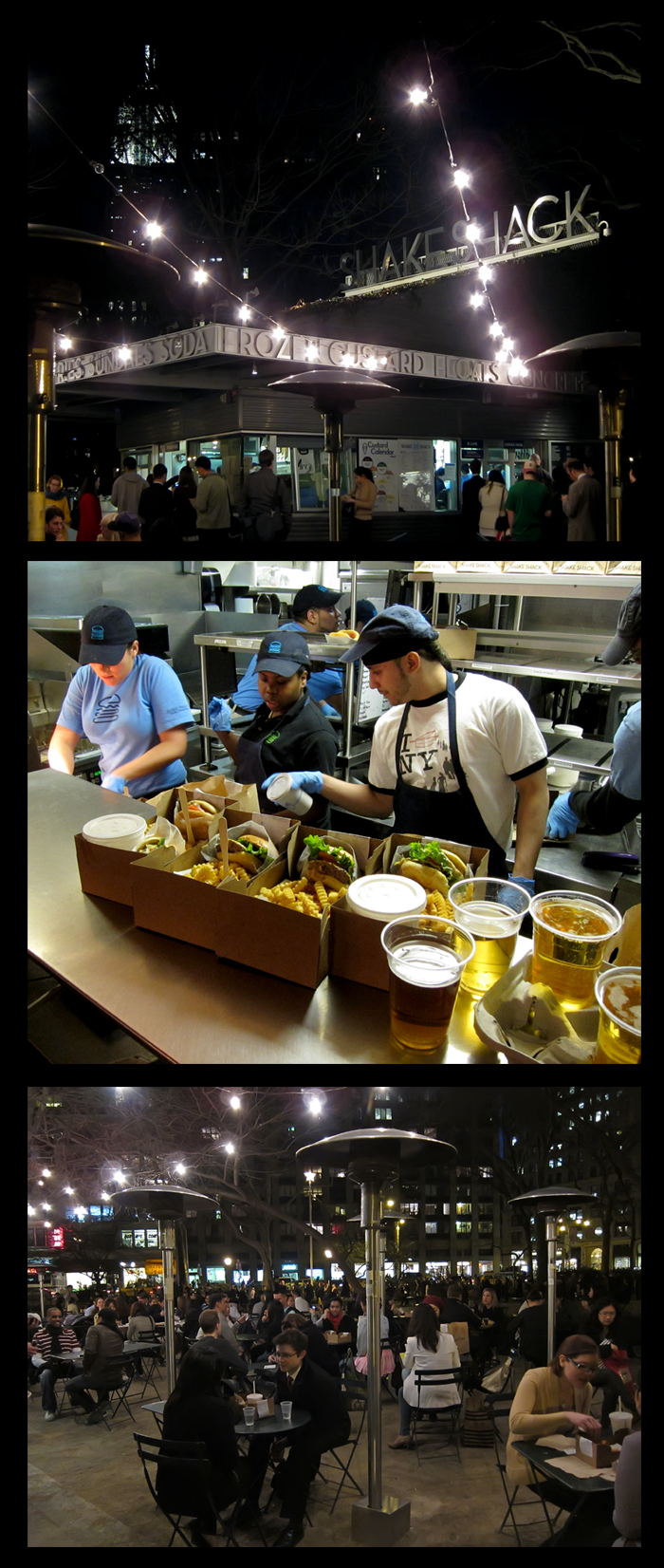
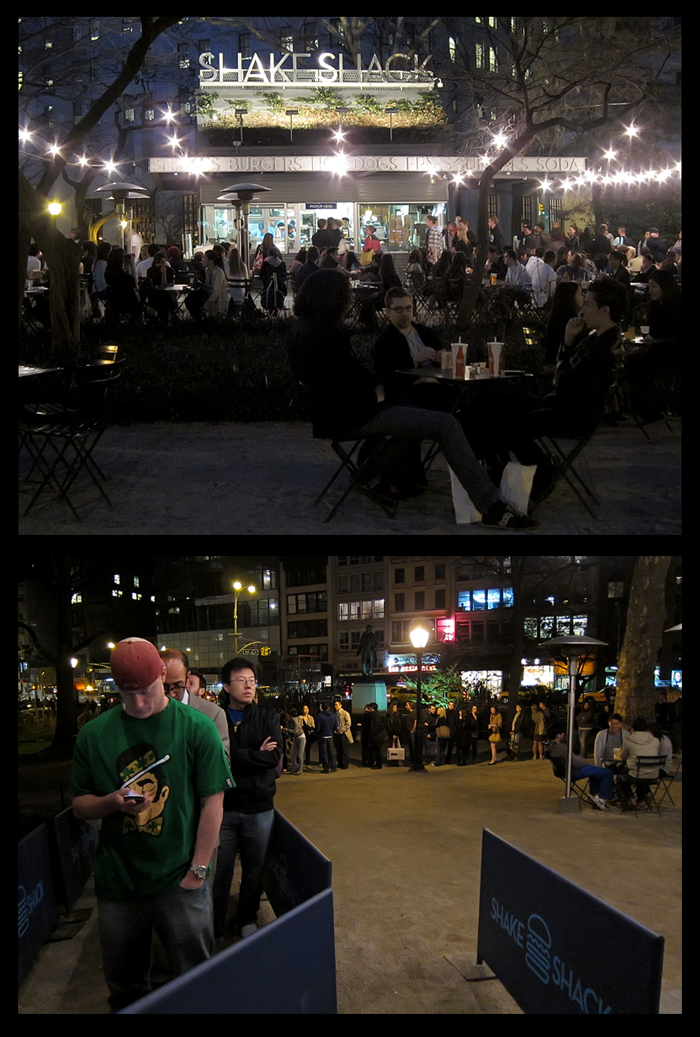
    This is the formula for the Shake Shack, located at Madison Square Park. Take American fast food favorites – burgers, fries, shakes, and frozen custard – and let a gourmet restaurant owner take it to the next level. The New York Times describes the burgers as made from “whole-muscle, no-trimmings, fresh-ground, antibiotic-and-hormone-free, source-verified-to-ranch-of-birth, choice-or-higher-grade Black Angus beef.”

    I don’t like waiting in lines in New York City for food, and lines at the Shake Shack can run over one hour. But if I ate burgers, I’d wait. (Shake Shack even has a live Shack Cam on their website to monitor the line.) Everyone I have spoken to that has eaten here raves about the food. At the online review site, Yelp.com, there are currently over 1,000 reviews, with an average of 4 out of 5 stars. See more photos here.

    Shake Shack is the brainchild of Danny Meyer, no stranger to the food business. Meyer’s company, Union Square Hospitality Group, owns 11 restaurants, including the Union Square Cafe, Blue Smoke, Eleven Madison Park, Gramercy Tavern, Tabla, and The Modern – a fine dining restaurant located in the Museum of Modern Art.

    Meyer spent parts of his childhood studying food and hospitality in France and Italy. His first foray into business as a restaurateur was in 1985, at age 27, when he opened the acclaimed Union Square Cafe. This restaurant has repeatedly topped the Zagat Survey as the number one most popular restaurant in New York City.

    Starting in 2001, Meyer’s group ran a cart in Madison Square Park selling Chicago-style hot dogs. In 2004, the Shake Shack was born as a permanent seasonal kiosk. The distinctive structure, with its English ivy-covered shed roof, was designed by the award winning architectural firm SITE (Sculpture in the Environment).

    There is outdoor seating at the Shake Shack. On a warm evening, sitting amidst the trees in the beautifully landscaped Madison Park with views of the Flatiron and Empire State buildings is about as good as it gets. I’ll get a shake or frozen custard. See you at the Shake Shack 🙂

    Note: Shake Shack now has three locations in New York City, with more planned to come nationwide. They have made an effort to go green – wind energy, on-site composting, low voltage LED lights, and construction of their Upper West Side shop using sustainable materials. See their website here.

    Related Posts: Life at Night, 23 Skidoo, Morphic Resonance, Equinox, ESB Straight Up


  • Little in the Middle

    More and more, there seems to be less and less of the middle. Certainly a city like New York is a place where people come for the edges and largely leave the middle behind. But now it feels like feast or famine. There are complaints of the loss of the middle class – people seem to be living either in multimillion dollar apartments or on the streets homeless.

    Heat is particularly frustrating – your home or office is either freezing or stifling. It is remarkable at how poor the services can be in a place like New York City, even when you are spending good money.

    In the 1980s, I was renting commercial space in lower Manhattan in a small five-story commercial building. Inadequate heat was a constant battle with management. I recall one occasion where we were absolutely frigid and the superintendent and his helper came by to investigate.

    They arrived wearing insulated winter jackets and, after a few moments, proclaimed that it felt comfortable to them. Of course it is comfortable – you have been active and have winter coats on. Why don’t you try taking them off, sit down, and type for a few hours?

    I am stunned that people would voluntarily sit and dine on the streets in the winter. It is amazing the number of people that to me appear grossly under dressed (or overdressed) for the weather.

    The photo on the left was taken after 9 PM, with a temperature in the 50s. People are in T-shirts. This is not strictly a function of alcohol and the St. Patrick’s Day celebration – I have seen people in shorts, tees, and flip-flops for a couple of weeks now. People in the parks in beach chairs sunning themselves. A quick run across the street to the bank is one thing, but sunbathing in the park or eating al fresco in March?

    The photo on the right was taken today, the following morning at 8:45 AM. The temperature is about 50 degrees, and this man is eating his yogurt and reading on a park bench. At least he has a jacket on.

    Nothing drives people to extreme behavior like the first warm spell in spring. After a winter’s diet of cabin fever, people are just dying to get outside. It would be perhaps more prudent to wait for warmer weather for dining at night al fresco or at least wear warmer clothes, but not in a city where there is little in the middle…

    Related Posts: Spring Fever, Spring MadnessWeather Means Whether


  • dinamic_sidebar 4 none

©2026 New York Daily Photo Entries (RSS) and Comments (RSS)  Raindrops Theme