• Cones

    Artisanal this and artisanal that – but, as Raul D’Aloiso pointed out last night at Cones, the word does mean something. Only a word, but most purveyors of foods wielding this word are taking it seriously and doing their work carefully. The extent to which most food artisans, such as the Doughnut Plant, are going with ingredient selection is extraordinary. Whether the customer is aware of the details or not, the result speaks for itself.

    Gourmet foods are expected in a city like New York, and in the world of ice cream, expectations are not disappointed. Competition has gotten fierce, with more high-quality individuals sampling the products of the serious artisans. Once you have had the best, there is no going back.

    Cones, Ice Cream Artisans, is located at 272 Bleecker Street in the West Village. The shop was started by brothers Raul and Oscar D’Aloiso, Argentinians of Italian ancestry. Oscar worked in the construction trade as a building site manager and was also a professional classical singer. Raul holds a master’s degree in architecture – he worked in the profession both in Buenos Aires and in New York City after his arrival here in 1989. Inspired by the artisanal gelato of Buenos Aires and their disappointment with Häagen-Dazs (which had a flagship shop in Buenos Aires), the brothers decided to introduce Argentinian-style ice cream to New York City.

    According to an article in the New York Times from 2003, New York City occupies an important place in America’s ice cream history. Reasons cited are America’s first ice cream shop in 1777, the patent for the cone-making machine of Wall Street restaurateur Italo Marchiony in 1903, and Reuben Mattus, a Polish immigrant and small-time ice cream maker in the Bronx responsible for Häagen-Dazs (and its short-lived New York-based imitators, Frusen Glädje and Alpen Zauber, made in Brooklyn). Sedutto’s, the nation’s first so-called superpremium ice cream, was founded in New York in 1922.

    More recently, we have the Cold Stone Creamery, Emack and Bolios (from Boston), the Brooklyn Ice Cream Factory, Ciao Bella Gelato, Fauchon, Grom,  Il Laboratorio Del Gelato, and the Van Leeuwen Artisan Ice Cream truck. There are still a handful of ice cream parlors too – Egger’s in Staten Island, Hinsch’s in Brooklyn, Jahn’s in the Bronx (closed), and Eddie’s Sweet Shop in Queens.
    If you’ve read this article, consider your homework done – go out and try some artisanal ice cream at Cones 🙂

    Note about Cones: The shop has focused entirely on quality of product and word of mouth and reviews (they received a 27 food rating from the Zagat Survey). There has been no advertising or marketing, and currently, Cones has no website.

  • Take Two

    I was recently looking for a Vietnamese herbal formula for a friend. Extensive searching online found neither the product itself nor anything like it in the USA, even though the manufacturer was a well-known company in Asia with a large product line.

    I took a printout of ingredients from the company’s website to Kamwo Pharmacy, where a very helpful staff member, fluent in English, Chinese, and online searching, quickly identified the ingredients and their Chinese names and said that the formula could be easily reverse engineered.

    Kamwo Pharmacy, located at 211 Grand Street on the border of SoHo, Little Italy, and Chinatown, is the largest herbal pharmacy on the East Coast. They stock a huge inventory of herbs and packaged products, but their real forte is the creation of custom formulations from a selection of over 1000 herbal substances from throughout Asia, including exotic ingredients such as dried seahorses, cicadas, deer antler, and geckos.

    The herbs for each formulation are taken from drawers which line the wall, weighed on balance scales hanging overhead, crushed or sliced, and wrapped in crisp white sheets of paper. Hundreds of orders are filled per day from around the country. The shop also has an online store.

    The staff at Kamwo is extremely diverse. Here, you will not only find employees who have received training in traditional Chinese medicine. Others in the organization come from the ranks of business, science, and western medicine, with degrees from many of the country’s finest schools in graphic design, hotel management, pharmacy, nursing, computer engineering, business administration, marketing, and biology.

    The owner, Thomas N. Leung, has a Bachelor of Science in Pharmacy from the State University of New York. Tom is a 4th generation herbalist. His father, Shan Leung, founded Kamwo Pharmacy in 1973. This training in both traditions gives him a special expertise in the trade.

    Few health-conscious individuals remain purists. Over time, diets and treatments for ailments evolve to a utilitarian, balanced approach – eating what is reasonable and using treatments that work. When the time comes to deal with a serious ailment, most, like Thomas Leung, will take a real world approach and turn to the products or modalities best suited for the job, be it Eastern, Western or the two.

    Tom feels that herbs are better at treating the underlying cause of a problem, while western medicine treats the symptoms. “I always tell people, if I have a headache, I’ll take a Tylenol, no questions asked. But if I have a persistent sore throat, I’ll take herbs.”


  • Misfits

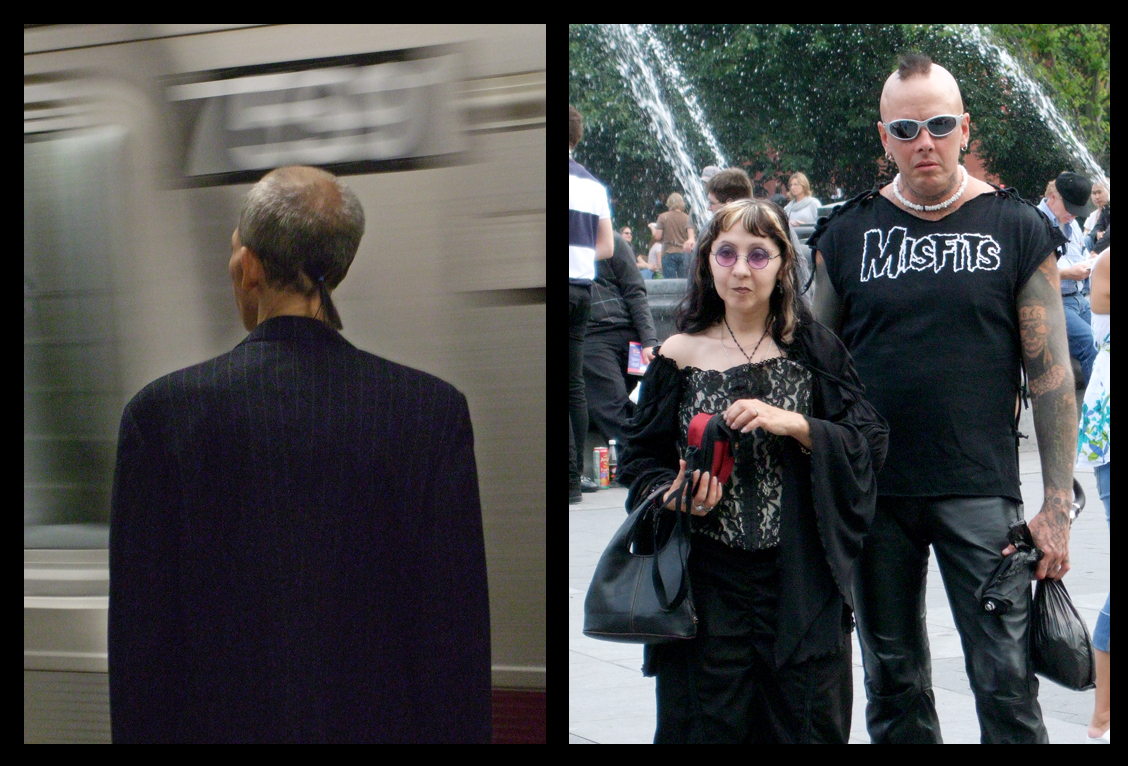
    It is safe to say that in a wired world, sights of individuals like those in the photo are no longer unusual. It is also a reasonable assumption that in many places, even outside urban areas or college towns, people like these can be found in the flesh.

    But I would guess that businessmen in pinstripe suits do not often wear their hair like our subway rider in the photo and that tattooed individuals brandishing mohawks do not usually walk the streets with a t-shirt reading “Misfits.” I imagine that the word is embraced for its dictionary meaning and not just for the punk rock band of that name.

    I have avoided using the word misfit in this blog for a number of reasons, one of which is that the word generally has a somewhat derogatory connotation. But, assuming social misfits exist, New York City is certainly a place to find them. This is an environment where virtually anyone with any manner of dress or lifestyle can feel quite at home. In fact, it is questionable whether the word misfit is really applicable in a city where such a large number of nonconformists exist and where one is often not very far from another.

    A trip to Tompkins Square Park can easily make the societal conformist feel like an outcast or misfit.
    In the case of the individuals in the photo, there is a strong element of exhibitionism. However, I have met many individuals here who, by any reasonable definition, really are social misfits, with extreme and very self-indulgent lifestyles, the nature of which may not be apparent to the outsider at all.

    Such a large number of misfits should come as no surprise in a country which has seen such a upsurge in the radical individualism of youth since the 1960s. The US Army has had to market with campaigns such as “Be all that you can be” and “Army of One.” This is, of course, rather ironic, since the Army never has been and never can be a place for individualism. But the ad campaigns do reveal how systemic and important individualism really is in this country.

    In a society without strong cultural scripting and where individualism and self empowerment are constantly trumpeted to be such laudable personal goals, we must accept the consequences. Here, in a city where there is such a a melange of iconoclasts and misfits, many live unaware of how outside the normal constructs of society they really are. Others are quite aware and proud enough to identify themselves with a t-shirt…

    Related Postings: Out There, Spike, Narcissism Gone Wild, Water Sprites, Wood Nymph, Spring Madness, The Dance Parade, Dyke March, Twelve Tribes, Penny Farthing, Homeless Art, Superheroes, Snake Charmer, Circus Amok, Fashion Forward, Piercing Al Fresco


  • Alchemist’s Corner

    Occasionally, demolition affords a rare opportunity to see something previously hidden from street view, such as fading vintage mural ads. The opportunity can also be limited in time, when new construction replaces old, as is the case here at 133-139 MacDougal Street, former home of Provincetown Playhouse (which will become NYU law offices). A friend and neighbor called my attention to a small rooftop house now visible from MacDougal Street. There are a handful of these small rooftop dwellings in New York City, and I’m fascinated by them.

    The small house is on the roof of 132 West 4th Street (photo right). The exquisite Greek Revival rowhouse was built in 1839 and was renovated in 1917 by Josephine Wright Chapman, one of the first successful female architects in America. The exterior was left largely intact, with the addition of casement windows to the parlor floor and a sloped studio window to the attic level where, in the same year, actor John Barrymore rented an apartment.

    Barrymore did extensive work and interior decoration, which included papering the walls in gold and building a rooftop garden. In an amazing twist, playwright Paul Rudnick leased the “medieval duplex” apartment in 1987. Here is Rudnick’s story from a New Yorker article in 2007:

    The apartment in question consisted of the full, narrow top floor, and I was smitten. The theatrical plasterwork continued throughout, and there was a bay window with a window seat, flanked by portholes of thick, leaded Mediterranean-blue stained glass, all overlooking the leafy corner of Washington Square Park where fanatics play chess. There was a micro-kitchen, one tiny closet, and a cramped, nineteen-seventies-vintage Pepto-Bismol-pink tiled bathroom, but none of this mattered, thanks to a vaulted skylight, a fireplace, assorted archways, and a hidden, winding staircase. The stairs led to the roof, where I found a large deck. A sun-bleached oak ship’s wheel, six feet in diameter, leaned against the outer wall of a hobbit-scale cottage-—one room, with a beamed ceiling. The broker was chatty, and she mentioned that the apartment had once been the home of John Barrymore.

    Learning of the history of the rooftop aerie, he was moved to write something set at the address, which eventually became I Hate Hamlet. Upon investigation, here is what Rudnick learned about Barrymore’s rooftop abode:

    As I settled in, I researched my new home. Barrymore had taken up residence in 1917, just before he began performing his legendary Hamlet uptown. His film career at that point was limited to locally shot silent movies, including an early take on “Moby-Dick,” which may have been the source of the ship’s wheel. Barrymore had remodelled the apartment as a Gothic retreat, christening it the Alchemist’s Corner. He had installed all the false beams, monastery-inspired ironwork, and stained glass, which made his lair resemble a stage set for an Agatha Christie whodunnit in summer stock. The rooftop had been his masterpiece, and had at one time included a garden, with cedar trees, a slate walkway, and a reflecting pool. Tons of soil had to be hoisted up by pulley, and eventually caused a collapse into the rooms below. Of Barrymore’s vision only the cottage remained; he’d likened it to a roost overlooking the spires of Paris.

    Make a trip soon to MacDougal Street if you want to see the cottage at the Alchemist’s Corner…

    Note: Frank Jump has built a website around fading ads – a photographic project documenting vintage mural ads on building brickfaces in New York City spanning nearly a century. Many of these gems are also uncovered in the process of New York City construction with demolition of structures which had prohibited views of the signage. See his website here.


  • Get Well Curve

    There is a peculiar variety of retailing in New York City. This is where sales people are actively involved in an anti-sales approach. I’m not talking about ignoring customers. I refer to sales people who actually argue with a customer, preferring that he/she buys nothing rather than buying a product which they do not consider worthy of consideration, even if they stock it.

    As a long-time resident, I have become used to this flavor of arrogance which can be found in certain businesses, particularly ones in a highly specialized niche market, often with high-end products.

    Welcome to Bicycle Habitat at 244 Lafayette Street in SoHo, a store where bike aficianados both shop and work. Complaints here range from being ignored (with sales people chatting among themselves, an all too common scenario these days) to outright rudeness. My experience there on one occasion is illustrative.

    I was interested in a Dahon folding bike. Bicycle Habitat was a dealer for Dahon at the time, but there were none on display. When I asked the salesman, who, judging by his attire, was a serious bicyclist, whether I could see one, he said if I really insisted, he could go downstairs and get one. However, he was quite reluctant and instead asked why I would want to spend money on a folding bike when I could buy a “real” bike for the same money? I answered that I had a “real” bike in storage which I never used and that if I had a folding bike, I could store it in my home and actually use it. The conversation ended here – there was apparently no use in him discussing the matter further with someone willing to compromise.

    A review site I visited shows 21 reviews for this shop. The distribution of 1 to 5 star reviews is an almost perfect inverted bell curve or well curve. Startling, isn’t it? Service here is typically experienced by the customer as great or horrific, with virtually no middle ground.
    The secret to a shopping in a place like Bicycle Habitat is to be knowledgeable about the products and on the same page as the staff. These are the customers who have positive experiences.

    Is it worth the trouble dealing with a place like this? Often, a customer has no choice, where the vendor is virtually the only one of its type, such as Canal Rubber. We have specialty stores here which exist nowhere else and where, often, the staff is extraordinary in their knowledge and expertise. Customers are very appreciative that such a place exists at all.

    Not every business with a dominance or captive audience abuses the privilege. Places such as B&H Photo treat customers very well in spite of their virtual hegemony in their retail niche.
    But for some, the get well curve, even in recessionary times, appears to be based on the philosophy there’s no business like no business 🙂


  • Yonah Schimmel

    The knish is perhaps one of the most distinctly New York City foods, rarely found outside the city environs. Most roads and knish conversations lead to the Yonah Shimmel Knish Bakery on the Lower East Side. You may find the service here a little on the rough side, but this is customer service, olde New York Style, and that means let’s get our business done, you know what you want, we’ve got what you want, we sell it to you, transaction completed. No hand holding. Like the famed Soup Nazi of TV’s Seinfeld.

    You will also find that the interior has an authentic 1910 decor. But the knowledgeable patron comes here for knishes, not service, decor, or ambiance. 

    The knish is essentially a baked or fried dumpling-like snack food – a dough-covered filling which is baked or deep-fried. It has its roots in Eastern Europe and is very similar to many Polish, Romanian, Ukrainian, and Austrian pastry-wrapped dumplings. The modern knish is a New York City creation, a food introduced by Jewish immigrants. Knishes come in basically two varieties – square or round. The square style are fried and reheated. Fillings run the gamut, but the classic and most common is the potato-filled knish. From the Cookstr.com website:

    It’s probably just that most tourists—most New Yorkers, even—don’t know the pleasures of a true knish. And by true I mean not the square, soggy, fried, gluey potato hand pie you still find stuck sadly to the side at most Famous Ray’s, but the round, open-faced, somewhat strudel-y incarnation.

    I concur completely with this view. Ironically, you will see reviews that contradict this and refer to the round style as doughy, etc. The opinions span the spectrum, both of which style is best and how Yonah Schimmel’s knishes stack up.

    Look at it this way – if square fried knishes were the standard by which all knishes are to be measured, then why would Gabila’s, who introduced the square fried knish and has sold over one billion of them since 1921, also make round baked knishes and refer to them as “gourmet style”?

    My first knishes were the square type, which, at one time, were readily available at most hotdog carts on the street. Regulations in 1996 made it much more difficult to sell knishes from street carts, so knishes in New York City are not as commonly available as they used to be. So if you look to have a genuine potato knish, visit Yonah Schimmel 🙂

    Note: Yonah Schimmel was a Romanian immigrant who started selling knishes from a pushcart on the Lower East Side in 1890. A small shop was rented by Schimmel and his cousin, Joseph Berger. In 1910, they relocated the business to 137 East Houston Street, its current location. Much of the business is take out, but there are a few tables and a menu of other items.


  • Accept the Invitation

    I have always loved bookstores. A great wave of comfort comes over me when I enter one – all of those books with the wisdom of the ages just waiting to be tapped.
    When traveling, I have found a city or town’s bookstore a good barometer of a place: the type of bookstore, atmosphere, inventory, patrons, and perhaps most importantly, whether a town has a bookstore at all. A small town with one or more bookstores says a lot about a community. They have a lot of readers. I grew up in a blue-collar town of 40,000 people with no bookstore to be found. Moving to New York City was like nirvana.

    When I first moved here, there were no bookstore cafes. It was rumored that somewhere out West, perhaps in Boulder, Colorado, there was a place where one could sit, read, relax, and even have snacks and beverages. But this was really a dream, a mirage. Certainly such a phenomenon would never come to pass in New York City, where magazine stands posted signs which said “No Reading.”
    Now bookstore cafes are a standard – customers expect them, along with unlimited browsing, reading, WiFi access, and laptop use. People park themselves for hours with stacks of books and magazines, often making notes or studying. The bookstore has become a library of sorts.

    One of the most inviting spaces is Housing Works Bookstore Cafe at 126 Crosby Street in SoHo, a used bookstore, literary hub, and concert/events venue. The bookstore is stocked entirely by donated books, music, and movies and is staffed primarily with volunteers. See more photos here.

    Apart from the bookstore cafe, Housing Works runs a chain of nine thrift shops (with lots of used designer clothing), a catering company, and a screen printing business as social enterprises to support their work and reduce their dependence on grants and donations. Earned income from these businesses accounts for approximately 90 percent of their revenue.

    Housing Works, Inc. is the largest community-based AIDS organization in the United States and operates more than 50 facilities in the five boroughs of New York City, Albany, NY, and Washington, DC.
    Housing Works was founded in 1990 by Keith Cylar, Charles King, Eric Sawyer, and Virginia Shubert. The organization has provided housing, medical and mental health care, meals, job training, drug treatment, HIV prevention education, and social support to more than 20,000 homeless and low-income New Yorkers living with HIV and AIDS. Learn more at their website here.

    The colors are so warm and the atmosphere so inviting – why not accept the invitation?


  • Mad as Hell 2

    Do you want to inflame some New Yorkers? Then set up a 9/11 conspiracy presentation on the street. There are several grassroots organizations involved in promoting 9/11 conspiracy theories – i.e. that the United States Government was responsible for 9/11 and the attacks were either a) intentionally allowed to happen or b) a false flag covert operation actually orchestrated and committed by the US Government itself.
    The alleged motives for such an act? To justify the invasion of Afghanistan and Iraq, increase military spending, and/or to restrict civil liberties. The movements are large enough to have grabbed the attention of mainstream media. You may also have seen “9/11 Was an Inside Job” on t-shirts and bumper stickers.

    We Are Change is one group that has appeared on a semi-regular basis in Washington Square Park on Saturday nights. On a recent occasion, a man who identified himself as an architect (and said his wife was also an architect) was so outraged that a major war of words ensued between himself and one of the presenters. Virtually out of control, the man paced to and fro like a wild animal. When approaching his foe, he asserted, “You’re an idiot. I defend your right to be an idiot, but you’re still an idiot.” He turned and attempted to leave repeatedly, but each time he left he was compelled to come back and repeat his mantra.

    The 9/11 conspiracy joins history’s many hoaxes and conspiracy theories:
    NASA faked the moon landings, Paul is dead, Shakespeare was somebody else, global warming is a hoax, Elvis Presley faked his own death, Diana, Princess of Wales was murdered, Holocaust deniers, Jesus conspiracy (ala the Da Vinci code), the AIDS virus was created in a laboratory, the Illuminati control world affairs, a flying saucer crash in Roswell, New Mexico, JFK assassination conspiracy theories, fluoridation is mass medication, Pearl Harbor was allowed to happen.

    One problem with such conspiracies is that the proponents are armed with a myriad of details that the average person is unfamiliar with and thereby unable to refute on the spot. Without opposing viewpoints, the arguments can be persuasive to some. Another problem is that unexplained facts or anomalies do not necessarily invalidate an accepted theory. From Scientific American:

    The mistaken belief that a handful of unexplained anomalies can undermine a well-established theory lies at the heart of all conspiratorial thinking. All the evidence for a 9/11 conspiracy falls under the rubric of this fallacy. Such notions are easily refuted by noting that scientific theories are not built on single facts alone but on a convergence of evidence assembled from multiple lines of inquiry.

    In the case of the 9/11 conspiracy, there are now numerous websites, magazines, and books which debunk the 9/11 conspiracy theories, point by point (and there are websites and books which attempt to debunk the debunkers).

    When conspiracists appear, I’m staying on the sidelines and letting others get mad as hell…

    Note: For another New Yorker pushed to the breaking point, see Mad as Hell here and here.


  • Rags and Riches

    I recall speaking to a young architect many years ago, expressing my dissatisfaction with NYU’s hulking Bobst Library on Washington Square South. She explained that from an architectural perspective, the nature of a library demands such an imposing structure. I was not thoroughly convinced that this particular library needed to have such an imposing presence on Washington Square, particularly such an enormous, monolithic, cubic design, but I did come to appreciate that certain types of institutions can instill confidence in their patrons by the nature of their structure. And what would be a better candidate than a bank, home and guardian for our money?
    From an article in the New York Times:

    Why build such evocative Greek temples to begin with? To inspire confidence. When the United States economy collapsed in the Panic of 1893, many people blamed banks for the depression that followed and withdrew their money.
    So, banks built in that era (until the end of the Great Depression, when banks began to demystify themselves with glass-fronted branches) were meant to suggest strength, as if they had been there forever.

    The Bowery Savings Bank, 130 Bowery at Grand Street, is an outstanding structure. It was designed by Stanford White (1853 – 1906) of the firm of McKim, Mead, and White, and built in 1895. The landmark building is adorned with Corinthian columns, Venetian glass, marble mosaic floors, and 65-foot ceilings.

    The Bowery Savings Bank, however, ran into serious financial difficulties and, in 1985, was sold to Richard Ravitch and others. Its current incarnation is Capitale, an upscale events space and popular wedding facility. To see a photo gallery of the beautiful interior spaces, see their website here.

    Equally remarkable is the building’s location on the Bowery, a street/area which, in recent history, has been quite impoverished, known as skid row and home for Bowery bums. Sections of the area have become gentrified. To walk the street is still a very uneven experience, with the lighting district, restaurant supply district, bits of Chinatown, an art museum, and Cooper Union. It is a rags and riches story…

    Note: The roster of works designed by McKim, Mead, and White is extraordinary. In New York City alone, they were responsible for the Harvard Club of New York, Madison Square Garden II, the Cable Building, Washington Square Arch, Columbia University’s Morningside Heights campus, The Morgan Library & Museum, the Manhattan Municipal Building, Bellevue Hospital Center, James Farley Post Office, the Town Hall, Savoy-Plaza Hotel, and the Villard Houses. The existing building replaced the original Bowery Savings Bank building of 1834.


  • Nondescript

    I think many people have a favorite phrase or word and often overuse it, use it inappropriately, or are unaware that they use it as much as they do. And, of course, the power of words or phrases are diminished by overuse, so this can be quite torturous. A fine balance needs to be achieved – the desire to brandish the word at every appropriate opportunity must be reigned in and evaluated by the worthiness of the situation.

    So titling an article such as this one using one of my favorite words, nondescript, is, likewise, a big consideration. It can really only be used once this way, so its application subject must be considered carefully, like a job applicant for a top position.

    The first time I became acquainted with the word nondescript was in an architecture article regarding a building in New York City. I was so very pleased – it was exactly a word I had being looking for. Nothing fits the bill so well when needed, and I was glad to replace descriptives such as dull, boring, or no character.Fortunately, avoiding the overuse of the word nondescript in New York City is not too difficult – there is much character and interest in most any given vista. For a fine use of the word nondescript in Manhattan, you need to take a trip to the Upper East Side, along Second or Third Avenue. Here, you have a parade of tall, postwar, nondescript apartment buildings, as far as the eye can see.

    Perhaps this is why Neil Simon chose to use the title Prisoner of Second Avenue for his play (later adapted as a screenplay for the film of the same name). After all, Prisoner of Park Avenue has a rather disingenuous ring, doesn’t it? In the play/film, protagonist middle-aged Mel Edison has lost his job, and the situation is exacerbated by a litany of city problems. What better insult to injury than to set the whole thing in a nondescript high-rise building on a characterless Second Avenue?

    In keeping with the title of this story, today’s photo is on a strip of Second Avenue of no particular interest, with buildings which are, shall we say, nondescript? 🙂

    Movie note: If you have not seen Prisoner of Second Avenue, I recommend it, as I recommend any of Jack Lemmon’s comedies, particularly those set in New York City: The Apartment, The Odd Couple, and one of my personal favorites, The Out-of-Towners (1970). These films, like many of Woody Allen’s, dig deep into the urban neuroses of New York City life. The Neil Simon scripts crackle, and Jack Lemmon plays the quintessential New Yorker at wit’s end.


  • Guerrillas in our Midst


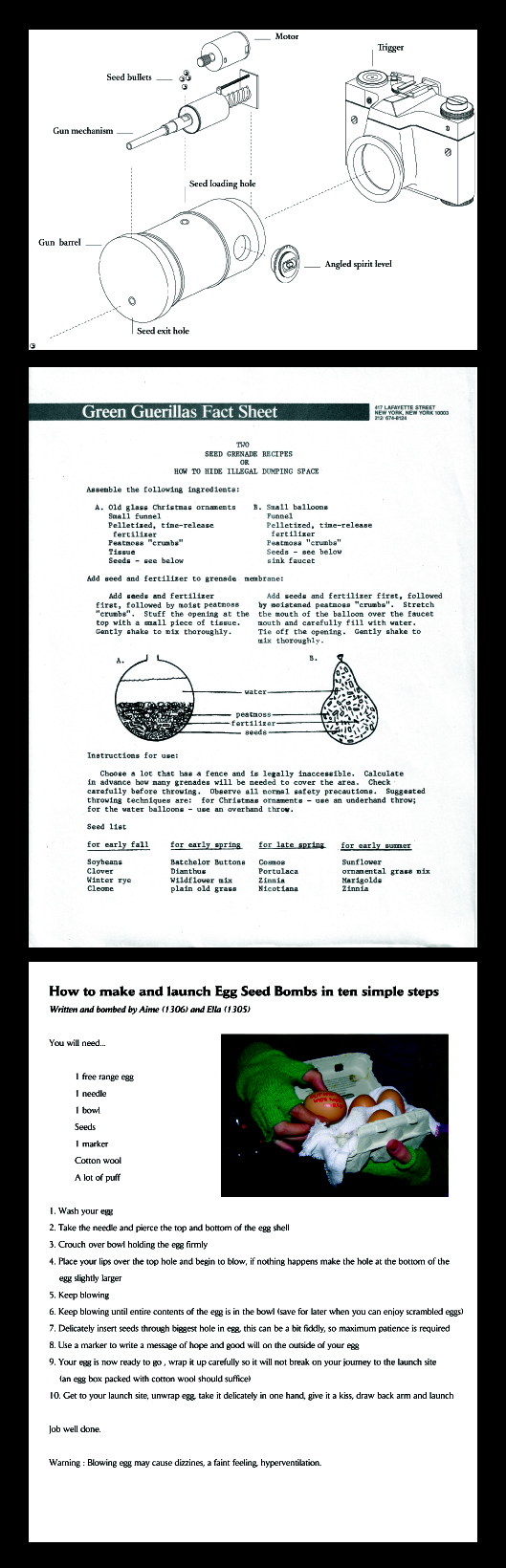
    There is a type of war being fought which has a very pleasant outcome, and unlike the war on drugs, it has been quite successful. I speak of the guerrilla gardening movement. They have weapons too – in addition to books, videos, and websites, guerrilla gardeners have cool gadgets such as seedbombs (which come in a least 6 varieties – classic clay seed ball, NYC grenade, Kabloom Seedbom, explosive eggs, seed balloon, and seed pills which can be shot from a camera), automatic seed shoes, and even a subversive gardener attache case. See drawings here.

    This is now an international effort. In 2004, Richard Reynolds started GuerrillaGardening.org, a blog regarding his solo efforts at gardening outside Perronet House, a residential apartment complex in London. In 2008, his book On Guerrilla Gardening was published, describing activities in 30 countries. Visit his website here.

    And right here in the midst of Manhattan, we have the origins of the modern movement and the term guerrilla gardening. Liz Christy and her Green Guerrilla group, who formed in 1973, are generally credited with the first use of the term. The group transformed a vacant lot into what would end up becoming a community garden. The plot is an entire city block in length on Houston Street, extending from Bowery to 2nd Avenue.

    I have seen this garden for decades, but it is the massive tree and sharing it on this blog that finally drew me in, entering a world much larger than I ever imagined. See more photos here.
    The garden has a small pond which is home to fish and turtles, a wildflower habitat, beautiful wooden furniture, a grape arbor, a grove of weeping birch trees, fruit trees (including an an ornamental orange tree), vegetable gardens, berries, herbs, hundreds of varieties of flowering perennials, and its pièce de résistance that drew me there: the towering dawn redwood.

    This massive tree is one of a handful in New York City. A native to the Sichuan-Hubei region of China, the Dawn Redwood (Metasequoia glyptostroboides) was introduced to the United States in 1948. The one at the Liz Christy Garden is 30 years old, stands at about 110 feet tall (estimated to grow to 150 feet), and can be seen from many blocks away.

    To all those who have worked hard to bring some green to our urban world, I salute those guerrillas in our midst 🙂

    Historical Note: There were earlier “guerrilla gardeners,” most notably, Gerrard Winstanley of the Diggers in Surrey, England (1649), and John “Appleseed” Chapman in Ohio (1774 – 1845).


  • What You Get

    One of the cornerstones of American culture is the view that You Get What You Pay For. In 2008, I wrote Free Lunch about free activities in New York City that defy aphorisms such as There’s No Free Lunch or You Get What You Pay For. I do empathize with those who use price as a measuring device. It does simplify life to sort by cost and thereby arrive at what must be best and worst in everything that has a price tag, be it medical care, electronics, food, clothing, homes, or education.

    So, where does the quality of college education stand in regards to cost?
    For most, this question is irrelevant. Something as important as a college education is not the time to be testing popular adages. Who wants to when the I Told You So refrain will be waiting to haunt for a lifetime those who have gambled and lost?

    A good test of the price-to-value hypothesis is Hunter, a senior college of the City University of New York (CUNY). Tuition in 2009 runs $9000 (New York State residents) against, say, NYU’s $42,000. These are very significant differences. College tuition today is a very serious matter. It has outstripped inflation and appears to be immune to economic laws – up appears to be the only way it goes. Many graduates of a liberal arts school will find themselves saddled with enormous outstanding debt and facing employment at basic living wages.

    If you look at surveys, articles, and reviews on American colleges/universities, you will find Hunter College in many lists such as Best Value Colleges for 2009, America’s Best Colleges, Best Universities-Master’s, Best Northeastern Colleges, etc. Reviews by students range the gamut, as might be expected. One constant I found interesting, however: all appeared to think highly of the faculty. The criticisms were typically about some of the physical maintenance and particularly the bureaucracy, registration, and other administrative horrors.

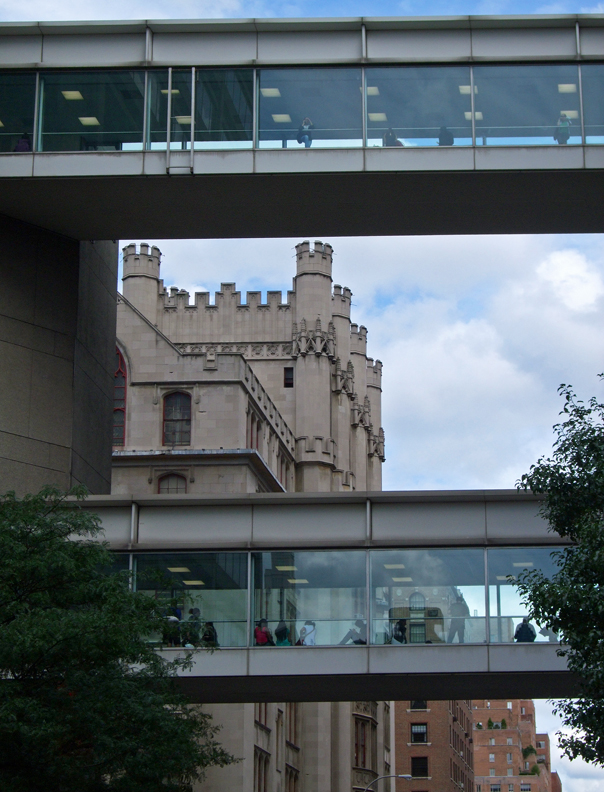
    Hunter College, founded in 1870 as Normal College, is located at 68th Street and Lexington Avenue on the Upper East Side. The urban college occupies 4 buildings all interconnected by skywalks – a very unique feature, providing not only some campus character for a school located in the heart of Manhattan but also sheltered travel between buildings.
    One of the four buildings, Thomas Hunter Hall, is a remarkable structure. This is the turreted structure in today’s photo. You can read about it here in an article by Christopher Gray of the New York Times.

    It is possible to get a good education at Hunter. Graduates have been admitted to the best grad schools in the USA. Many graduate programs are highly regarded. The alumni roster also has numerous notable individuals, including two women who were Noble Laureates in medicine. In the end, I see Hunter College as a good example that it’s not so much “you get what you pay for” as “you get what you put into it”…


  • Doughnuts

    Do you like doughnuts? To me, they are the quintessential American comfort food, soft and benign looking. I rarely eat them, however – doughnuts are typically a fast food and are not known for their health benefits. Nonetheless, a friend and I got a hankering and, having heard of a gourmet doughnut place somewhere downtown, I started to do my research.

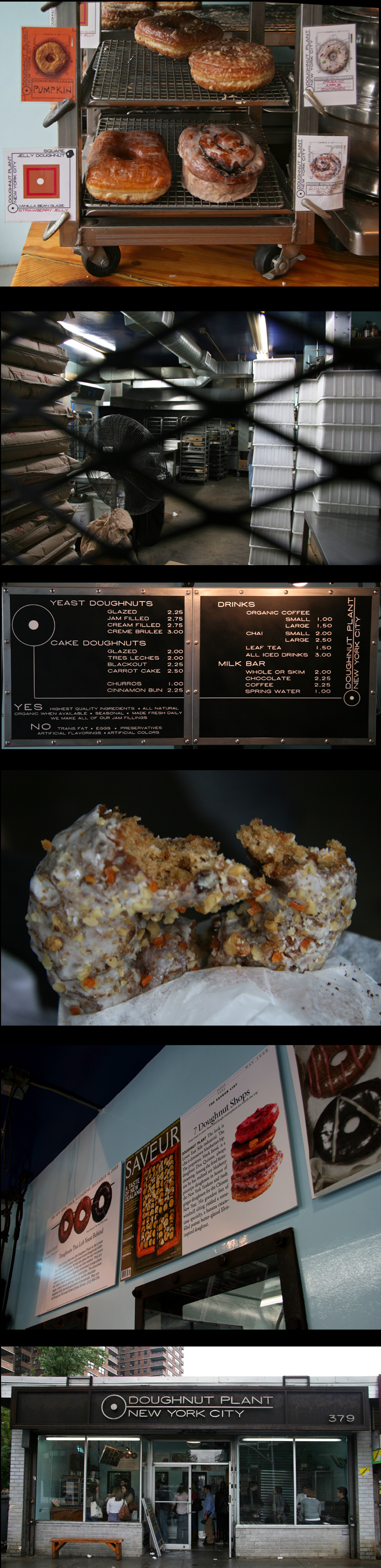
    This was a relatively easy search. Although there were many other contenders for our quest, most roads seemed to lead to the Doughnut Plant at 379 Grand Street (near Essex Street), owned and operated by Mark Israel. Many consider the doughnuts here to be the best in New York City, if not the world.

    The location is off the beaten path – somewhat east from prime Lower East Side and located in a nondescript, quasi-industrial one-story building. It does not have the feel of a place to be seen or concerned with decorative touches, such as Magnolia Bakery.
    But no matter, because this place is a destination. There is a sense of seriousness and intention. A quick look around showed the focus and intensity of customers who knew what they wanted and were here to get it, even at $2-$3 per doughnut. See more photos here.

    This is the type of New York City establishment run by an owner who is driven to make a superior product. He changes his frying oil daily, uses ingredients such as Valrhona chocolate and Tahitian vanilla beans, makes his own fruit preserves, uses fresh coconuts, buys fruit for his glazes from the Union Square Greenmarket, roast and grinds his own peanuts, and has flour milled to his specifications. He uses organic ingredients, and his doughnuts have no trans fats, artificial ingredients, or eggs.

    The Doughnut Plant was founded in 1994 by Mark Israel, using the recipe of his grandfather, Herman, who started working in a St. Paul Minnesota bakery at age 16. During WWI, Herman was stationed in Paris, France, where he baked bread in the Army bakery. From 1935 to 1965, he owned and operated the College Pastry Shop in Greensboro, North Carolina. Mark was born in 1963 in North Carolina and moved to New York City in 1981. He operated from the basement of a Lower East Side tenement until 2000, when he moved to his current location.

    There are blackout doughnuts, lavender-glazed cake doughnuts, and exotic creations with coconut custard filling, creme brulee, tres leches (with 3 sweet creams), rose petal-glazed, banana cream-filled peanut butter-glazed inspired by Elvis Presley’s favorite snack, and blueberry pinstripe doughnuts in honor of the New York Yankees. See their website here.

    The Doughnut Plant turns out over 2000 doughnuts per day and distributes to over 40 shops in New York City, including Dean & Deluca, Citarella, and Zabar’s. The shop closes when they have sold out of the day’s production.
    Mark has collaborated with partners and now has 10 shops in Tokyo and 10 in South Korea. The New York City location is the only one in the USA, but there are plans to open in other locations.
    Doughnuts, anyone?


  • Del Floria’s


    There were many things I saw growing up which sold me on this city. One was watching the TV series The Man From U.N.C.L.E. This program (from 1964-8) was about a fictional secret intelligence agency, U.N.C.L.E., with headquarters in New York City. The entrance itself was secret, located in the rear of Del Floria’s, a tailor/laundry shop located somewhere below street level in a brownstone in the East 40s near the United Nations. See video of the opening trailer here.

    As a boy, I was riveted to images of the show’s opening sequence, determined to glean enough details to find Del Floria’s at some future time. So I could never understand the fear and dislike for the city. At the very least, didn’t you want to find Del Floria’s Tailor shop?
    But rather than fascination, most New Englanders whom I grew up with had feelings about New York City that ranged from being afraid to being terrified. When I say terrified, I mean a nearly pathological fear that transcends any rational explanation. A fear of being lost in the black hole of New York City’s highways, byways, cloverleafs, on ramps, off ramps, bridges, tunnels, and one-way streets, apparently never to return.

    However, I must admit that the roadways of New York City can be daunting and unforgiving. The Triborough Bridge, shown in the photo, is a good example of what could be a traveler’s nightmare. This bridge is actually a complex of three bridges connecting Manhattan, Queens, and the Bronx.

    There is often no humanity on the roads of New York City. Make a mistake and you will pay the price, sometimes literally. In most cases, if you mistakenly find yourself approaching a bridge or tunnel, I have bad news for you – you’re going through it or over it, with no opportunity for turning around. I was furious for years over an incident where, while driving in Brooklyn, I missed the last exit and was forced to travel over the Verrazano Narrows Bridge to Staten Island and pay an exorbitant toll.
    In spite of space for an easy turnaround, I was not allowed and was forced to pay the toll, exit, and return. Begging the toll officer was of no avail – better luck negotiating with the man from U.N.C.LE.

    In some ways, I enjoy successfully navigating the maelstrom of New York City, so for me, this has always been a challenge to meet, not a cross to bear. And when I find Del Floria’s, you’ll see it here…

    Note about the photos:
    Top Photo: This is the base of the Triborough Bridge (built in 1936 and renamed the Robert F. Kennedy Bridge in 2008) as seen from Ward’s Island. For more info, see here.
    Bottom Photo Collage: Sequence showing Del Floria’s Tailor Shop and method of entry to U.N.C.LE. headquarters.


  • Barbie Girl

    Barbie turned 50 in 2009. According to the New York Times, all 1120 tickets to this year’s celebration in July were sold out within two days after going on sale in July 2008.

    Although officially born in Willows, Wisconsin, I like to think of Barbie as a New York City girl since her birthday is based on her original debut at the International Toy and Trade Fair in New York on March 9, 1959. She attended the fictional Manhattan International High School, based on the renowned Stuyvesant High School.

    The Barbie doll was created by Ruth Handler, the wife of a Mattel co-founder Elliot Handler (Ruth later went on to become President in 1967). Ruth was inspired by her daughter, Barbara, who preferred playing with paper dolls. The design itself was based on a German fashion doll called Bild Lilli (1955-1964), who in turn was based on the German comic-strip character Lilli.

    An icon this huge will, of course, garner its share of controversy, parodies, and comedic spins. Mattel does respond and change her image. Her original physique at 1/6 scale, Barbie would have been 5′ 9″ with measurements estimated at 36-18-33. A 1965 Slumber Party Barbie book entitled How to Lose Weight advised, “Don’t eat.” This gave way to the term Barbie syndrome. In 1997, Barbie’s body mold was redesigned and given a wider waist.

    Barbie is multifaceted. She has had over 40 pets and has owned a wide range of vehicles, including pink Corvette convertibles, trailers, and Jeeps. She also holds a pilot’s license, operates commercial airliners, and serves as a flight attendant. Barbie’s life shows that women can have many careers, including Miss Astronaut Barbie (1965), Doctor Barbie (1988), Nascar Barbie (1998), and an Olympic swimmer.

    In 1997, Mattel filed a defamation lawsuit against MCA Records over the bubblegum pop song “Barbie Girl” by Danish group Aqua. The song was a parody of Barbie and Ken with lyrics loaded with sexual innuendos, such as “You can brush my hair, undress me everywhere.”

    Barbie does keep up with the times. In the most ironic twist ever, Mattel just released its own version of the offending song, renamed The Barbie, using the same melody and some of the same lyrics to promote Barbie Fashionistas – you can see the video here.

    I met the young girl in the photo in August in Washington Square Park. She was sporting an entire Barbie-inspired wardrobe, from head to toe, including a medallion necklace with the letters “BFF” (best friend forever). Now that’s a Barbie Girl 🙂

    Barbie is also an animal rights activist. See my story – Barbie in Furs.


  • dinamic_sidebar 4 none

©2026 New York Daily Photo Entries (RSS) and Comments (RSS)  Raindrops Theme