• Urban Coral Atoll

    Posted on by Brian Dubé

    Those inexperienced with urban auto break-ins will often leave valuables in plain view in a parked car on the streets of New York City. If warned, their corrective behavior is often to only leave things of no value, perhaps in a bag. But the problem is that only they know it contains nothing of value. Anything with contents that cannot be seen by others is also a target. Thieves will break into an car if there is virtually anything of any value (or anything which may contain something of value) in plain view.

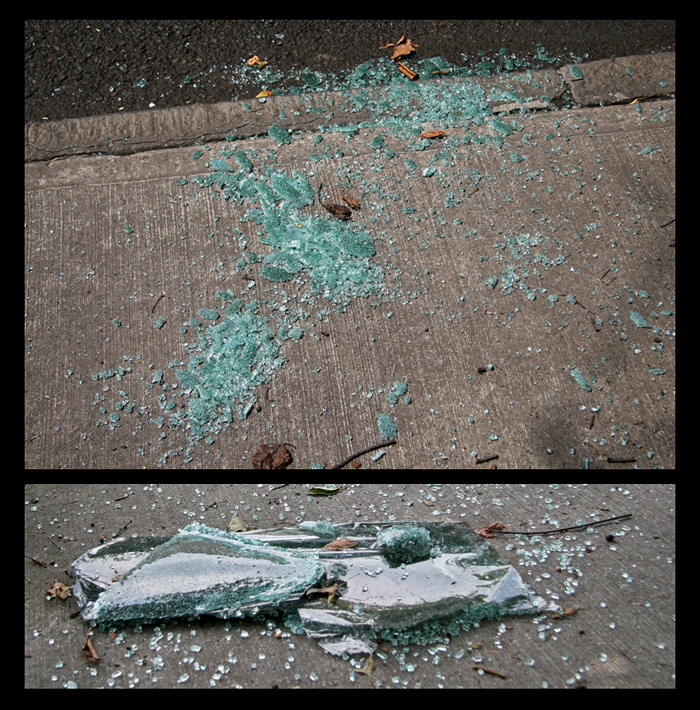
    Breaking a window is a quick and easy way to find out. The telltale evidence of an auto break-in is the small broken round or cuboid bits of glass (a safety feature of tempered glass used in automobile windows) found curbside.

    In much of Manhattan, this is now seen very infrequently, compared to the 1970s-80s, when this was an all too familiar sight. Car radios were a frequent target, resulting in the ubiquitous “No Radio” signs. Many installed removable radio and cassette player systems, while others removed them completely. Convertibles were often slashed.

    Many owners of luxury cars opt to leave cars unlocked in order to avoid damage to their vehicles. You will occasionally see luxury convertibles, top down, parked unattended in the streets of New York City, a clear signal to potential miscreants that there is absolutely nothing of value in this vehicle.

    At one time, in an anemic attempt to prevent break-ins, alarms were a standard in virtually every car. Car alarms are virtually useless. Studies have shown they are essentially no deterrent; thieves hit and run before any response to an alarm is possible. Plus, alarms are most often triggered by the rumble of passing trucks, thunder, or any other number of events other than theft or vandalism. The sounds of alarms going off was a regular occurrence, a hated urban cacophony.

    In the outer boroughs, auto break-ins with sidewalks of broken glass is still a common occurrence, as I learned on Sunday, walking down Southern Boulevard near the entrance to the Bronx Zoo. I was surprised to see this on such a major thoroughfare along the zoo property. Not just one, but a chain of broken windows, like islands and islets in an urban coral atoll…

    Posted on by Brian Dubé

  • Bronx Zoo

    Posted on by Brian Dubé

    Zoos have gone through numerous incarnations, a mirror of society’s relationships with and views of animals. From the early menageries in Europe, we have moved away from cages and entertainment to habitats and education. There was no hiding from the populace that the conditions in most zoos at one time was deplorable. Eventually, the cages themselves became more difficult to justify. The emphasis today is the conservation message – the graphic for the Wildlife Conservation Society gets equal time with the Bronx Zoo on all of the literature, merchandise, and entrance gates.

    The Bronx Zoo was founded in 1899 as the New York Zoological Park, with 843 animals in 22 exhibits. A group of beautiful Beaux-Arts buildings designed by Heins & LaFarge surround a sea lion pool (seen in the photo) at the main entrance, which also features beautiful gardens. This is the largest zoo in the United States, covering 265 acres with more than 4,000 animals, many of them endangered species.

    The transformation can be seen at locations such as the Lion House, one of the original Beaux-Arts buildings, which no longer houses the big cats. All have been moved to larger areas. Some exhibits, such as the World of Darkness, have closed due to budget cuts.

    Efforts have been made to place animals in as natural an environment as possible. Ultimately, however, the overriding feeling I have in any zoo is still one of exhibits of animals in confined spaces. Some argue that if conservation is the motive, money would be better spent in open wildlife sanctuaries and contributions made towards the animals’ native environments in their home countries.

    At one time, when the Bronx Zoo made the transition to habitats, everything seemed to be so dramatically large and the animals so free. As I have visited the zoos since that time, the habitats feel smaller. I can’t help but compare these environments to the areas which the same animals must inhabit in the wild.

    Many of the inhabitants of the zoo are rescued animals whose fate would likely have been grim had not the zoo adopted them. Endangered species are protected, bred, and some even reintroduced to the wild. And I am sure that the place is staffed with dedicated animal lovers who cannot be expected to argue for their own demise. But when I peer into the eyes of those gorillas, I always wonder how happy they are and what they are thinking…

    Related Posts: Feeding at the Zoo, Rain Forest, Red Panda

    Posted on by Brian Dubé

  • No Fusilli

    Posted on by Brian Dubé

    Things start well enough on Sunday – my mother calls to wish me Happy Birthday, and from my window, I see a partly sunny day. I suggest to my girlfriend that we go to the Bronx Zoo, something which I had not done in years.
    We opt for public transportation – the subway has a zoo stop.  A short distance outside, however, and it is clear that this is going to be a hot and very humid day. But I remain optimistic – trains are air-conditioned, and the zoo is shaded and also has indoor exhibits.

    This trip requires two trains, a local to the express. When we get to Astor Place, however, the local train is not running at all. Out to the street for a six-block walk to Union Square for the express train.
    Signs indicate that the number 5 train is also not running for the weekend. We jump in the first express train which arrives quickly – things are starting to look up.

    But once we arrive in the Bronx, I notice the stops don’t look quite right. That’s because only the number 5 runs to the zoo, not the 4 which we had taken. A brief conversation with a passenger confirms my mistake and that I will have to take a bus across Fordham Road. We exit the train, armed with our Metro Cards, expecting a free transfer.
    However, the bus driver indicates that we need to go back to the machine on the street and purchase reduced price tickets at $1.10 each for this BX12 bus.
    Off the bus. Buy tickets. Back on the bus. The ride across Fordham Road is quite depressing.

    Our stop is Southern Boulevard, and the driver tells me I have a choice of two entrances. I forget the East Fordham Road entrance is the main one, which is quite beautiful. Instead, we traipse nearly twice as far down Southern Boulevard for what feels like an interminable distance in the heat to finally arrive at the side entrance. We see “The Complete Experience” listed for $27 per person, with no posting of general admission prices. This already smells of a zoo sadly doing badly. Being late in the day, we opt for general admission at $15 each.

    The day’s humidity is almost unbearable, even in the shaded areas of the zoo. We quickly learn that many of the best exhibits are part of The Complete Experience and can be purchased ala carte. $6 more gets us into the Congo Gorilla Forest – can’t miss that. We watch a movie, and the screen lifts to a live panorama of gorillas.

    I overhear a disappointed father of a family asking his wife who is reading a map – “No elephants?” (there are only two left which can only be seen from the Bengali Express monorail). We decide to purchase a drink after building up a thirst and $2.75 buys a small bottle of water.

    A zoo employee tells me that the zoo closes at 5:30 PM, so I pace myself for that. However, an announcement at 5PM tells us the zoo is now closed, so we barely get to the gardens and exhibits at the main entrance, which I was saving until last.

    We exit and make our way back to the Fordham Road bus stop. We purchase those silly tickets for the crosstown BX12 and wait at the bus stop, confident that we have the system mastered. The bus arrives quickly, but it stops inexplicably some distance before the stop and we miss it. Not to be fooled, we move, and the next bus stops behind us. A quick jog in the heat with camera equipment in tow, and we just make the bus.

    The train ride itself is uneventful. But at our final stop, I notice a man with a VERY wet umbrella – he confirms a torrential downpour outside. This provides a most amazing photo opportunity and, of course, a wet journey home. The streets are littered with downed tree branches.

    We decide to go Indian for a birthday dinner. The place I frequent is typically nearly empty, but tonight the place is packed, and there are a couple of huge parties. We are seated at one of the few remaining tables. We wait for some time, but I have a bad feeling that this will be a painfully slow process, so we leave as gracefully as possible.

    My spirits pick up as we opt for Trattoria Spaghetto just a few short blocks away. They are also unusually crowded, and the only remaining table is sandwiched between the kitchen and the service exit to the street used by the waiters. Not daunted by eating on a super highway, we sit and get our menus. I do not need to even open mine, because I am ready to order my favorite dish here: Fusilli Puttanesca. However, our waiter informs me that he is sorry, because tonight there is no fusilli 🙁

    Posted on by Brian Dubé

  • Dreams

    Posted on by Brian Dubé

    There can be comfort in unrealized and unattainable dreams. A basket of these can provide a hidden agenda, and false hopes of realization can give one’s life purpose. These aspirations can be wielded in conversation: “One day I hope to…” And, perhaps, one is better without the realization, because not only is the dream lost, but also, with the accumulated expectations over time, the reality could be a disappointment.

    And so it has been for me with my love affair with Washington Square Arch, a monument which I have looked at nearly every day of my adult life and dreamed to enter and ascend to its roof. As a boy, I had the same passion for reaching the summit of the Washington Monument, which was an easily attainable goal: pay the admission fee and take the elevator.

    The Washington Square Arch stairway is rarely open to the public. Until recently. Late one night, I was informed by a park habitué that the small door at the foot of the west end of the base of the arch was open – or, in fairness, I should say ajar. My first reaction was indignation – how dare I not be told about this opportunity! After waiting for decades, wasn’t I the most worthy?
    It soon occurred to me, however, that rather than spend time being self-righteous, perhaps I should consider taking advantage of this rare opportunity and actually entering the Arch. After all, goals are attained by those who act, not whiners.

    There was no sign of prohibition at the door. Many an opportunity is missed by overthinking, overplanning, and excessive worry, so with little fanfare or deliberation, I entered.

    An extremely narrow spiral staircase winds its way to the top. Fortunately, it was left lit, so my journey was easy enough. At the top, there is a large, cavernous chamber. A staircase ascends further to a skylight trap door, leading to the roof of the arch (photo lower left). It appeared to be easily opened, but I decided not to press my luck. I took several photos through the transparent domed roof hatch (photo lower right).

    There is not a tremendous amount of information about this interior Guastavino terra cotta tile staircase and upper chamber. Typically, the story of Marcel Duchamp and his cronies is told – see my story here. I have done nearly ten stories involving the arch (see the list of links below).

    What do you do when a small lifetime dream is realized? Just refine and redefine. After all, what I really wanted to do was to exit that domed hatch and go the roof. I am told that such a thing can be arranged if one speaks to the right people. When I do that, you will be the first to know 🙂

    Related Posts: Flash of Light, Comfort and Joy, Arch Rebels, Constant, Evening Arch, Cello, Nested Embraces, Singing Bowls

    Posted on by Brian Dubé

  • Eight Twenty Five

    Posted on by Brian Dubé

    From time to time, early in the morning, I have heard the lone voice of a bagpipe from my window. This is peculiar enough, but what has been even more perplexing is that it frequently happens early on a weekday. This meant that I had to discount many theories – festivals, funerals, or other functions. It has since occurred to me that someone uses the park space as a good location to practice – playing bagpipes at home would not be looked at favorably by significant others or neighbors in an apartment building.

    Of course, the simplest solution to satisfy my curiosity would have been to dress quickly, leave the house, and chase down the sound. But the times when I have heard the bagpipes being played have been rather inauspicious.

    Yesterday, Wednesday at 8:25 AM, on a beautiful sunny morning, I believe I encountered my mystery man taking a nap.
    I do not know where you live, but seeing a man fully clad in Scottish Highland dress at 8:25 AM, snoozing on a park bench, is somewhat startling. I am not sure why a man needs to dress in such a way so early in the morning if he is practicing and not performing, but I am sure that there are things about this man’s musical practice which I do not know.

    Of course, I admit that this search for absolute reason is rather parental. There are many things that people do which are not necessary, particularly in this city, such as being tattooed, eating at midnight, and taking photographs of someone napping on a New York City park bench in Scottish Highland dress early in the morning.

    People come to New York City for many reasons – for an opportunity to make money, to pursue a creative interest, or just to be themselves in any way they want. And the beauty of it is that you can do it here without hardly turning an eye, except, perhaps, by that of a photographer carrying a camera at 8:25 AM 🙂

    Photo Note: The oval-shaped article on the man’s lap is a sporran, a pouch that functions as a pocket when wearing the pocketless Scottish kilt.

    Other People Posts of Interest: TasteOnly In New York, Out There, Spike, Narcissism Gone Wild, A Colorful LifeSpring Madness, Walid SoroorNew Yawk Style, New York NymphSuperheroes, Balsamic VinaigretteFacts and Fiction, Tale of Two ColorsSnake Charmer, ParasolCircus Amok, Piercing Al Fresco, Flamboyant, Color Brigade, New Yorkers Gone Wild, Debutante Ball, Fashion Forward

    Posted on by Brian Dubé

  • Mavericks

    Posted on by Brian Dubé

    The thing that bothers me most about the word maverick is that it appears to never be used by mavericks – only by established journalists or interviewers – and that it is typically used to describe business iconoclasts, another word rarely used by true iconoclasts.

    And so we can really never know solely by reading the accounts of reviewers how much of a maverick any person really is, such as Thom Mayne of Morphosis, designer of the new Cooper Union Building. In 2005, Mayne won the highly regarded Pritzker Architecture Prize, being the first American to have won it in 14 years. The NY Times article headline at the time was “American Maverick Wins Pritzer Prize.”

    There has been a lot of development in this immediate area of the East Village around Astor Place by NYU, Cooper Union, and private developers, with projects such as the Gwathmey residential tower (see here). I do empathize with all the critics of these projects and any displaced tenants. However, in fairness, there is also a lot of really hideous architecture in this largely seedy area. I find the massive scale of the new building a little daunting, but at this point, I find new work like this to be a visual relief from the abominations that abound. A replacement, designed by Japanese starchitect Fumihiko Maki for the building at 51 Astor Place, is in progress.

    The structure being replaced has been desribed as the “ugly beige eyesore connected to Starbucks.”
    The new Cooper Union engineering building at 41 Cooper Square (3rd Avenue), with its signature perforated metal exterior, is, of course, highly contentious with neighborhood residents; nearby graffiti proclaimed, “ALIENS! PLEASE PARK SPACECRAFT ELSEWHERE!” Architecture critics, however, including Nicolai Ouroussoff from the New York Times, generally like the building. For his article about the building along with a multimedia slide show, go here.

    My family loved to use the word cowboy to describe a wild and rebellious individual. Personally, I’ll take cowboy over maverick 🙂

    Posted on by Brian Dubé

  • Slummin’

    Posted on by Brian Dubé

    Slumming is a peculiar phenomenon. People work hard to improve their lives economically and socially, yet once they are established, some work just as hard to find and frequent the type of places which they endeavored so desperately to leave behind.

    Or so it appears. There is a cache to slumming. The act of dumbing down ones choices for eating and playing somehow confers authenticity and coolness. But I think what is actually happening is that this type of activity is limited to areas where others of like mind and age have settled. How many actually want to live among the poor, isolated in a neighborhood with none of their peers? There are some, of course, who did move into uncharted territory, paving the way for others. I have always admired the spirit of these early pioneers.

    In fact, it is debatable whether there can be any real slumming in Manhattan. Virtually every neighborhood is fully gentrified, partially gentrified, or populated by some variant of the downtown hipster. There are few neighborhoods left which are strictly the domain of the common, working-class man or woman.

    In the final analysis, a person of means can never really experience the life of the poor or the common man. If nothing else, knowing that one has options and is only a tourist in a disadvantaged world makes all the difference.

    I was surprised to learn that slumming dates back to the late 1800s. According to a recent fascinating New York Times article, When ‘Slumming’ Was the Thing to Do, the practice started in London and had versions in urban America, centered in Chicago and New York City.

    In 1884, a headline in The New York Times proclaimed: “A fashionable London mania reaches New-York. Slumming parties to be the rage this winter.”
    It was one of the early indicators of what grew to be an entertainment phenomenon that lasted decades: well-off white New Yorkers exploring black, Chinese, gay or poor working-class communities. Popular neighborhoods for this voyeuristic pastime included Chinatown, Harlem and the Lowest East Side tenements, home to the “Hebrews.”

    More recently, a new industry has been built around the practice, coined “slum tourism” or “poorism.” The practice is controversial: is it tourism or voyeurism/exploitation? See an article here about the phenomenon.

    Hector’s Diner is authentic. Located at 44 Little West 12th Street under the High Line, it is still patronized by workers from what remains of the local meatpacking industry. The meat packing district was truly the quintessential working-class neighborhood and one which required some intestinal fortitude to visit. Carcasses hanging on hooks, barrels of entrails, and meat refuse was the reality here. I rented storage space here at one time, and early morning visits required a little mental preparation for the visual assault. The neighborhood is now quite ultra chic, but vestiges of the original meat industry still exist, as I explored in Fresh Meat.

    I have not eaten at Hector’s or been inside, but judging from the food reviews (which have been quite favorable), I expect that at the right time of day, along with the common man, you will find some others slummin’ 🙂

    Related Posts: Pastis, Old Homestead, Men Making Noise, Western Beef

    Posted on by Brian Dubé

  • Umbrella and Chevy

    Posted on by Brian Dubé

    Had I known of Otto Lilienthal’s impressive early pioneering efforts in human flight, it may have inspired more serious and potentially successful efforts of my own as a child. But, having neither the funds, knowledge, or resources, my earliest attempts consisted of jumping off my father’s Chevy with an umbrella to obtain some type of gliding experience. Of course, there was none. Somewhat later, I learned to travel the forest canopy, moving from treetop to treetop ala Tarzan.

    As an adult, still desperate to become airborne, I took 10 hours of flying lessons in the 1970s. But I slowly realized what every aviator knows: flying is a hobby for the rich, or at least those with disposable income who are willing to make the sacrifice. And, down the road, some investment in a plane or high rental fees would be necessary. An interest in hang gliding was quickly curtailed with tales of accidents and spinal injuries.

    Much later, while perusing magazines in a New York City shop that advertised itself as having an exhaustive selection of titles (over 3000), I was quite shocked to see a magazine on RC (radio-controlled) jets. As a child, I had seen tethered U-control planes with their operators circling in a dizzying affair. I had no idea that hobby aircraft had advanced to the point where there existed genuine ducted fan engines powering scale model jets.

    But where to see such a thing in New York City? Nowhere. Or so I thought. Yesterday’s second excursion to Floyd Bennett Field confirmed what I had read. There is an active club of RC Aviators operating on an unused runway at the decommissioned airfield. A number of enthusiasts were on hand and the displays of flying were very impressive, however, what I was seeing was exclusively propeller-driven planes. Secretly, I was hoping to see some jets. Soon, my wishes were fulfilled, and a couple of jet fliers turned up and flew their aircraft. See my photo gallery here.

    I also learned that not only did RC propeller planes exist in both fuel-powered engines but jets also were available with electric ducted fan turbine engines. Surprisingly, an entire setup, including the radio transmitter, can be had for a few hundred dollars. At the other end of the spectrum, some run into the tens of thousands. There are even RC Concordes; I was informed of one perfect scale model with a working hydraulic nose, real windows, etc., costing upwards of $30,000. Beats an umbrella and a Chevy 🙂

    Note: I will be posting a video of my excursions to Floyd Bennett Field and of the various activities there. Check back here in a few days.

    Posted on by Brian Dubé

  • Floyd Bennett Field

    Posted on by Brian Dubé

    One of the most amazing and interesting places I have ever visited in the five boroughs of New York City is Floyd Bennett Field. This enormous space, with huge undeveloped tracts of land, is startling for this city. Nearly all of the airfield is drivable, providing an easy way to explore for a first-time visitor. See the gallery of photos here.

    Knowing of my visiting friend’s interest in aviation and model planes, I recently investigated the details about Floyd Bennett Field, a place which I had been looking to explore for some time. In a replay of Morphic Resonance, the New York Times just happened to be running a feature article that very day (see it here).
    Unfortunately, my friend was not able to join me, so I made the visit without him. After my first visit, I know that I will be making other visits in the future.

    Completed in 1930, primarily on landfill, Floyd Bennett Field was New York City’s first municipal airport, later used as a military training and testing facility until the airfield was decommissioned in the early 1970s. Now it is a virtual playground. Weeds sprout from crevices on unused runways.  From the New York Times article:

    The Park Service has preserved the historic look and feel of the airfield while seeding an area larger than Central Park with things to do and see, from camping and gardening to bicycle races, kayaking, fishing, golf and indoor sports. There’s even an archery range and a cricket pitch.

    Add to that radio control jet aircraft flying and land sailing, which I will feature in later posts.
    The airfield also boasts a number of antique hangars. Hangar B houses a number of retired military planes – some can be boarded. (The photos in today’s collage were all taken in or immediately outside Hangar B.)

    The hangar is also home to the Historic Aircraft Restoration Project, a volunteer organization of aircraft enthusiasts, engineers, and pilots, who rebuild vintage aircraft and assemble full-size replicas. Fortunately, I was able to tour Hangar B and the workshop; it is only opened Tuesday, Thursday, and Saturday.

    Posted on by Brian Dubé

  • The Reservoir

    Posted on by Brian Dubé

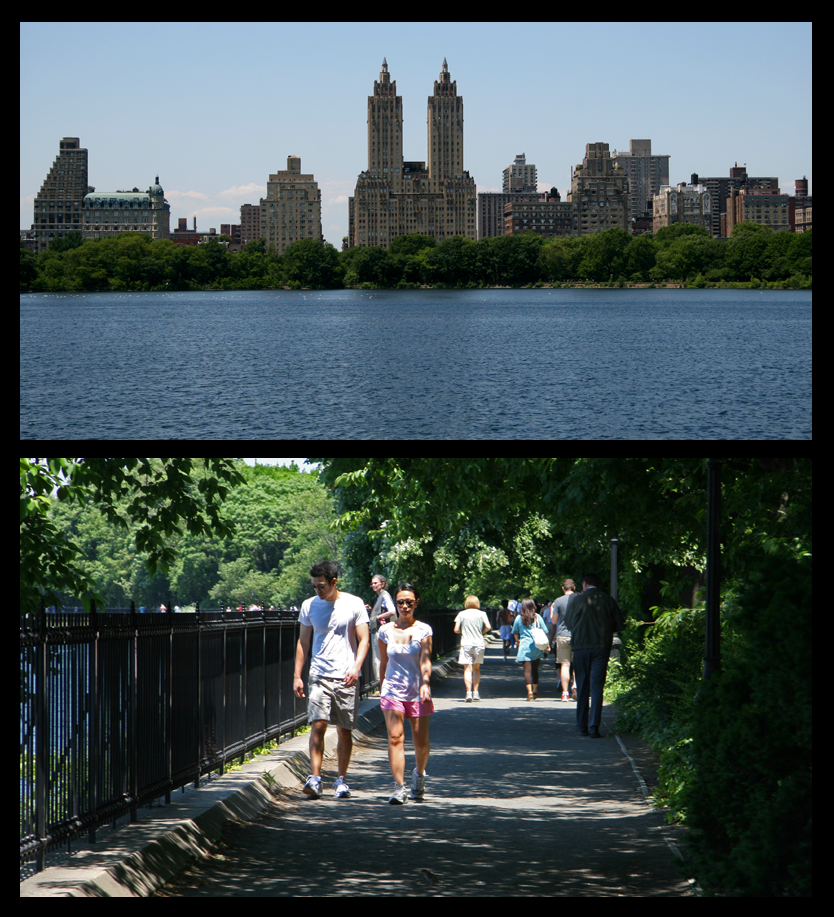
    Seeing the Central Park Reservoir for the first time is quite stunning. In the congested, densely packed borough of Manhattan, the last thing one expects to discover is such a enormous body of water. The reservoir covers 106 acres and holds over one billion gallons of water.

    This was built to the Olmstead and Vaux original plan for Central Park between 1858 and 1862, designed to receive water from the Croton Aqueduct and distribute it to Manhattan. It ceased functioning as a reservoir in 1993 when it was considered obsolete because of a new water main connecting to the New York City Water Tunnel No. 3.
    Anything this large and prominent in Manhattan is going to take on a life of its own, its use maximized. There is a 1.58 mile running track that completely circles it, on which there are weekly races sponsored by the New York Road Runners Club.

    Take a walk around all or part of the reservoir, and you will find many things – ornamental cherry trees, over 20 species of aquatic birds which have been sighted, three ornamental stone gatehouses designed by Calvert Vaux, three pedestrian cast-iron bridges that span the bridle path, ( one of which is the Gothic Bridge, one of the park’s most beautiful and distinctive), and, of course, vistas of the skyline surrounding the park.

    The photo was taken at the Engineers Gate entrance with the Purroy Mithcell Monnument. Looking across the Reservoir, you see Central Park West. The tall building in the center is the El Dorado, one of four twin-towered luxury apartment buildings designed by Emery Roth along Central Park West between 1928 and 1932: the El Dorado, the Beresford, the San Remo, and the Ardsley. Read Christopher Gray’s New York Times Streetscapes article about the El Dorado here.

    Note: The Central Park Reservoir is now officially known as the Jacqueline Kennedy Onassis Reservoir. The 1994 naming commemorated her contributions to New York City. Jacqueline, who had a Fifth Avenue residence, enjoyed jogging in the area.

    Posted on by Brian Dubé

  • City Island

    Posted on by Brian Dubé

    There are places which are a writer’s dream subject. If your reader is unfamiliar with the locale, it makes you look like a brilliant explorer who has uncovered a real gem. And visiting for the sake of a writing assignment is a real perk. The only real difficulty is avoiding the cliches which have been used ad nauseum.
    In this case, the place is City Island, Bronx, and the cliches are words and phrases such as “look and feel of a small New England fishing village,” “more like Cape Cod than New York,” “Nantucket,” “less Cape Cod, perhaps, than a tiny, Stephen King-like town on the lonesome Maine coast,” ” a constant reminder that this idyllic spot is not Nantucket but an island in the Bronx,” and “an active fishing village with a 718 area code.”

    The beauty of City Island is that it does live up to all the cliches, metaphors, and comparisons. I suggest a visit – you won’t be disappointed. If you don’t have access to a car, it is serviced by public transportation. However, you will need to take both a train and bus to get there.

    You are never more than a few blocks from the water. City Island is quite small – at 252 acres, it is only 1/3 the size of Central Park with 4520 residents. It is accessible to the Bronx mainland via the City Island Bridge. As would be expected, everything is defined by the ever present water – fishing, boating, shops with a maritime focus, and the Nautical Museum. We spent a pleasant time with proprietor and long-time resident John at Trader John (upper photo), 239 City Island Avenue, which specializes in new, used, and antique marine and nautical supplies.

    Seafood and seafood restaurants are abundant. We chose Tony’s Pier Restaurant at one end of the island (1 City Island Avenue), a fast food-styled place on the water (across the street from Johnny’s Famous Reef Restaurant). We ate our food to the sounds of the ocean and a huge population of seagulls. See my gallery of island photos here.

    I find a comfort and restorative experience being at the ocean. Instinctually, we all recognize its constancy and tremendous power – surrender to it and in that surrender, find comfort. Like being in the hands of a vigilant, caring doctor…

    Posted on by Brian Dubé

  • Rosenwach Wood Tanks

    Posted on by Brian Dubé


    On my recent visit to Williamsburg, Brooklyn, while circumambulating the neighborhood, a sign jumped out from the corner of my eye: Rosenwach Wood Tanks. I realized that this must be the very same manufacturer of wooden water tanks which I wrote about in a story (Tank Worship), one of only two companies in New York City that manufacture wood water tanks.

    I nearly shrieked to my companion who was driving and asked him to please indulge me and circle the block so that I might be able to verify it this was the place. If so, I could perhaps go inside and do some photography.
    ‘Twas done in a jiffy, however, upon arrival at the Wythe Avenue entrance, something looked amiss. Charred, blackened wood was everywhere, and areas were secured with safety tape. Yes, a man confirmed that this was that company.

    However, coincidentally, I had arrived only some days after a major fire. The two-alarm fire occurred on the 4th of July;  the Fire Department of New York said the cause of the fire was illegal fireworks. The gentleman in the yard said that I was welcome to return at a later date, get a tour, and do some photography. However, at that time, fire marshals were everywhere, and it was not the time for a factory tour and photo shoot.

    This location, at 87 North 9th Street at Wythe Avenue, a former stable, is the wood mill for the company where the planks are prepared using equipment dating back to the 1930s. The tanks themselves are assembled at the customer location.

    Rosenwach Tanks was started on the Lower East Side in 1866 by barrel maker William Dalton. In 1894, Dalton hired Polish immigrant Harris Rosenwach. The company is currently under the watch of fourth-generation business owner Andy Rosenwach.
    I am looking forward to going back and touring the place when the dust clears…

    Posted on by Brian Dubé

  • Roots of Pizza

    Posted on by Brian Dubé

    The variations in the human food palate is remarkable. I perused the 241 reviews on John’s Pizzeria at the Yelp.com website which ranged from 1 to 5 stars. You will find every permutation of good, mediocre, and bad for both service and food. If you don’t agree with any given reviews, you could dismiss them as being written by people who have limited experience with pizza or who have not tasted better. However, a closer examination of the reviewers will reveal many long time NYC pizza aficionados who actually have sampled the wares from iconic places such as DiFara’s, Lombardi’s, Grimaldi’s, Totonno’s, or Nunzio.

    One problem with a place like John’s that makes such a large volume of pizza and serves so many people is that it is possible to have genuinely different experiences either with the food or service. Combine an off night for both with high expectations, and the range of reviews become more understandable.

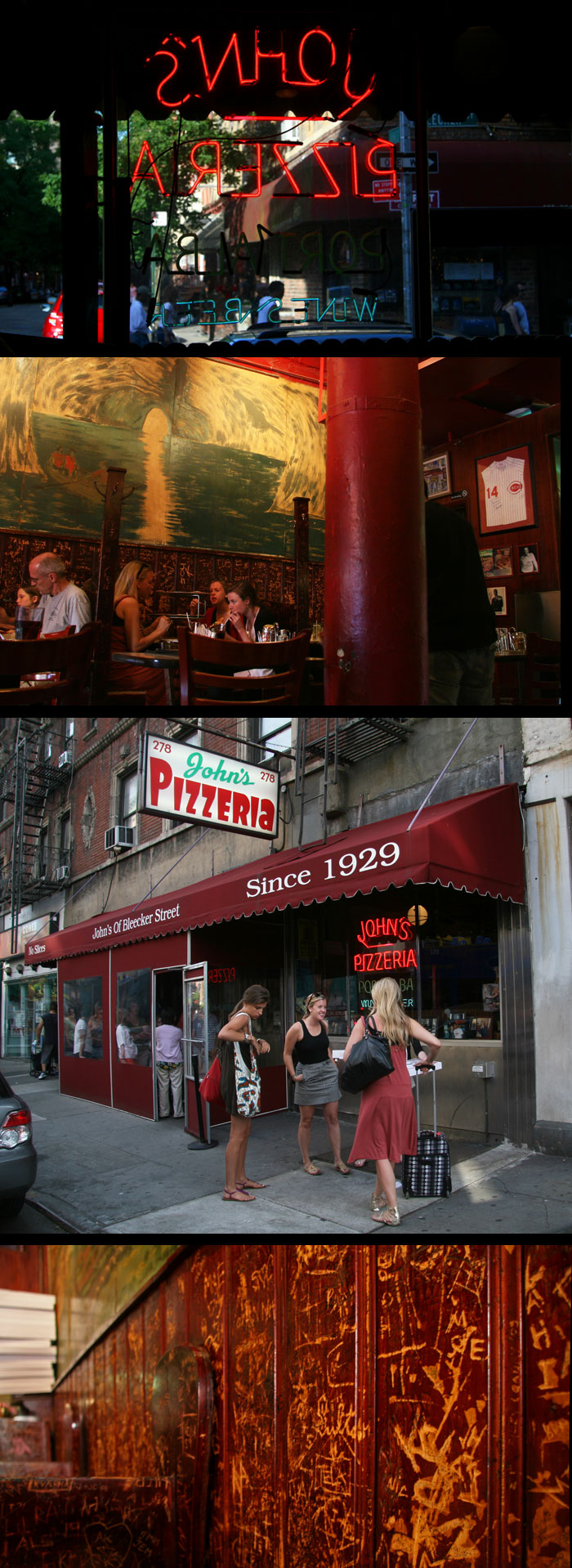
    John’s Pizzeria, at 278 Bleecker Street in the West Village, was started in 1929 by John Sasso. Current proprietor Bob Vittoria is a relative of the original owner. John’s is one of the few pizzerias in New York City to use a coal-fired brick oven, introduced to the city by Gennaro Lombardi. Anthracite coal is still shoveled daily from the basement to pizzeria’s oven. A coal oven can reach temperatures in excess of 800 degrees F.
    John’s crust is thin and crispy. According to an article in The Villager:

    Vittoria attributes the restaurant’s steadfast popularity to the special brick oven that reaches over 800 degrees and crisps the homemade crust to perfection, and the fresh, high-quality meats, produce and cheese. He buys his meat from down the street at Faicco’s Pork Store, open since 1927 at 260 Bleecker St.

    You will never get a consensus on a place like this – pizza is one of the most contentious food subjects in New York City. Like sushi, everyone seems to have a favorite or know the best place. The styles and ingredients vary substantially – very cheesy, thinner or thicker crusts, crispy or chewy, oily or dry, ovens used, classic red sauce, white sauce, and non-traditional styles with toppings like pesto.

    I had not been to John’s in many, many years. My recollection was that I had found it overrated and somewhat disappointing. Since that time, I have primarily frequented places which serve gourmet or non-traditional styles, such as that of Two Boots or Ray’s on Prince Street. On my recent visit to John’s, however, I found the classic red sauce a refreshing change. Like going back to the roots of pizza …

    Note: John’s virtually always has huge lines, although they do more fairly quickly. They do not serve slices (only whole pies) and do not take credit cards.

    More Photos – See Here.

    Posted on by Brian Dubé

  • Williamsburg

    Posted on by Brian Dubé


    If you live in New York City, Williamsburg, Brooklyn, as well as its resurgence as a vibrant community, comes as no secret. The press/media and its readers love stories about the next SoHo, the Next Neighborhood, the American version of Le Marais, and other analogies intended to drive sales of newspapers, magazines, and real estate properties.

    Many changing neighborhoods have been over-hyped, later to miss the mark on the predicted trajectory. Williamsburg, however, appears to be living up to its expectations. Domination of conversation about these new burgeoning neighborhoods should not be interpreted to mean that prime real estate in New York City’s finest neighborhoods are now out of favor and can be had for a pittance. There’s just little excitement and buzz about neighborhoods whose future have long been a fait accompli and where prices are now stratospheric. Everyone is looking for the next new place.

    It would be difficult to overstate Williamsburg’s importance; its history is quite remarkable. The neighborhood was once home to Corning Glass, Pfizer Pharmaceutical, Esquire Shoe Polish, and the iconic Domino Sugar factory.

    From 1827 to 1855, Williamsburg became its own incorporated town/village/city, later annexed into the city of Brooklyn. It was home to mansions owned by Vanderbuit, Fisk, and James Pratt, who founded Pratt Institute. The area became an American industrial powerhouse, and at one time in the 19th century, it had 10 percent of the wealth in the United States. This is an enormous subject – read more here.
    The area is also very ethnically diverse, with many groups including Hispanic, Italian, and Hasidic Jews – over 70,000 Satmar Hasidic Jews live in Williamsburg.

    Since the 1970s, as rents escalated in SoHo and the East Village, Williamsburg became a magnet for a growing community of artists and musicians. The trend has continued, but as to be expected, the cost of real estate has forced those shopping for less expensive alternatives to look further afield. According to a New York Times article, Old Europe and New Brooklyn in Williamsburg, there has been an enormous influx of Europeans to the neighborhood, with shops to service their needs.

    One feature of the neighborhood has always been convenience; Bedford Avenue (the heart of the area) is only one subway stop from Manhattan. However, it should be noted that this stop is serviced by the L train, which only travels crosstown on 14th Street in Manhattan.

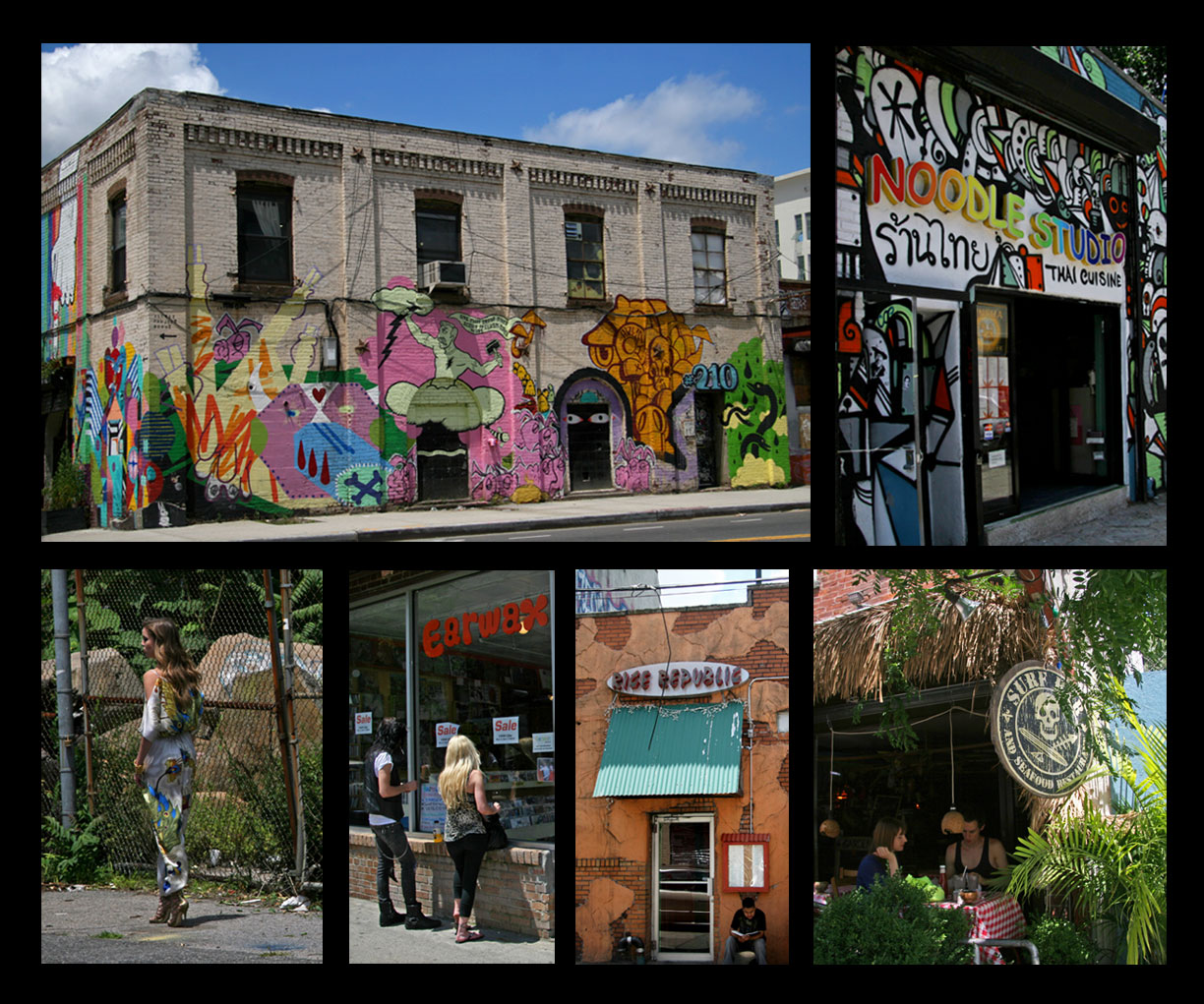
    There is a enormous number of shops, clubs, cafes, restaurants, and galleries catering to the wave of newcomers in the last few decades. To anyone unfamiliar with this neighborhood, I would highly recommend a visit to Williamsburg…

    Posted on by Brian Dubé

  • The Conductor

    Posted on by Brian Dubé

    Meet Benjamen Denham, conductor. This man has, for 11 years, shown up in Washington Square Park and silently conducted many planned and unplanned musical gatherings. However, he is, in fact, conducting no one. Because Mr. Denham, armed with two drinking straws with paper intact, conducts for his own enjoyment.

    This man has been an enigma for as long as he has been frequenting the park. Seen as extremely eccentric but quite benign, he is largely ignored, as are many other unusual characters in this city. He, like others, just becomes part of the tapestry of New York City, woven from some individuals from every walk of life imaginable.
    Upon meeting and conversing with people over the years, I have found that many are extremely remarkable, and I have been pleasantly shocked more often than I have had any misgivings confirmed.

    I have met so many individuals in this city with extraordinary backgrounds and histories, both past and present, disguised as ordinary mortals – editors of prestigious magazines, internationally known musicians, academics with degrees from Ivy League schools, engineers with multiple degrees, attorneys (one who  argued a case in the U.S. Supreme Court), grads from Wharton School, scientists, politicians in NYC government, prominent real estate developers, actors, and former corporate execs.
    In the 1970s, I met a man who had left a position as mechanical engineer for Farberware to work in a leather shop on Bleecker Street. Why? To escape the rat race and “let his hair down.” Although less true now that the Village has severely gentrified, this was, at one time, the reason why many ended up in Greenwich Village after a productive career.

    Rumor had it that any attempts to engage our conductor Benjamen in conversation was met with indifference; apparently no one had ever had any substantial conversation with him in all the years he frequented the park. When I decided to approach him, for some inexplicable reason, he was quite forthcoming. We spoke for some time – he seemed eager to share details of his life.

    I learned that he loved music and that he felt he could learn any instrument easily. He said he wanted to author 100 books and showed me a notebook filled with coupons and rebate offers – his current project is a book on the subject. When asked if he had ever had a story done about him, he answered affirmatively and showed me an old article from the New Haven Register, which I did not have the opportunity to read. Regarding his livelihood, he told me that he had operated 13 shops in his lifetime, each one ending in bankruptcy – he attributed his 13 failures to various cyclical recessions. He currently lives in Brooklyn, New York. Upon returning to my seat, I was greeted with excitement by others who saw the conversation as a watershed event.

    Our little girl in the photo was accompanying a group of musicians that Ben was conducting. When on a break, she at times looked at her mother for approval and at other times shared our wonderment with The Conductor 🙂

    Posted on by Brian Dubé


  • dinamic_sidebar 4 none

©2026 New York Daily Photo Entries (RSS) and Comments (RSS)  Raindrops Theme