• Closed Forever

    Change is typically incremental, even radical change. But often, there is that moment or day that PUNCTUATES a transformation. An unmistakable, inarguable sign that times have changed by technology. I saw the long, slow shift from vinyl to CD. And one day, the change was complete – the vinyl section in Tower Records was closed completely, supplanted by music CDs.
    Recently in my business, we made the decision to give away our entire inventory of VHS tapes. The decision to divorce ourselves completely, even from viewing legacy video tapes, was also made. We will be uninstalling our video monitor and VHS tape player. DVDs are threatened as well. We recently converted all of our video media to electronic form and uploaded them to a touch screen computer. This showroom kiosk now replaces monitor, VHS tape player, and DVD player.

    The future of printed books is unclear. Ebooks have been heralded for eons, but print continues to live on. The adoption of electronic books over print is a much greater hurdle – unlike video, where the form of delivery media is not so consequential, print is tactile and the difference between paper and electronic imaging is still huge for most individuals. Ultimately, I believe technology will force its hand as costs, storage, and distribution of electronic media win easily over paper.
    Bookstores have closed here and there. At one time, 8th Street in Greenwich Village was a virtual mecca for book lovers, with numerous bookstores, befitting its literary and bohemian roots. Many have anguished over the encroachment of the large chains into New York City, particularly Barnes and Noble. Personally, although I understand the sentiment, I always welcome a bookstore. I also have a sentimental attachment to Barnes and Noble, as I wrote about in World of Waiting.

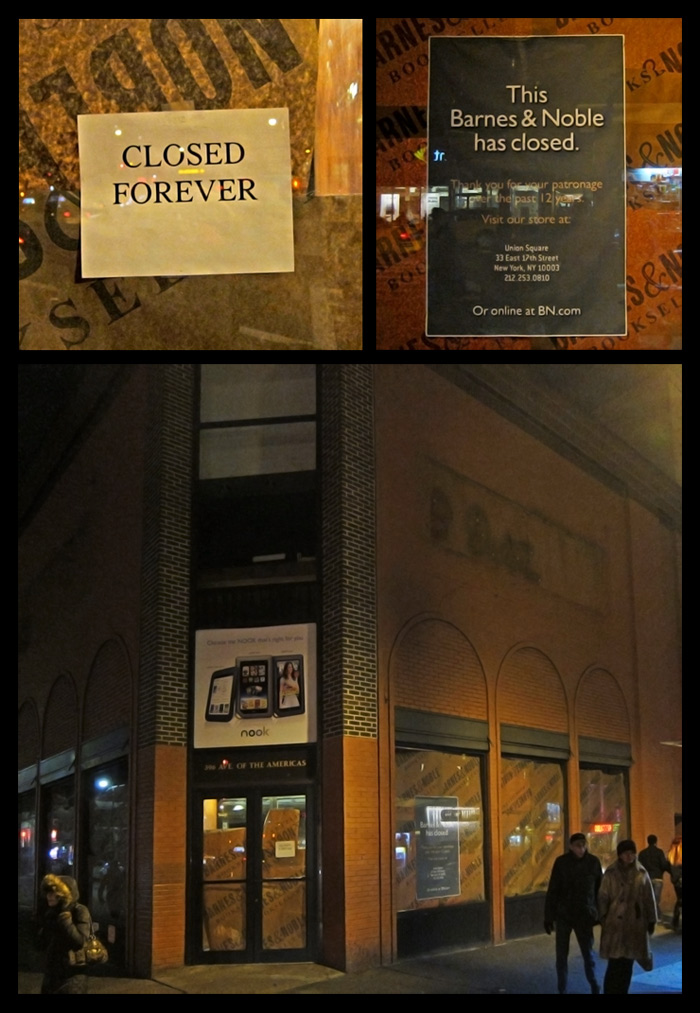
    It had been announced that the Barnes and Noble at 8th Street and 6th Avenue would close. The store is an anchor for the block – it occupies the corner and the entire two-story structure. It has had numerous incarnations. In the 1960s-70s, it was a popular late night watering hole and home to Nathan’s and an Orange Julius. I paid little mind to the store closing announcement, as many things can be said and stays of execution are common in business. However, last night en route home, the death knell tolled again. The windows were papered and a sign on the door said it all. Closed Forever.

  • No Sense of Urgency

    It was the 1980s, and my business was going through growing pains. I was forever frustrated with employees who were often too lackadaisical – they just didn’t share my view of the importance of tasks and the need to get things done promptly. On one occasion when I was especially frustrated, I turned to a friend to vent. I chose this friend because she was of similar mind and temperament – someone who was very driven, efficient, and strove to get things done right and quickly. She could cut to the chase in any matter and was very intolerant of those who did not share her worldview. I was struggling for the right words when, understanding my sentiments, she interjected and articulated my feelings exactly, using the phrase that I had been searching for in vain. “They have no sense of urgency,” she said. Ahh, that was it. A phrase I would never forget and use often – no sense of urgency.

    In the time of crisis, adrenaline flows and people rise to the occasion. Support is everywhere to be found as many of those unscathed empathize with the plight of victims. Unfortunately, crisis does not change people, and the sense of urgency, largely driven by extreme circumstances, soon fades as people lose steam over time. With those further removed, such as government agencies, concern seems to take the form of rhetoric, news bites, posturing, and paperwork, as evidenced by the anger of victims in any of these events at the slowness and ineffectiveness of government response. In the days and weeks immediately after Hurricane Sandy, I experienced a broad range of responses by neighbors, sanitation, fire and police departments, city agencies, insurance companies, adjusters, contractors, and volunteer groups.

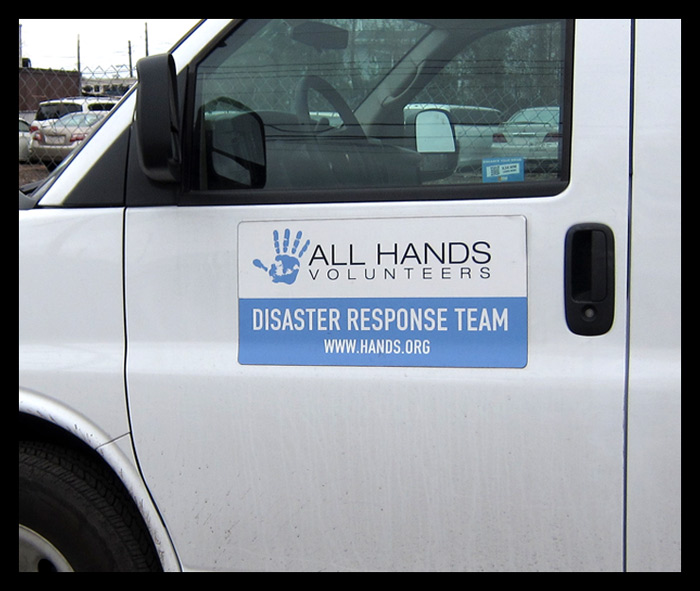
    The NYC Rapid Repairs program has been far from rapid. The group only visited my friend’s home in Staten Island one month after the hurricane. Paperwork was filed on site, and we were assured that work would be completed by “the holidays.” We only received a call letting us know that the crews would be in my friend’s neighborhood on January 13th to discuss the beginning of work. Needless to say, most Staten Island and Brooklyn residents have taken repairs into their own hands, rather than suffer the torture of delays and broken promises. This is why, ultimately, my friend whose house I have assisted in rebuilding has resorted to volunteer groups such as All Hands, who was the only group (other than private contractors) that responded in a timely manner and was willing to take on a large cleanup.

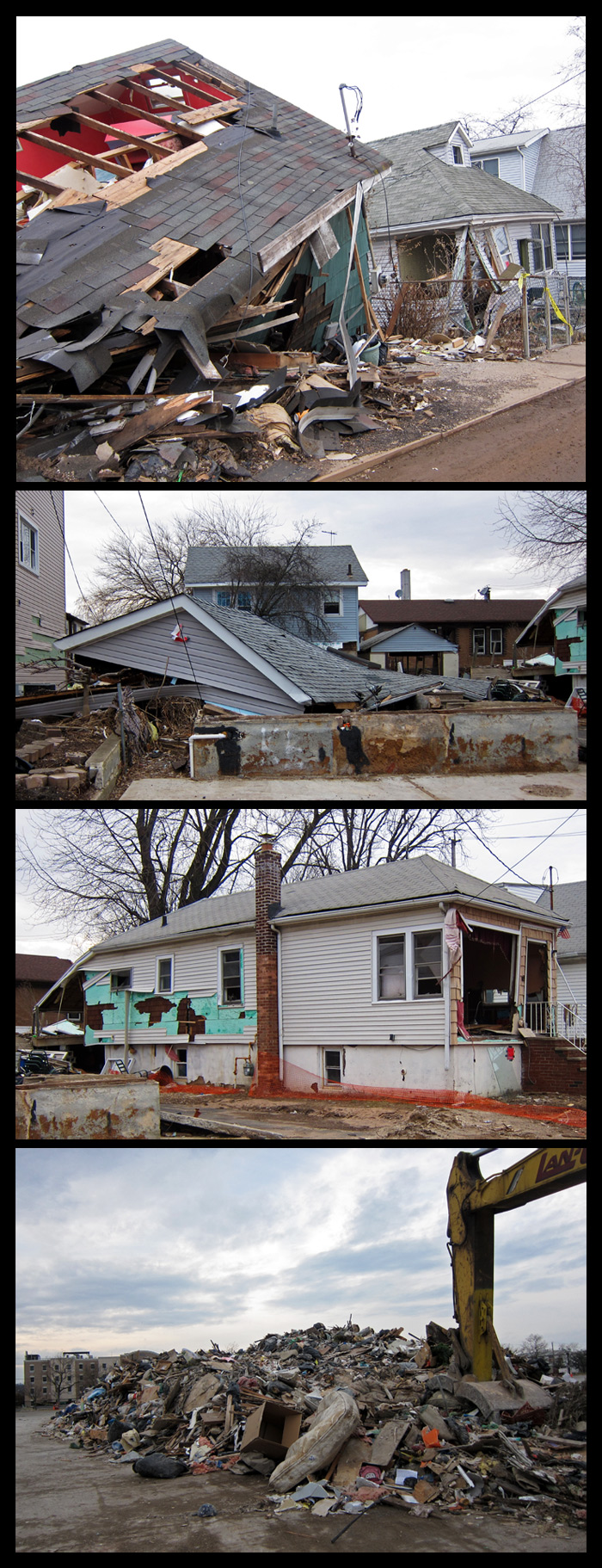
    Yesterday, I drove through one of the worst hit areas on Staten Island, New Dorp Beach, which still looks and feels like a war zone. Police vehicles are everywhere, patrolling the neighborhood. Many homes remain unoccupied, with red, green, and yellow placards taped to their home by the Department of Buildings, identifying their occupancy status. Some homes appear to have been largely renovated while others still await repairs. And there are those which are beyond repair.

    It has been over eight weeks since the hurricane, yet I saw people still shoveling debris. The work of rebuilding is far from over. There is however, a general malaise and despondency hanging in the air. Spirits have been beaten down. Volunteer groups and aid vehicles have largely left the area. Understandably, as time passes, the attention of outsiders is directed elsewhere as the entire disaster is largely seen as “over.” However, things are far from over, and rebuilding will go on for some time to come. The damage wrought by Hurricane Sandy is still at hand, along with the same need for verve and work. But sadly, there is No Sense of Urgency


  • Happy New Year – 2013

    The Empire State Building all aglow with its new laser light show on New Year’s Eve.


  • Up the Ante?

    I once met a Brooklynite who insisted that Brooklyn was a city. The central defense of his argument was a sign on the Belt Parkway that proclaimed, “Welcome to Brooklyn 4th Largest City in America.” I explained to him that the sign was meant to say that IF Brooklyn was an independent municipality (which it was until 1898), it WOULD be the 4th largest, but that Brooklyn was a borough of New York City. Unfortunately, my words fell on deaf ears. The individual’s belief was resolute and like the fundamentalist Christian, he was taking a literal interpretation of the words. Metaphors were apparently not part of this man’s world, particularly in this case of civic pride which clouded all reason and his ability to see Brooklyn as anything other than the greatest place on earth.

    However, his pride is understandable. Brooklyn has some of the richest history in New York City and many of its most enduring icons, notable history, and contributions to American culture, whether film, TV, literature, music, art, or architecture. Coney Island, the waterfront, Brooklyn Heights, the Dodgers, the Brooklyn Botanic Gardens, the Brooklyn Museum, Brooklyn Academy of Music, DUMBO, Prospect Park, Green-Wood Cemetery, Pratt Institute. Brooklyn is also a badge of honor for many who have achieved worldly success and risen from inner city working-class roots. It’s a place that many are proud to be from.
    The legendary sign, which greeted motorists on the Belt Parkway in Brooklyn in the 1970s, achieved its iconic status in the opening title sequence of the popular TV series Welcome Back, Kotter. The show also launched the career of John Travolta, later to star in Saturday Night Fever, based in Bay Ridge, Brooklyn. The last remaining of the three versions of this sign found a home in Gargiulo’s restaurant after the retirement of Brooklyn Borough President Sebastian Leone. Gargiulo’s owner Nino Russo was persuaded by Borough President Marty Markowitz to donate the sign to the city. It now hangs in Brooklyn Borough Hall.

    I have seen street performers cleverly play on this borough pride and rivalry. While taking a contribution, the performer would ask and announce the borough from which the audience member was from, the amount, and also brandish the currency, taunting the audience and challenging someone from a rival borough to make a greater contribution. This would escalate to a virtual bidding war with single contributions going to $5, $10, or more. Some may say this is all in good fun, and certainly all participants are willing victims. However, I find this aggressive money pitch highly manipulative, akin to creating a bidding frenzy like that found in an auction, where bidders lose control. Nonetheless, it certainly illustrates the civic pride in the boroughs of New York City and that some are willing to pay hard cash for one-upmanship.

    Recently, I spotted the vanity license plate shown in today’s photo. I’ve got the KNGOFQNS here. Certainly there is someone from Brooklyn who can do better than that. Isn’t there anyone from the 4th Largest City in America who wants to Up the Ante?


  • Looking Back – Christmas in New York City

    Looking back at Christmas in New York City. Classic, iconic, enduring, timeless – Macy’s, the tree at Rockefeller Center, Tiffany’s, Saks, Cartier, Santa at Macy’s, Bergdorf (not shown, from 2008), Dyker Heights (not shown). Images from 2006. Click on the photos for links to stories, galleries, and videos.


  • Flies or No Flies

    It takes a lot to raise the eyebrows of a New Yorker. However, in 2007, I wrote Rats R Us about one of the most outrageous displays of rats gone wild in New York City and how it caught the attention of residents and even made national news. New Yorkers stood outside a Taco Bell/KFC in Greenwich Village and watched rats cavorting on the floors and tables while local news media sent reporters to the location and filmed the incident – you can see the video here. I featured a photo of the closure notice by the Department of Health which had a myriad of humorous comments scrawled over it by passersby. It was a classic New York response – a blend of sarcasm with a super tolerant attitude of the slings and arrows of the gritty side to this city.
    On December 11, to the surprise and chagrin of many, John’s Pizzeria was closed by the Department of Health. Here is the report from the DOH website:

    Violation points: 45
    Sanitary Violations

    1) Raw, cooked or prepared food is adulterated, contaminated, cross-contaminated, or not discarded in accordance with HACCP plan.

    2) Evidence of mice or live mice present in facility’s food and/or non-food areas.

    3) Filth flies or food/refuse/sewage-associated (FRSA) flies present in facility’s food and/or non-food areas. Filth flies include house flies, little house flies, blow flies, bottle flies and flesh flies. Food/refuse/sewage-associated flies include fruit flies, drain flies and Phorid flies.

    4) Facility not vermin proof. Harborage or conditions conducive to attracting vermin to the premises and/or allowing vermin to exist.

    5) Pesticide use not in accordance with label or applicable laws. Prohibited chemical used/stored. Open bait station used.

    I was not particularly shocked. Irrespective of the quality of their pizza, John’s is far from the paradigm of cleanliness. The place is quite run down, and attention to detail never appeared to be the order of the day. It’s a money machine that swallows patrons daily who wait in long lines to get in. It is nationally known and on the “must do” list of many visitors to the city who care nothing about how the place looks or manages its food and premises. With such a deluge of patrons, who has time or need to worry about vermin, flies, or proper food handling? I am sure it will reopen soon and, undaunted, New Yorkers will line up again, Flies or No Flies 🙂

    Another recently closed pizzeria: Ray’s (Not Enough Dough)


  • Floating Pool Lady


    In October 2012, I made an excursion to the South Bronx to visit the Vernon C. Bain floating prison. My confidence in photographing the facility was rather foolhardy, as I wrote about in Crossing Over. On that particular excursion, I explored the immediate area, driven by my interest in seeing the enigmatic North Brother Island, which sits in the East River and is generally off-limits to visitation. From studying maps, it appeared that one of the best potential viewing locations of the island would be from nearby Barretto Point Park, a place I had never visited nor heard of. A big feature here is the Floating Pool Lady, a seven-lane, 25 meter pool on a barge. I had the luxury of driving to the park and pool, so my visit was relatively blissful and the park a surprising jewel in a daunting land. Accounts of those who have taken public transportation (the nearest subway is over one mile away), however, sound rather harrowing. Here are excerpts from one woman’s account of the journey:
     

    My friend and I decided not to be put off by others’ fear of the Bronx or derision of public pools as being “ghetto.”
    We surfaced to a dirty street full of no-name discount businesses. No big deal – it looked just like North Williamsburg or something, and there were plenty of people going about their daily business. Walking East, we went under the Bruckner Expressway, and suddenly it was like the post-apocalypse. The pockmarked streets got super wide and empty, and there was not another human being around. There was a four-way intersection with no lights or stop signs. Random trucks and low-riding cars with lights creepily on slowed, honked, and stared.One dude screamed, “Goin’ to the POOL???”
    At an intersection where there were apartment buildings, hope was restored. But then we took a right onto Tiffany, and then it was all junkyards, auto shops, and warehouses with broken (or bulleted? Seriously…) windows. Here, the catcalls from groups of men, whether they looked like kind grandfathers or teenage thugs, became worse. A couple times, they followed us , making sucking noises, clapping their hands, and shouting. Staring at the stains on the ground, I wondered if they were blood or rust as a montage of every mafia and gangster movie I had ever seen ran through my head. In a moment of hilarity, we saw a wholesome looking “Baby Spinach and Arugula” truck  up on a curb…with a shattered windshield. For the first time in my life, my heart palpitated with fear in broad daylight (and I’ve walked alone in rough and poverty-stricken areas all around the world before.)
    The last 100-yard stretch was permeated with an incredible stench of trash and opened up to a tiny little park with a ribboned gazebo. Someone was actually having a wedding reception there, and there were women and children frolicking in fountains. So weird.
    As we walked towards the boat, a young girl with a park shirt on screeched “HEY! Over HERE!” We walked to the entrance, where she was standing with a woman who asked us if we were wearing bathingsuits. “Show me your bottoms,” she commanded.
    The locker room was spotless. One freezing cold spigot in the showers spurted water endlessly. I asked a guard if it was possible to shut the water off. “It’s just running,” she said with indifference.
    A ramp led us to a blue 82′ x 52′ rectangle of 4-foot deep water filled with tattooed men in wifebeaters and exultant children. I asked how they’d all gotten there, and they’d done The Walk, too. There was no other way.
    And my friend had her breasts touched by the 12-year old fatty perv. But no matter; we did what we came to do. We saw that the pool existed, and that some locals can get there.
    Hey, this is a great, well managed pool, but if you have a vagina, pack a crowbar and some thugs to get to it. I worry about what the people in the East Bronx (especially women and children) have to go through to get to their local pool. As for me, having a choice in the matter, I will probably never come here again.

     
    As for me and the friend that accompanied me, by driving and visiting off-season, we found our journey uneventful and the park quiet and serene. The pool was closed, so I have neither direct experience with swimming there nor tales of public pool horrors. Men were fishing on the adjoining pier and children were playing on nearby beach.  The sirens of North Brother lured me in the distance. It was a perfect day and a beautiful spot in one of the most unlikely spots in the entire five boroughs of New York City  – the South Bronx, a neighborhood more known for urban decay and crime than anything else (two vendors I use in my business are located there and actually park their vehicles INSIDE their factory facilities, which have no windows).

    Like so many of life’s arenas, it is often true that there is nothing new under the sun. I was surprised to learn that the floating baths and pools in New York City waters date back to the 1800s (shown in the collage of vintage photos). You may need a bit of nerve to get there, but here, in the South Bronx, behind a chained link fence, on a barge with views of Rikers Island (prison), you can have a swim in the Floating Pool Lady 🙂

    Another NYC pool: Page or McCarren


  • All Things Feral

    I recall a conversation with my sister about children and a viewpoint expressed by Polly Platt in French or Foe. In this book, various aspects of French culture are laid out by the author, an American living in France married to a Frenchman. According to Platt, the French, who believe that they brought the world civilization, see the importance of discipline in child rearing as well, with children viewed as “little savages” who must be civilized in order to enter society. Children are expected at a very young age to behave like adults, even, for example, sitting well behaved throughout an entire meal in a restaurant.

    I summarized for my sister the discipline imposed on children by the French and their expectations. My sister concluded that this type of child rearing was cruel. Strict discipline of children is certainly a contentious subject, however, with what I have seen in the subways of New York City which at times can appear to be like Lord of the Flies with children and teens acting out and even cursing their parents in public, perhaps a bit of French thinking might serve us well in the taming of children.
    The conversation with my sister regarding wild children was appropriate coming from a French perspective – not only is my family of French ancestry, but also, perhaps the most well-known case of feral children is that of Victor, the Wild Boy of Aveyron. The story is the basis for Truffaut’s film L’Enfant Sauvage.

    In 1797, a boy was first discovered and captured by hunters near Saint-Sernin, France. He was taken in and studied by a young medical student, Jean Marc Gaspard Itard, who named him Victor. At the time of Victor’s capture, he was estimated to be about 12 years old and was naked, filthy, had numerous scars on his body, and was wild, unsocialized, and unable to speak other than guttural sounds and squeals. It was speculated that he been raised by animals and was a true “feral child.” Although there were many hypotheses regarding his origin, nothing was ever substantiated, including any rearing by wild animals. His interests were very basic, and he was highly attuned to activities, sounds etc. During his time with Itard, he wore no clothing, eliminated by squatting on the ground, and would neither use utensils to eat nor sit on a chair. Little progress was made with his socialization, and Victor died in Paris in 1828. You can read more here.

    I have always been fascinated with stories of feral children, and on a raw, cold, bleak November day nearly a decade ago, I got as close as I ever have at meeting someone who certainly appeared untamed. I was passing through Washington Square Park, which was deserted, excepting one lone musician who was sitting on a concrete bench playing guitar, seemingly oblivious to the cold. I recognized him, having seen him previously a handful of times playing in the park, often with a wild, disheveled appearance. He was playing blues with occasional use of a slide, which I love. His raw, edgy style and interpretations of blues classics were very engaging – I listened to a few songs standing in the cold and left a dollar in his open guitar case. When I asked his name and he said Feral, I confirmed the spelling, lest he had thought that I had asked about his disposition or temperament.

    Years passed and I had not seen him since that period. Recently, at the Folk Festival, I scanned the program and was excited to see Feral Foster listed as the closing act. He played and sang an original composition, The Whole Wide World. I really liked it and after his set, introduced myself. He gave me one of his CDs, all original songs, i.e. no covers – a difficult road to travel for any musician, but a necessary path for anyone looking to make their mark. I saw him a few days later at The Gaslight, a club on MacDougal Street in the Village. His music still has a rawness and his playing style and persona has an idiosyncratic and untamed look and feel, befitting a man named Feral. Whether it is a film like L’Enfant Sauvage, the rearing of children in France, or my meeting of Matt Foster, from early on, there has been a thread in my life of All Things Feral 🙂

    Photo Note: Top photo courtesy of Bill Shatto.


  • Fleas or Teased

    New York City was home to one of the most astonishing things to those unfamiliar – the real flea circus. Most are familiar with the phrase, however, there are only a handful of flea circuses at the time and fewer yet that employ actual fleas, so it is very unlikely that any given individual has seen one of these performances first hand.

    Yes, real human fleas, pulex irritans, were trained to pull miniature chariots and perform circus acts, rotate ferris wheels, and kick balls. Minuscule harnesses made from thin gold wire were wrapped around the neck of the flea. The harnesses were then attached to a variety of objects. Fleas are renowned for their incredible strength and are able to pull up to 160,000 times their own weight and jump 150 times their own size. Their lifespan, however is typically only months, and so new recruits must be found and trained. And, they must be provided a diet of human blood. Typically, owners of flea circuses just let fleas feed from their arms.

    The flea circus flourished in the Victorian age, however, the harnessing of fleas goes back much further. The first to harness fleas were watch makers who demonstrated their skills in fine metal working skills. Mark Scaliot is 1578 is credited with locking a flea to a chain with “a lock consisting of eleven different pieces of steel, iron, and brass which, together with the key belonging to it, weighed only one grain.”

    One of New York City’s great institutions was Hubert’s Dime Museum, which occupied 228-232 West 42nd Street near Times Square from the mid-1920’s until 1965. The building which housed Hubert’s was a schoolhouse, designed in the 1880’s by McKim, Mead & White. Hubert’s was a phantasmagoria of some of the greatest novelty, freak, sideshow, and variety acts and the home of the last working flea circus in the United States – Heckler’s Flea Circus. Heckler’s occupied a section of the basement and required an additional admission. It was here that the Heckler family plied their trade. The circus was started by native Swiss William Hecker circa 1923 and sons William Jr and Leroy (“Roy”). Roy took over the operation in 1933 and continued to operate the flea circus until he retired in 1957.

    So, when I attended the World Maker Faire on September 29, 2012 and happened upon the Acme Flea Circus very unexpectedly, you can easily understand why I was stopped in my tracks and jubilant that I would at last be able to see a real flea circus. Adding to the serendipitous encounter was that the performer, Adam Gertsacov, already knew me, having been a previous customer of my business. I stood alone at his booth and it was a good 30 minutes to showtime. However, I was very passionate about seeing a flea circus in person and close up, so I stood and chatted with Adam while he prepared for his show. He told me all the details of the flea circus. I was later to learn that Adam was one of the most educated clowns in America – not only was he an alumnus of Barnum and Bailey’s Clown College, but he was also a graduate from the University of Pennsylvania and held a master’s in theater and communications from Rhode Island College.
    Adam assured me that I need not be concerned about having a “front row seat” since his show was designed to insure that all audience members were guaranteed to see all the details of his performers. This perplexed me, since I had learned that flea circuses like Heckler’s typically provided audience members with magnifying glasses. Historical photos showed him surrounded closely by a small number of viewers. How would Adam accomplish this at a distance? Theater.

    Adam’s show involves a lot of theater, history, and clever quips and bits, including a “flea market” where small items are sold to the audience, whom he then proclaims has been adequately fleeced. The act consists of his two fleas, Midge and Madge, who engage in a chariot race and a tight-wire act. Children laughed and squealed, however, credulity was strained when the fleas were shot from a cannon through a hoop of fire to land inside a miniature Airstream trailer.
    I became intrigued and through a little research learned that a number of flea circuses currently working do not use fleas. At least one, Hans Mathes’s flea circus at Oktoberfest (you can see an actual video below), has real fleas. As to Adam Gerstacov and his Acme Flea Circus, in the end, I just decided to suspend and see it as an enjoyable piece of theater, not worry whether I had seen trained Fleas or had just been Teased 🙂


  • Road to Salvation

    I grew up in New England, where self-reliance reigned supreme. In that environment, “neither a lender nor a borrower be” defined the attitude towards assistance. Help was a four-letter word and asking for help showed a weakness of character. Charity and philanthropy were at best necessary evils and a sense of entitlement was a despicable character trait. No one deserved anything, excepting perhaps the right to work. Do-it-yourself was not some trendy moniker, appropriated by Maker Magazine. DIY, was a necessary condition in a world driven by hard times, lean circumstances, and real need. In a harsh, rural, sparsely populated environment, embracing such an extreme view of self-reliance makes sense and is arguably necessary for survival.

    Recently, however, I have learned a poignant lesson on the nature of HELP. Today marks one month since Hurricane Sandy ravaged New York City. For the last four weeks, I have helped a friend in Staten Island, one of the worst hit areas. The borough is literally a disaster that will take an untold time to restore. Many will be digging out and repairing for months or years to come – some will never see their homes in its former state. In the house I have worked in, nearly every task necessary on the road to recovery has required a team effort. In our case, clearing a basement with belongings drenched with seawater and sewage was a mammoth job, inconceivable for one or two people. We could find no one really willing and able to do the job, even as work for hire.

    We were nearly at wit’s end until meeting Leticia Remauro at the volunteer table in Miller Field in Staten Island. Leticia, I was to learn later, is chair of Community Board 1 for that borough. When I told her of our cleaning dilemma, she wrote out her cell phone number as well as that of Jeremey Horan (a volunteer) on a card and handed it to me, telling me with the utmost confidence that Jeremy would handle any work that needed to be done. But Jeremey was associated with not just any volunteer group, of which there are numerous, typically loosely banded as a response to a crisis. No, the group who finally and thoroughly cleared the basement was All Hands Volunteers, a non-profit group doing work worldwide, and Jeremey was Director of Operation. There is too much good to be said about this group of men and women who are undaunted by any task, regardless of how unpleasant it may be, and, with energy that can only be described as indefatigable, apply themselves and carry through these thankless jobs to completion. Members come from all walks of life, most typically with day jobs, often driving in on weekends from out of state, just to help. I was privileged to meet Travis Gibson, US Field Operations, who personally came to inspect the project. Travis is one of a few full-time staff with the organization.

    The response and value of government or insurance agencies has been anywhere from useless to disgraceful (apart from The Department of Sanitation, who has done a tremendous job), when viewed from the perspective of URGENT NEED at the time of crisis. With tens of thousands rendered homeless, bureaucratic process with forms and applications does virtually NOTHING to address many of the immediate needs of those hit by a monumental catastrophe. Many with enough cash pay out of pocket, hoping to be reimbursed by insurance. Everyone else must rely on wits, resourcefulness, and volunteers to see themselves through. It was only seeing the situation first hand that I quickly learned the value of Help. Volunteerism has been the saving grace in Staten Island after Hurricane Sandy.

    In my case, All Hands Volunteers not only cleared any and all debris, but also volunteered to completely gut the interior of the home, a process that only takes one team about two days – ripping out carpeting, floors, and walls and removing appliances and furniture. It was astonishing to see them work. Without All Hands Volunteers, we truly would have been at a loss. The entire experience is harrowing owing to time pressure – every day that a home that has been flooded sits idle, mold continues to grow and makes the restoration process worse.

    And so it was how Leticia Remauro and All Hands Volunteers taught me that HELP is not just a desperate plea while drowning nor a four-letter word, but, in time of catastrophic need, Help is The Road to Salvation 🙂


  • War Rations

    New York City is noted worldwide for its cuisine. It is, arguably, perhaps one of its strongest suits, with tens of thousands of restaurants in the five boroughs, spanning the gamut from fast food to haute cuisine. You can enjoy a great falafel from Mamoun’s for $2.50 or spend $100 per person or more at places like Babbo. In all cases, you will at least be provided with light, seating, and a temperature controlled environment, unless you opt for al fresco dining, which is not typically seen near the beginning of December. Unless you are working outdoors with no other options – like gutting a house on Staten Island in the wake of Hurricane Sandy, which is where I found myself this past weekend.

    Saturday, I ordered Chinese for delivery for a work crew of 10 which we ate truck side (bottom photo), my first experience with “tailgating”, sans the grill, coolers, tables, or summer weather. Sunday, a work crew member opened two cases of MREs – my first ever experience with war rations. MREs (Meals Ready-to-Eat) are self-heating emergency meals. Ours were A Pack, made by AmeriQual group, the largest provider of MREs to the U.S. Military. Each meal pack comes in 6 varieties and includes an entrée with a self-heating unit, side dishes, beverage mix, condiment, utensil, and towelette.

    The crew was a stoic bunch and enjoyed their rations sitting on the ground in Tyvek suits soiled with every manner of dirt and sewage.  There were no complaints, just perhaps a bit of impatience as we struggled to open the various foil packs, read the instructions for heating, and tried to execute them, while standing in the cold. I was far from my home in Manhattan in many ways, where it was business as usual with shopping and eating out. This was not Shake Shack nor dining New York style. We were only a public bus ride away, yet some of Staten Island is still a disaster zone, where for some, today’s lunch is War Rations


  • Unfettered not Defeathered

    On my last visit to Staten Island in the wake of Hurricane Sandy, I was stunned to see a flock of wild turkeys crossing Hylan Boulevard, one of the busiest thoroughfares in the entire borough. Such a sight would not perhaps raise an eyebrow in rural America, but the last thing one expects in New York City is a flock of turkeys crossing a busy street in a heavily populated area midday.

    Virtually every news source has covered this story and reading about the birds, apparently they are not loved by neighborhood residents who find them a menace. The birds are very aggressive with a myriad of tales and complaints. Articles with titles such as: Turkeys Terrify Staten Island Residents Trap Woman in Car; Scourge of Staten Island: Turkeys terrorize residents as they roam neighborhood; Staten Island’s wild turkeys flourish despite Sandy’s woes; Wild Turkeys Get a Taste of Domesticity; Much to a Borough’s Chagrin, Staten Island Locals Fear Wild Turkeys!; Wild Turkeys Push Staten Island Homeowners to the Breaking Point, et. al.

    Estimates of the turkeys numbers range in the hundreds. Officials say that the turkeys are not indigenous to the island. It is thought that the presence of wild turkeys in Staten Island dates back to 1999, when nine turkeys were released onto the grounds of the South Beach Psychiatric Center by a local resident who had held them in captivity.

    As to dealing with the menace, The New York Times says:

    The state has rejected efforts to transfer the flocks to more rural counties, where turkeys normally forage — but where the Staten Island flocks, officials fear, might not adjust well after acclimating to a human habitat. The Staten Island turkeys cannot be hunted, either, because they are protected with prescribed seasons and areas, none of which are within the city limits.

    At this time of year, many Staten Island residents think like Allan Barnhardt: “I have the perfect spot for these turkeys. Right between my mashed potatoes and cranberry sauce.” However, hunting turkeys is illegal in New York City, and so, the birds, like many a New Yorker, walk through the city streets with attitude and a touch of arrogance. They’re not going to be on anyone’s plate this Thanksgiving. For now, the turkeys of Staten Island go Unfettered not Defeathered 🙂

    More wild and unexpected animals in NYC: That Should Cover It, Lost in that Wool, Bronx Zoo, Warm and Fuzzy, Parrots, Rain Forest, Horsing Around, Albino Burmese Python


  • Serious Business

    I was recently informed by my office staff that we would be visited by Ringling Clowns and a film crew to shoot a promotional spot for the 2012 Boss Clown Election Debates. The individuals who were running for office were Ringling clowns Michael Richter and Todd Zimmerman. The moderator/MC was Joel Jeske. The debate, which toured nationally prior to the national Presidential election, was an educational effort to inform young students about the political process using comedy and clowning.

    What may perhaps come as a surprise to some, is that the competition to become a Ringling Clown is quite fierce. Typically, clowns possess a wide range of skills and talents that go far beyond those demonstrated in the ring for a given show. For 29 years (1968-1997), Ringling clowns were auditioned, admitted, and trained within the Ringling Brothers and Barnum & Bailey Clown College – around 1,400 clowns were trained during that period. Since the closing of Clown College, clowns are hired through a more conventional theatrical audition practice. Having been a teacher or graduate from Clown College has had a certain cachet – a veritable feather in one’s cap, a fait accompli and demonstration that an individual had the raw talent to be one of the chosen few. There have been many notable alumni who have gone on to work in other venues, such as Penn Jillette (of Penn and Teller) and Bill Irwin. You can find Joel Jeske’s bio here.

    I have often been asked if my business needs to be located in New York City. The answer is, of course, NO, however, I do have a small but significant retail business which helps offset some of the premium we pay for a Manhattan location. It certainly is a luxury and a privilege to be located here. We enjoy the surprise visits of the illuminati of the entertainment world, most of whom are typically happy to share a little shtick with us – like Bill Irwin, who recently dropped in. To the audience, clowning is light-hearted, whimsical, and fun. But do not be deceived. Clowning around, just like any craft or performance art, is Serious Business 🙂

    More people from the juggling/circus world: A Special Serendipitous Meeting, Look How Tall He Is, Fountains of Success, Just Like Them, Smile By Fire, Please Rub Off on Me Just Like Steve Mills, Think Big, The Women, Really Smart Guys, Kind Words, Viktoria’s Secret, Artiste Extraordinaire, Circus Amok


  • Shabby is Not Chic


    It was high school gym class, and a classmate, looking to validate his negative assessment of my mode of dress with our gym teacher who stood nearby, pointed out to him how absurd I looked with my T-shirt tucked into my gym shorts. The teacher, rather than side with my classmate, defended me, saying that I looked neat and that my classmate might want to see me as an example of someone to emulate, not deride. It was a small triumph.

    Growing up, I was tidy and neat, always preferring the well-kept, the organized, pristine, the newly made. Over time, I have grown to appreciate old world charm and antiques, even if they are less than “perfect.” I have come to know many artists, who typically prefer the unmeasured, unmanicured, unkempt – flaws that in some way give things character.
    My exploration of this alternate universe reached its pinnacle when I was introduced to the decorative world of Rachel Ashwell by a friend. I was impressed with the ambiance of the store and wrote Off-White By Design. I began to investigate Rachel’s world of Shabby Chic as well as French country decor. I even had employees from the Ashwell team come to my home and make a proposal for a badly needed redecoration of my apartment.

    However, I never went through with their plan. Their solution seemed quite pricey and honestly, the old neat and tidy man came out – I found many of the articles just too rough, poorly made, and overpriced. I guess one could say that I ultimately just found the look too shabby, or at least did not want to pay good money for that which I did not find particularly chic.

    Recently, I found myself in the very same home of the friend who introduced me to Rachel Ashwell. I was helping sift and sort through her possessions in her residence in Staten Island, which had been flooded in Hurricane Sandy. The entire experience has been unpleasant. While in her living room, I was stunned when I came across a badly damaged, water-soaked copy of the classic Shabby Chic by Rachel Ashwell. There it sat on the water logged carpet, the ultimate in irony – the modern day bible for the celebration of all things shabby, sitting amidst rubble soaked in seawater with traces of sewage.

    In the showrooms of SoHo and the homes of the well-healed, the deliberate selection and placement of the aged and worn may in fact be charming. But here, in Staten Island, amidst the wholesale damage left by Sandy, at least for now, Shabby is Not Chic 🙁

    A similar scene: Kind Of


  • This Hood is a Done Deal

    I recall a conversation many years ago with an artist who lived in Brooklyn and said that she found Manhattan over gentrified and fundamentally uninteresting. I was angry, defensive, and took this as sour grapes from someone who was not fortunate enough to live in Manhattan. After all, Manhattan was a mecca for so many human endeavors and the center of the universe, was it not?

    Unlike the stereotypical Manhattan resident, I have visited Brooklyn and Queens often. And, over the course of the last six years that this website has been in existence, I have spent much more time in the outer boroughs, exploring and canvassing for subjects and potential stories. Now, in fairness, I must admit that the cultural brew in Brooklyn and Queens feels much richer than that of Manhattan, which has become more much more business and tourist oriented. If you seek an authentic New York and ethnic enclaves, the outer boroughs are where you must go. Neighborhoods such as Jackson Heights, Astoria, Richmond Hill, or Flushing in Queens and Borough Park, Sheepshead Bay, or Bay Ridge in Brooklyn have virtually no parallel in Manhattan, save Chinatown. In these neighborhoods, you will find a variety of merchants and restaurants catering to the local ethnic groups.

    Regardless, Manhattan residents are a remarkably and classically xenophobic bunch, so you know things have changed when Manhattanites start traveling to Brooklyn and Queens for cultural and recreational activities. There are plenty of good reasons: the Brooklyn Museum, the Mermaid Parade, Coney Island, Dead Horse Bay, Floyd Bennett Field, the Queens Farm, the Queens Museum, Flushing Meadows – Corona Park, and perhaps one of the biggest draws and hottest neighborhoods in the five boroughs, Williamsburg.

    You know things have really changed when, on a weekend, one Manhattanite runs across the dyed in the wool East Village icon, David Peel, in Williamsburg, Brooklyn, who both have crossed that river into another borough looking for a change of pace. Walking down Bedford Avenue, the main commercial artery of Williamsburg, I spotted David in a local pizza parlor, wearing his signature John Lennon-styled sunglasses.
    The neighborhood has gone through remarkable transformations and even has a lively street scene with street performers, unusual outside of Manhattan. David knows me from our frequent meetings in Washington Square Park as well as the stories I have done including him as a subject. I spoke to him briefly about the irony of meeting in Brooklyn. He showed little surprise at all, knowing that Williamsburg was obviously the place to be. After all, New Yorkers love the hot new place and This Hood is a Done Deal 🙂


  • dinamic_sidebar 4 none

©2026 New York Daily Photo Entries (RSS) and Comments (RSS)  Raindrops Theme