• Category Archives Curiosities of NYC
  • Manhattan Address Locator

    I’ve always had a love of numbers and have enjoyed studying the street and avenue numbering systems of New York City, specifically Manhattan. For the numerically inclined, there is no better place. Here, north of 14th Street, the borough is a numbered grid. The original design was created as the Commissioners’ Plan of 1811.

    There is a method to the madness of the street and avenue numbering. Algorithms are available and have been translated to various forms of address calculators, available in phone books, maps, tourist guides, and online. They can also be found as small, laminated wallet-sized cards – I have carried such an address locator since my early days in New York City in 1969.

    Locating avenues given the numbered cross street address is relatively simple and really requires no guide, calculator, or GPS. Fifth Avenue divides Manhattan into East and West. Cross street numbers increase moving away from Fifth, typically by 100 per block. So, for example, 325 East 57th Street will be between 2nd and 1st Avenues.

    Locating streets given avenue numbers is more involved. There is an algorithm, but it is complex, with many exceptions and special considerations for certain avenues. Here, it is better to use a chart or calculator such as the one that I have customized. Enjoy your Manhattan Address Locator 🙂

    Related Posts: I’m Throwing Them Away, Leave the Driving to Us, Flailing and Hailing, Sittin’ On Top of the World, What Numba Kissena?


  • 212 and 2:12

    Many non-residents cannot fathom why New Yorkers tolerate so many extreme hardships, while life outside the city is in many ways so much easier and less expensive. I have created a category for some of my stories called Slings and Arrows, which illuminates many of these day-to-day dramas. In Dwanna, I told of how one new resident (who hailed from Tennessee) left nearly as quickly as she got here, even though she was ambitious, hard-working, and successful in finding a good job and housing. Her reason for leaving? Life was just too hard.

    But yet there are so many extraordinarily wonderful things about this city, many arguably not found anywhere else, particularly in such close proximity. It is this density of services and culture that led me to coin the phrase Sirens of Convenience to describe the city’s lure in spite of rocky shoals. So therein lies the key to understanding this whole perplexing situation:  New York City is not a place of moderation, it’s one of extremes, and for most, it’s a Love/Hate thing. When Love overrides Hate, then you’re a New Yorker. When Hate overrides Love, you don’t want to live here. Or, in the case of a long-time resident, he or she may be inclined to leave.

    Many New Yorkers who truly love the city obsess over iconic minutiae, such as having a 212 area code. This area code is one of the oldest in the United States, created in 1947. It was assigned to New York City because it could be dialed fastest with a rotary dial (at that time, 0 and 1 were not allowed as the first digit, the second digit was either 0 or 1, and the third digit could not be the same as the second digit).

    Hence, there’s a cachet to 212: it is historic, with implied roots and stability of the owner of the number, both residential or business. New phone numbers with the area code 212 are no longer available; someone interested in the area code must rely on getting a recycled number via luck or purchase such numbers through specialized websites. This prestige associated with a 212 area code was even used as a minor plot thread in a Seinfeld episode, The Maid. So, New Yorkers Love 212. As a long time resident of the city, I am pleased that my home and office numbers all have 212 area codes.

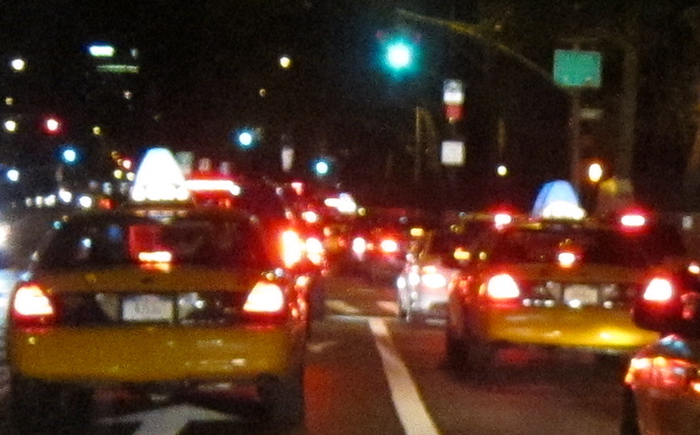
    But this weekend, I even found Love/Hate sides to 212. Saturday night, I was returning to Manhattan via the Manhattan Bridge, which courses up Chrystie Street. I was exhausted, and there was bumper-to-bumper traffic. Incredibly, it was after 2 AM, adding insult to injury. I just wanted to get home and sleep, but I was forced to slog up Chrystie and across Houston Streets behind a sea of yellow cabs and the cars of late night revelers, commuters, and what have you.
    In reviewing the photos this morning for exact time, I found in a serendipitous numerological twist that the exact time my photos were taken was 2:12 AM. I always knew the currency used to pay for New York City was a two-sided Love/Hate coin. Now, carefully examining both sides, I discovered it clearly marked: 212 and 2:12  🙂


  • Wonder Why

    I grew up in a family with limited means. However, we triumphed through brute force and tenacity. My father, originally a woodcutter, once in Connecticut, worked a handful of blue collar jobs, often maintaining more than one job at a time. One of his brothers, in addition to his full-time job in construction, worked a second job – mowing grass on highways until 3 in the morning. Work defined a person’s worth. Certainly this ethic has been a factor in my survival in New York City for the last 40 years.

    For people like my folks, who were so determined to make a better life, generics or house brands were signs that a family could not afford to have the best. Brand names were symbolic and tantamount to saying that in a small way, we had made it.

    This type of thinking certainly is not unique to those of lesser means – the sale of premium brands is fueled by this type of thinking.
    However, we now have a world of smart shoppers who not only hunt for discounts but also evaluate products based on a quality and merit basis, not just by brand. Celebrities such as Oprah shop at Costco, conferring that shopping for price and value is nothing to be ashamed of and does not neessarily imply that one is of lesser means. Of course, this price consciousness can be taken to the extreme, something Americans do all too well.

    In the 1960s, Wonder Bread was the premium brand, and our family was proud to eat it. For many today, with an emphasis on health and whole grains, Wonder Bread is virtually a perforative metaphor for white bread and all that is bad with the highly processed.

    On March 18, 2011, the Washington Post ran a story, “Wonder Bread: 90 Years of Spiritual Vacuousness?” Within the article, there is a quote from Warren Belasco’s essay, “Food and the Counterculture: A Story of Bread and Politics”:

    A virtue of brown bread was that it took some time and skill to produce, and this leads to another important contrast, convenience verses craft. Wonder bread represented the ultimate in labor-saving convenience, which was (and is) the food industry’s main product and primary hope for global expansion. It saved time, effort, attention, and money — it even took virtually no time or effort to chew. Sliced white bread thus may have been one of the world’s wonders, but the costs in taste seemed enormous. Thanks to the nutrients added back after processing, it may have been “biochemically adequate,” but was spiritually vacuous.

    From the same Washington Post article:

    Industrialization made great contributions to America but not to American food. Wonder bread may have helped build strong bodies 12 ways but it discouraged taste for bread in all ways. Bread is meant to have a grainy taste and a chewy texture. A traditional sandwich was flavored bread. But Wonder bread’s bland flavor made the bread simply a holder for the fillings. Its softness contributed to the American appetite for foods that “go down easily.” Both had great caloric implications. In fact, I am sorry to say, the name “Wonder bread” is short for “Wonder why anyone thought to call it bread?”

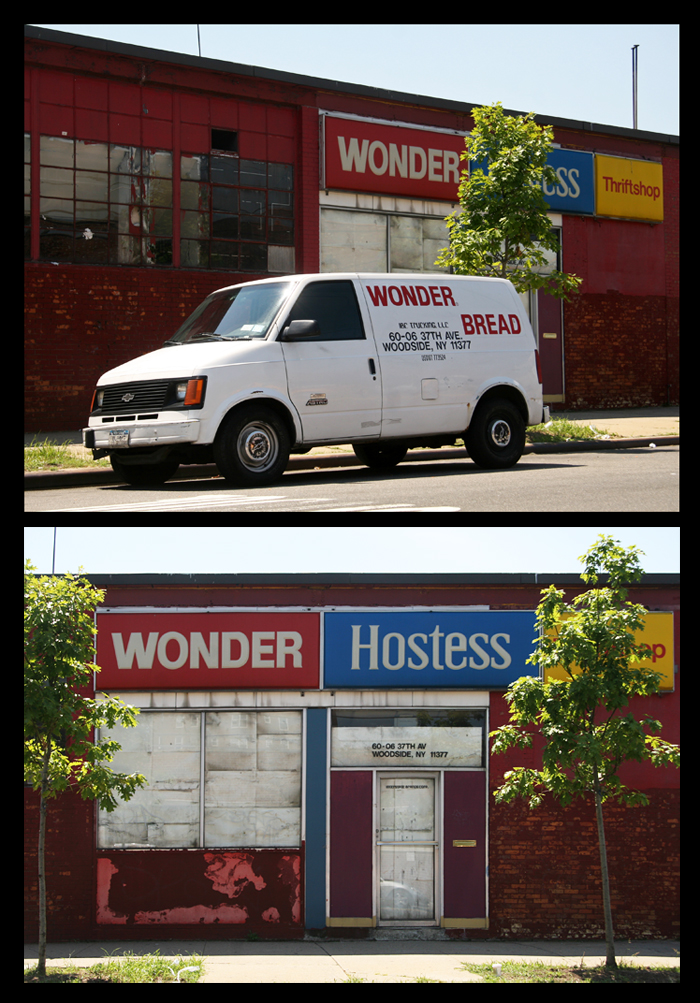
    Looking at the Wonder Hostess Thriftshop facility at 60-06 37th Avenue in Woodside, Queens, makes one Wonder not only why anyone thought to call it bread but also why the bread still exists at all…

    Related Posts: Pecking for Pita, Bagels


  • I Doubt It

    The story behind 95 Bedford Street is befuddled. Not astounding, really, because no one wants to do primary research anymore. Actual pieces of information, misinformation, conjecture, and extrapolation are all blended together. Pieces are copied and recopied. Variants on all these mixings can be found everywhere. Good luck sorting them out.

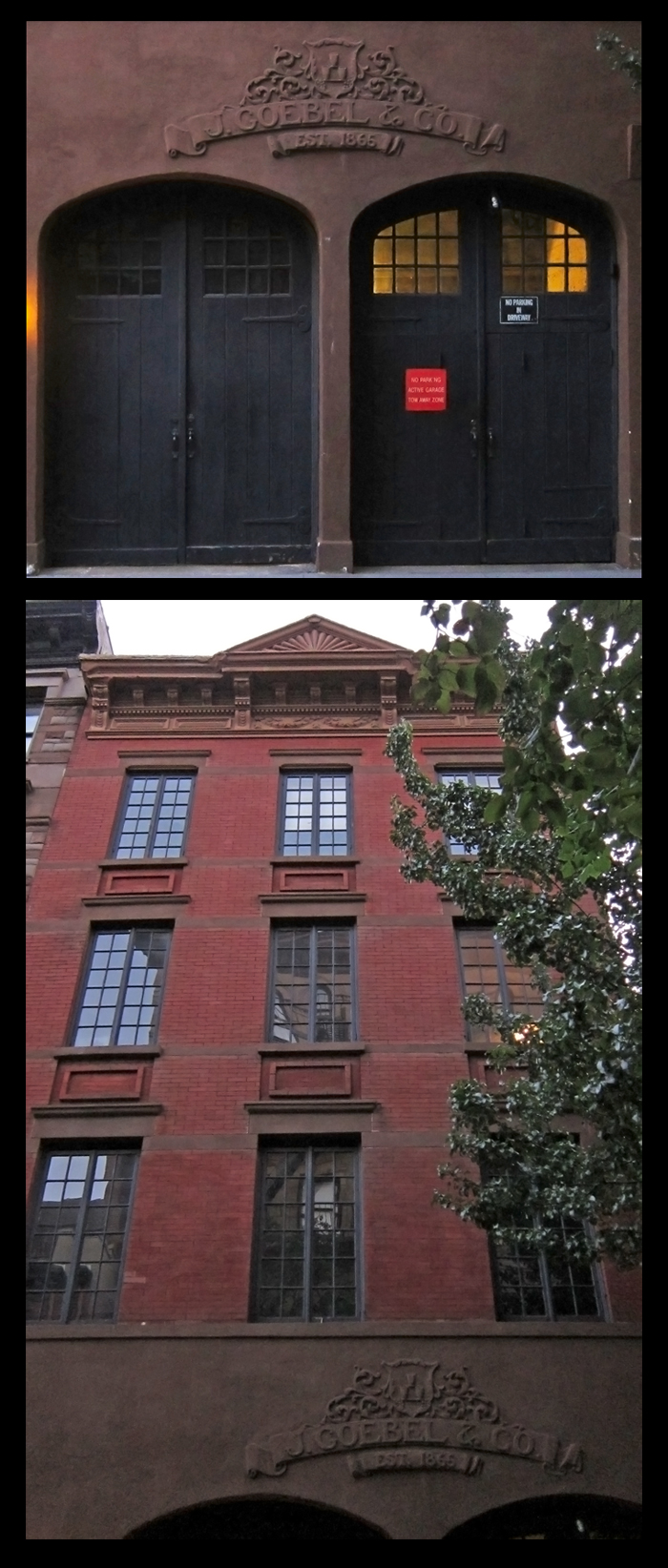
    Take this simple historic building at 95 Bedford Street in the West Village. The AIA guide says:

    Originally J. Goebel & Company, 95 Bedford St., between Barrow and Grove Sts. W. Side. 1894. Kurzer an& Kohl.  A stable once used by a wine company, as the lettering on the facade clearly indicates; converted into apartments in 1927.

    I don’t know much about wine, but if they are referring to the 3 vessels in the logo, I believe they are crucibles. From Refining Metal Waste, published in 1940, we have a reference:

    J. Goebel & Co., (crucibles, tongs, fluxes, furnaces, casting equipment) 95 Bedford St., New York.


    The building is engraved 1865. How is that related to 1894? Perhaps the business was founded in 1865?
    I did find a book, Metal Industry, which indicates a location of J.Goebel at 67 Cortlandt Street.

    One website says:

    At 95 is a ground-floor former stables belonging to J. Goebel & Co., whose name and symbol is still displayed above the entrance. The 3 cups are appropriate, since he operated a crucible in the building.

    I don’t think he operated a crucible. I believe they manufactured crucibles.

    Yet another site says:

    This beautiful edifice on 95 Bedford Street, marks the former home of J. Goebal & Co., a factory that produced crucibles–containers for holding molten glass–founded in 1865. Notice the three glasses in the edifice design.

    I would guess that the three “glasses” are crucibles. However, crucibles are often used to melt other materials, and “containers for holding molten glass” appears to be just conjecture.

    From New York Songlines, we have:

    The AIA Guide describes this building as being built as stables in 1894, later serving as a winery before becoming apartments in 1927. A neighbor describes this as “hogwash,” however, saying that the building was actually built by J. Goebel & Company as a factory for crucibles–containers for holding molten glass. Apparently the basement is still full of them.

    After reading numerous websites and a few manuscripts, I am still not certain if this building is dated 1894 or 1865, if Goebel was a wine company, if the logo shows glasses or crucibles, or if this building was a former stable and when. Who will do the leg work and sort all this out?  Does anyone care besides Christopher Gray*?  I doubt it.

    *Christopher Gray is a journalist and architectural historian noted for his column in the New York Times, Streetscapes, about the history of New York architecture and real estate. He is the founder of the Office for Metropolitan History, which provides research on the history of New York buildings.

    Other West Village Posts: Friends Pt. 2, Friends Pt. 1, Zena, Buzz and Bling, Itsy Bitsy, Conflicted, McNulty’s, Nuance, Parfumerie, Abingdon Square, Night Out, Paris in New York, 121 Charles, Gay Liberation Monument, Chocolate Bar, 17 Grove Street, Rubyfruit Bar and Grill, Grove Court, The Garden at Saint Lukes, Cherry Lane Theater, Hess Estate Triangle, Jane Jacobs


  • The Envoy Motel

    My first big family trip was to Washington, D.C. at the time of the Cherry Blossom Festival. This was also the first large city I was to explore and a major event that greatly influenced my desire to move to New York. Though only 12 years old, I had planned the trip, itinerary, and accommodations and even navigated the driving. I had mailed for brochures and maps and had searched our local library. I was so excited.

    The choice was the Envoy Motel on New York Avenue – how predictive. I recall arriving at the motel and my sisters jumping up and down on the bed with glee. It was the first time we had stayed in a motel or hotel, and this luxury called for indulgence and jubilation. We had no idea as to whether this was the Waldorf Astoria Hotel or a dump, and as children, it mattered not. One of the joys of being a child or being around them is the enjoyment of simple pleasures and immersion in the world without pretense.

    Back at home, for a short time, we had a small plastic pool, much like that in the photo. But it was not inflatable and setting up was a bit of a project, so when our parents agreed to do so, it was a big event. To us, this cheap vinyl pool, barely deep enough to submerge ourselves, was a great source of summer joy. I would watch my young sisters splashing and frolicking about like it was an event in a full-size Olympic pool.

    Recently, while exploring Queens, I stopped to visit a small community park on a hill in Woodside. This was strictly a local park – nothing of note to a visitor, just neighboring residents on a hot summer day. This was not the world of the very affluent with country homes or summers in the Hamptons. This is the real New York of the working class and how the vast majority live their lives and spend their summers. Many city dwellers have no air-conditioning, and there is little respite from from the oppressive summer heat.

    But make no mistake. For the children playing, the joys appeared to be the same as swimming in an Olympic-sized pool or summering in the Hamptons. And I know they would love a room at the Envoy Motel 🙂


  • Signs Were All Around Us

    One of my best friends is a Brooklyn-born Jew turned Christian. How he got there is a long story, perhaps for another time and place. We have a long history, he knows my position, and although he does not proselytize, we do often discuss religion.

    On one occasion, we spoke generally of whether or not I believe in God. I said that essentially, I am agnostic, and that I would like to believe, but I so wish for a sign, any sign at all. He responded that the signs are all around us and that I just don’t see them. I am sure there are signs, but are they really from God or a product of one’s mind?

    These types of theological questions have been asked for millennia, and answers have been thought through and articulated to the point where discussions like this become rather formulaic.

    On a recent day trip with my aforementioned friend, we were making our way towards Floyd Bennett Field and Dead Horse Bay via the Belt Parkway. We briefly pulled into a small turn out area to describe to our fellow travelers the activities that can sometimes be seen here, such as kite flying.

    Upon leaving, I was struck by the appearance of a Hasidic Jew on the roadside combing the area. This type of stark contrast of orthodox religious clothing, particularly on a summer day, though not uncommon, is always startling. On the hottest of Saturdays in Borough Park, Brooklyn, orthodox Jews can be seen strolling fully clothed in black pants, long sleeved shirts, and wool hats.

    As we sped away, I regretted not having stopped quickly and asking what this man was looking for. It seems that we were all searching that day and signs were all around us…

    Related Posts: Christ is Risen, Toches ahfen tish, Explorin’ Part 1, Come Together, With All Due Respect, We Got Religion, Sense of Humor, Botánica, Salat


  • You Always Find Something

    Some years ago, I was visited by a customer who was quite complementary to the manner in which I ran my business and the quality of my products. He had vocalized this on the internet. I thanked him. It is always heartening to hear complements in a world of high expectations.

    Conversation ensued, and I was very surprised to learn that the man was a military helicopter pilot. I have no idea of what it takes to earn such a position, but I was reasonably sure that this must be a highly coveted and competitive job for the very skilled with the right stuff. This was an easy opportunity to return a complement, which I did. He did not deny my observations.

    On a subsequent visit, he returned with his girlfriend, also a military helicopter pilot. Wow. Certainly this must be a rarity for a woman in the armed forces. I was awed really and so impressed. What an unique couple.

    The man offered to tour me privately around a military installation in Brooklyn, where they were based. But I was forewarned that as a civilian, as much as he would like to, I would not be allowed to fly in a military helicopter. I understood and had expected that.

    I told a close friend who was fascinated with military technology about this encounter. I invited him to come along in the event I were to take this man up on his offer and visit the military base. He was ready to go at a moment’s notice. I pointed out to my friend however, that we would of course not be able to board or fly in a helicopter. To which he replied, with no equivocation, that it was no problem because even at a dog show, you always find something.

    This statement was so poignant – I could not agree more. It was just a restatement of something I had always said – things are not boring, people are boring. It’s what you bring to the table or experience.

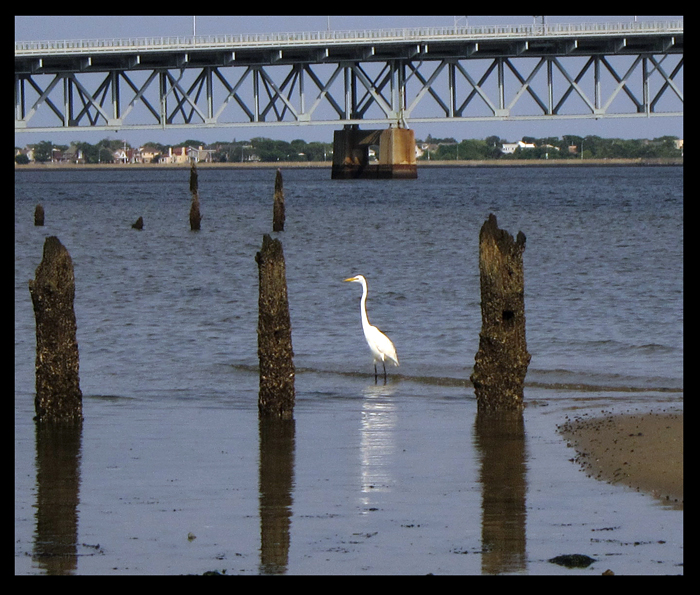
    New York City’s table is already filled with a staggering array of goods. But if you really want to mine the gold here, don’t just settle for what’s already on the table. Take an interest in the cracks and crevices. Talk to strangers, the homeless, and crusties too. Go to The Hole and Dead Horse Bay, where you may sight an egret, like that in today’s photo. Explore Far Rockaway, a place few want to visit.  If your lucky, you will meet Walid Soroor in a Jackson Heights restaurant, Mark Birnbaum strolling in his signature cadence, Ferris Butler wandering the streets a bit confused and even AndrĂ©, who, I am sure you will agree, is a bit OUT THERE. In the park, you may sight a Nymph. Come to these pages for ideas and inspiration.

    If you’re feeling a little bored or perhaps do not have the time to venture far afield, just look at little harder. Bring your attention to the city around you. Investigate how graffiti artists etch glass in the subway or marvel at the chewing gum on the streets. Because even at a dog show, you always find something 🙂

    Related Posts: Mark Birnbaum Pt. 1, Ferris Butler Part 1, Gaby Lampkey Part 2, Fashion Forward


  • It’s Perfect


    I was once led to visit an artist on Broadway, only a few blocks from my office. Not knowing whether my destination would be of interest, I paid no mind to exactly where I was going or who I was visiting. I have no idea what her name was to this day, but we had a conversation that left an indelible imprint in my mind.

    Her work was quite unique – furniture as art. What particularly struck me was her use of machinist’s tools and equipment. Her work was impeccable – I had never seen anything crafted so perfectly and I told her so. She did not take the complement but instead corrected my choice of words. Precision, she said, not Perfection.

    TouchĂ©. A distinction very well made. We had a conversation about it, but she was preaching to the choir. I have reflected on her comment a myriad of times – often when I work or whenever the word “perfect” is used emphatically in praise of a product well made.

    When it comes to man-made articles, it is quite true. Perfection does not exist, only tolerances and precision. Given measuring devices accurate enough, anything manufactured will vary from its specifications. Certainly the eye or hand will be unable to perceive variations within tolerances in a finely crafted article, but the lack of perfection is there nonetheless.

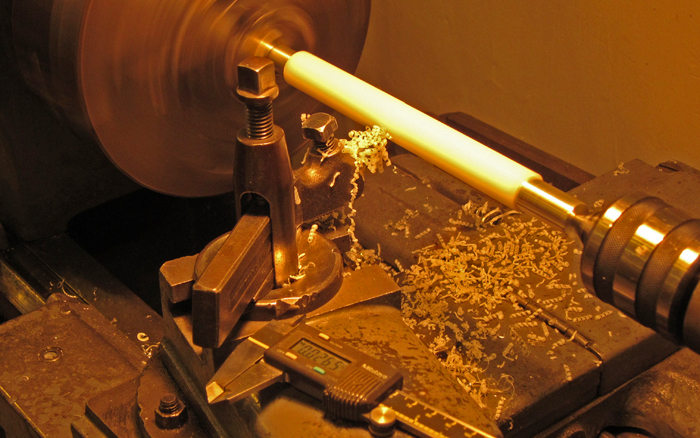
    I’m not sure what surprises people most – what I do for a living or that I do it in Manhattan in a prime SoHo location. I do maintain a machine shop on Broadway. In the photo, I am machining a part on a 1951 LeBlond lathe. The machine is a real workhorse, made at a time when American machinery was built to last. This machine will likely outlive me.

    I often wonder how many lathes are left in New York City, particularly Manhattan. I only know of a couple of machine shops. In the 1990s, there was a small machinist who occupied an entire one story building on Crosby Street around the corner from me. At one time, numerous other small manufacturers dotted the area, even entire buildings were occupied. I never appreciated the luxury of strolling to a machine shop and in minutes discussing a project, leaving drawings and picking up parts in hours or a day. The place is now a carpet shop.

    My lathe was purchased at Grand Machinery Exchange on Lafayette Street in an area once known as machine shop row. There were 40 machinery dealers in the area north of Canal Street. Grand Machinery was the last of these dealers and relocated to Long Island in 2006. I very much would have loved to do a story on them, however, I only learned of their closing a few days after their move. My visit there was only to press my face against dirty windows and peer into an empty industrial ground floor space.

    I do love machining a metal part. It is so satisfying to produce something with a high level of precision in a world of the unpredictable, uncertain or mutable and riddled with poorly made articles. When I take a beautiful gleaming metal part off that lathe, check it with my Mitutoyo digital caliper and find that the diameter is exactly what I wanted, there are no thoughts about that artist on Broadway and the nuances of perfection versus precision. It’s perfect.

    Related Posts: Brawling Over Brands, In Industry, Because I’m the Best Part 2, Because I’m the Best Part 1, Released From Captivity, Space Surplus Metals, Canal Rubber


  • I’m Throwing Them Away


    I was a little disappointed to learn that according to a 2007 British Study of walking in 32 cities around the world, New York did not top the list of fastest walkers. Singapore bested the list, New York came in at number eight. Nonetheless, we got some fast walkers and we did come in fastest in the USA.

    New York City is a fascinating smorgasbord of things to see and walking is a joy. However, I have walked daily to my current office location for 21 years. So at times I do get a bit bored and my mind wanders. I have always liked numbers and playing with them, so inevitably, I ponder the numbers associated with streets, blocks and walking.

    I have often timed my walking. In Manhattan, there are 20 north-south blocks to the mile. A brisk pace is about 45 seconds per block. Do the math and that is a 15-minute miles or about 4 miles per hour. The pace of some New Yorkers is astounding. On a stroll last night, following a much shorter woman, I tried to match her pace. It was quite an effort and I am sure she was walking in excess of 4 miles per hour.

    I have to walk through or around Washington Square Park to go to work. Having been a lover of mathematics, the prospect of not taking the diagonal is anathema. But how much distance and time do we save? I have about 15 minute walk to work, which has given me ample time over many years to do a myriad of calculations related to walking distances and times in the city. Doing these in your head is tedious and much longer than using aids but the time does pass more rapidly.

    Washington Square Park is about .5 miles around. So the distance around the park (one length and one width) walking to my destination is half the circumference or .25 miles. The park is about twice as long as it is wide. So if A is the short side, 2A is the long. The total distance around is 6A. A is therefore .50/6 or 1/12 mile.

    Now Pythagoras says: a2 + b2= c2. So now we have one side as 2A and one as A, so(1/12)2+ (2* 1/12)2 = c2. Solving this is rather simple – 1/12 2 is approx. .0069. 2/12 2 is approx. .0278. so c2= .0069 + .0278 = .0347. So, c= ? 0.0347 . or .187 miles.* So we save: .25 miles – .187 miles = .063 miles, or a little more than one standard north-south Manhattan block. So we save about 1/16 of a mile or one minute walking.

    In Sirens of Convenience, I told about a fictional New York City character created by a friend who throws money away. At times, in a similar spirit of reckless abandon, I flaunt time and distance. Perhaps I stroll leisurely, enjoy the walk and just let that woman move ahead of me. With disdain for the diagonal, I’ll just walk around the park. Distance? Time? I don’t care about distance or time. I throw them away. In fact, here’s 1/16 of a mile and one minute. I’m throwing them away 🙂

    *Square roots can be done in one’s head, but it is extremely tedious and requires good memory. Just start with a guess and through an iteration process, you can come quite close fairly quickly. Just don’t get hit in traffic doing the calculations.

    Related Posts: Steaming Masses of New York, Number 1, got math?, Sirens of Convenience, Keuffel and Esser, Urban Road Warrior, Babies, Winter Walks, Dead Man Walking, Math Midway, 1560, Huddled Masses


  • Shortly Before Execution


    I was once in a restaurant with a friend in Park Slope, Brooklyn, where a family of four was finishing their dinner. The two children were playing with food and every condiment on the table. Sugar packets had been opened and the contents were everywhere. Salt, pepper, uneaten rice, dirty utensils – all had become playthings. Food was everywhere and the floor (carpeted unfortunately) was covered in food debris. The parents made no effort whatsoever to stop the activity. There was a sense that these were children and that is what children do.

    Where I grew up, that is what children do, shortly before execution.

    This is the parents’ fault, of course, and in many instances in the city, I have seen extraordinary examples of parents indulging children in grossly inappropriate behavior. No one says anything, lest they be perceived as child haters or interfering with other people’s business.

    I am intrigued by etiquette. So seemingly quaint and outdated, yet I am fascinated by the thinking and history behind what often appears to be arbitrary or whimsical rules of conduct. And in any world or society, particularly one so complex as where we are now, there is a huge appeal for doctrine, dogma and customs. Life so much easier with a rule book.

    I expressed this interest in codes of behavior some years ago and was gifted a copy of Emily Post’s Etiquette. I was surprised to see it was still published – the classic tome is now in its 17th edition.* A guide to every aspect of social behavior is covered, even including how to eat bing cherries. There are also sections on the etiquette of things that new technology has ushered in – cellphones, email, use of iPods, etc. and changing progressive mores – sex, dating, relationships, gay lifestyle.

    There is also urban etiquette, covering things specific to the city life – crowded sidewalks and streets, subways, taxis, umbrellas, doormen, apartment life. Urban issues provide plenty of raw material for comedy writing – many of the minutiae of urban living which beg for some form of urban etiquette have been the subject of classic moments in TV shows like Seinfeld, Curb Your Enthusiasm, Frasier et. al. Although some plot themes appeared to be farcical and hyper exaggerated, like Covenant of the Keys, they were in reality issues that are often very important in city life.

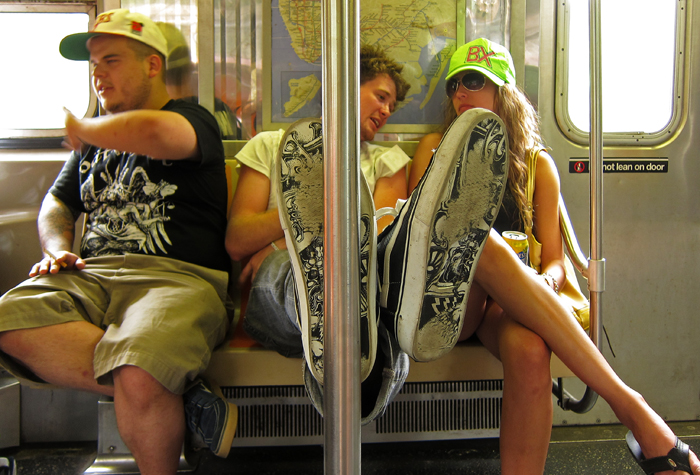
    The New York City subway is heavily used and the perfect environment for observing every manner of manners. Some see it no differently than the great outdoors. It can be dog eat dog and every man for himself. Others try to maintain a sense of decorum, following rules of urban etiquette.

    The photo was taken on the D train to Coney Island for the Mermaid Parade. As I approached my destination, my fellow riders appeared to become more casual – one had a cigarette and the other had his feet up on a pole. Where I’m from, there’s no problem with that, shortly before execution 🙂

    *Emily Post died in New York City in 1960. The Emily Post institute still survives and is headed by Peggy Post, Emily Post’s great-granddaughter-in-law.
    Related Posts: Follow the Crowd, Teleportation, Aspiring Rebel, Random Acts of Consideration, Twinship, The Curse of Trade, Just Don’t Stick, Flailing and Hailing, Covenant of the Keys, Sardines, Get a Room, World of Gray, No Salga Afuera, PDA, The Subway


  • Stopped In My Tracks


    In New York City, vagaries define the special. There is nothing more appealing than the lack of specific information or the secret. We just love “there’s this guy” or “there’s this place” with a lack of precise information as to where. Particularly in our current time, nothing is more unappealing to a New Yorker than a place that is part of a national brand or regional chain and has been marketed and branded to death.

    No one wants what everyone else has or wants to shop at places everyone knows about. This is at the heart of “being the best,” an obsession in New York City. How can something be one of New York’s best if it is part of a national franchise? Street cred for a business has to start with a minimum requirement of existing only in New York. The problem, however, is that unique places and services are fast disappearing. In the span of this website’s existence, many iconic places I have written about have gone out of business.

    I have even experienced a holding back of information, as if to be worthy of the knowledge, one must venture forth and ferret out a person or place’s whereabouts on one’s own. No pain, no gain. This holding back is often justified in that overexposure may ruin a business’s character. Although this may be true, I think the real motive stems more from selfishness – those desiring the special want if for themselves. After all, how special can it be if everyone knows about it?

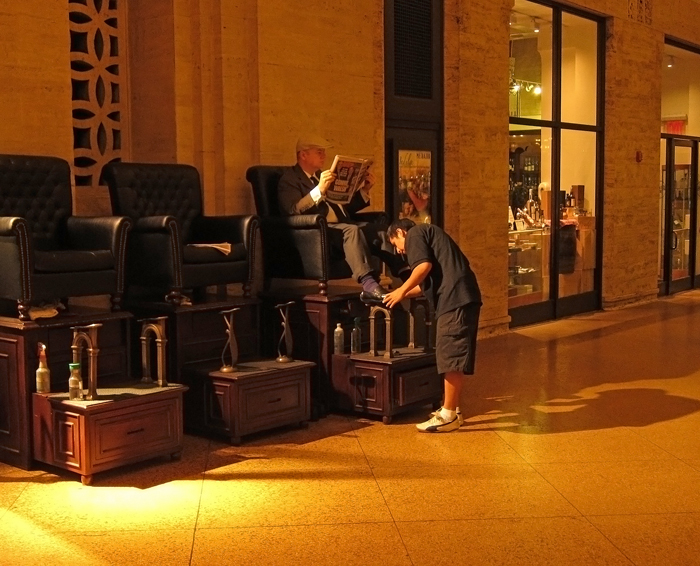
    The shoe shiner is a perfect candidate for the New Yorker’s lust for “there’s this guy.” By their nature, those involved in the business are sole operators and are often transient. In New York City, one should never underestimate the potential of any activity if done by an astute, aggressive, streetwise individual that can promote him or herself. Transient does not equal unsuccessful. Don Ward is a good example (not the man in today’s photo). Located at 47th Street and 6th Avenue, Don has been shining shoes for over 20 years. He does an average of 50 customers per day at $5 per shine plus tips. This man has interesting insights*, aggressive solicitation and clever patter. He is quite the character and a bit of a celebrity, reminiscent of the Gentlemen Peeler (see my story here).

    I have never felt comfortable with shoe shining. Although it is, perhaps, no worse than someone doing your laundry, shining shoes seems so transparently servile, too close to kissing someone’s feet. Perhaps it is my French ancestry rearing its head. In an article from the New York Times in 2008, The Politics of the Shoe Shine, Roger Cohen writes:

    Broadly speaking, there are two kinds of societies: those where you can get a shoe shine and those where you can’t. France falls into the latter category. Search Paris high and low for a seat to kick back and se faire cirer les bottes: you’ll search in vain. There’s something about the idea of having someone stooped at the feet of a client applying polish to his or her boots that rubs the Gallic egalitarian spirit the wrong way. It’s just not what 1789 was about.

    In the United States, of course, it’s a different story. Unlike humor, which is in short supply, or banned, a shoe shine is freely available at U.S. airports. Walk a few Manhattan or Chicago blocks and someone will be there to make your shoes gleam. There’s something about having someone applying polish to a blithe client’s boots that comforts American notions of free enterprise, make-a-buck opportunism, and the survival of the fittest.

    Nonetheless, on my way to the Metro-North train on Saturday, I could not help but be stunned by what I saw entering Grand Central Terminal. It was like a still frame from an old film set in New York City. Everything was perfect – two men alone on a quiet morning, the customer reading a paper while the shiner plied his trade, both basking in the yellow-orange sunlight streaming in. The whole scene gave me chills. Like the train that awaited me on track 24, I was Stopped In My Tracks

    *From Don: “Ninety-nine percent of the time, women will look at your shoes and immediately dismiss you if they’re below standard. If you can’t keep your shoes looking decent, you can’t do anything else.” “If you can’t take care of this one small detail, I’d hate to see your living conditions.”

    Related Posts: One Size Too Small, Urban Road Warrior, Very Resilient, Entombed, Uggly or Not, Mania, Just Passing Through, Camper, Grand Central


  • One Word 2


    Perhaps one of the most prescient pieces of business advice ever given in a film, and certainly one of the most enduring lines in film history, is that which is said to Dustin Hoffman in The Graduate. In this scene, Ben is chatting with a few women at his college graduation party, when Mr. McGuire comes to take Ben outdoors for a serious private talk:

    Mr. McGuire (to Ben): Come with me for a minute. I want to talk to you. Excuse us Joanne.

    [Mr. McGuire takes Ben to the back yard of the house to the pool area.]

    Mr. McGuire: I just want to say on word to you, just one word.

    Ben: Yes, sir.

    Mr. McGuire: Are you listening?

    Ben: Yes I am.

    Mr. McGuire: Plastics.

    Ben: Exactly how do you mean?

    Mr. McGuire: There’s a great future in plastics. Think about it. Will you think about it?

    Ben: Yes, I will.

    Mr. McGuire: Shhh … ’nuff said. That’s a deal.

    The word plastics has never had a positive connotation, always tainted in some way. At the time of the film in the 1967, there was a sense that plastics were part of the space age. However, it was also commonly used to mean fake, phony or artificial and hated by many, as author Norman Mailer said in an interview: “Plastic is the excrement of oil.” Although not really a scathing work, Mailer endorsed the book Plastic: The Making of a Synthetic Century.

    Today, specific plastics are promoted for their strength, performance and/or special properties in particular applications – polymers such as Lexan, Delrin, Kevlar, Teflon, Cordura Nylon, Gore-Tex, Viton, silicone, polyurethane, etc. However, when used generally, the word plastics brings up images of a world mired in plastic bags, bottles and other waste.

    In today’s photo, we have a solution to plastics recycling as well as rain gear, occasionally seen among the homeless in New York City. This man had crafted a very extensive wardrobe that appears to be extremely well suited for a day of predicted rain during a very wet spring. His possessions were neatly packed in bags, also made from plastic. Whether seen as a cultural metaphor, an icon of evil by Mr. Mailer, a promising future by Mr. McGuire or used as an impromptu raincoat, all agree on the importance of One Word 🙂

    Related Posts: We Don’t Do Windows, Released From Captivity, One Word, Rosenwach Wood Tanks, Caught, Canal Rubber


  • Electronics, Not Acid


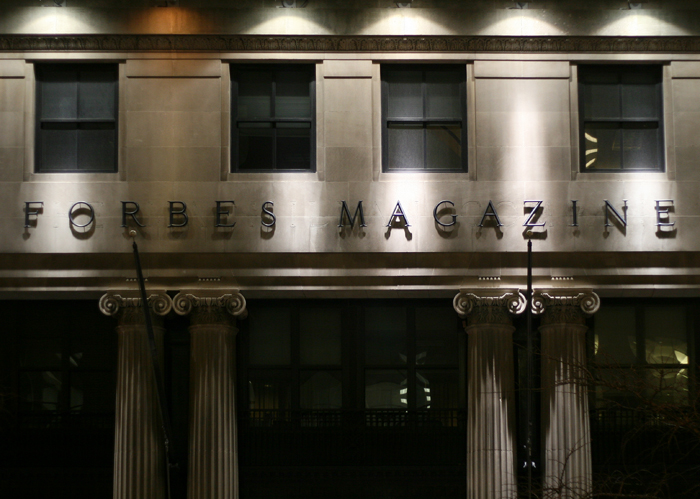
    If you would like to see hard evidence of the decline/death of print media, take a walk to 60 Fifth Avenue and see the historic 12 story, 122,000 square foot shrine to publishing. The large limestone edifice has always intrigued me. It is so prominent on lower Fifth Avenue and its Greenwich Village location between 12th and 13th Streets always seemed such an unlikely location for corporate headquarters for Forbes, most well-known for its flagship business magazine of the same name.

    The structure was built in 1924 for book publisher Macmillan & Co. It was designed by architectural firms Carrere & Hastings, responsible for so many New York City icons such as the New York Public Library and the Frick Museum. Forbes took occupancy of the building in 1962 when Macmillan moved uptown.

    The American Institute of Architects is not, however, so enamored with the structure:

    For four decades, Macmillan conducted its publishing in this pompous limestone cube whose boring surfaces are embellished here and there with echoes of Rome’s glories.

    In 2007, during a much headier real estate market, Forbes nearly sold the building for $120 million ($140 million listing price) to Renta, a Spanish real estate company. By 2010, the market had declined substantially and the property was sold to NYU for a reputed $55 million. NYU will not occupy the building immediately – Forbes has a five-year lease-back agreement.

    The sale did meet with community opposition as does every NYU property purchase. On April 16, 2009, in Gorilla and Cookies, I wrote:

    NYU is seen by many Greenwich Village residents as the neighborhood 800-pound gorilla. Every real estate move it makes is highly contentious and seen by opponents as the act of an avaricious behemoth whose appetite for properties is never sated. Perhaps a new variant of an old joke might be: “What real estate does an 800-pound gorilla buy?” “Whatever it wants.”

    Limestone is commonly used as a building material, including libraries as well as the Forbes building. However, it is partially soluble. We worry that the acid in rain damages limestone and that the acid in wood pulp destroys the paper in books and magazines. We never saw the future and that the real enemy of print media and the limestone structures that house them would be electronics, not acid…


  • Good Connections


    Connections was a BBC TV series hosted by British science historian James Burke. I enjoyed many episodes of this tour de force, each show exploring a nearly mind numbing web of interconnections, driving history and innovation in what the program called an “Alternative View of Change.”

    The prospect of living in New York City for many is intimidating. Apart from the costs, many feel that a person can get easily lost and devoured by a large monster, leaving no traces. There are countermeasures, such as making connections, which make the difference between feeling like an outsider versus an insider or a bystander versus participant. Friends and family are key, like anywhere else, to a quality life. Connections with colleagues, coworkers, business owners, etc. also aid to make New York feel like home and not the cold, impersonal place that visitors or observers may perceive.

    If one is fortunate to have relationships with accomplished individuals, they can provide the personal connections to people and things that make New York City the great place that it is for advancement and pursuit of dreams and goals difficult to achieve elsewhere.

    Those obsessed with brushing against the powerful, hoping mere proximity will bestow fame and fortune, will find any real benefits to these pursuits to be illusory. But when kept in proper perspective and for those with skills who can truly make use of opportunities, connections to the talent pool of New York City can be instrumental in success. It’s not just the cliched who you know, but what you do with the privileges granted by who you know.

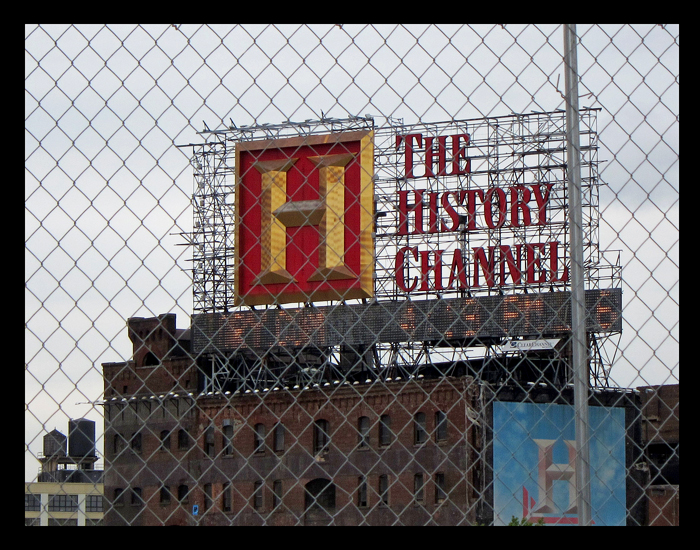
    In the 1980s I was introduced to an exceptional graphic artist, Michael Samuel, whom I hired to do freelance illustration. On one visit to his office, I asked to see his portfolio of work – I was impressed to see the History Channel logo, something he designed while at William Snyder Associates, who used to work with legendary CBS television designer Lou Dorfsman.
    The concept was something heraldic, royal and classic but not specific. I have seen this logo and billboard for years on my many trips out of the city. Every time I pass by via the Willis Avenue Bridge, I think of Michael, his exacting work, and how lucky I was to have someone with his expertise working for my small business. He says about this logo:

    One of the highlights of my career is this logo for The History Channel. Developed with William Snyder Design, this remains one of my favorites. Computer memory was so limited that each facet had to be saved in a different file. A relatively unknown station in it’s infancy, this cable channel has become famous for their interesting and diverse programming. The 60 foot, 3-D, glowing billboard at the end of the Triborough Bridge in the Bronx doesn’t hurt either.

    Be not deceived, however, because in this city, talent is often found in the least likely places – like a man’s artwork displayed on the roof of a building in the Bronx and most often viewed from a bridge or behind a chain link fence. I wish you good connections 🙂


  • Bamboo Big as Pipe


    I have had a small obsession with bamboo for decades. Like palm trees and tropical islands, they are things rarely associated with New York City, so I have had to travel and explore to feed the passion. In the 1980s, my fascination with bamboo reached its apex. I purchased a hard cover coffee table book on bamboo, helped my father fabricate bamboo fly fishing rods and sought out bamboo bonsai at the Brooklyn Botanic Gardens.

    The pièce de rĂ©sistance was a trip to the island of Nevis in the West Indies, where I sought out my ultimate dream – a bamboo forest. My sister and her husband, who were traveling with me at the time, however, did not share my dream, but tolerated it, hoping that after an excursion, I may regain my sanity and normalcy. I did.

    On such a small island, networking to find services is virtually an effortless process. Shortly after arrival, I was able to find a local guide who would take me to a tropical jungle. This was easy, but the most imperative for me was whether or not we would see bamboo in its native habitat. He assured me yes, I would see “Bamboo Big as Pipe.”

    Bamboo is a remarkably versatile material and is used in furniture, flooring, molding, fencing, textiles (I have a bamboo t-shirt), paper, as a food, musical instruments, to build homes, scaffolding, even bamboo bicycles. All taking advantage of many unique properties of the wood – it is denser than oak, harder and lighter than maple. It is very attractive, distinctive and maintains well. It is stronger than wood, brick, concrete and steel and less expensive than many other woods. Unlike many trees, which can take 20-50 years to mature, bamboo takes only about five years, making it environmentally sustainable – this is the big plus from a marketing and consumer perspective. Some are calling this wonder grass the super material of the future.

    The appreciation and use of bamboo with related imagery permeates Asian cultures. This is true to a much lesser degree in the United States, however, I am not the only New Yorker to enjoy the symbolism of bamboo – scores of restaurants, spas and other shops use the word bamboo in their name.

    Recently, I found a retail store display of bamboo cutting boards. Nearby were two signs – one promoting bamboo as eco-friendly and the other, “why use bamboo?”, featured 5 bullet points: renewable resource, resists odors and bacteria, naturally beautiful finish, harder and lighter than maple, stronger than steel. At a number of home furnishing shops I am seeing more bamboo furniture.

    I am happy to finally see bamboo sprout all over the city in so many ways, helping to complete the overused but apt metaphor of New York City as the concrete jungle. No need to travel to the forests of Nevis – just look up and imagine Bamboo Big as Pipe 🙂


  • dinamic_sidebar 4 none

©2026 New York Daily Photo Entries (RSS) and Comments (RSS)  Raindrops Theme