• Category Archives Parks
  • Shag Carpeting

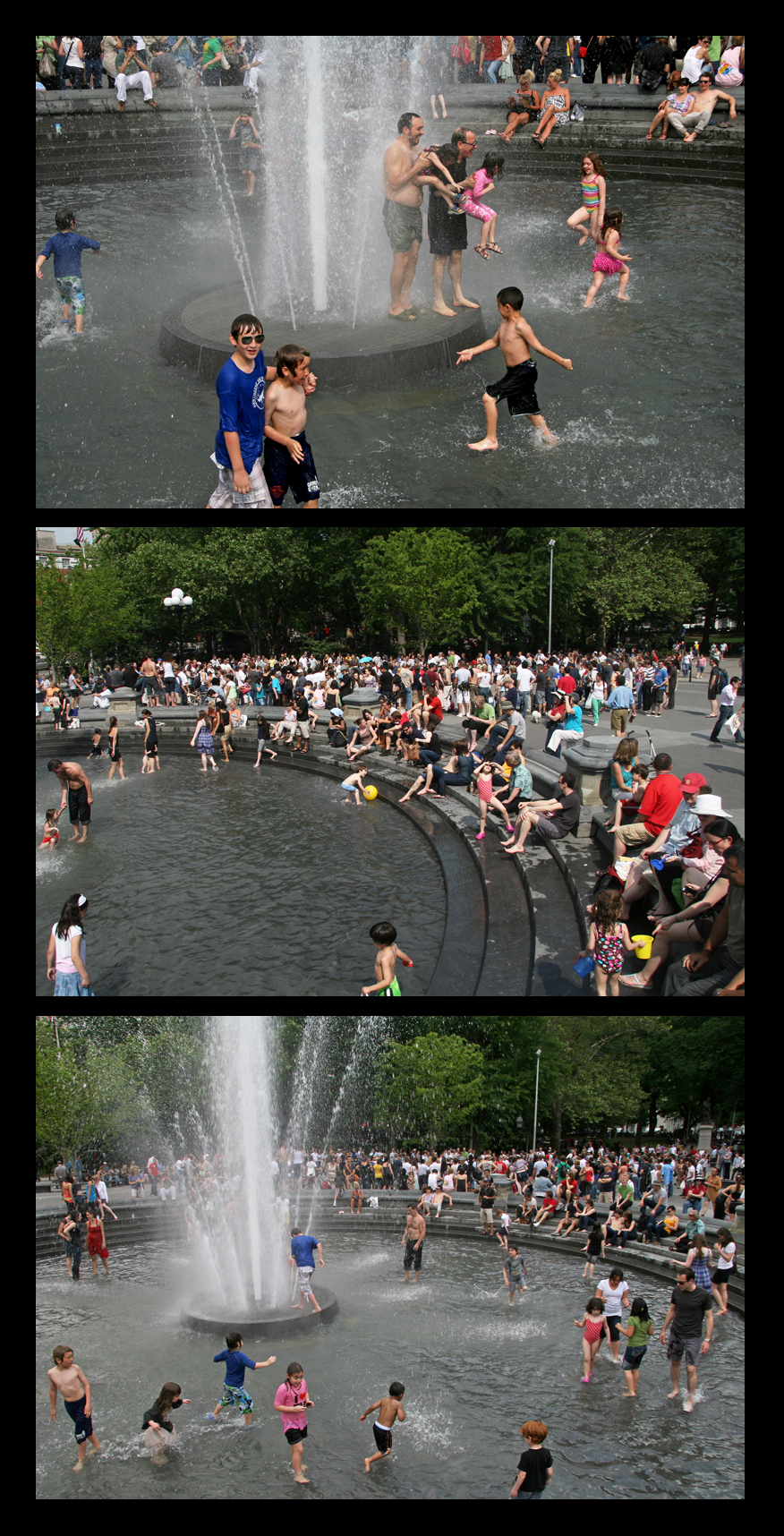
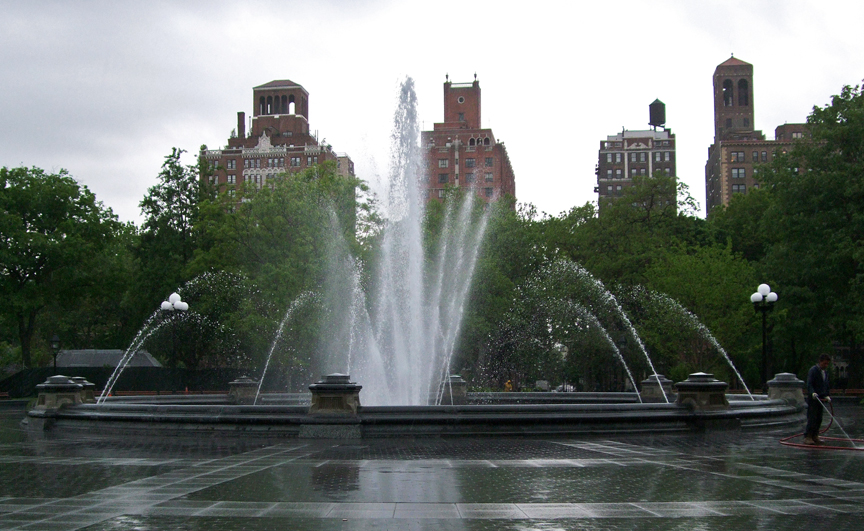
    The phrase of choice when I was growing up to describe extreme fun was having a blast. For a literal interpretation, head to the fountain in Washington Square Park, which was finally opened after being closed for one and a half years. It was perfect timing for some prematurely hot weather on a holiday weekend. It was a beach scene with all the accouterments, including children with sand buckets. See more photos here.

    The summer cooling method of choice when I grew up was the sprinkler. For those with no access to the beach or a home swimming pool, the announcement that our parents were going to set up and turn on the sprinkler in the yard was a cause for jubilation. In New York City, fire hydrants are officially made available – upon request, the fire department will put on a sprinkler head to a hydrant for the neighborhood’s children to cool off.

    There are other fountains in Manhattan, but the one in Washington Square Park, located in a residential neighborhood with a history of permissiveness, beckons to be used as a water park. Adults and children (and the occasional dog) play in the water with street clothes. Personally, I do not approve of children playing in the fountain water – this is far from a sanitary environment, with all manner of fluids and solids. There has been some controversy about the situation – dogs are officially banned, and signs stating such are soon to be posted. Tickets have been given out for the violation.

    This whole environment brings to mind shag carpeting in cheap motels. You never know what’s lurking beneath the surface – most likely, there is some accumulation of bits of food, humans, and other debris of unknown origin. Better not to look or think. The same applies to this fountain pool – who knows what’s really in that soup – better not to think or look too deep, just like with shag carpeting 🙂

  • Verdant Oasis

    Frequent users of Washington Square Park have been eagerly awaiting its reopening. It has been closed for one and one half years, since November 2007. The renovations were a contentious battle – I wrote about it in Jeopardy. There were lawsuits and fighting over the big stuff and the little stuff too: size of the plaza, moving the fountain, height of fences, width of walkways, removal of mounds, trees, grass, plants – no stone was left unturned.

    The reconstruction is being done in phases. The first (approximately 2/3rds of the park) is the largest and includes the fountain and plaza area. So its reopening has been highly awaited, particularly by local habitues such as myself and a number of friends.
    In the last few weeks, the fountain has been tested – I have chanced upon it twice. Yesterday morning I took a photo through a hole in the chainlink fence.

    The entire renovation process has been less transparent to the community than many would have liked, and its reopening is mired in secrecy. Even at this late date, no one appears to know the date of its reopening. There are speculations and rumors. Some say it will first open uneventfully, with an official celebration later. Surprising, being that this is a relatively major event.

    Historically, the park has been a center for cultural activity – music, chess, scrabble, art, street performing, skateboarding, filming, parades, marches, protests, rallies, concerts, and a myriad of events, both regular and spontaneous. Numerous local eccentrics. And, of course, still plenty of drug dealing. The park also serves as New York University’s de facto campus, so students are abundant.

    It seems certain that the park will open within the next week or so. Keep an ear to the ground or an eye to this website. When it opens, visit soon – everything is green, beautiful, and immaculate. I see it outside my window now – a verdant oasis awaits you…

    Related postings: Out There,  Hawk Fest, Evening Arch, Twelve Tribes Arrive, New York Nymph,  Bluegrass Reunion, Cloud Appreciation, I Am Legend, Birds Sing at Night, Rats Gone Wild, Piercing Al Fresco, Police Riot Concert, Artiste Extraordinaire, Comfort and Joy, Livid, Flash of Light, Delivery,  Conflux, Dog Run, Sounds of Summer, Krishna, Spring Madness, Back to Boyhood, Hookah, Lockout, Danger and Caution, Obama, YouTube Meetup, Dachshund Octoberfest, Music Speaks for Itself, Park Night, Petanque, Washington Square North, Nested Embraces, Left Bank New York, Fashion Forward


  • Conflicted

    Posted on by Brian Dubé


    In my tagline for this blog, I promised you a “place of diversity.” Lest I be accused of hollow words and just using a catchy phrase to sell this city and website, today I bring you a park full of flowers after Friday’s meat hanging on hooks. And I did not travel to all ends of the city to find these contrasts. The park in the photo is only a short walk from the meat packing district. This is the fascinating thing about the city – it’s not only the magnitude of contrasts but also the rapid change you can find from one environment to another. Sometimes the change is even within eyeshot, particularly with a neighborhood still in transition.
    Many would argue that the meat packing district has arrived and is completely gentrified. For those who believe that, I suggest that you stroll along West Street at 7AM on a weekday, and you will see many hard at work loading and unloading trucks full of meat parts.

    But that was last week’s story. Today we have flowers. Spring in New York City is a beautiful time of year (when not raining). However, like any city, spring here is not a full immersion experience. There are elements of spring, but these are tempered by the manmade world that dominates the city’s landscape. This is particularly evident when one leaves the city mid-season and is impacted with the sensations, almost overpowering by comparison. One can get close in New York – the wooded areas of the bigger parks go a long way towards capturing that country feeling and communing with nature.

    The park in today’s photo is Abingdon Square in the West Village. While there, a friend who is also new to this city exclaimed that this must certainly be one of the most beautiful parks in all of New York. To which I replied, do not be overly swayed by the display which is primarily tulips. Their life is quite short, and soon this spectacular display will be much more subdued. That said, Abingdon Square is a beautiful pocket park, many of which can be found throughout the city.

    You can see in my posting from October 27, 2007, that my enthusiasm for Abingdon Square was a bit bridled. If my impressions and assessments of aspects, places, people, and things sometimes appear conflicted and contradictory, they are – just like New York City itself…

    Posted on by Brian Dubé

  • Flash of Light

    New York Daily Photo started originally as a photoblog, a publishing format where postings are driven by photos rather than text. In time, however, with an interest in research, small descriptions grew to longer articles. With an interest in giving subjects a less clinical and more personal view, I have drawn from anecdotes in my life, and the writing in many postings may be better described as stories and are more about the story than the photo. Now there is an expectation, both on your part and subsequently on mine, of writing.

    I have come to really enjoy the writing of this blog, and recently, in reading about writing short works, I came across an entire genre of fiction which I was completely unaware of: flash fiction, aka sudden fiction, microfiction, nanofiction, micro-story, postcard fiction, or short short story. There are even types of fiction which use exact word counts: 55 Fiction (55 words), the Drabble (100 words), the Drouble (double Drabble or 200 words), and the 69er (as the name suggests). There is no better time for flash fiction with the growth of visual media, competition for everyone’s time, sound bites, and the decline of book reading.

    The bane of nearly every student of English in high school was the dreaded writing assignment where there was a word length requirement. For me, being somewhat verbose, these assignments were not quite as painful, but there still was always the concern that I would not have enough truly meaningful things to say. Certainly there is value in exposition and learning articulation skills, but there also is much to be said for using one’s words sparingly and not padding the writing. I am sure that flash fiction would have been heartily welcomed in my English classes.

    Flash fiction is, of course, not without its critics. In the same way that assignments with minimum word lengths may encourage verbosity, some feel that flash fiction with maximum or exact word lengths is no better, artificially paring a story down where perhaps a few more words may have improved the story. I think there is value, at the very least, to use flash fiction as a writing exercise.

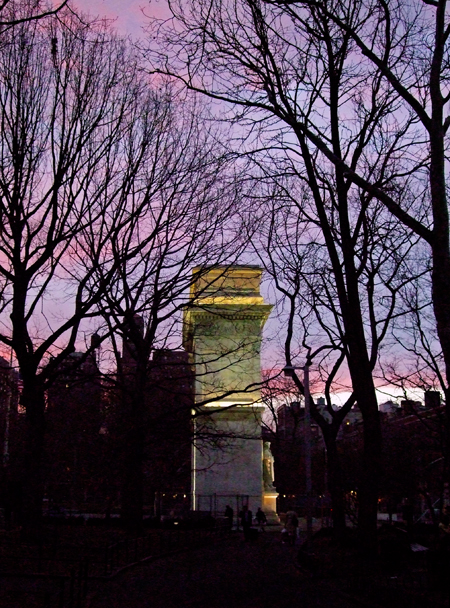
    I hope you enjoyed today’s unnecessary digression because, after all, not only is brevity the soul of wit, but this picture should also be able to speak for itself and be worth at least four hundred and one words 🙂

    PHOTO NOTE: I witnessed this dramatic pink and blue sky framing the Washington Square Park arch on Wednesday evening, March 11, 2009, at 6 PM.


  • First Flakes

    Snow is a funny phenomenon – bemoaned by most once there is an accumulation, yet beloved during its first flakes. That was the case yesterday, when New York City had its first real snowfall for the winter of 2008 which stuck to the ground. At one point in the mid-afternoon, enormous flakes came down, and there wasn’t anyone that didn’t seem awed by the sight.
    New York is not really a very natural place, so displays by Mother Nature are particularly outstanding. A flood here rather than in a coastal area or a tornado here rather than in Kansas is going to be very dramatic juxtaposed against the urban backdrop.

    Snow brings out the child in many of us, with memories of play, days off from school, sleds, dogs barking, snowmen, and snowball fights. As I wrote in Small Gestures: “Like a child who does not need to go to school on a snowy day, a rainy day gives permission to play and indulge in the small things we often miss or forget. This opportunity can be for a pause for reflection – a welcome moment of respite for the weary New Yorker.” I have witnessed absolutely remarkable things during blizzards, such as people making snow angels in the middle of 7th Avenue and business men in suits cross-country skiing down Broadway to go to work!

    So it is with great pleasure that I observed the final moments of our first snow and the thin white blanket that was cast over Washington Square Park. The scene was reminiscent of photos by André Kertesz, a village resident, who produced many stunning black and white images of the park after a snowfall. Snow softens the city, and watching it can be a mesmerizing and relaxing experience.

    By morning, everything had melted, typical of the city with its warmer infrastructure and climate. Our snows often melt or turn to rain, quickly erasing all traces of childhood indulgences. I awakened to a gray day, reminding me that there’s work to be done…

    Related Postings: Small Gestures, First Snow, Anomalies, Nor’easter, New York Survivor


  • Comfort and Joy

    There is nothing like a small, intimate community or family gathering. Certainly the dramatic and lavish is enjoyable in New York, but in a city where stress and intensity dominate, immersion into a social activity is a good way to reconnect with humanity, providing a respite from all that is electric.

    Historically, I have been rather scroogish in my attitude towards Christmas, bristling at its overly commercial nature. But over time, I have softened and now realize that nothing is gained in being a curmudgeon. Why stand alone on principle and isolate yourself while the rest of the world is busy singing around you? I am not saying that one should throw principle into the wind, but certainly looking for the good is not the worst life approach. So I see holidays as opportunities to celebrate, and there are so many ways and places to celebrate everything imaginable here, both religious and secular. I wrote of this in Let’s Have a Parade.

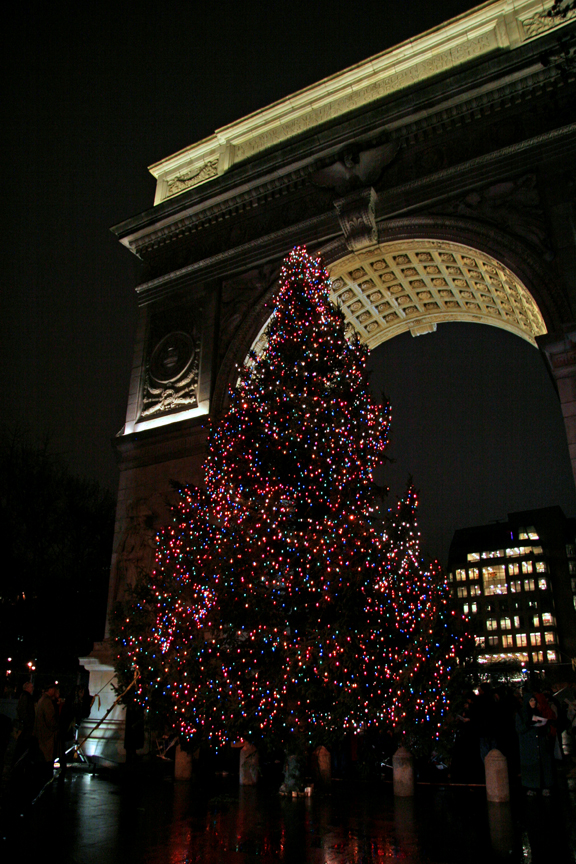
    I joined the annual tree lighting ceremony last night in Washington Square Park. In its 82nd year, the ritual actually dates back earlier than the tree lighting in Rockefeller Center. The weather was balmy and drizzly, with a small turnout huddled under the arch. Christmas carol books were distributed for a sing-along, guided by a small group of musicians.

    Not to be insensitive to the needs of the have-nots, but for most of us, there is much truth in Willy Wonka’s assertion: “If you want to view paradise, simply look around and view it.”
    New York City is a place of the driven and ambitious. Living here is costly. If you are interested in coasting through life, there are better places to do so. But work and purpose should not define acceptable behavior.

    So if you find yourself concerned that perhaps some activity or indulgence is perhaps capricious or not worthy of your time, remember this other morsel of wisdom from Wonka: “A little nonsense now and then, is relished by the wisest men.” To which I would add a little comfort and joy…

    Photo Note: Click on the photo to see the original green version.


  • Morphic Resonance

    There is something called the hundredth monkey effect – a phenomenon where, supposedly, a learned behavior spreads instantaneously from one group of monkeys to another once a critical number has learned it. This idea was popularized by Ken Keyes in his book The Hundredth Monkey. On the Japanese island of Koshima in 1952, macaques were observed to have learned to wash potatoes. This behavior was passed on to others on neighboring islands, supposedly without any direct contact between monkeys. The paranormal effect was reported to be evidence of morphic resonance, a theory of Rupert Sheldrake, a former British biochemist. According to the theory, the repetition of similar acts and/or thoughts creates morphic fields which have effects on others.

    The whole concept is extremely fascinating and very compelling, perhaps accounting for its popularity amongst new age thinkers. However, morphic resonance is not supported in the scientific community, and the hundredth monkey effect is largely considered to be an urban myth.

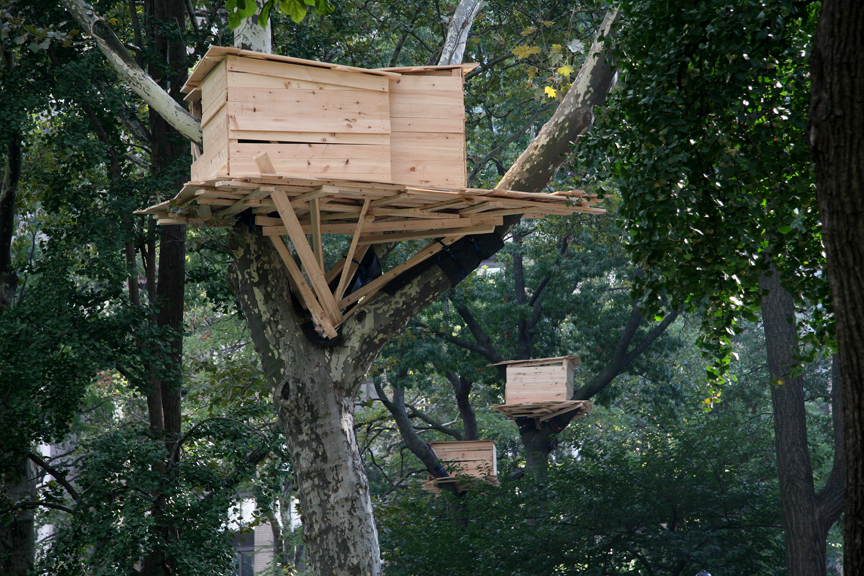
    I have always been interested in treehouses. At one time several years ago, my interest became so acute that I decided to search for existing books on the subject, and surprisingly, a new text had just been published. Subsequently, there has been a proliferation of other books and articles – a number have appeared in the New York Times.

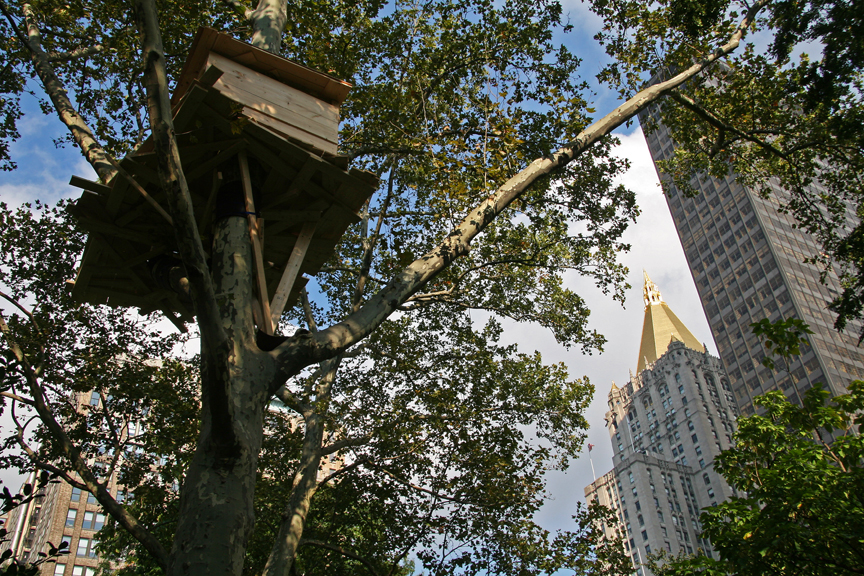
    I was both surprised and excited to see this display of tree houses in Madison Square Park, juxtaposed against the New York cityscape (see another group shot here). This is a public art project called Tree Huts by Japanese artist Tadashi Kawamata. If you don’t mind a bit of artspeak, you can read about it here at the Madison Square Park website (update 1/10/12: Link no longer works) or here at the Tree Huts blog.

    Although I realize that all the recent interest in tree houses is almost certainly due to cross-pollination, I just love the idea that it could be morphic resonance 🙂

    Note about the photo: The gold-topped building in the background is the New York Life building – you can read my posting and see its spectacular night time illumination here


  • Camperdown Elm

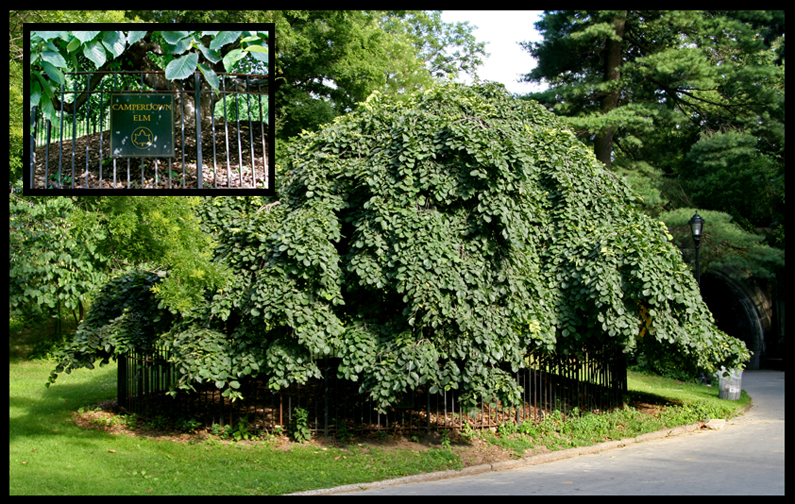
    In New York City, we have a surprising variety of flora and fauna. A myriad of trees introduced from other countries can be found in the major parks, such as Central Park and Prospect Park. Varieties are often identified with plaques (look for these identification plaques on the trees themselves). In Prospect Park, Brooklyn, one can find the notable 136 year-old Camperdown Elm tree. This cultivar can not reproduce from seed. From the Prospect Park website, we have a description of the species, propagation, and history:

    The Camperdown Elm, planted near the Boathouse in 1872, has developed into a stunning specimen. No more than 12 feet high, it resembles an over sized bonsai. It is the most famous specimen tree in Prospect Park. The weeping shape of this elm is extremely attractive and a peek under the canopy reveals an amazing branching structure. The many cavities in the branches and the size of the trunk show that this is an older tree.

    Between 1835 and 1840, the Earl of Camperdown’s head forester, David Taylor, discovered a mutant contorted branch growing along the ground in the forest at Camperdown House, in Dundee, Scotland. The Earl’s gardener produced the first Camperdown Elm by grafting it to the trunk of a Wych Elm (Ulmus glabra) – the only elm species that the Camperdown will accept as a root stock. Every Camperdown Elm in the world is the product of a cutting taken from that original mutant cutting and is grafted onto a Wych Elm trunk, usually 4-6 feet above ground.
    Suffering from severe decay a century after its donation to the Park, the elm’s fifteen minutes of fame arrived in 1967 when Marianne Moore’s poem about it helped raise funds to pay for its treatment. 

    There are park maps and other information available in Belvedere Castle in Central Park and the Boat House in Prospect Park. Both parks are highly recommended any time of year; there are a plethora of environments and activities…


  • Sheep Meadow

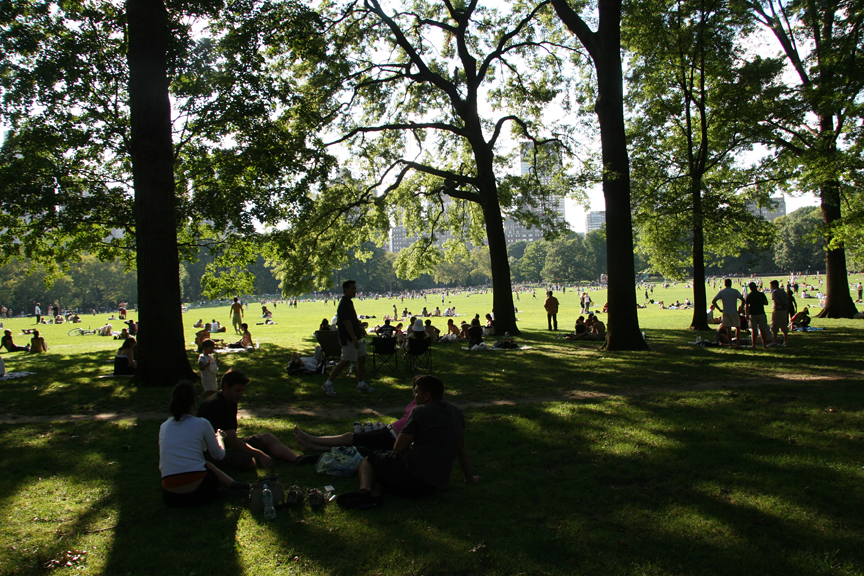
    In looking over my archives, I was shocked to find that I have never done a posting on Sheep Meadow. Why shocked? Because, for me and many New Yorkers, this patch of grass is one if the most special and important places in New York City. Why did I wait so long? To get a photo that does justice to the feeling of this pastoral place. And as time passed, I just assumed that it was a fait accompli.

    As I have written before, parks are so important in New York City. These are the only outdoor spaces we have. In many cases, they have become much more than just what one thinks of as a park. They have evolved into centers for a myriad of activities – tennis, running, walking, biking, chess, birdwatching, model boating, kite flying, frisbee, horseback riding, baseball, theaters, ice skating, roller skating, swimming, boating, music performances, street performing, and, of course, people watching. A world of recreation and entertainment.

    And let’s not forget relaxing. Perhaps a picnic. Or just reading. Many a weekend I have found myself in Sheep Meadow with a magazine, book, or a copy of the Sunday New York Times, a veritable ritual in the city.

    Sheep Meadow is located in Central Park, which is literally (and, for me, figuratively) at the geographic center of Manhattan – both east-west and north-south. Fold a map of Manhattan and you will see what I mean. The 30-acre meadow itself is located in the lower portion of the park. Until the 1930s, sheep did actually graze there. They were moved to Prospect Park by Robert Moses.

    The meadow is convenient to various trains and buses, making it an egalitarian place, accessible by all. The space gets heavy traffic, yet it has been consistently well-maintained. Remarkable for this city…


  • Steps From Paradise

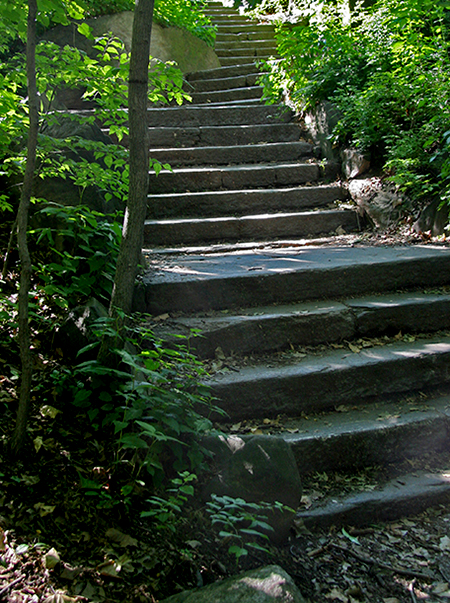
    Do you want to find one of the most idyllic, bucolic areas in Manhattan? One where you feel virtually removed from the city itself? Then step into the Ramble, a 38-acre “wild garden” in Central Park (in the words of Park designer Olmsted) with rocky outcrops, secluded glades, and a tumbling stream called The Gill.

    The designers of the Park literally sculpted the Ramble out of a wooded hillside. One of the first parts of the Park to be built, the Ramble is totally artificial except for its bedrock base. Even the water running in the Gill is turned on and off with a water tap.

    What is extraordinary about the Ramble is how one can be completely secluded in a heavily wooded environment in the center of Manhattan with no visual sense of being in an urban setting. You have to look hard in New York City to find spots of nature which are capable of really acting as a retreat and providing a respite from city life. Some of my favorite spots are the various community gardens (see Shangri-La).

    The Ramble is a major bird-watching area due to its location on the Atlantic flyway (the migration route that birds follow during the spring and fall). It is one of the top 15 birdwatching sites in the entire United States – 230 species have been spotted.

    One aspect of the Ramble, which has kept some visitors away, is its use since the early 20th century for gay encounters. The heavily wooded seclusion which the Ramble affords has made this an ideal location in the city for outdoor gay sex. However, I have been to the Ramble many times over the years, and personally I have never witnessed anything of this nature, so I would not let any of this deter you from visiting this area.

    I am frequently surprised at many people I meet who are unaware of the Ramble’s existence. If you are in Central Park, always remember – you are only a few steps from paradise…


  • When Worlds Collide

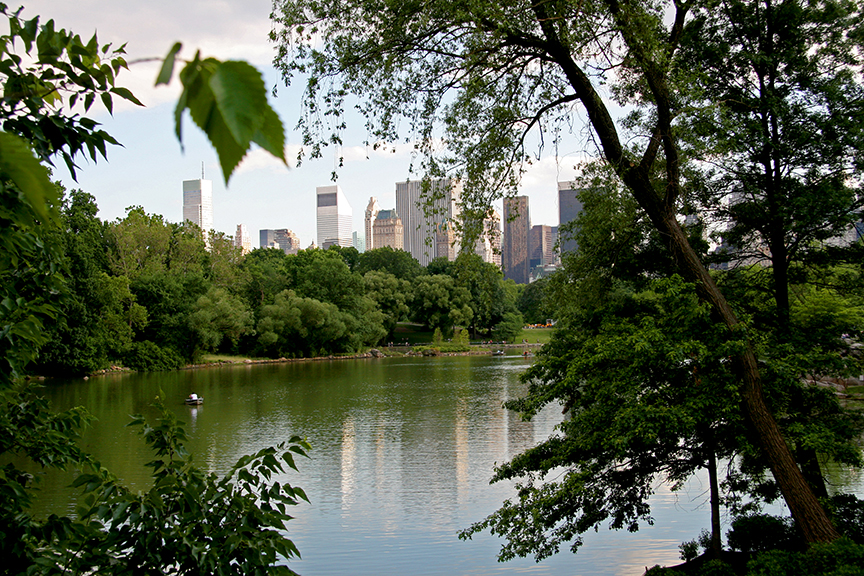
    There are things one never tires of, and for me, Central Park is one of them. What is there to get tired of in this idyllic urban oasis? I place it at the pinnacle of any must-see list for visitors.
    Given the lack of outdoor space for city residents, parks take on a much greater significance – they effectively become our backyards and recreational playgrounds. So the reason for my bias is obvious.

    I can easily be accused of being a one-man campaign for Central Park and taking every visitor I have known there for an obligatory visit. This landmark was designed by Frederick Law Olmstead and Calvert Vaux and was completed in 1873. The landscaping and architectural elements are exquisite. As I wrote in my article on the conservatory water, on a perfect day, I feel like I have been transported to Seurat’s Sunday Afternoon on the Island of La Grande Jatte.

    This 843-acre wonderland is remarkable for many reasons, including its myriad of different environments and areas set aside for a variety of uses (see the list of articles and photos I have done in related listings below). There are extensive walking/running tracks, two ice-skating rinks, tennis courts, the Central Park Zoo, the Central Park Conservatory Garden, a wildlife sanctuary, the Ramble, a 106-acre/billion gallon reservoir (with an encircling running track), ponds, the Lake, a Conservatory for model boats, the Delacorte Theater (which hosts “Shakespeare in the Park”), Belvedere Castle, the Swedish Cottage Marionette Theatre, and the historic Carousel. There are numerous major and minor grassy areas, some used for sports, some are set aside as quiet areas, and there are a number of enclosed playgrounds for children.

    From many vantage points in the park, the city’s skyline is visible – the juxtaposition of the urban landscape and the bucolic is a potent reminder of where you are and how fortunate we are to have both worlds…

    Related Postings: Conservatory Water, Kerbs Boathouse, Bethesda Fountain, The Beresford, Not So Kleine, Belvedere Castle, Red Panda, Feeding at the Zoo, Albino Burmese Python, The Boathouse Restaurant, Alice, Strawberry Fields, The Bow Bridge, The Dakota, Central Park Mall, Going Tribal, Vivid View


  • Belvedere Castle

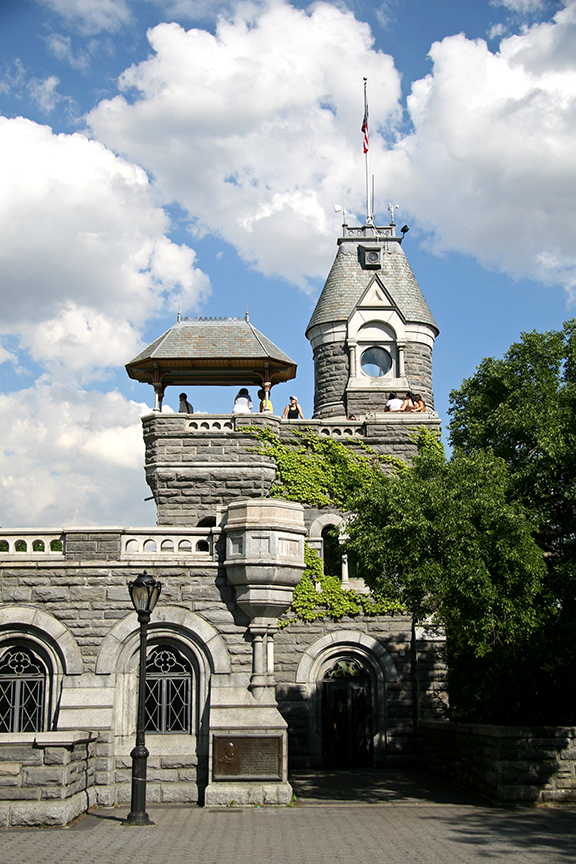
    Yes, we do have castles too, albeit small ones. This is not one of the most well-known or often visited spots in the city, but given good weather, I would put Central Park and Belvedere Castle on a must-do list. The castle, built from Manhattan schist, is in a secluded area near the Ramble. Two narrow staircases each bring you to an observatory level. There are excellent vistas, greenery, the Shakespeare Garden, the Duck Pond, and the Great Lawn. For those of you interested in the Castle’s history and purpose, read this description from the official Central Park website:

    In 1867, Central Park designer and architect Calvert Vaux (1824-1895) created an observation tower atop Vista Rock to overlook the old reservoir that is now the Great Lawn. The Gothic-style Castle was designed as a landmark for the pedestrian park visitor. The castle’s United States flag could be seen from the Mall, drawing the walkers down to Bethesda Terrace, over Bow Bridge, and through the Ramble to the castle itself.
    The original plans for the building included another elaborate two-story structure on the site of today’s pavilion, but financial concerns halted construction and left the castle in its present state. Portions of the castle are made from the same type of schist as the Vista Rock, creating the illusion of a castle rising out of the park itself. Its light colored stone trim is made of granite quarried from Quincy, Massachusetts. Its roofs are made of colored slate from Vermont, Virginia, and New York.
    Belvedere Castle was once an open-air structure, with no doors or windows. This changed in 1919 when the United States Weather Bureau moved the Central Park Observatory to the castle. Until that time, weather measurements were taken from the Arsenal at Fifth Avenue and 64th Street where Dr. Daniel Draper founded a meteorological observatory in 1869. The Weather Bureau took over the operation in 1911, and moved it here eight years later, enclosing the castle and altering the turret’s shape to accommodate their scientific instruments.
    In the early 1960s, the Weather Bureau replaced the lab with automated instruments and closed the castle offices. The empty building was left to deteriorate until 1983, when the Central Park Conservancy replaced the original turret, rebuilt the pavilions, and converted the castle into a visitor’s center. The Henry Luce Nature Observatory in the castle, created in 1996, provides interactive nature exhibits inside the castle as well as bird-watching kits, which can be used throughout the park.

    Note: Belvedere is an architectural term from the Italian “beautiful view”, referring to any architectural structure sited to take advantage of such a view.


  • Sieve

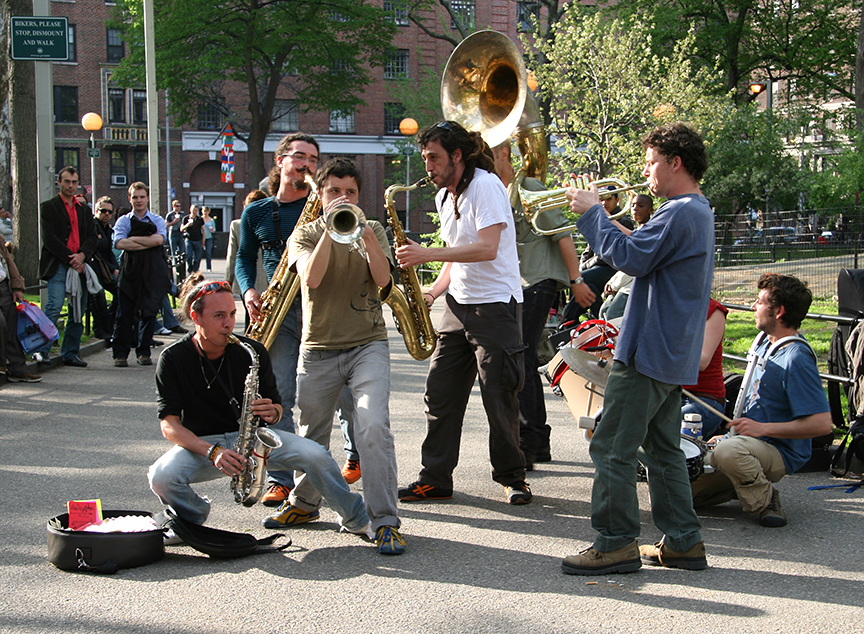
    New York is an international magnet. It’s like the whole world is on a tilt and anyone who isn’t tied down ends up in the city at one time or another. And for most musicians and performers, working in NYC is a right of passage.
    For a brass band from Marseille, I guess it would be de rigueur.

    On the same day that I met renowned Will Galison, we had this brass band from Marseille only a few hundred feet away. They called themselves Samenakoa and used a number of unique devices, including a megaphone for the singer.

    We are so spoiled in this city. We have one cultural tour de force after another. Even on the streets, we have extraordinary talent and, in some cases, people who work professionally on stages worldwide. I have seen Philippe Petit (who walked between the twin towers), David Blaine, and a plethora of others.
    The streets are a good training ground for performers. Unlike a theater, you do not a have a captive audience – they need to be gathered and held. A tough job in a city with so many distractions and so much talent. If your act is not immediately compelling, most will just walk away.

    Performers I have known who honed their craft this way have become extraordinary performers – not just showmen, but true entertainers. People like Penn and Teller. On the streets, an astute performer can easily ascertain what works and what doesn’t. That which doesn’t work is discarded. It’s liking working with a sieve, sifting for the nuggets of gold that remain after discarding the sand. Separating wheat from chaff.

    All those nuggets of gold and kernels of wheat – that’s why I love this city.

    Related Postings: One Man Band, The Naked Cowboy, Street Revival, Reverend Billy, Missionaries Meet Their Match, FĂŞte de la Musique, Palehorse Productions


  • Influences


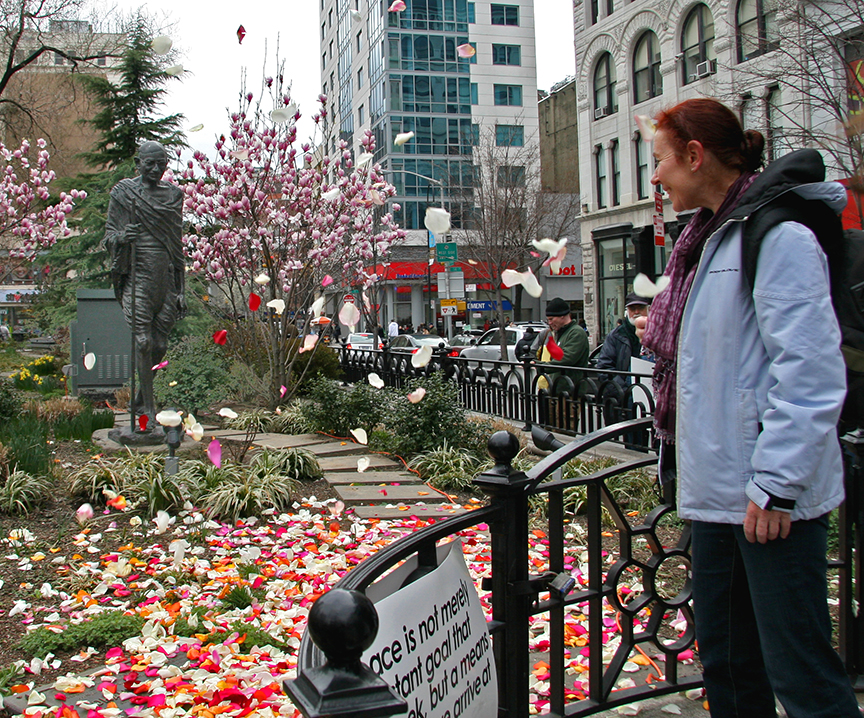
    Union Square can always be depended on as a locus for political activism. Saturday afternoon was the Be the Change walk – the initiation of a month-long tribute to Mohandas K. Gandhi. The walk started in four different locations and ended in Union Square near the Gandhi statue, where a number of speakers were present for the commemoration, including composer Philip Glass, author Mark Kurlansky, and author/activist Reverend Osagyefo Uhuru Sekou. There was also a traditional flower petal ceremony. The Iraq War was, of course, foremost in the minds of the participants, many of whom carried large signs with quotes from Gandhi: Outer peace is useless without inner peace and An eye for an eye makes the whole world blind.

    Gandhi is generally seen as a pioneer in the use of civil disobedience on a wide political scale, both in South Africa and India. Along with King, many others have credited Gandhi as being a major influence: Albert Einstein (who exchanged letters with him), anti-apartheid political activist and former President of South Africa Nelson Mandela, and former U.S. Vice-President and environmentalist Al Gore.

    This walk also coincided with the assassination of Martin Luther King (April 4th, 1968). In 1999, Time Magazine named King as one of the Children of Gandhi and spiritual heirs to non-violence.

    Influences trickle down and are transformed, adapted, and built upon for time, place, and use. Even those who are extraordinarily creative or provided seminal roles have had influences – one of Gandhi’s was the classic essay, Civil Disobedience, by Henry David Thoreau, first published in 1849. But that’s another story…

    Related Postings: Union Square, Vintage Mural, Reverend Billy, Picture New York, Flora, Gentleman Peeler, Luna Park Cafe, Metronome, Union Square Greenmarket, One-Man Band


  • Key Privileges

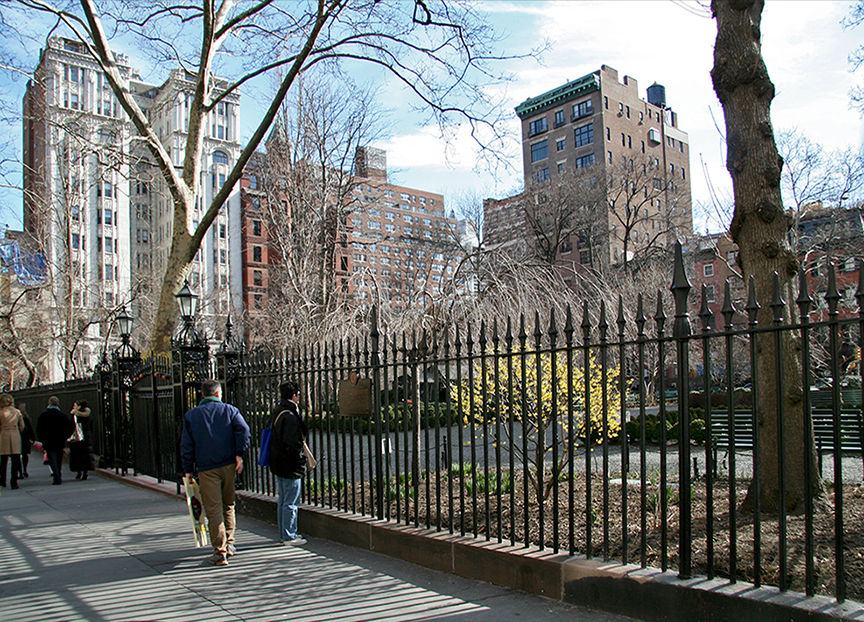
    Unless you stay at the Gramercy Park Hotel or are extremely well-connected, this is as close as you will get to enjoying Gramercy Park, from this side of the fence. Well-known to city residents, Gramercy Park is the only private park in the city. To gain access, one must have a key – these are available only to residents in the buildings surrounding the square, who own the park in common. Although NYC has its share of money and exclusivity, private outdoor space is an anomaly in the city, and the park’s privacy comes as a surprise to many.

    Originally, this park was swampland. The name Gramercy is from the Dutch ”krom moerasje,”for ”little crooked knife.” In 1831, Samuel Bulkley Ruggles bought and drained the land and divided into 108 lots. The park occupied 42 of the lots, and homes were built on the remaining 66 (these are the buildings which have keys to the park.) This area was located unfashionably north at the time, so Ruggles built a private park to attract residents and buy properties.

    The square is surrounded with magnificent row houses and prewar buildings. The immediate area is rather quiet, with only a few business establishments such as O’Henrys. The neighborhood, known as Gramercy, is surrounded by tree-lined streets. Not far away, however, is the bustling Union Square, as well as the Village to the south.

    But I do not pine for access, and neither should you. There are many extraordinary parks in the city – Central Park, Prospect Park, Washington Square Park (under construction), Union Square, the Conservatory Garden, Brooklyn and N.Y. Botanic Gardens, Van Cortlandt, Riverside, Carl Schurz, City Hall, et. al. These urban oases dot the city, and the privilege of entry requires no key…


  • dinamic_sidebar 4 none

©2026 New York Daily Photo Entries (RSS) and Comments (RSS)  Raindrops Theme