• Category Archives Animals
  • Black Cowboys


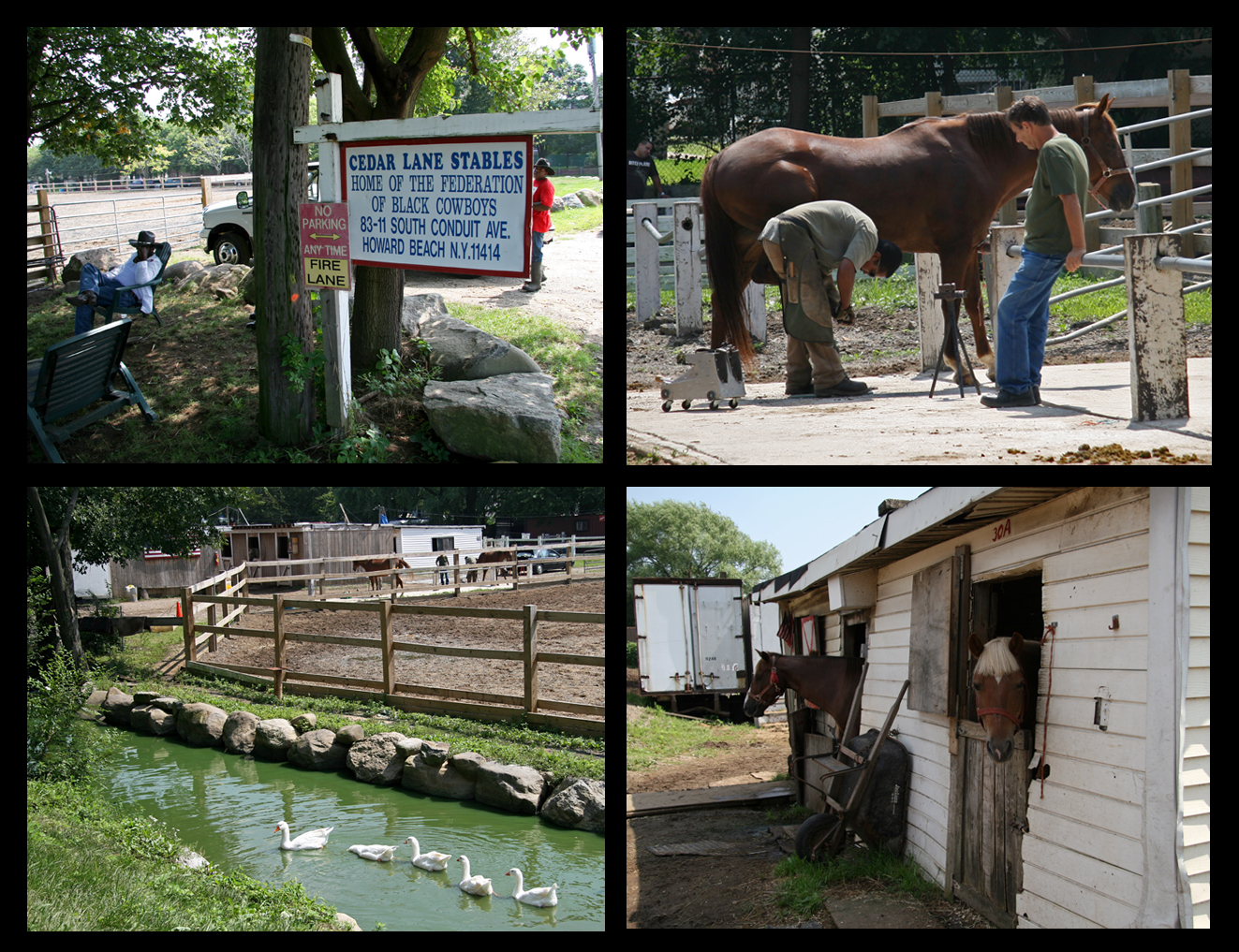
    If you are looking to visit the Federation of Black Cowboys in Howard Beach, Queens, be prepared for some circuitous circumnavigation. Even neighbors showed initial moments of puzzlement when I asked for precise final directions. The street address of 83-11 Conduit Avenue will not help you at all since the facility is on Cedar Lane, with one entrance on Linden Boulevard. (Update: A recent Google map search put the facility at 78-83 South Conduit Avenue.)


    I was quite elated when I finally found the entrance signs; I knew this would not be a typical Sunday afternoon in New York City. And it wasn’t. I was greeted by a handful of men in cowboy gear. Geese were wandering the property and a horse was being shod, while others were busy with various stable duties.

    The Federation of Black Cowboys currently has 34 members and 40 plus horses, stabled on 24 acres leased from the city since 1998. The ranch, Cedar Lane Stables, was part of a larger property, a vegetable farm owned by Herman and John Brockman. From the NYC parks website:

    The Federation of Black Cowboys was formed in 1994 when a group of diverse men came together out of their common love of horses and their desire to share the forgotten legacy of the Black West. African Americans played an immeasurable, yet often forgotten, role in the settling of the American frontier. Many African Americans made the journey west after escaping slavery, while others moved westward in wagon trains after emancipation.

    Many more moved during the exodus of 1879, when many African Americans, convinced that the end of Reconstruction meant the end of their chances for a successful life in the South, relocated to states such as Texas and Oklahoma. By the closing of the American frontier in 1890, there were 500,000 African Americans living in these two states alone. Many of these frontier settlers found employment as cowboys, a position essential to the economies of many western states.

    The non-profit organization, headed by Edward J. Dixon, has a primary goal to expose black children to the art of western horsemanship, the skills required to properly care for a horse, and the historical role of black cowboy in the old West. Read more here (updated 12/9/11). This is done through regular instructional programs, work release programs, prison visitations, parades, lectures, block parties, rodeos, and showdeos 🙂

    Note: I have a relationship with this world beyond photographs and a story. If you are curious about my friends in common, go here and here. My business activities are revealed here and here.


  • Pet Pride Parade

    Money and privilege often lead to indulgence, and what better place than New York City to find businesses, products, and services oriented to those who want to give their pets all the special treats that they and other humans have?

    We have pet cemeteries and mausoleums, a pet bakery in Brooklyn (Buttercup’s Paw-Tisserie), a Parisian boutique for dogs (Zoomies), the Dachshund Octoberfest, pet spas with underwater treadmills, massage, and acupuncture, as well as homemade organic dog food and physical therapy. There’s doga (yoga with dogs) and dog dating.

    Medical treatments know no bounds – the Animal Medical Center of New York City is world-renowned. This veterinary hospital provides routine and emergency medical care for pets and also offers treatment for animals suffering from complicated diseases. The staff, which includes more than 90 veterinarians, utilizes an interdisciplinary team approach and combines expertise in 17 different specialties. The facility is open 24 hours a day, 365 days a year.
    And with all the stresses of the city lifestyle, pets may need psychotherapeutic treatment. No worry, however, because pets are now also getting psychoactive drugs.

    Of course, much of this is not really so much about the comfort of the pets but more often about indulging the neuroses, obsessions, and compulsions of the pet owners themselves. Fortunately, pets are typically happy to oblige.

    In today’s photo, we find our four-footed friend who sported his walking shoes and appeared to be quite content. Some dogs are fitted with shoes owing to their fragile nature and discomfort with cold or rain; others wear them because their owners desire for cleanliness in the home. Sweaters and other apparel are quite common with dogs in the city, where daily walks in all four seasons are necessary.

    We have a Dance Parade, Gay Pride Parade, Lesbian Parade, Easter Parade, Halloween Parade, Mermaid Parade, St. Patrick’s Day Parade, Hispanic Day Parade, Thanksgiving Day Parade, and Spring Madness. May we soon perhaps have a Pet Pride Parade?

    Related Postings: Dog Dating, Dachshund Octoberfest, Easter Parade, Wolfdog, Robin Kovary Run For Small Dogs, Ă  la Chien, Spring Madness, Parasol, Dog Run, Zoomies


  • Tic-Tac-Toe Playing Chickens

    Spoiler: This story has a happy ending.

    The sign in this photo at the Chinatown Fair at 8 Mott Street, is missing a very critical word: Chickens. The sign used to read “World Famous Dancing & Tic-Tac-Toe Chickens.” Since the 1960s, a number of dancing and tic-tac-toe playing chickens have been home here. Chinatown Fair was originally a museum. In Manhattan’s Chinatown (2008) by Daniel Ostrow, there is a 1958 photo showing Chinatown Fair located at 7-9 Mott Street with an amusement arcade. Reference is made to Clarabelle, a scientifically trained chicken. According to the book, she was trained to play tic-tac-toe when Chinatown Fair relocated across the street to 8 Mott Street. The shop evolved to a gaming shop; today it is a popular video gaming arcade.

    According to a story in the New Yorker from 1999, chickens were trained in Hot Springs Arkansas, by Animal Behavior Enterprises, started by Keller and Marian Breland, both psychologists. After Keller’s death, Marian married animal trainer Bob Brailey. Dr. Marian Bailey was one of B. F. Skinner’s earliest graduate students.

    Animal Behavior Enterprises trained chickens to walk tightrope and trained dolphins for Marineland. In the 1970s, the Bailey’s produced a couple hundred “Bird Brain” chickens who, with the assistance of a primitive version of a computer, could play tic-tac-toe without losing. One was installed in Chinatown Fair in 1974.
    There was also a Dancing Chicken, which was a sadder situation – claims have been made that it danced because of electrical shocks to a metal plate on which the chicken stood.

    But the real attraction was the tic-tac-toe playing chicken. For fifty cents, you could match your wits against the chicken. The chicken was housed in a glass cage which taunted, “Can you Beat This Bird?” Backlit letters indicated “Your Turn” or “Bird’s Turn.” If you won, you got a bag of fortune cookies.

    The New York Times ran a story in 1993 about a chicken named Willy when he died in a heat wave after two years of service, replacing a previous chicken that lived to be eight. The owner was uncertain about replacing the bird, but a tic-tac-toe playing hen named Lily did eventually appear.

    In 1998, there was an article in the Poultry Press which tells the story of the release of Lily, the last tic-tac-toe playing chicken. The rescuer, in a plea to owner Mr. Samuel, was able to win Lily’s release on January 29, 1998. After a few days in the rescuer’s apartment, Lily was moved to Massachusetts to live with other rescued animals. Read the story here.

    Chinatown Fair no longer has any dancing or tic-tac-toe playing chickens 🙂


  • Bronx Zoo

    Zoos have gone through numerous incarnations, a mirror of society’s relationships with and views of animals. From the early menageries in Europe, we have moved away from cages and entertainment to habitats and education. There was no hiding from the populace that the conditions in most zoos at one time was deplorable. Eventually, the cages themselves became more difficult to justify. The emphasis today is the conservation message – the graphic for the Wildlife Conservation Society gets equal time with the Bronx Zoo on all of the literature, merchandise, and entrance gates.

    The Bronx Zoo was founded in 1899 as the New York Zoological Park, with 843 animals in 22 exhibits. A group of beautiful Beaux-Arts buildings designed by Heins & LaFarge surround a sea lion pool (seen in the photo) at the main entrance, which also features beautiful gardens. This is the largest zoo in the United States, covering 265 acres with more than 4,000 animals, many of them endangered species.

    The transformation can be seen at locations such as the Lion House, one of the original Beaux-Arts buildings, which no longer houses the big cats. All have been moved to larger areas. Some exhibits, such as the World of Darkness, have closed due to budget cuts.

    Efforts have been made to place animals in as natural an environment as possible. Ultimately, however, the overriding feeling I have in any zoo is still one of exhibits of animals in confined spaces. Some argue that if conservation is the motive, money would be better spent in open wildlife sanctuaries and contributions made towards the animals’ native environments in their home countries.

    At one time, when the Bronx Zoo made the transition to habitats, everything seemed to be so dramatically large and the animals so free. As I have visited the zoos since that time, the habitats feel smaller. I can’t help but compare these environments to the areas which the same animals must inhabit in the wild.

    Many of the inhabitants of the zoo are rescued animals whose fate would likely have been grim had not the zoo adopted them. Endangered species are protected, bred, and some even reintroduced to the wild. And I am sure that the place is staffed with dedicated animal lovers who cannot be expected to argue for their own demise. But when I peer into the eyes of those gorillas, I always wonder how happy they are and what they are thinking…

    Related Posts: Feeding at the Zoo, Rain Forest, Red Panda


  • i’m lovin’ it

    I thought I had a very special photo opportunity when I caught this squirrel enjoying a french fry. Upon reflection, however, it occurred to me that this my observation might not be a particularly unique phenomenon, New York City or otherwise. A little searching turned up other photos on Flickr and videos on YouTube.

    Everything about this city conspires to make it a haven for scavengers. The population density along with the waste so conveniently available makes it a veritable smorgasbord for those creatures who find the city hospitable. It is estimated that there are more rats than people in New York.

    Squirrels are a curious phenomenon. As rodents, they share a family (technically an Order) with rats and mice but are looked at more fondly. They scavenge but yet are still fed, watched, and even doted over. The attraction is understandable; they are not as furtive in their behavior, and they don’t slink through the darkness of subways. And they are arguably much more attractive than other rodents – many would say beautiful. I’m not sure why, but I see many visitors to the city stop and interact with squirrels with a look of extreme fascination. I’m not sure whether it is the relative rarity of squirrels in their home locale or perhaps the emboldened character of a city squirrel and how easily and closely they can be approached.

    I’ve looked over the list of slogans used by McDonalds over the years, beginning in 1961, to see what might be an adequate caption for this photo if the golden arches were to use it for their advertising. How about their 2003 slogan based on Justin Timberlake’s song: “i’m lovin’ it” ?


  • Urban Mitts

    Cats have been known to fall from as high as a 32-story building and survive in a phenomenon known as high-rise syndrome. I can’t say that this is the reason for the broken glass in the photo, but it does afford an opportunity to introduce this concept to this website. I don’t anticipate being at the exact moment in time to photograph an event like this, and I do not intend to post photos of maimed or dead cats.

    Cats love high places. Factor in their curious nature and inevitably, you will end up with cats, as astute and agile as they are, falling from apartment buildings for one reason or another.
    Remarkably, cats do routinely survive enormous drops. One factor is cat righting reflex, an innate ability which allows a cat that has fallen to reorient itself in order to land on its feet. Popular lore has it that cats actually do better from falls of over 6 stories. It has been proposed that this is the case because cats reach terminal velocity after 5 stories and relax and flatten themselves, much like a flying squirrel, thereby minimizing injury.

    One study often cited is from the Animal Medical Center in 1987. There were 132 cases of high-rise syndrome (average height of fall was 5.5 stories) with a 90 percent survival rate.
    However romantically attractive the notion of cats faring better from higher falls is, as Cecil Adams points out in the Straight Dope, the big flaw in all of this is that cats that don’t survive are not reported or brought into a veterinarian’s office or animal hospital. His thinking was confirmed by a conversation with Dr. Michael Garvey – head of the medical department and current expert on “high-rise syndrome” at the Animal Medical Center in New York City. A study from Croatia from 1998 to 2001 confirms that cats falling from greater heights suffered more severe injuries.

    So much for urban mitts 🙂

    A Personal Experience: I once came home to a note on my building that my cat had jumped and been taken to the vet in my absence. I have many birds who frequent my windows, and I had seen him highly animated on numerous occasions – my theory is that my cat was able to force open a window left slightly open to get to the bird, attack, and fly off the A/C unit. He was taken to the Animal Medical Center and he did survive.


  • Warm and Fuzzy

    I have very strong memories of school as a child outside the city – carrying books, walking home, erasers with chalk dust, blackboards, recess, homeroom, the cafeteria, homework, lockers, report cards, being called on, tests, passing notes. As I got older, there was the familiar sight and sounds of children in playgrounds with the familiar chatter and laughing.

    I am sure many children growing up in New York City have many of these experiences, but for those of us without children, the world of children and school is virtually invisible. As I wrote in Mary Celeste, schools and playgrounds do exist, but depending on where one lives and typical daily routines, most will never see them or children at play, and even when you do, there is so much competing for your attention that everything is diluted.

    So when you see a cardboard box being toted through the streets of NYC, you pay little attention. However, when you see that it is being carried by a mother and her young daughter, you take notice. And when it is quiet at night and you hear faint squeaking coming from the box, you run after them because – could this be the sound of live animals?
    Yes it was. I found a mom and her girl with a box of young chicks – I was told that it was part of a school project.

    They were quite happy and eager to share their little bundles of joy and offered to let me handle one chick (and grab a couple of quick photos with my point and shoot). I believe this is the first time I have actually picked a baby chick up – ironically, on the streets of Manhattan. I’m glad I stopped them. It was a warm and fuzzy experience and a nice way to end the day – a bit of fur now and then is cherished by the wisest men 🙂

    Note: In May 2008, I welcomed an entire school class on a field trip to my business. It was quite an outing – see Little Burnt Out here.
    There are a number of other posts on children here: Mary Celeste and Heart Warming.


  • Attention

    Posted on by Brian Dubé

    “Oh, have I got your attention now? Good.” This line, spoken by Alec Baldwin in his famous sizzling speech in the award-winning film Glengarry Glen Ross, would be appropriate for our friend in the photo, could he only speak. But having a large, inflated rat sitting in front of your business or building will certainly get your and the public’s attention, so no worry that this rat is mute.

    These rats have been seen on New York City streets since 1997. Local 79 of the Construction and General Building Laborers claims to have been the first to introduce the rat to New York City in 1997. They are not unique to the city, but we are the largest consumers and users of the rat invented by Big Sky Balloons and Searchlights of Plainfield, Illinois. At any given time, a number of the union rats are deployed around town to deliver a message about employers whose business practices have bestowed upon them the honor of induction into the family of rats.

    In 1990, Don Newton, an organizer for a Chicago bricklayers union, went to Big Sky looking for a more effective way to to get the attention of nonunion employers. Owner Mike O’Connor proposed the idea of creating a large inflatable rat, and “Scabby the Rat” was born. Big Sky has since produced hundreds of rats used throughout the country, along with hundreds of other inflatables such as the “Greedy Pig,” the “Corporate Fat Cat,” skunks, bulldogs, and cockroaches.

    Some victims have retaliated, such as a larger cat looming over a rat by Radio City in 2005 or the anti-union dinosaur which was placed in front of the AFL-CIO’s headquarters in Washington, D.C. in 2006 by the Center for Union Facts to symbolize their belief that unions were outmoded and would become extinct.
    The numerous articles regarding these rats show the price range escalating – now ranging to nearly $10,000 for the biggest rat. I suppose everything is subject to inflation 🙂

    Film Note: Glengarry Glen Ross – Highly recommended drama, screenplay adaptation from a play of the same name by David Mamet. It will forever change your view of sales. Warning – strong language.

    Posted on by Brian Dubé

  • Bovine Love

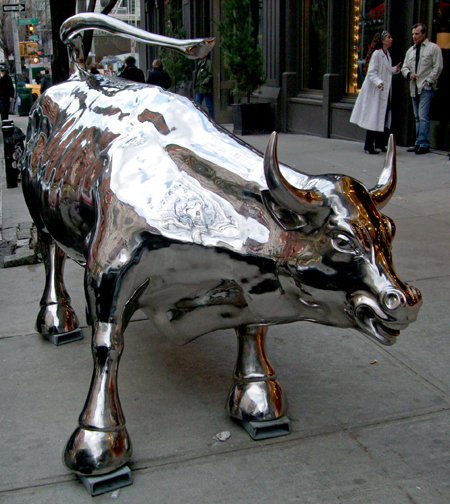
    Generally speaking, you do not walk down a familiar street and expect to be greeted by a newly installed massive steel bull. This fellow was in front of Cipriani’s in SoHo on West Broadway, discovered after an expedition to the Peter Lik gallery just up the street.

    Speaking to a waiter at the restaurant, I was informed that this was the work of Arturo Di Modica and that it just mysteriously appeared on the sidewalk with no explanation.

    Di Modica is best known for his charging bull in the financial district. That bull was originally installed after the 1987 stock market crash. It was placed in front of the New York Stock Exchange by the artist on December 15, 1989 without permission as a Christmas gift to the city. It was seized by the police but, due to public furor, was reinstalled downtown in the plaza at Bowling Green. The bull is extremely popular as a photo subject, often with visitors on, besides, or grasping the bull in some manner.

    There seems to be a fascination with the bovine family. In 2000, the streets of New York City were graced with cows as part of an international public art exhibit. This is an interesting choice of animal, since I have not thought of cows as being seen as particularly charming or attractive. The concept for the Cow Parade originated in Switzerland with art director Walter Knapp and sculptor Pascal Knapp, who holds the copyrights to the various cow shapes seen in the exhibits. Perhaps the Swiss connection provides some explanation of the choice of cows as animal subject.

    When confronted with the Di Modica sculpture on West Broadway, I, like many others, was seized with the inexplicable desire to embrace a bull and be photographed by a friend. There’s just something about a bull that makes you want to hug him, especially when he is frozen in time and unable to charge 🙂


  • Land Sharks

    Fire Island has very few amenities and no cars – it is loved for this very reason. A quiet refuge with red wagons and walkers, it is one of the most remarkable environments considering its proximity to New York City. Typically, the very few bars and restaurants that do exist in some communities are quite poor, catering to a captive audience. But invariably, a combination of boredom and curiosity does set in, and a visit to the local watering hole at least once is inevitable.

    While weekending there many years ago, a friend returned from the only bar in town. When asked about the nature of his adventure and the type of people he found, he replied, “Land sharks, nothing but land sharks.” By land sharks, he meant men who had no purpose other than a very focused and singular mission to score with women. Perhaps we found it repugnant because there was not even the artifice of a mating ritual at a bar at that time. Or perhaps we were just jealous that we did not have the chutzpah to join the mix and endure the slings and arrows of female rejection.

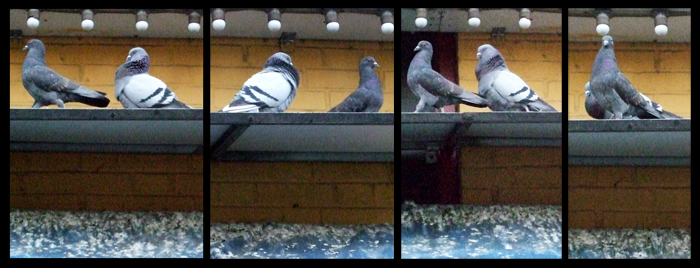
    The nice thing about being a pigeon is that courtship rituals are so well scripted. There is no anxiety, trepidation, or self consciousness in their application. Best of all there appears to be no stigma or concern with rejection.

    The recently vacated Mexican restaurant, Senor Swanky in Greenwich Village at Bleecker and Laguardia, was a place that proclaimed itself as a “celebrity hangout” on its signs, a source of hilarity for a number of us neighborhood residents. It has been closed since July 2008, and its awnings and ledges have become a very busy pigeon roost, with droppings everywhere. In observing this appropriately consecrated place (the restaurant was dreadful, from what I have read), I observed the mating ritual of two pigeons in a very linear style, confined as they were to the edge of the canopy. Left to right, right to left, left to right. Persistence is part of the game.

    The mating rituals of the feral pigeon (Columba Livia – Rock Pigeon or Rock Dove) are, of course, well documented with behaviors such as bowing, tailing, driving, and cooing. But we may never know whether some males, unsuccessful in their courting efforts, will return to some of their brethren and, when asked about the doves at Senor Swanky’s, will respond in defense, “Land sharks, nothing but land sharks.” 🙂


  • Ambassadors

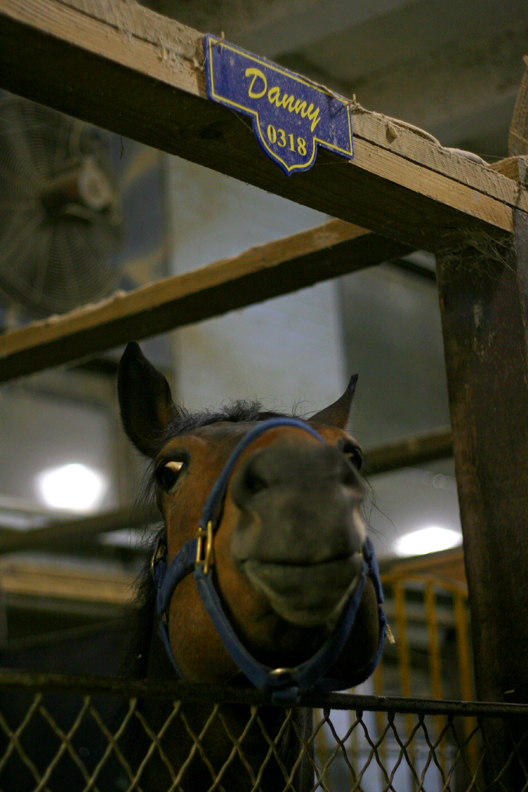
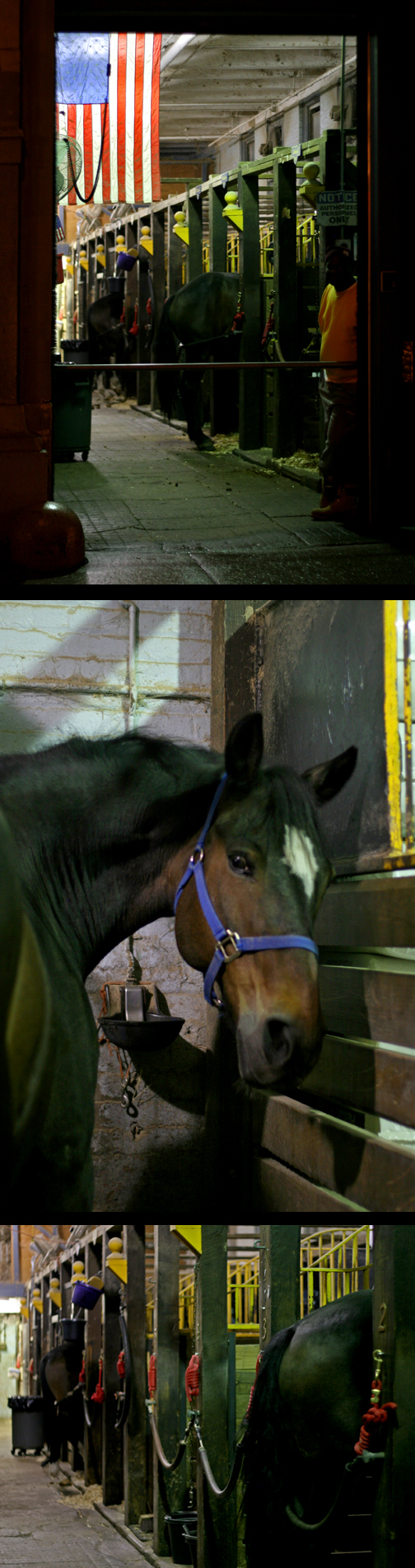
    It occurred to me on Sunday evening that the mounted police horse stables would make a great photo subject. The horse stables are very few, little known, and rarely visited. However in a post 9/11 world, regardless of how benign a person’s intentions might be and how unlikely a target for terrorism a place is, it is always reasonable to expect a “no photography” reception.
    So I went out into the foggy, drizzly night hoping for the best but expecting the worst. I was quite happy to find the stable entrance open to the street and immediately began taking photos – a preemptive strike is the best policy when in doubt about photo policies. The horses could be seen in their stables in the dim lighting with a large American flag hanging from aloft (see more photos here).

    The real surprise was when the stable keeper, upon seeing my interest, immediately waved me and my companion in. We learned that our gracious host, Daniel Allen, hailed from Panama and has been working with horses since he was a child. He was a race horse jockey in Panama (having won three races) and has worked various race tracks such as New York City’s Aqueduct.

    Sixteen horses are stabled here in quarters which abut the First Police Precinct at 16 Ericsson Place at Varick Street in lower Manhattan . To visit a place like this is decidedly an earthy experience, surrounded by hay, wood chips, and mice skittering about. And, of course, the horses – an animal which is extremely sensitive but whose size always commands immediate respect.

    There are stables in 4 of New York City’s boroughs: Coney Island in Brooklyn, Pelham Bay Park in the Bronx, Fresh Meadows in Queens, and a new facility at Pier 76 on Manhattan’s West Side. In total, there are 112 mounted police officers with approximately 80 horses. You can learn more about them and their training here.

    Many nonresidents of the city are surprised at the use of mounted police in an urban environment like New York City. However, a mounted officer has unique abilities. Police commissioner Raymond Kelly says, “Their impressive visibility make our mounted police officers and their horses great crime fighters and outstanding ambassadors to the public.”

    Related Posting: Horse Sense


  • Bygones be Bygones

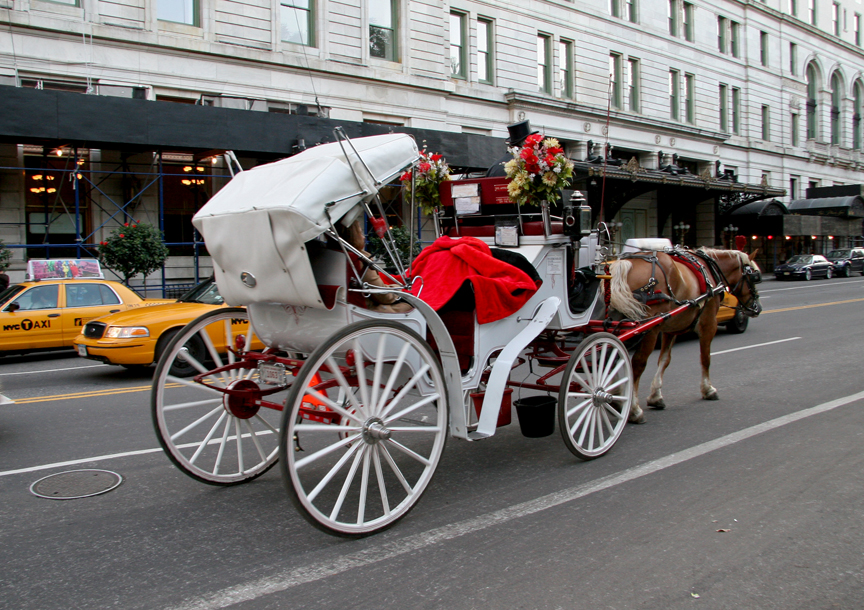
    Horse-drawn carriages in Manhattan have been the center of controversy as of late. The COALITION TO BAN HORSE-DRAWN CARRIAGES has spearheaded a campaign to put an end to what they and many others consider an outdated concept that no longer is appropriate. From the Coalition’s website:

    “Carriage horses are out of place in midtown’s congested streets and belong to another century when there were far fewer vehicles and pedestrians. When hansom cabs are mixed with cars, taxis, buses, pedestrians, bikes and emergency vehicles – fire trucks, ambulances and police cars – they are a recipe for disaster.”

    Business is involved here, and where there’s money at stake, there’s bound to be bitter conflict. The carriage industry and owners paint a different picture, stating that the the animals are well cared for, have a long life, and are happy. Investigations have shown conflicting reports. An audit by the City Comptroller in 2007, however, did show some horses being maintained in substandard conditions. The fate of the 68 licensed carriages in the city is still in limbo. Mayor Bloomberg defends the industry and the continuation of the carriages. Some have proposed a stabling area inside the park, which seems like it would be a good compromise.

    The romance of the past is a powerful force, and of course, visitors love the idea of a horse-drawn carriage ride through Central Park. This is one of those New York City signature activities that many feel compelled to do at least once in their life. But unfortunately, history and romance, no matter how compelling, do not alone justify the continuation of a practice. The circumstances and standards of a society change, and I think we all like to believe that our consideration of other humans and animals improves over time. In the final analysis, we may have to let bygones be bygones…


  • Back to Boyhood

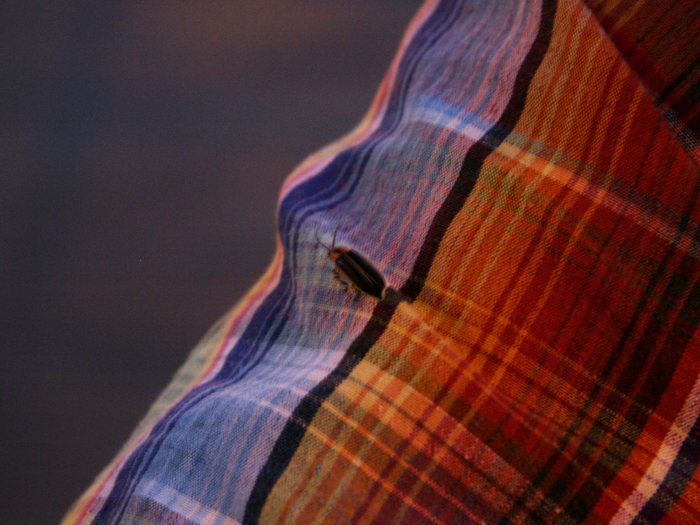
    There are a few things that, to me, that really epitomize the countryside on a summer evening. And two of them are fireflies and cicadas. And, yes, you can find these in the parks of New York City. This one was photographed on the arm of a friend in Washington Square Park. Many nights this month, we were witness to a wonderful light show. I attempted unsuccessfully to capture one glowing. I was reassured, however, by my photographer friend Bill Shatto, who is an expert at insect photography, that capturing this was not an easy feat . You can see his work here on his flickr site.

    There are many fascinating facts about fireflies, such as the light efficiency of bio luminescence – 90% of the energy used is actually converted to light (as contrasted with an incandescent bulb, which is only 10% efficient). The production of light is primarily a tool for mating – males exhibit courting behavior in the form of flashing patterns while flying. Females generally do not fly but respond with flashes. You can read more about them here.

    I like the gentle flashing of fireflies – it is so emblematic of a warm summer’s eve. I immediately enter into a comfort zone, transported back to my boyhood in New England…


  • Peregrine Falcons

    On an excursion downtown, I ran across this sign proclaiming the reemergence of the peregrine falcon in NYC. Until the middle of the 20th century, peregrines ranged from Alaska to Georgia. But in the 1950s and ‘60s, the pesticide DDT found its way up the food chain. The birds that peregrines hunted fed on insects contaminated with DDT. Due to biomagnification, DDT accumulated in the peregrines, causing their eggs to become too weak to even support the weight of the mother incubating her eggs. The eggs shattered before fledglings could hatch. By the time DDT was finally banned in 1972, there was not a single peregrine falcon left east of the Mississippi. The reemergence of the peregrine is considered an environmental success story.

    I became interested in birds of prey in NYC several years ago, when, like many other New Yorkers, I learned of the red-tailed hawk Pale Male (and his family), who had nested on a prime building on Fifth Avenue. I made frequent trips to the Boat Basin area of Central Park to spend afternoons, along with many others, watching the antics of the Pale Male. But problems ensued, and the situation became a huge international story for the city. If you missed it, click here for links and a posting with a photo of my own sighting of a red-tailed hawk at my bedroom window, a real lucky photo op which got quite a response from birders and local residents.

    I was surprised to find this tiny patch of green (in the photo) at the entrance to the Brooklyn Bridge and learn that it was a prime spot for sighting falcons. I also was not aware that this is a Greenstreet property, part of a huge $391 million, ten-year initiative to plant street trees in all possible locations, creating 800 new Greenstreets, and reforesting 2,000 acres of parkland. The initiative is part of PlaNYC, “a blueprint for New York City to attain sustainable growth and improve the quality of life in the face of escalating population projections. The Mayor’s plan—shaped by input from environmental, business, community, and legislative leaders as well as thousands of New Yorkers—details 127 initiatives within five key areas of the city’s environment: land, air, water, energy, and transportation. Components of the plan include increasing access to open space, cleaning up contaminated lands, improving water quality through natural solutions, achieving the cleanest air quality of any big city in America, and reducing global warming emissions by 30%.” It sounds great. Let’s hope it’s not just hot air 🙂


  • Bird Country

    Regular readers of this site are aware of the spots of country I have featured, particularly the numerous community gardens. I, like many other New Yorkers, look for pieces and reminders of the country for any number of reasons, and evidence of seasonal change is one of them.

    It is easy to go through seasons in the city with little to mark them except temperature and changing light. But to witness the other changes nature has to offer – leaves turning color, migratory birds, etc. – requires more work and looking in special places such as gardens and parks.

    In seeking out the natural in the city, one frequently discovers surprises like grapes growing on vines in the center of the Village, red-tailed hawks eating their prey, butterflies, waterfalls, spectacular sunsets (such as Manhattanhenge), a Time Landscape, a microclimate in the Garden at Saint Lukes, turtles, squirrels, and birds.

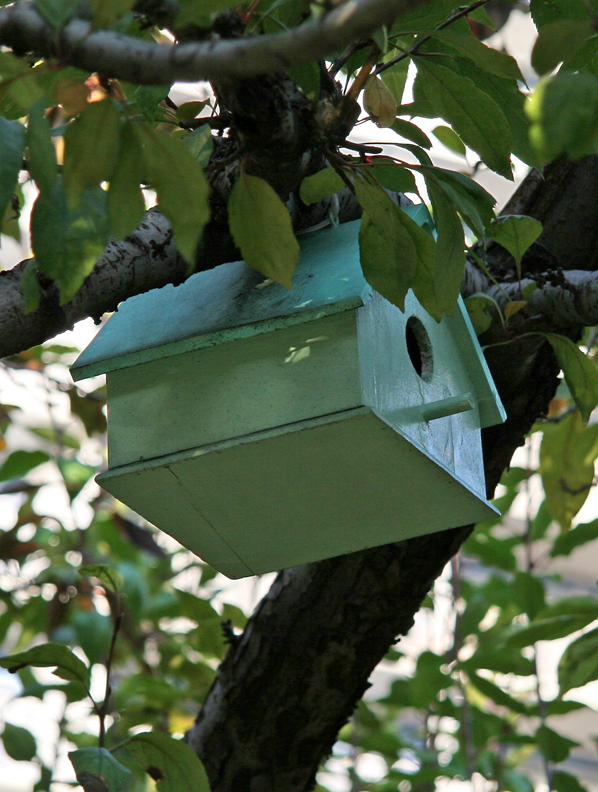
    New York City is actually one of the most important bird areas on the East Coast. It lies along the Atlantic Flyway and draws numerous species from places as far away as Patagonia and Greenland each spring and fall, which is why Central Park is a great area for bird watching. This birdhouse was in the LaGuardia Corner Gardens in a tree laden with apples (I have picked many here when it is open). I can see a new city festival – New York Is Bird Country


  • dinamic_sidebar 4 none

©2026 New York Daily Photo Entries (RSS) and Comments (RSS)  Raindrops Theme