• Category Archives Stores
  • At the Door

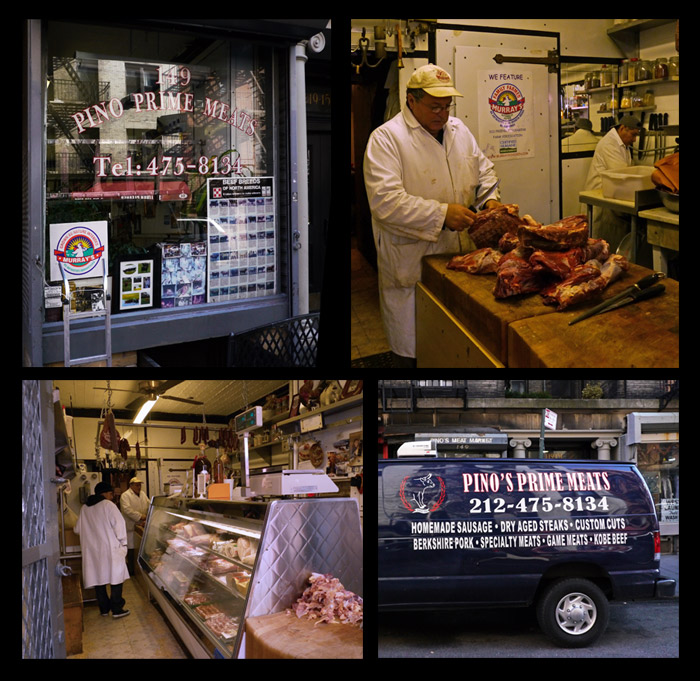
    Being a butcher has little allure, and today, like most jobs that involve physical labor, there is no appeal for the young, restless, and upwardly mobile. At one time, butcher shops dotted the city, but now, a shop like Pino’s Prime Meat is rare and noteworthy, the subject of articles that bemoan their loss and extol the pluses of getting one’s meats from a skilled, multi-generational specialist, like Pino Cinquemani of Pino’s Meat Market.

    Supermarkets, case-ready meats, the increasing costs of retailing in New York City, and the glamourlessness of the job have all conspired to make the old-fashioned butcher shop a rare commodity. To visit a place like Pino’s is truly an opportunity to step in the past and experience old New York. The shop, located in an Italian area of the South Village, has been in existence since 1904, taken over by Pino in 1990. From an article in Food and Wine Magazine:

    Pino has been carving up sheep, pigs and cattle since he was a teenager in the Sicilian town of Castrofilippo, and you might say that meat is in his blood. When I asked him about his family, this was his answer: “My grandfather was a butcher. My father was a butcher. My brothers are butchers. My brother-in-law. My sister-in-law. My nephew and my other nephew—butchers. My son is a butcher.”

    I had passed by this shop for decades, but, not being a meat eater, I had neither stepped in the door nor met the owner. I recently made a visit, photographing and filming my encounter and recording our conversation. Pino was quite cordial and accommodating. We discussed Italy, my travels there and love of small Italian hill villages, and his home in Sicily:

    I am no judge of meat quality, cuts, or the skill of butchers, but everything I have read about Pino indicates that he is the ne plus ultra in his business. This is old school, where the skill of the trained artisan triumphs over the mass merchants. Here at Pino’s, genuine, authentic European tradition lives on in a small shop in SoHo, encroached by a wave of high-end merchants that have essentially engulfed the entire area, if not the entire borough of Manhattan.

    I have a number of close friends and acquaintances who are vegetarian, as I was for 30 years (I now eat fish). Decisions whether to eat meat or not are highly contentious, and I have stopped debating such subjects long ago. Here, at Pino’s, to understand and appreciate the man and his family tradition, it is perhaps best to leave dietary preferences At the Door 🙂

    Related Posts: Pork and Power, Mystery Meat, Shrine to Beef, Fisherman’s Widow

  • Foolish World of the Fiscally Frivolous

    There is nothing more irritating for some men than the occasion when they feel the need to buy their girlfriends flowers. This obligatory event may be a minuscule effort yet looms larger than anything conceivable. And then there is the terror of Valentine’s Day, where a last-minute purchase in New York City is tantamount to lunacy.

    Adding insult to injury is the perception of wastefulness – buying something whimsically that is decorative and perishable is antithetical to the nature of the practical man. Flowers are a waning asset, so why invest?

    However, having established that everything should not always be reduced to the Very Practical and that whether wasteful or not, there is reason on occasion to the cry, Let’s Have a Parade, the prudent man sees the merit of the flower, the message it will send, and the profound effect it will have on his better half.

    Ironically, the very nature of a gift of flowers being fiscally frivolous is one of the keys to their appeal. Symbols of life and beauty, flowers make a woman feel special and beautiful, particularly when done spontaneously and not for any special occasion.

    In New York City, flowers can feel out of character in a world of steel and concrete that is fast-paced and where utility often rules. After all, the streets of New York do not evoke images of the Monet’s Gardens at Giverny, Boboli Gardens of Florence, or the gardens of Versailles. However, not to be outdone, New York City does have its own spectacular displays and like many good things here, they just have to be sought out. The Brooklyn Botanic Garden (see here and here) and the Conservatory Garden are worthwhile visits for anyone who favors nature’s floral extravagance. There are numerous other smaller and lesser known gardens, such as St. Lukes, which, for those in the know, provide respite from the city.

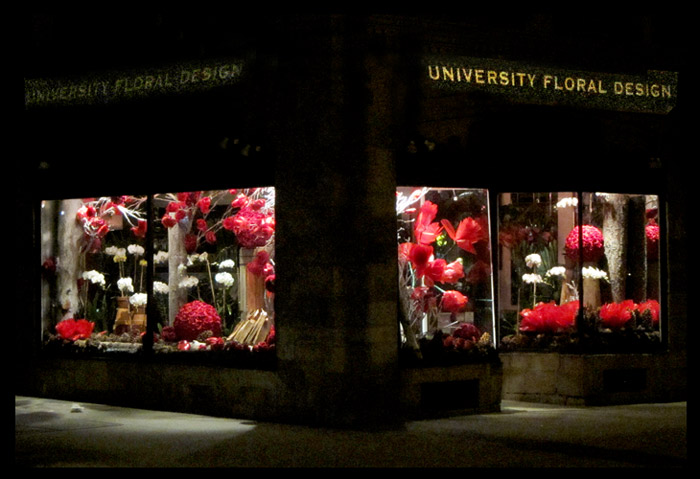
    There are also numerous flower shops throughout the city. University Floral Design, a Village landmark and neighborhood icon, is family owned and operated since 1928 with daily delivery of fresh Dutch flowers. It’s not that long a walk or that big an effort to go through the doors of a flower shop like that at 51 University Place and enter a world guaranteed to soften even those who see it as the Foolish World of the Fiscally Frivolous 🙂

    Related Posts: Joe Plourde, La Vie En Rose


  • A Sharp Focus

    I once was expressing my interest in traveling to Singapore to a friend, born in Taiwan and knowledgable regarding Asia. It seemed to be a beautiful destination – both tropical and pristine. However, said friend said that she would never go to any country that did not have an art museum (there is at least one art museum now). This reminded me of conversations in my early days in New York City – an echo of the sentiment against the well-manicured lawn and gentrification.

    Puzzling, because I have always liked a beautiful lawn, as well as bonsai, topiary, and clean and tidy places. And conversations in my youth about gentrification also left me perplexed – I would always be pondering, what is wrong with an improved neighborhood?

    Appreciation and patronization of very unique businesses that could only survive where rents were low began to give me a clue as to why people would vehemently object to gentrification. But it would be many decades and the loss of some of my favorite iconic businesses, such as Vesuvio’s Bakery, before I would finally understand how the march of “progress” would typically mean the loss of not only the bad old things but also the good old things. Gentrification also means increased cost of housing, leaving neighborhoods all but unaffordable to virtually everyone except the super affluent. Soon, neighborhoods defined by ethnicity and their culture become defined by economics.

    I began to see that clean and tidy in Manhattan usually came with sanitization, conformity, upscale tenants, and the closing of the small independent merchant in a niche market, unable to afford rising rents. So I have run to see the last of these best of breed. A number of the places I have written about in the last six years have already disappeared – Space Surplus Metals, Vesuvio, National Wholesale Liquidators, Ray’s Pizza, etc. Others on my to-do list have closed before I had an opportunity to visit for photos and a story, such as Grand Machinery Exchange.

    A handful of special, unique businesses still survive, many of which I have written: Joe’s Dairy, Raffetto’s, Schoen Trimming and Cord, Jim Murnak, Alidoro, il Laboratorio del Gelato, Cones, Faerman Cash Register, the Music Inn, and Matt Umanov Guitars.

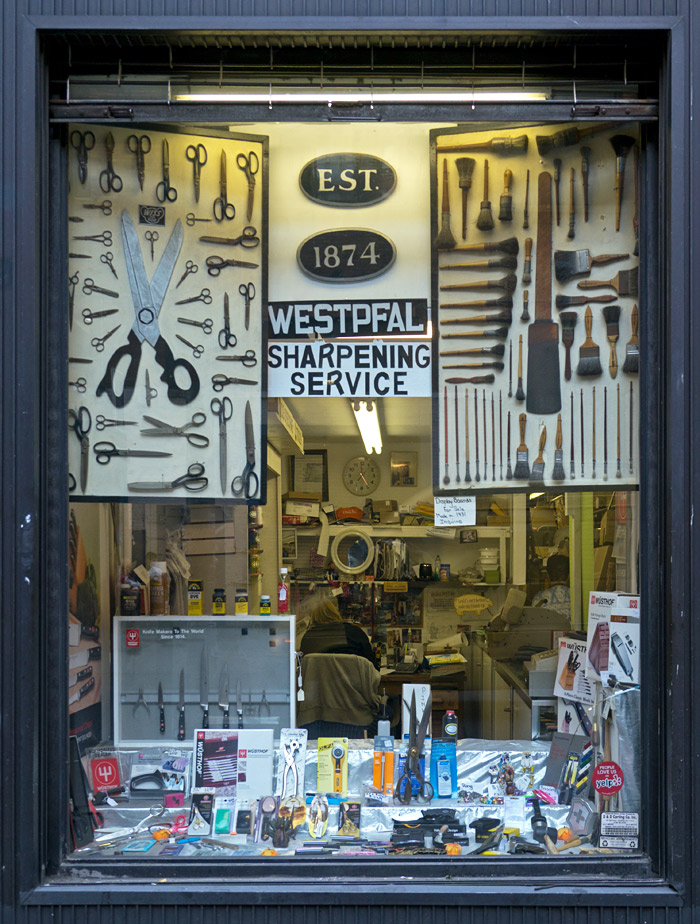
    I try to keep a keen eye out for those which I have not written about before it is too late, some renowned in their niche, such as Henry Westpfal & Company. Westpfal is located in the garment district at 115 West 25th Street. With a decor hearkening back to the 1950s, the place typifies the best of Olde New York where content is king. They have been in business since 1874 and have been managed by Cam Weinmann for the last 50 years. It is considered one of the best places (and few remaining) in New York City where virtually anything that has a blade can be sharpened – scissors, knives, straight-edge razors, and other tools. According to Cam Weinmann, “If you can’t cut a tomato, you know your knife needs sharpening.” At Henry Westpfal, for 137 years, the secret to small business success has been a sharp focus 🙂


  • For No Good Reason

    Service in New York City retail is a VERY uneven experience. Many single-location privately owned operations which are legendary have an attitude regarding customer service bordering on the arrogant. I have seen salesman curse customers for no good reason. And yet I have seen the same salesman as sweet as sugar. The reason? It often depends on how you approach the sales staff – your attitude, knowledge, and other factors. Retail sales can admittedly be very trying, however, a customer should not have to walk on eggshells or ingratiate or prostrate himself to assure good service. It should not be that way, but welcome to New York.

    The large, high-profile retailers or chains are much less inclined to risk reputation than a mom-and-pop operation working with a captive audience in a specialty. When a store attains iconic status in New York City, arrogance may often become a component of service. The differences become strictly a case of management style.

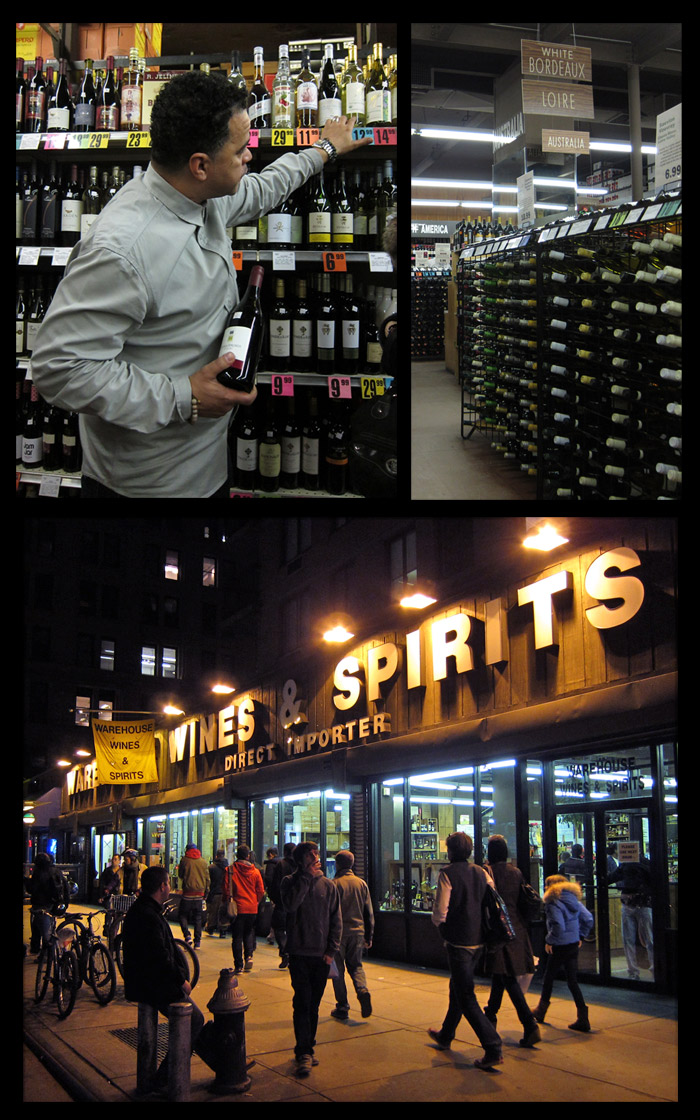
    If you read reviews of places like Warehouse Wines & Spirits at 735 Broadway, you will find a virtually inexplicably broad spectrum of reviews and customer experience, from one to five stars. Not unusual for a place like this, known for its very competitive pricing, often the lowest in town.
    What brought me to Warehouse recently was a very specific mission. A friend was desirous of exploring wine, however, their previous experience with headaches made them apprehensive. The subject of red wine headaches is debated. Many naturally occurring substances have been blamed – sulfites, tannins, histamines, and prostaglandins. Rather than wade through the literature, I decided that finding a wine salesperson with real customer experience regarding wine and headaches would be a simpler, more effective solution.

    As I entered Warehouse Wines, I approached and asked the first salesperson visible who might be the resident wine expert. He responded, “that would probably be me.” I told him of my mission, asking of his experience, if any, with wine headaches (sometimes referred to as red wine headaches, owing to the feeling that red wine is more problematic than whites). He made immediate suggestions and accompanied us to an area with a number of wine which, from his personal experience, were successful with his customers who previously had wine headaches. Although added sulfites have been implicated by some and dismissed by others, we chose an organic white.

    I was impressed by his knowledge and asked about his wine background. He introduced himself as Dennis Johnson and told me that he had worked 22 years as cellarmaster at the Windows of the World restaurant.*

    I was elated at my shopping experience at Warehouse Wine with Dennis. It is ironic that in New York City, I have become so inured to the unpredictable nature of customer service that I often feel that great service comes for No Good Reason 🙂

    *Windows on the World was a restaurant on the top floor of the North Tower of the World Trade Center.

    Related Posts: Trimmings for Sale, Instincts, We Don’t Do Windows, No Students After 1, Pick Two


  • Trimmings for Sale


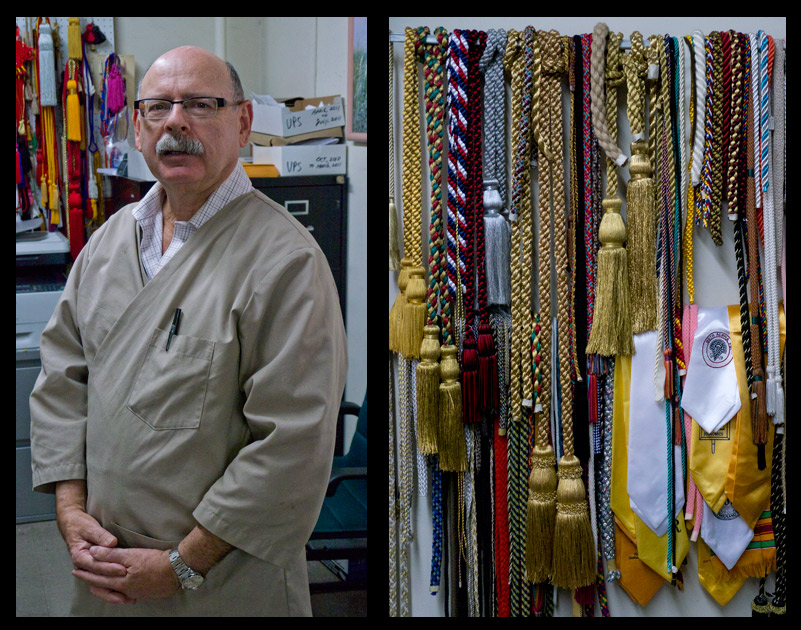
    I was appropriately reprimanded. Marty Silver asked why was I working with a supplier in Georgia when he was the largest tassel manufacturer in the world and was located within walking distance? I had no answer except that I had not done my homework properly. Schoen Trimming and Cord manufactures tassels and cords right in Manhattan at 151 West 25th Street.

    There is no phone tree, messaging systems, extensions, or phone tag at Schoen. On my first call, I was told I needed to speak to the owner, Marty Silver, who immediately picked up the phone. A proud New Yorker and native Brooklynite, he proceeded to tell me about the company and his recent job with Victoria’s Secret, who opted for a local source over China. The order of nearly $100,000 was for over 20,000 pieces and was completed in just a few weeks. I described my own project needs, and he suggested I just drop by. He said that he was open at 7AM, so when was I coming in? Tomorrow morning, I answered.

    It was clear from the brief phone conversation that Schoen was a no-nonsense operation run by a man who gets things done. No meetings, no memos, no marketing plans, no grandiose schemes, no Twitter feeds. A rarity these days, and a perpetual frustration for me in business to ferret out these kinds of operations. Schoen services a niche market, and they address the needs of their customers with the essential ingredients: good quality, service, delivery, and pricing. This is why they have been in business for 72 years.

    When I arrived, Marty was tied up briefly, working with his accountant. He appeared somewhat irritated that this aspect of his business was taking him away from overseeing his production work and meeting with me. We went over my project quickly, and he said he would get back to me.
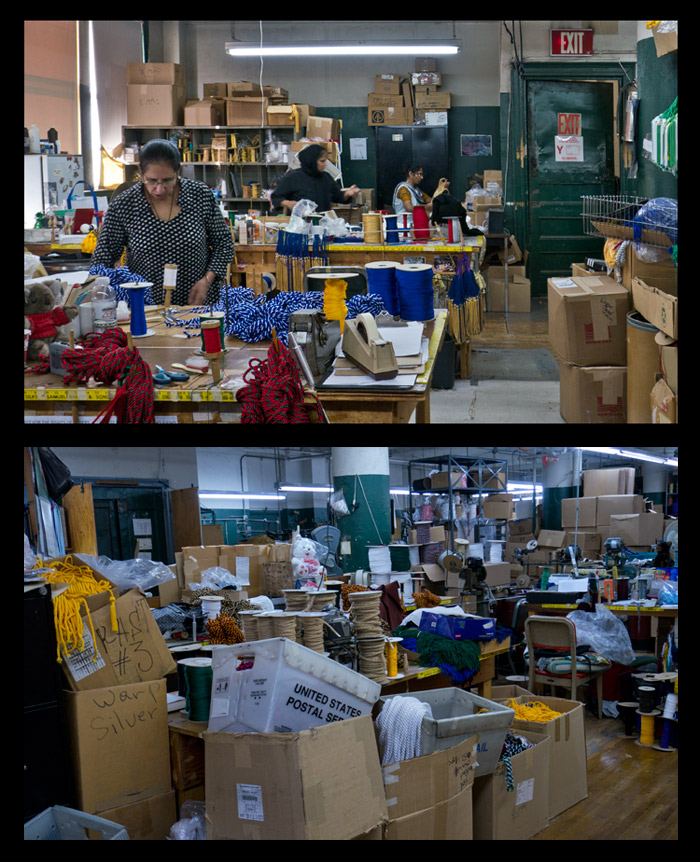
    I was surprised when, only hours later, he called my office to tell me that he had completed some prototypes for me – when did I want to pick them up and discuss them?  Tomorrow morning, I answered. I visited Schoen again, went over my samples, and toured the factory. Marty was quite accommodating regarding my request to take photos. Nothing to hide. I like that. And so it was that in less than 24 hours, Marty Silver did what the factory in Georgia has yet to do in two months.

    I have encountered business owners like Marty in the last 37 years. This breed of men and women are the ones that have been the captains of industry and have stewarded our city to become the world leader that it is in so many arenas. Some are left and, here and there, the spirit lives on. New York City is as hard-edged as it comes, and if you are going to survive 72 years in business, you’re going to need exceptional tenacity, resourcefulness, drive, and the ability to stay focused on the bottom line.

    Schoen typifies the classic old world New York City-style manufacturer or commercial/industrial supplier. They are lean machines, bare bones, and stripped of artifice and excess at every level. The only decorative elements you will find are Trimmings for Sale 🙂

    Related Posts: It’s Perfect, Brawling Over Brands, Because I’m the Best


  • Pretty Rad, Part 2

    A Slice of Charles Knapp (see Part 1 here)

    In Part 1 of Fairway to Heaven, I found myself unexpectedly immersed in a food emporium, the likes of which I had never seen. I traveled there with a friend who you will meet in Part 3 of this adventure in Red Hook, Brooklyn. However, the plot thickened, or perhaps I should say curdled.

    I have written a number of stories with the theme Abandon All Preconceived Notions Ye Who Enter Here. However, looking back, it is fair to say that all of the people I have featured could easily fit under this umbrella. In New York City, more than any place I can imagine, you cannot define or judge a person by color, creed, occupation, lack of occupation, appearance, hygiene, education, or any other outward signs – even those things which a reasonable person may use to reasonably judge someone unfamiliar. This city is a salad bowl of ethnicities, types, and kinds. It’s a magnet for luminaries, geniuses, eccentrics, misfits, artists, and every other imaginable variant on the human condition. But the overlying theme is the number of remarkable individuals hidden behind an unassuming or unprepossessing exterior.

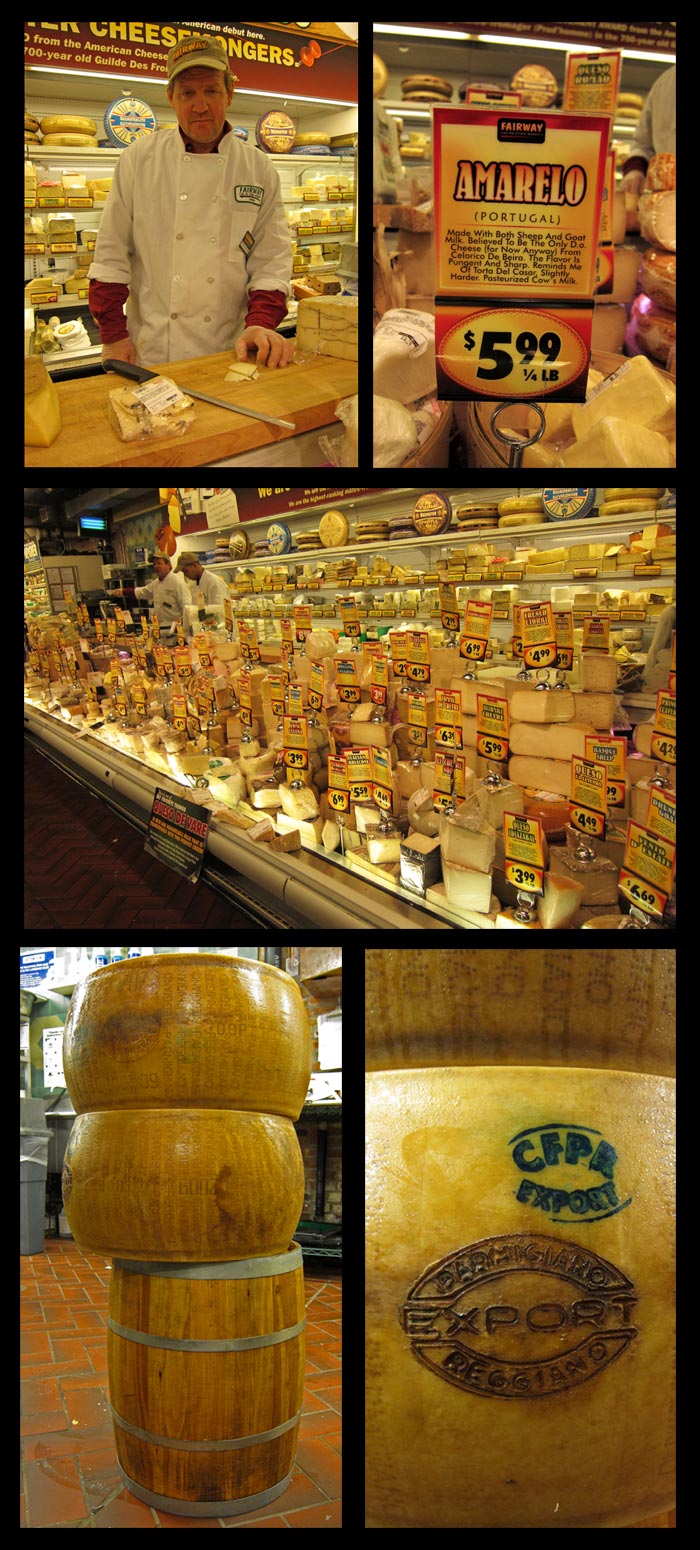
    As we explored the aisles of Fairway, we approached the cheese department. I love cheese but do not keep it in the house, lest I lose control and consume too much. My eye was drawn to two wheels of cheese stacked on a wooden barrel. My interest was immediately spotted by a man behind the counter who told me of the special nature of this authentic Parmigiano Reggiano.

    No sooner did I show interest in a cheese that I was offered a taste. Soon it became a cheese tasting extravaganza with no holds barred. My first and favorite for the night was Amarelo – a strong but extraordinary tasting cheese from Portugal, made with both sheep and goat milk. As conversation ensued, it became abundantly clear that this was not just an ordinary salesperson but also someone who had a passion for cheese and a depth of knowledge. I also knew that this man, who introduced himself as Charles Knapp, would be the subject of a story for this website. Charles gave me a postcard with the details of a wine and cheese tasting that he conducts periodically at botto di vino in Red Hook, Brooklyn (see details here).

    As I was leaving, I asked for his full name and contact information. He informed me that he also had a cheese blog which I perused this morning, along with a number of other blogs he authors.*
    Charles has had a fascinating life and is far from what one might expect from a counter salesman in Fairway. Born as a Catholic, Charles studied atheism and shamanism in college, then became an SGI Buddhist. His father was in the Air Force, so Charles moved a lot as a child.  Here are some ruminations from his website:

    Food Trip
    Born in San Antonio, Texas. Raised in Europe. Love food Mexican Food only in Texas and California. Ate a lot. Parents had to hold me back. Was a husky kid always.Making lunch for school. Traveling to Holland. France, Italy,Spain. Ate diff foods olives,olive oils, meats, bread, wine, beer, and spirits. Always liked sweets. Candy gum cake. chocolate. Hot oatmeal. Strawberry picking, Elmers food and steak house. SOSC Cafeteria. Mom was a great cook. In Europe brotchen bread bratwurst. In spain, Bread and olives, cheese, wine and olive oils. Not only the food, culture and history for the region. It continues. I want to take Ben carlos. Own Business in Catering. Gouda in Holland. manchego in Spain. Quantro for dessert. Flowers and food. We have been on the go for the first 15 years of my life. learned German in first grade. Spain Rain on the plane to Majorca. The italians where so wonderful. Very giving about everything. They wanted top show off their food and history and culture all the time. Naples was wonderful Roma did we see the churches. After awhile it became dull. Humor and sarcasm were always around. Munich oktoberfest. garmische partenkirchen. The Sound of Music was our family we danced, learned a lot and ate a lot and drank a lot throughout chiildhood. Potsdam. Checkpoint Charlie. Our history together. resentments. Golden Child. Ms Griffith. 3rd grade Wizard of Oz. Tam class president. I supported her a lot. I was the class clown and the mischievous one.1975 we cam home to Oregon. Strange time. Came out of the cocoon of military life. Life is some cocoons. go in and out.

    And there you have a Slice of Charles Knapp 🙂

    Note: If you want to be even more astounded with Charles’s transparency and the candid exposure of his rich life, follow the links for his various blogs – 21, manspace, spiritworld2011, and snazzysales2011.


  • Pretty Rad, Part 1

    Fairway to Heaven

    Don’t you love a bargain, a deal? A two for one sale? How about three for one? Please come with me on an adventure in three parts and see why New York City is everything you were told it would be, and more.

    I do have a tendency to get very excited and animated by things that may perhaps be seen as ordinary, boring, or just “interesting.” And it is true that once unleashed, my unbridled enthusiasm often embellishes – things such as chewing gum on the sidewalk, etched windows on the subway. or a place where one may find nothing. But, nonetheless, I cannot conceive of another place where one can find the plethora of absolutely amazing people, places, and things that can be discovered and explored in one evening in one locale. Let me explain.

    Needful of photos and story material, I was prompted last Saturday to corral a friend to explore Red Hook, Brooklyn. I chose Red Hook to visit a highly rated neighborhood bar, Sunny’s. But, as typifies any train of thought travel in New York City to the open-minded, I was quickly derailed, and Sunny’s became a postscript to the novella of the night. I often go on photography jaunts alone, but when possible, I do prefer company in these urban safaris. I have often explored the corners of the city with fellow photographer Bill Shatto.

    On this trip, however, I recruited a friend who is a college student and who brings spontaneity, impulsiveness, and a fresh curiosity to the table. You will meet her in part three of this story and learn why this story is entitled Pretty Rad. However, I had no idea that this night would become the next cool adventure, befitting her expectations from a couple of previous outings.

    I had visited Red Hook a number of times and was aware of the two big retail attractions of the area: Ikea and Fairway. Fairway is a market very well known to New Yorkers for its extraordinary prices and selection. It is an institution on the Upper West Side of Manhattan.
    Given the scenic wonders of Red Hook and that I already knew Fairway, shopping here was never of interest to me. Hence, I had never set foot inside this particular Fairway. My companion had not been in a Fairway before, so I decided to briefly tour her around the store before our main feature of the night.

    I made a big mistake in assuming that this Fairway was just another store and that an excursion here would be a quick perfunctory run through. When I say big mistake, I mean BIG. Have you ever seen limes stacked 20 across and 16 high? Or an aisle of yogurt? An olive oil department? An entire section of vanilla beans?

    I have visited suburban Pathmarks and the like, but I have never seen such a mammoth selection of products within one food category as this market in Red Hook, Brooklyn. Those nearby who can shop here regularly are truly blessed with good fortune, and their path there must truly feel like a Fairway to Heaven 🙂

    See Part 2 here for a slice of Charles Knapp.

    Related Post: Gotham City


  • Off-White by Design

    At the risk of sounding ungrateful, I must tell you that I really don’t like being in my apartment much. I say ungrateful because although I have worked hard like many, I have also been lucky. And to live in an 1837 landmark townhouse on Washington Square is one of the rare privileges afforded very few in New York City.

    Notice that I said apartment rather than home. The reason is simple: my place does not feel much like a home, for which I take full responsibility. It has not been decorated at all. Even the Shaker style, for all its spartan utilitarianism, at least has a style, grace, and aesthetic. I’m embarrassed to say and hate to admit, perhaps my place has devolved into a bachelor pad with a hint of hope.

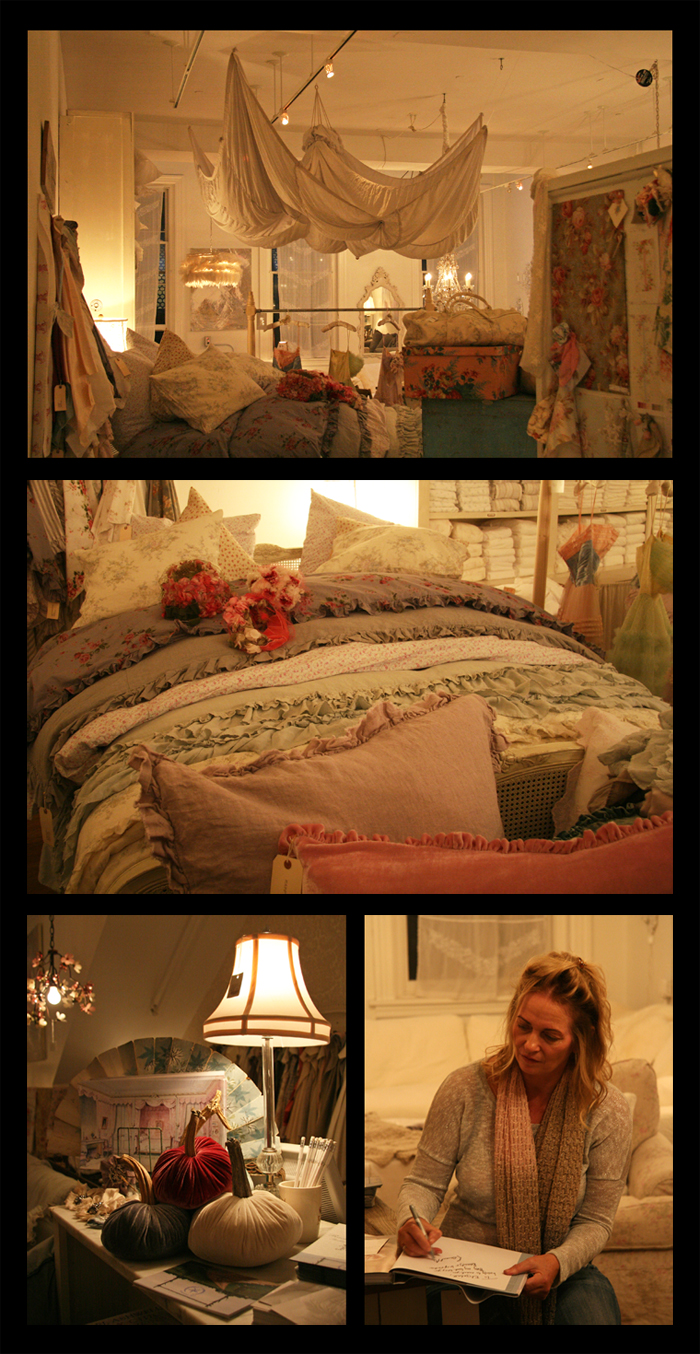
    Recently I was strolling home from my office via Mercer Street. An exquisitely appointed retail interior caught the eye of a friend, who immediately recognized the furnishings as the Shabby Chic style of Rachel Ashwell, a woman whom she much admired and many of whose books she had acquired. She wandered inside. I waited outside at first but soon decided to explore the store myself. The shop had an extraordinary feel. Truly inviting and homey, a place you want to just linger in. And we did. See my photo gallery here.

    I was pleased to learn that Rachel Ashwell herself would be present for a book signing in just a few days, so I discussed with the staff my desire to return for the signing, meet Rachel, take photos, and do a story. The staff was extremely amenable, befitting my entire experience there. I was given a green light, and so, with cameras in tow, I returned last night for the small happening. It amazes me how so many such fetes with notables are going on concurrently in New York City.

    I know nothing of the Shabby Chic style, but it is immediately apparent that although there is a casual nature to the decor, nothing is really left to whim. The messy, mushy, wrinkled, and time-worn comfort is deliberate – every element is given thoughtful consideration, even down to the white pencils, offered free. The lighting in the SoHo shop is soft with a yellow cast. Intrigued about the details of the decor, particularly the colors, I asked about the paint, and, as I expected, the precise shade was known and written down for me as per my request – Winbourne White by Farrow and Ball.

    The turnout was not too large or too small. Free appetizers and wine were made available. Everything seemed just right. I waited in line and met Rachel briefly, telling her of this website. She was charming and cordial. I told her of my intentions and left my card.

    We often like our things crisp and clean with hard edges, particularly in a world ruled by the precision of modern technology. We like bright and bold colors and harsh contrasts. In my lifetime, painting a place white meant a pure white. On November 17, 2009, I wrote White by Design. But that’s white, not off-white. My apartment is now painted Atrium white – a stark, bluish white. I never understood the desire for off-white. Why be so muted? I understand now. The world can be a harsh place at times. Who wants to come home more of that? I have seen the light, and it’s a little yellower. I want to come home to a place that evokes the comfort of a time gone by. A place that is soft and Off-White by Design 🙂

    About Rachel Ashwell: Rachel Ashwell, was born Rachel Greenfield on October 30, 1959, in Cambridge, England and raised in London. Rachel is an author and interior designer who created the Shabby Chic style, opening her first store in 1989 in Santa Monica, California. Her mother restored antique dolls and teddy bears, and her father was a secondhand rare books dealer. While in her teens, Rachel began selling antiques at London outdoor markets, later pursuing a career as in England as a wardrobe and prop stylist for TV commercials and photo shoots. She currently resides in Los Angeles, California.

    Related Posts: White by Design 3, Yellow by Design, White by Desire, Rhapsody in Blue, White by Design 2, Coup de Grace, Soho Treasures


  • Hey, Thanks Steve


    Please Click and Play Audio Clip to Accompany Your Reading:

    Around 1980, a close friend suggested that I get a computer to run my business. He explained why I should get one with not just a floppy drive but also a big hard drive. It would take removable floppy discs. “What’s a floppy disc?” I asked, and why were they floppy? A few years later, I bought my first PC – a DEC Rainbow running CP/M. Some time later, I got an IBM PC running MS-DOS.

    In the early 1990s, we wanted to start doing our graphics in house. For the first project, I rented a Mac. The day the two-week rental was over and the machine needed to be returned, our graphic artist was away. I needed to get the files off the rented machine, but what to do? If this was anything like DOS, I would have to learn a new set of instructions. I had only a little time before the rental facility closed to make the two-week deadline.

    I decided to try my hand – I had no choice. I inserted a disc and voilĂ , it APPEARED ON THE DESKTOP. I had never seen such a thing. But how to copy the file? I had an insane idea – what if I were to just drag the file I needed onto the disc icon? And that was the moment I became a BELIEVER. The file was copied, and I had ZERO knowledge of the operating system. This was my first experience with a graphical interface. I returned the rental machine, clearly a man converted.

    This rental had essentially been a test before purchase. However, I found Macs to be expensive, and some friends began telling me that Windows could do anything a Mac could do and much more cheaply. So I ordered a Dell for our graphics needs. When it arrived, the Windows interface was nothing like Apple’s. Disappointed, I decided to call sales at Dell. I took  the honest approach and told the saleswoman that the machine was fine, but I really preferred a Mac interface and COULD I RETURN THIS DELL?

    The sales person was exceptionally pleasant and understanding (I have over the years purchased some Dells and have recommended them for anyone wanting a Windows PC). She said she understood completely and that her daughter was a graphic artist and used Macs. A return would be no problem at all. We sent the Dell back and went out and bought a Mac. And so my long relationship with Apple began.

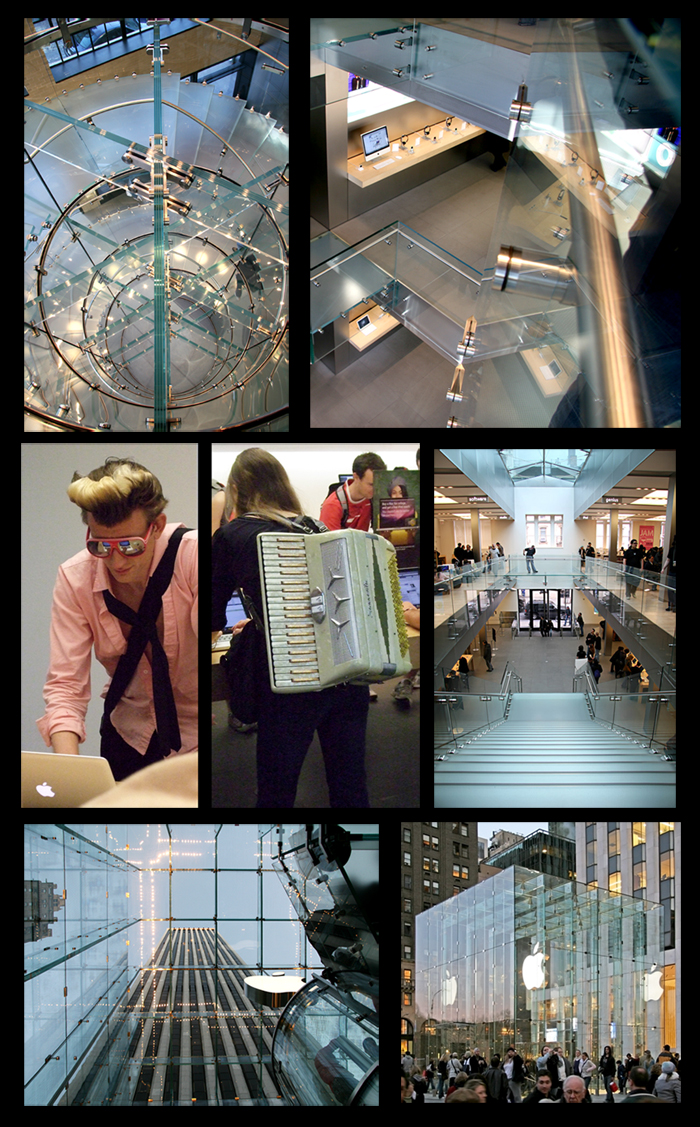
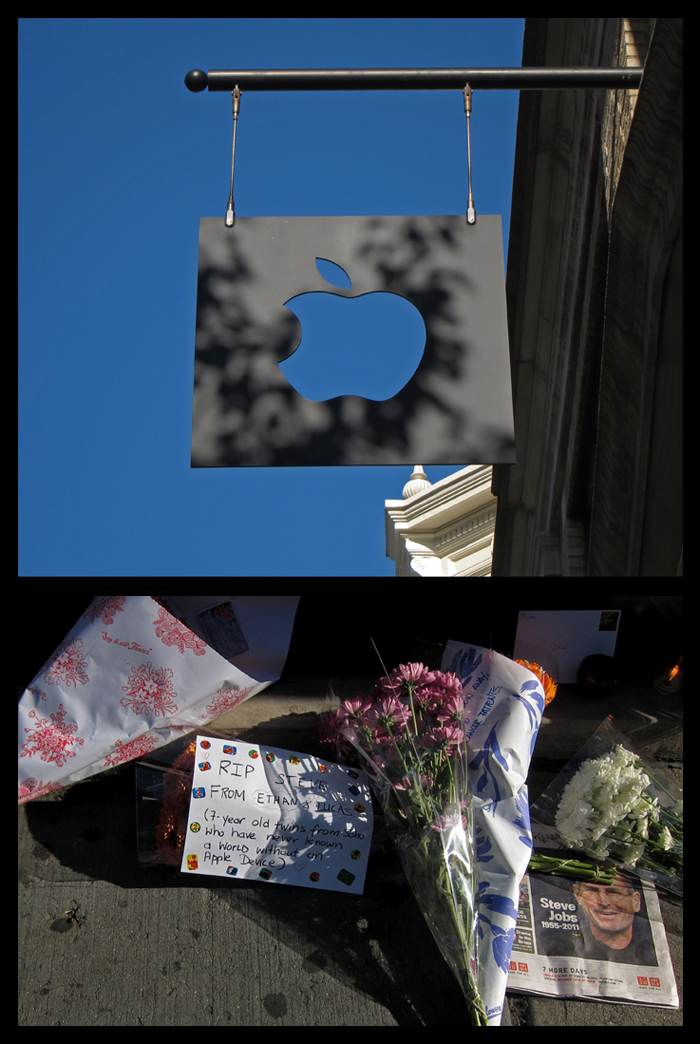
    In 2001, I was excited to visit my first Apple Store in the Westfarms Mall in Connecticut. Subsequently, Apple opened stores in New York City, the first being just footsteps from my office in SoHo, where I and millions of others found it to be something akin to a clubhouse for happy members. Many an evening on the way home, for no particular reason, I drop in and peruse.

    Since that time, I have owned nearly 20 Macs, an iPhone, an iPod, and and an iPad. I spend most of my waking hours using one Mac or another. I write these words using a Mac Mini. I have written a number of stories about Apple stores – some of my favorite photos have been of their interiors and exteriors, particularly Step Softly (top photo).
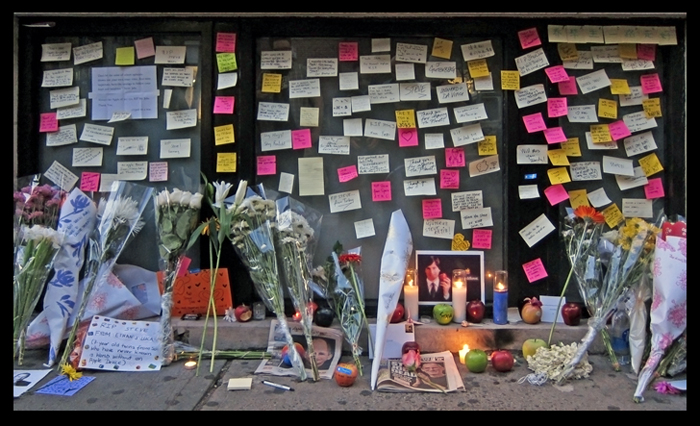
    I am a little saddened to have heard about the premature death of one of America’s great visionaries: Apple CEO, Steve Jobs. I never got to meet Steve nor thank him personally for a job well done. So, I think I can speak for many of us here:

    Hey, Thanks Steve 🙂

    Related Posts: Top of the Glass Staircase, Pomp and Circumstance, Apple and Sherry


  • Legacy


  • None of Us Go

    You can read tomes about Italy, look at photos, see videos and films, and speak to native Italians, but you will never know Italy until you finally get on that plane for the first time and go there. When you arrive, you will have that Aha! experience that I am sure you have had in other ways before – so this is Italy.

    Like an old friend not seen in decades, you will recognize many familiar things in his face, but the essence of the man himself is much more than a few big pieces. The image you have conjured prior to visiting Italy will be seriously devoid of the many, many things which will never be written of – the mundane, the inconsequential, the trivial, the ubiquitous, the details, the customary – yet these are the things which comprise the bulk of day-to-day existence.

    Someone living in New York City may be here for decades and never set foot in any of the major iconic tourist attractions or even those places reported in guides to Secret New York, Forgotten New York, Not For Tourists, etc. Because for the New Yorker, like anywhere else, the city is about the corner deli, the laundry, the nondescript row of houses in an average neighborhood. Who would want to read about or see images of such things?

    You do.

    I have featured most of the major attractions. However, I have also endeavored in these pages to bring you the side of the city not typically written about or photographed, to show the real New York. I have woven into my stories many anecdotes to make the ordinary as accessible as possible. Like many of our wonderful ethnic cuisines, I have taken the basic staples and prepared meals with spices from my personal cupboard to make them as enjoyable as possible to eat. I have written about chewing gum on the sidewalks of New York, car washes, and other very ordinary things.

    Perhaps some of my stories have come as bitter medicine that you may not want to take. But all of my efforts have been like that of the mother who only wants the best for her child. I do not only want to share my joys with you but also the slings and arrows of living in New York City.

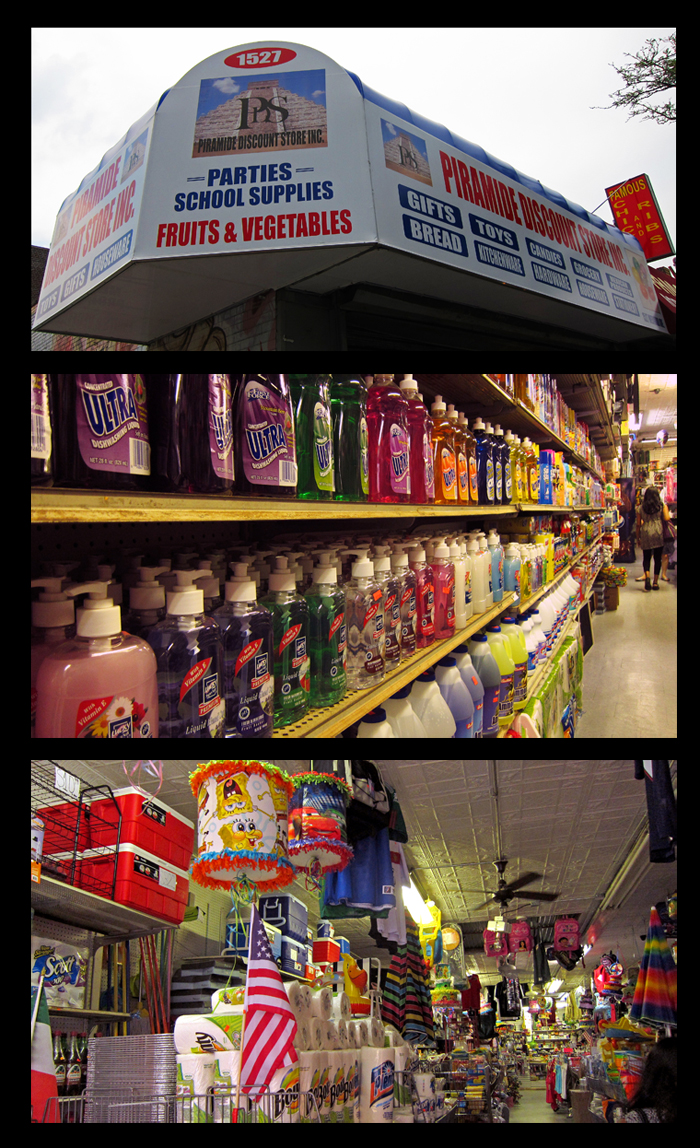
    On a recent journey to Coney Island with a few friends, we found ourselves drawn to the Piramide Discount Store on 16th and Mermaid Avenue. My friend Leslie (see White By Design), a graphic designer by trade, was all abeam with the store’s tidy and colorful displays and arrays of every imaginable item for sale. The sign outdoors proclaimed: toys, candies, grocery, bread, kitchenware, hardware, houseware, stationery and Mexican products. More succinctly put, a true general store. Not the quaint country store which has been restored and has historical and architectural significance. No, this is the real neighborhood place that everyone there knows and where everyone there goes, but none of us know and where none of us go…


  • Garish Glory

    There’s no reason to apologize if the offense is within the eye of the beholder.

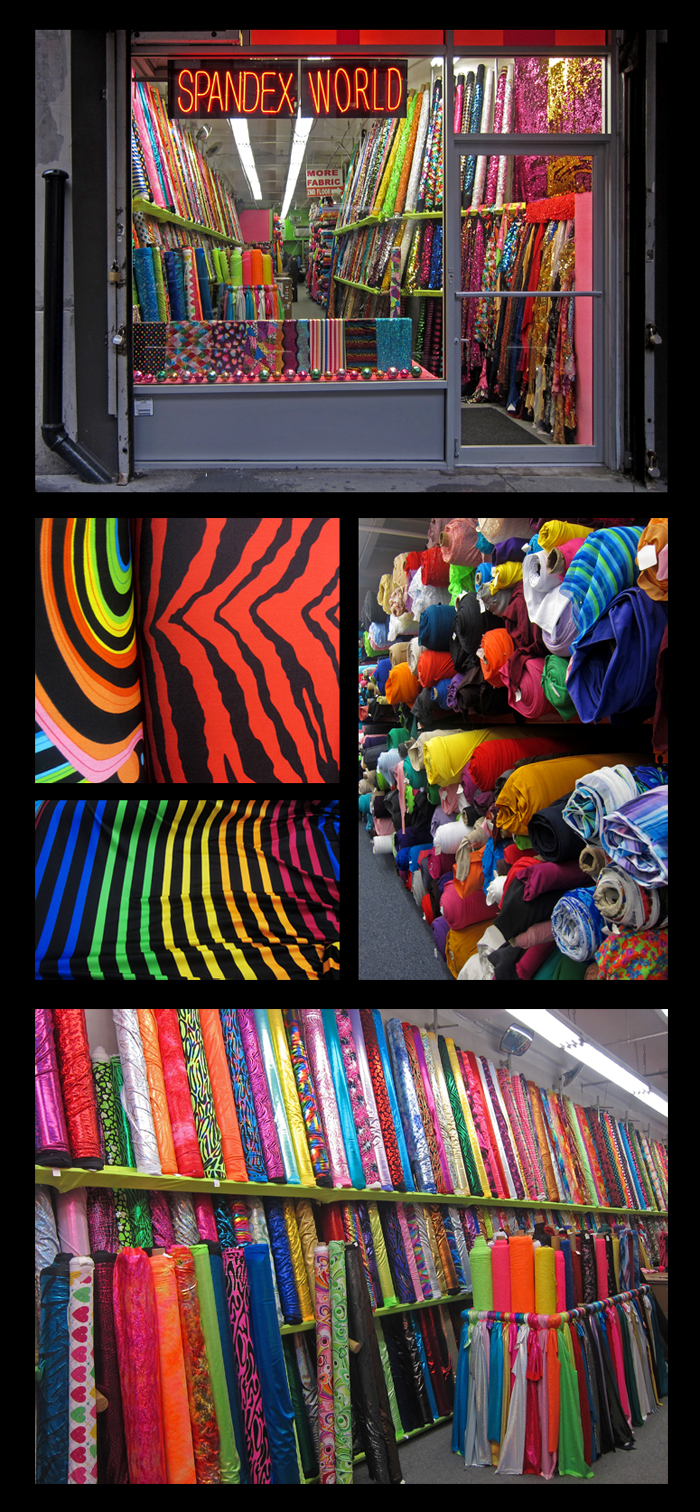
    There’s just something about Spandex World that everyone in my office loves. It’s a playground for the eye and hand. All that stretch. All that selection. For a riot of color, it’s hard to beat an emporium of brightly covered fabrics like Spandex World.

    The place screams We Sell Spandex in every color imaginable. Tie dye, neon fluorescents, wild patterns, textures, effects. It’s all here at 228 West 38th Street, in the heart of the garment district – the last surviving industry in New York City, smack in the middle of midtown Manhattan. Miraculous, really, to see the streets relatively unchanged in decades.

    There is a time and place for hard-to-find specialized products, and New York City delivers in niche product lines. If you want a lot or even just a little spandex in your life, you’re best off to go to that ultimate place – a business that has built a SHRINE to spandex*. A place that, like So Good, is unabashed, unapologetic, and proud to roll out the goods, regardless of whether those goods are outrageous, over-the-top, garish, or just so bright that they hurt the eyes.

    Spandex World is the kind of business that New Yorkers love to patronize and offer up proudly and smugly as the ultimate trump card in the game of street cred. Where else will you find a shop like this, with two full floors at street level of nothing but Spandex fabrics?

    This is not about feng shui, natural fibers, new age, or the soft pastel world of the French impressionist. This is SPANDEX WORLD in all its garish glory 🙂

    *Spandex or elastane is a polyurethane-polyurea copolymer co-invented in 1959 by chemists Joseph Shivers and C. L. Sandquist at DuPont’s Benger Laboratory in Waynesboro, Virginia. The invention was the culmination of 10 years of research by Shivers. It is branded as Lycra in the USA. The word spandex is an anagram for expands.

    Related Posts: Fashion Trash, Shrine to Paper, Soho Treasures


  • Wonder Why

    I grew up in a family with limited means. However, we triumphed through brute force and tenacity. My father, originally a woodcutter, once in Connecticut, worked a handful of blue collar jobs, often maintaining more than one job at a time. One of his brothers, in addition to his full-time job in construction, worked a second job – mowing grass on highways until 3 in the morning. Work defined a person’s worth. Certainly this ethic has been a factor in my survival in New York City for the last 40 years.

    For people like my folks, who were so determined to make a better life, generics or house brands were signs that a family could not afford to have the best. Brand names were symbolic and tantamount to saying that in a small way, we had made it.

    This type of thinking certainly is not unique to those of lesser means – the sale of premium brands is fueled by this type of thinking.
    However, we now have a world of smart shoppers who not only hunt for discounts but also evaluate products based on a quality and merit basis, not just by brand. Celebrities such as Oprah shop at Costco, conferring that shopping for price and value is nothing to be ashamed of and does not neessarily imply that one is of lesser means. Of course, this price consciousness can be taken to the extreme, something Americans do all too well.

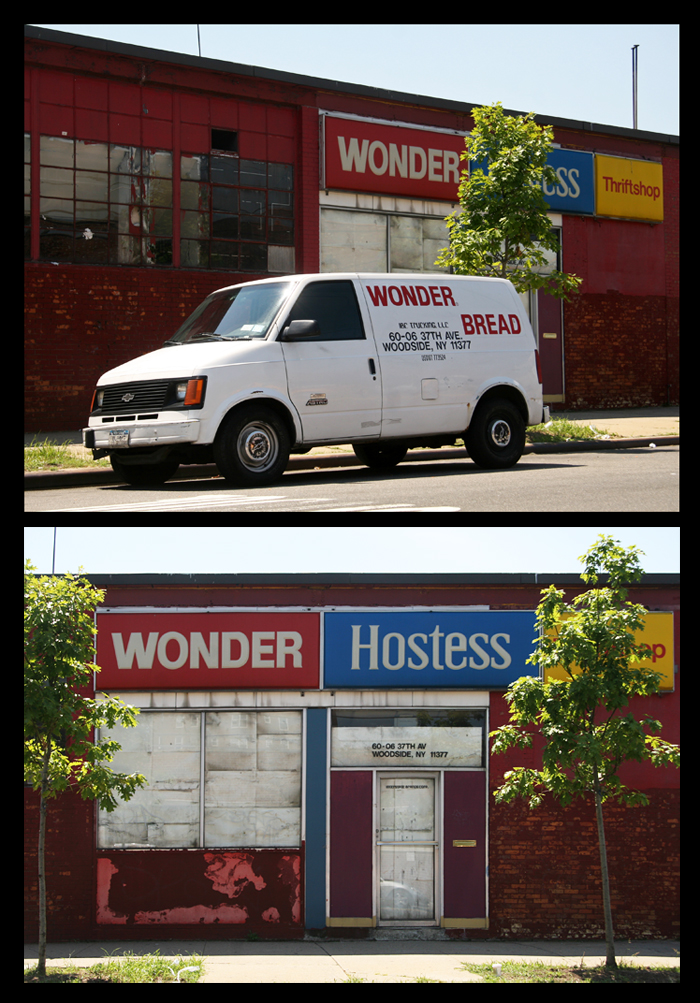
    In the 1960s, Wonder Bread was the premium brand, and our family was proud to eat it. For many today, with an emphasis on health and whole grains, Wonder Bread is virtually a perforative metaphor for white bread and all that is bad with the highly processed.

    On March 18, 2011, the Washington Post ran a story, “Wonder Bread: 90 Years of Spiritual Vacuousness?” Within the article, there is a quote from Warren Belasco’s essay, “Food and the Counterculture: A Story of Bread and Politics”:

    A virtue of brown bread was that it took some time and skill to produce, and this leads to another important contrast, convenience verses craft. Wonder bread represented the ultimate in labor-saving convenience, which was (and is) the food industry’s main product and primary hope for global expansion. It saved time, effort, attention, and money — it even took virtually no time or effort to chew. Sliced white bread thus may have been one of the world’s wonders, but the costs in taste seemed enormous. Thanks to the nutrients added back after processing, it may have been “biochemically adequate,” but was spiritually vacuous.

    From the same Washington Post article:

    Industrialization made great contributions to America but not to American food. Wonder bread may have helped build strong bodies 12 ways but it discouraged taste for bread in all ways. Bread is meant to have a grainy taste and a chewy texture. A traditional sandwich was flavored bread. But Wonder bread’s bland flavor made the bread simply a holder for the fillings. Its softness contributed to the American appetite for foods that “go down easily.” Both had great caloric implications. In fact, I am sorry to say, the name “Wonder bread” is short for “Wonder why anyone thought to call it bread?”

    Looking at the Wonder Hostess Thriftshop facility at 60-06 37th Avenue in Woodside, Queens, makes one Wonder not only why anyone thought to call it bread but also why the bread still exists at all…

    Related Posts: Pecking for Pita, Bagels


  • Buy Magnesium


    Once lit, magnesium produces light so bright that it will burn the retinas in your eyes. It burns so hot that if water is sprayed on it, rather than putting the fire out, the heat will break the water down and separate the hydrogen and oxygen atoms, which in turn feed the fire. This is the whitest light produced by burning a substance.

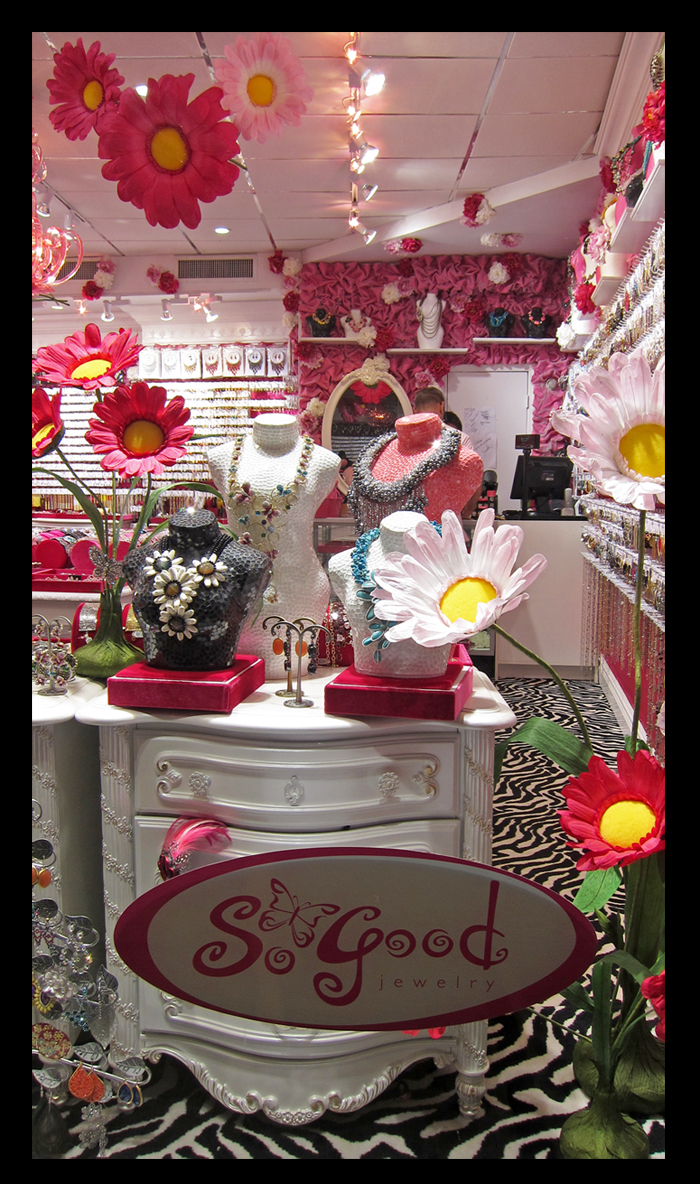
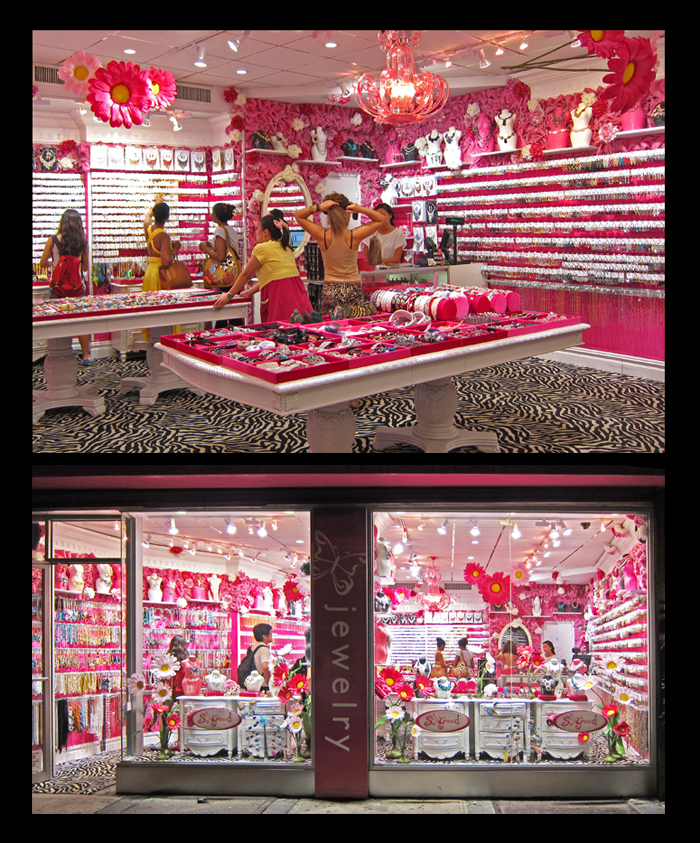
    I think So Good Jewelry must be using magnesium to light their stores. They are BRIGHT.  When I say bright, I don’t mean what you think may be bright. I mean magnesium so bright that it burns the retina and wakes the dead. For photographers, this place is a perfect tutorial for overexposure. Walking down 4th Street at night, I was astounded by the brightness. The place beamed me in.

    Did you ever notice how bright fluorescent lights in delis late at night are not flattering? I find that they bring out the alien green in me. In the event that there is a mirror somewhere, it is a supreme battle to deflect my eyes, lest I discover that I, too, can scare children. There are, however, a small number of people that are so gorgeous that no light is unflattering. These must be the women who shop in the bright lights of So Good Jewelry, at 184 West 4th Street in the West Village.

    But there is more than bright going on here. There is PINK. Lots and lots of pink in a decor that is over-the-top, super cute, and extremely kitschy. But none of this is a death knell. It is a runaway success. Part of the secret is to be unabashed and unapologetic, like Dolly Parton. Take the extreme and run with it. It is when you hold back a little, knowing that perhaps you are a little too cutesy. No, build a shrine to pink and bright. Make it So Bad, it becomes So Good.

    It must work. Located in cities around the United States (and Australia), the place seems to be a success. Reading online, reviews appear to be very favorable towards their line of costume jewelry. The chain is Korean-owned, masters of bling.

    While browsing and taking photos, I saw a woman with a bow in her hand, apparently unable to attach it properly to her hair. In the ultimate endorsement, she said, “It doesn’t stay, but it makes me happy.” I was happy to visit the shop. It really was So Good, because it was there that I learned what must be the key to financial success in these trying times: Have plenty of pink, and don’t buy gold, buy magnesium 🙂

    Fashion Note: More Birds of a Feather Tied Together (see Part 1 here).

    Related Posts: Fashion Trash, La Vie En Rose, A Colorful Life, Soho Treasures


  • Don’t Bet Against Many Goods

    In the 1980s, I was introduced to a man who had worked various outdoor markets and planned to open a large magic/costume store in a prime Greenwich Village location. I found it a ludicrous concept, really, for such a limited clientele for the products in a very high-rent district of Manhattan. I was also not very impressed with this man overall. He was really quite crass, unsophisticated, and very oriented to making a buck. A huckster.

    Of course, I was completely wrong, and the store was a huge success. I became one of his vendors, and since the shop was in the neighborhood where I live, I would visit occasionally, always privy to some conversation, typically tainted with vulgarity, racism or other unpleasantry. There was a wooden Indian figure on the street outside his door. On one occasion, when I visited the shop just before closing, I heard the owner say to his employee, “Bring in the f…kin’ Indian and let’s go home.” It was almost as if he had disdain for his own crass commercialism but was compelled to do distasteful things anyway.
    One of my most memorable visits was listening in on the owner’s end of a phone conversation with a customer that went something like this:

    “Yeah – we got shrunken heads. $19.95 and $99.95” [pause]
    “The cheap one’s got fake hair the expensive one’s got real hair.”

    On yet another visit, he proudly showed me his new specials brochure. “What do you think?” he asked me. “It’s like a Chinese menu – a little from column A and a little from column B.” An absurd idea to me, but at this point I deferred to him, entirely knowing that he really did have great business instincts and the Midas touch – everything he did turned to gold. The cruder the idea, the better it seemed to work.

    Every day, walking through the streets of New York City, I see restaurants PACKED, often with lines to get in, day after day, while others have wait staffs standing idly gazing at empty tables. I see businesses that are roughly put together but deliver what people want at good prices and are successful – places like Pearl Paint, Canal Rubber, or Astor Place Haircutters. Some focus on the basics in their early years and then reinvent themselves in a grander, much more polished way, like B & H Photo. And yet, there are businesses started and operated by individuals with business education and acumen but fail miserably.

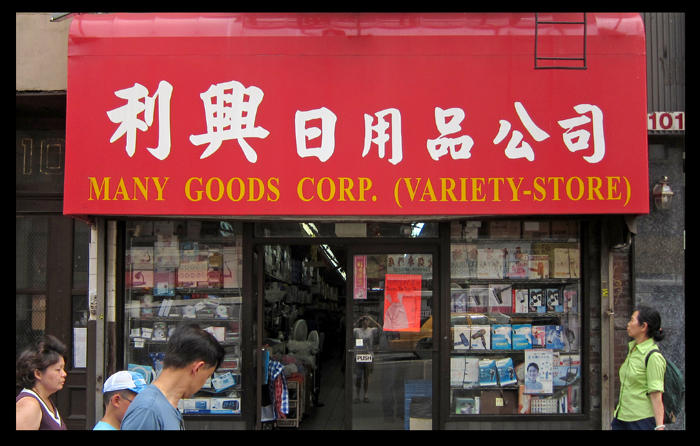
    In Chinatown, hard work and low prices are the rule. The store in today’s photo on the Bowery has no cachet and is not well known, glamorous, or special in any way. The name, Many Goods Corp., is completely unimaginative, likely only selected as a necessity for business incorporation. Like the magic/costume shop, these proprietors have an instinct. If I had to wager on who would be the survivor between a high-end SoHo retailer versus this shop in Chinatown, I’d say Don’t Bet Against Many Goods 🙂

    Related Posts: It’s Perfect, Because I’m the Best Pt. 2, Because I’m the Best Pt. 1


  • dinamic_sidebar 4 none

©2026 New York Daily Photo Entries (RSS) and Comments (RSS)  Raindrops Theme