New York City is much loved by many. However, it is no paradise, and the slings and arrows can easily outweigh the pleasures. I cannot speak to the experience of living full-time anywhere else, but this is no heaven and unless a masochist, the resident is best to lower their expectations for bliss and look for Pockets of Joy and Small Gestures, not Eden. Random acts of consideration will stand out and become noteworthy events, set against acts of rudeness. Here, acts of humanity come in small bites, not large meals.
On October 1, sitting in Washington Square Park with a friend, we noticed an individual place a small light on the ground clipped to a white card. Everything about it seemed deliberate. It beckoned to be picked up, so I did, handing the light to my friend while I kept the note. On one side of the small white card it said:
If you are lonely, sad or missing someone special,
please take this free Friendship Light.
On the reverse side:
A year ago I had a dream of people united, playing and having fun. People of all races and creeds were tossing and wearing this little glowing light. This moved me deep inside. I worked day and night for a year to make this dream come true. They are called Friendship Lights and represent love and friendship.
If you are feeling alone, missing someone special, ill or need a smile – please take one. It will warm your heart and help to get you focused on positive side of life. It has for me and many others.
I do not want anything in return. Your happiness will make me happy. And I believe good deeds make you a better person. We all get down sometimes and need someone or something to get us back on track. If you are interested in reading my story and why I do this: http://www.friendshiplight.com/maker
God bless, Jack
We delighted in the impromptu gift and positive, life affirming message. And so, Jack has decided to make an industry of Small Gestures with his Friendship Lights…
About the inventor: Jack Giambanco is a Gravesend, Brooklyn resident where he makes the lights in his garage in various colors from a biodegradable plastic. You can read more about Jack and the story behind The Friendship Light here.
Where could you place an enormous eight-foot mushroom on a sidewalk and get nary a glance from most passersby? The streets of Manhattan, of course. Here, given a combination of busy lives in conjunction with a populace that is inured to just about everything, a giant mushroom will easily go unnoticed or, at best, treated as a minor irritant. Some stopped and took photos. But most navigated around it while deep in thought, engaged with their smart phones, or chatting with companions. Some taller individuals ducked to avoid being struck, without even breaking stride or knowing what they ducked for.
The mushroom and tiny lawn, located on Fifth Avenue and Washington Square, were accompanied by a small poster announcing a new TV series on ABC – Once Upon a Time in Wonderland, airing October 10. Most who noticed the display were charmed and, in a childlike impulse, took advantage of the opportunity to be photographed underneath a mushroom on the streets of NYC. Nearby was a plainclothes security guard, hired by ABC to keep an eye out for vandals and dogs who invariably wanted to do their business at the base of the artificial treelike growth. I chatted with the guard for some time as we watched amused at the various scenarios that played out and the reactions of passersby. His work shift was overnight until 8AM, when the mushroom would have to stand on its own.
One couple was particularly offended that the streets of New York City were being used for corporate advertising. This reaction is to be expected, particularly in the Village, the cauldron for political dissent and home of a general cynicism of all things government or corporate. The guard assured them that whatever permissions needed to display and promote on the streets had been gotten by ABC. Not persuaded, the couple fumed and complained for some time before leaving. I imagine this was a recurrent theme for them, disgruntled at being victimized and their powerlessness over the excesses and greed of corporate America.
And so it was, like it has been for eons in this neighborhood. Some come to play here while not over thinking, and, like Alice, they find wonderment in the world around them, while others, more political, look as deeply as need be to find sinister connections to commerce in everything – the world where Eternal Malcontents Find Only Malintent…
This is typically neither a city of positive affirmations nor a place where one comes to relax. Although there have always been small communities with a bend towards New Ageism, Veganism, and other countercultural extremisms, in time, the harsh realities of New York City will grind down most optimists and idealists. Many, like Dwanna, will leave, finding the city just too hard and simply not worth it.
Idealism is usually a transitory condition of youth, lost as the hard knocks of life put things in perspective. Some remain idealistic, often those who have a privileged lifestyle which acts as a buffer between their world and the world most people know. There are those for whom a hard day is a hard day shopping.
I recall seeing a segment on TV where John Lennon and Yoko Ono were promoting an idea to create love and peace by making a random phone call to a stranger somewhere in the world and telling them “I love you,” asking that person to do the same, essentially creating a chain of goodwill around the world. Watching it today, I do find it embarrassingly naive. I imagine it’s much easier to entertain such ideas when you are living a gilded palatial life in the Dakotas.
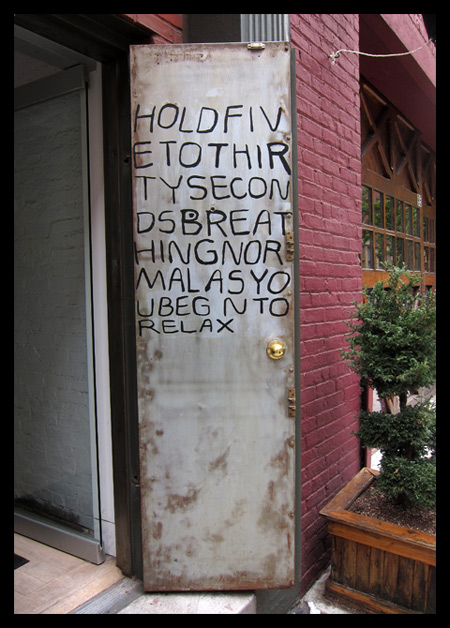
Strolling in SoHo on Crosby Street, I came across a doorway with a hand written message, appearing cryptic at first owing to the concatenation of words. A second look revealed that someone had made an effort (much less ambitious than Lennon’s) to inject a small dose of peace and tranquility to stressed New Yorkers on the move by suggesting: HOLD FIVE TO THIRTY SECONDS BREATHING NORMAL AS YOU BEG N TO RELAX
I have a childhood friend who has been a biker his entire life. He once told me about the allure of bikers with women and how just owning one was a guaranteed way to meet women. Women have offered him their phone numbers while waiting alongside him in their automobiles.
Why the appeal? There are many thoughts on this – the bad boy rebel image, freedom, excitement, and danger. Perhaps it is best summarized by a scene in Woody Allen’s film Play It Again, Sam. In the opening of the film, Allan’s wife, Nancy, bluntly tells Allan why she is leaving him:
Nancy: I don’t want any alimony. I just want out. I can’t stand the marriage. You’re no fun, you suffocate me. There’s no rapport and I don’t dig you physically.
Later, their parting words:
Nancy. I want a new life. I want to go discothecquing and skiing and to the beach. I want to drive through Europe on a motorcycle. All we ever do is see movies.
Allan. I write for a film magazine. Besides I happen to like movies.
Nancy. You like movies because you’re one of life’s great watchers. I’m not like that. I’m a doer. I want to participate. I want to laugh. We never laugh together.
Allan. How can you say that? I don’t know about you, but I’m constantly laughing – I chuckle, I giggle, I guffaw occasionally. Besides, why didn’t any of this come up when we were dating?
Nancy. Things were different – you were more aggressive.
Allan. Everybody is during courtship. It’s only natural. You try and impress the other person. You can’t expect me to keep up that level of charm. I’d have a heart attack.
Nancy. Goodbye, Allan. My lawyer will call your lawyer.
Allan. I don’t have a lawyer … have him call my doctor.
In another part of the film, Allan has a fantasy of his ex-wife riding with a biker through the countryside, stopping, and being thrown to the ground and made love to.
There you have it – the motorcycle as an icon for freedom and reckless abandon. The fantasy of women looking to escape the doldrums of relationships without fun or excitement. It became a private joke for a friend and myself – we often spoke of a particular woman fantasizing about going off with a man with a motorcycle.
Recently while walking on 8th Street in the Village, a friend and I encountered a very muscular, imposing man proudly displaying his bike and chatting with admiring onlookers. Although I have never been particularly attracted to the outlaw biker image, I can appreciate a fine machine. The owner, Louis, told us about the customization of his bike, including the signature blue LEDs elegantly strung throughout the bike, all hidden from view.
I delicately brought up the issue of straight pipes – the bane of New York City residents. He turned his bike on – the sound was deafening. When I asked about the issue of legality, he commented that he carried a badge. I have no idea if he was actually a police officer.
Some moments later, a very large woman appeared with a friend. There was lots of flirtatious banter between the woman and Louis. She asked if she could mount the bike. It was clear that this woman had no inhibitions whatsoever. It was a reenactment of Woody Allen’s fearful fantasy – a woman gone wild being lured to a man with a motorcycle. As I snapped a photo of her straddling the bike, she asked, feigning worry about what my camera may have caught, Do I have underwear on?
There are many, many juxtapositions and sharp contrasts in New York City. But, barring an occasional visit from the Mennonites, there is nothing quite like seeing Hasidic Jewish men in an urban setting. The beards, payot, rabbit fur hats, tzitzit, skullcap, and formal all black three-piece suits that are worn year-round and are particularly startling to see on hot summer days.
For eons, I have admired the spectacular vistas of Manhattan while crossing the Williamsburg Bridge by car and had promised myself I would return by foot to take photos of the New York City skyline. So, armed with my camera, I finally made the pilgrimage across the Williamsburg Bridge via the bike and footpath from Manhattan to Brooklyn and back.
It was evening, and an extraordinary number of Hasidim were making the passage from Williamsburg to Manhattan in small groups and large. At various moments, they dominated the view down the walkway. I saw two jogging across the bridge, still dressed in traditional attire. I was not the only one to take notice – as a group passed, a man next to me stopped, turned, watched, and then commented, “What was that about?”
I am sure that visitors to the city are startled by such an apparent anachronism. I don’t find even the piercings and tattoos of urban youth quite as shocking – the phenomenon of extreme body art and mutilation can be seen around the world and is more and more common, whether in New York City or the suburbs. But the traditional, conservative dress of Hasidic Jews along with strict religious practice, rituals, and customs, such as closing on the Sabbath, are truly remarkable to see in a place like New York City in the 21st century. Enormous retail giants like B&H Photo forgo what I imagine would be substantial business by being closed Friday afternoon and Saturday.
I got numerous interesting photos of the bridge structure, ships passing, graffiti, building rooftops, the Domino Sugar Factory, and people crossing. Ironically, the worst photos are what I set out to shoot – the skyline. Even though I timed my visit to take advantage of the sunset, none of the skyline photos, which needed to be taken through chainlink fence, were good. It was not at all what I set out to capture. The most interesting images were of men in black in the amber glow of the setting sun. It was, altogether, A Different Kind of Sunset…
Sometime in the early 1970s, I found myself in the unenviable position of being in New York City with no place to live. For a time, I lived, or, better said, crashed, with a number of people in a variety of scenarios, living out of a suitcase.
One brief stay was as the guest of four women, at least one of whom was clearly not a New Yorker. One evening, this girl was busy finishing her shower in the bathroom and overheard the Yiddish expression, Oy Vey iz mir, I’m chalishing (oh my, I’m fainting). Unfamiliar to her, we attempted to teach her how to say it. Her interpretation went something like: Ova schmear, allava hallashing. I wondered whether an ova schmear was some medical procedure unfamiliar to me. From the living room, we urged her to repeat it over and over. On each telling, she popped her head out of the bathroom and proudly volunteered, “Ova schmear, allava hallashing.”
As she retreated, we laughed hysterically and secretly, never revealing how severely crippled her mispronunciation was, perhaps the worst bastardization of Yiddish I have ever heard. The scene was hilarious and reminiscent of a sophomoric prank in Wayne’s World where Mike Myers and Dana Carvey trick their mother to repeatedly announce a phone call from a mythical “Mr. Sphincter.”
Some Yiddish is a rite of passage in New York City. Certainly a working knowledge of basic words and phrases is a necessity. The lack of familiarity is a dead giveaway that an individual is an out-of-towner. If you doubt how much Yiddish is part of the fabric of the city, note the sign on the Williamsburg Bridge which proclaims, Leaving Brooklyn, Oy Vey!, below which one finds the names of the Borough President, Marty Markowitz, and Mayor Michael Bloomberg, both Jewish. Williamsburg, Brooklyn, has the world’s largest enclave of Satmar Hasidic Jews, estimated at 60,000 of the world’s 150,000.
The sign leaves no doubt of where you are. You should know that iz mir bears no connection to a schmear, which is a thin coating of cream cheese on a bagel, and that ova are eggs. And if you don’t, we New Yorkers can only say in despair, Oy Vey!
There are numerous guidebooks to NYC that purport to be not for tourists, offering an insider’s view or secrets of the city. But the aforementioned places are the REAL secrets of the city – places that are inaccessible, on private property that will require trespassing, or just very remote and little known, like Dead Horse Bay, The Hole, or Willets Point. Urban explorers daring and brazen enough to risk arrest or mishaps have visited all these spots, and their travails are documented on the handful of websites inclined to cover such as undercity.org, gothamist.com, and forgotten-ny.com.
One of the most intriguing to me is the ship graveyard in the Rossville section of Staten Island. The area is largely abandoned and sits quietly, secretly, and out of plain view behind a long strip of corrugated metal fence on Arthur Kill Road. From the New York Times in 1990:
As with the fabled elephants’ graveyard, ships go to die at Rossville on Staten Island. For decades the Witte Marine Equipment Company, the lone remaining commercial marine-salvage yard in the city, has given mothballed, scuttled, abandoned and wrecked ships of all sizes a final port. Through the years it has become, an “accidental marine museum,” as a nautical magazine described it, with one of the world’s largest collections of historic ships.
After hearing about this place for the first time, I viewed numerous photo galleries online of those who had visited and documented the adventure. The images of decaying ships with weathering wood and rusting metal were beautifully striking and haunting. I immediately made a trip to the area. However, an impenetrable fence, a barking dog, stories of a mean man, and no obvious coastal access kept me from exploring.
On a recent visit to this area of Staten Island, I noted a patch of yard where some ships were visible – a teaser to the real shipyard. I respected the no trespassing sign and took a handful of photos from the roadside. My good behavior was rewarded – the owner of the property introduced himself as Tony and welcomed me to access his private property if I wanted to take photos of the famed tugboat/ship graveyard. He said many photographers had come before me, even that very day, and he was always happy to accommodate those who respected his property in advance. I was elated at the opportunity and told him that I would return soon when I had more time to make a full excursion. He pointed out his home nearby and told me to just knock. I have done my research as to where and how and examined maps and aerial views. Soon, courtesy of Tony, I will go back to explore for the first time and bring you those images here. And that’s No False Promise 🙂
It was some years ago when an employee came into my office with very bad news. Our shop vac appeared seriously damaged and was no longer working. When I asked about the nature of the damage, I was told that there appeared to be a problem with the wire connection near the plug. This was laughable, and I responded that I would just pick up a new plug for a couple dollars and rewire it. To which my employee was so impressed, he commented, “Wow, I have to see that.” I asked where he had grown up – the suburbs of Miami. I joked how he was a sad man, that he would be stupefied with such a simple repair. He watched, fascinated, as I replaced the plug in just a few minutes’ time.
The whole affair was indicative of how many Americans are estranged from even the most basic repairs. With such a strong emphasis on white-collar work and getting a college education (both laudable goals) and such a lack of dignity for blue-collar work, fewer and fewer people use their hands. My high school was very well equipped in the industrial arts, but, being tracked for college, I never set foot in the school’s tech wing. A disappointment to me now – I would have enjoyed a few classes in machining.
The situation in New York City is much worse. Without space for storage of tools and workspace to use them, most urbanites have limited ability to do their own repairs. Most handiwork in apartment buildings is done by superintendents who wear many hats and do repairs in a variety of trades, none of which they are qualified to do. Most of the work ranges from mediocre to horrific. This is sad to me for so many reasons. There is a real shortage of labor doing quality work and great difficulty in finding someone to do small jobs. On the flip side, there are pluses to the do-it-yourself approach – a cost savings and satisfaction of working with your own hands.
At one time, I ran into a number of fudge shops in shopping malls that made fudge on the premises. The process of pouring, cooling, cutting, and serving was such a big attraction to shoppers that the shops turned the making into theater. Just before pouring, employees would run through the mall ringing a bell and announcing, “Fudge time!” Shoppers would run and flock, much like sheep, to witness the remarkable event – someone pouring hot fudge into a tray. They remained entranced, as if witnessing the height of artisanship.
Certainly there is value in seeing quality demonstrations of skilled craft, and there seems to be no dearth of fascination with the watching of things made. However, the audiences are often undiscriminating, watching virtually anything, regardless of how unskilled or inane. People will stand fixated as if watching the miraculous.
On the streets of New York City, you will from time to time find individuals spray painting works using objects as stencils and tools. I have waited some years to photograph one for this website. On Easter Sunday, returning from the parade, I had the good fortune to run across the spray paint artist in today’s photo. He was surrounded by a flock of tourists, admiring his command of schlock art. Watching, I could almost hear a bell and the cry of “Fudge Time” 🙂
‘Tis a bit unfair, but among close friends, the town where I grew up, Bristol, CT, has become the butt of a private joke – a metaphor for all things boring, a place devoid of culture and nightlife. Whenever I see something particularly unusual, crowded (as I wrote in 212 and 2:12), or abuzz, I sometimes remark that it is certainly something you’re not gonna find in Bristol.
In this town of 60,000, there is little to do but visit strip malls and eat fast food. My family never ate in Bristol, opting instead to travel for our infrequent restaurant outings. Although it does have a surprising number of claims to fame – Lake Compounce (the oldest amusement park in continuous operation in the US), national headquarters for ESPN, home of Little League New England, a Clock Museum ( one of a very few museums in the United States dedicated solely to horology), the New England Carousel Museum, and the Otis Elevator Company test tower – the largest in the United States. Nonetheless, these are things of little import on a day-to-day basis, and most residents will only partake of these places once or twice in a lifetime, if at all. But for culture or shopping quality merchandise, most residents will find themselves traveling. My high school English teacher, a rebel, advised us not to read the local paper, something he found tantamount to trash. He recommended that we leave Bristol altogether. There are staunch supporters of my hometown, I am sure. In my lifetime, I have seen Bristol alternately on lists of best and worst places to live in America. But I yearned to live in New York City and, in 1969, undeterred by my guidance counselor (as I wrote about in Jungle Lovers), I came to the big city.
In the 7 years that I have written for the pages of this website, I have featured many unusual and remarkable people, places, and things – people such as Mark Birnbaum or pianist Colin Huggins, who performs with a baby grand in Washington Square Park. But, as typifies the New Yorker, I have become inured to the lunacy of a man assembling and disassembling a baby grand piano daily, hauling it many city blocks to and from storage, setting it up, and playing for hours, even in the most inhospitable weather. Most recently, Colin upped the ante considerably by performing during the winter months in frigid weather. Neither biting cold nor a slim audience deters him from his daily grind.
As I traversed the park on the morning of Friday, February 15, the bar for novelty in New York City was raised again – a piano turner wearing roller blades was busy tuning Colin’s baby grand piano, with banks of snow as backdrop. It was decidedly a scene uniquely New York and certainly something You’re Not Gonna Find in Bristol 🙂
Given the real estate values in New York City, it is completely baffling to see properties unoccupied for years. Perhaps some of the best examples in Manhattan are properties in the estate of Bill Gottlieb. I had the privilege of meeting this eccentric man in the 1980s when I was looking for commercial space for my business. I had been enamored with the prospect of renting a small one-story garage and was intrigued that all of them bore the name of Bill Gottlieb as agent/owner. I met him and toured a number of properties in his signature old station wagon with cracked windows taped together. Little did I know that this man’s estate was valued in the hundreds of millions.
Recently, I read about the Spook House of Williamsburg on the Forgotten New York website. So, curious to see the place for myself, I took an excursion to 539 Driggs Avenue in Williamsburg, Brooklyn. The storefront appears to have been abandoned for some time and is framed with a weathered wood exterior. A flag graces the front door and venetian blinds cover all the windows. Little seems to be known about the property, and most online searches trace back to the Forgotten New York website, where information is sketchy. It’s another mysterious case in New York City real estate of unexplained Vacancy…
There is great comfort in the familiar – the worn shoe, the daily routines. Here in New York, creature comforts provide a balm, soothing the scratches from a city that can be jarring and stressful. For the resident, there are many comforting icons of the familiar, whether it be a neighborhood diner like the Waverly, or those things recognized around the world, like the Macy’s Thanksgiving Day Parade or the Christmas tree in Rockefeller Center.
I find great comfort in these enduring icons, particularly after living in this city for over four decades, a place where change is ever present – sometimes welcome but also often the enemy. As Professor Gurland once said in a lecture at NYU, people are driven to look for stability in a world of change. At another time, a close friend who knew me well, suggested that I needed a country home, not to seek country in the city. Certainly both individuals made good points – my ability to survive in this city has been enabled by seeking peace, tranquility, comfort, the durable, and the classic. Finding secluded spots, such as community gardens or Dead Horse Bay, is what I seek here, not the over-animated urban environments of clubs, bars, or other scenes.
Certainly I must not be alone. How else to explain, at least partially, the success of a restaurant like the Meatball Shop? There you will find many reasons for a thriving business, not the least of which is a cuisine that revolves around an American comfort food, meatballs. For me, the deepest and most profound comforts are those which draw on connections to places, experiences, and things of my childhood.
My father was one of the most dependable, predictable people I have ever known. He had a creative side, but essentially he was a man who lived by habit and routine. He loved pastries, crackers, and breadstuffs. At many meals, a box of saltine crackers appeared. But not just any box – a metal can sporting the Nabisco logo in one corner and proclaiming Premium in large type in the center with smaller type below it, Saltine Crackers. Newly purchased boxes of saltines were opened and the four sleeves of crackers were slid into that tin, keeping them fresh. We stored our crackers in that can for decades.
Driven by my family’s obsession to modernize, minimize, and sanitize, that can is no longer. Apparently they neither had interest in keeping nor found charm in an old can. I recall once advising my folks that they should consider keeping such a container, that perhaps it may be of value some day. My instincts were right – these Nabisco tins have become collectible, and recently while at the indoor flea market at One Hanson Place, I spotted one – the word Premium leaped out from a table of goods.
It was only recently that I learned that the Nabisco conglomerate was formed in New York City and occupied what is now the Chelsea Market building. I am sure that these cans evoke different things to its numerous collectors, but to me, that tin is a link between New York City, home of the National Biscuit Company (later Nabisco), and meals in New England with my father as I sat ruminating and fixated on that word Premium 🙂
I once met a Brooklynite who insisted that Brooklyn was a city. The central defense of his argument was a sign on the Belt Parkway that proclaimed, “Welcome to Brooklyn 4th Largest City in America.” I explained to him that the sign was meant to say that IF Brooklyn was an independent municipality (which it was until 1898), it WOULD be the 4th largest, but that Brooklyn was a borough of New York City. Unfortunately, my words fell on deaf ears. The individual’s belief was resolute and like the fundamentalist Christian, he was taking a literal interpretation of the words. Metaphors were apparently not part of this man’s world, particularly in this case of civic pride which clouded all reason and his ability to see Brooklyn as anything other than the greatest place on earth.
However, his pride is understandable. Brooklyn has some of the richest history in New York City and many of its most enduring icons, notable history, and contributions to American culture, whether film, TV, literature, music, art, or architecture. Coney Island, the waterfront, Brooklyn Heights, the Dodgers, the Brooklyn Botanic Gardens, the Brooklyn Museum, Brooklyn Academy of Music, DUMBO, Prospect Park, Green-Wood Cemetery, Pratt Institute. Brooklyn is also a badge of honor for many who have achieved worldly success and risen from inner city working-class roots. It’s a place that many are proud to be from.
The legendary sign, which greeted motorists on the Belt Parkway in Brooklyn in the 1970s, achieved its iconic status in the opening title sequence of the popular TV series Welcome Back, Kotter. The show also launched the career of John Travolta, later to star in Saturday Night Fever, based in Bay Ridge, Brooklyn. The last remaining of the three versions of this sign found a home in Gargiulo’s restaurant after the retirement of Brooklyn Borough President Sebastian Leone. Gargiulo’s owner Nino Russo was persuaded by Borough President Marty Markowitz to donate the sign to the city. It now hangs in Brooklyn Borough Hall.
I have seen street performers cleverly play on this borough pride and rivalry. While taking a contribution, the performer would ask and announce the borough from which the audience member was from, the amount, and also brandish the currency, taunting the audience and challenging someone from a rival borough to make a greater contribution. This would escalate to a virtual bidding war with single contributions going to $5, $10, or more. Some may say this is all in good fun, and certainly all participants are willing victims. However, I find this aggressive money pitch highly manipulative, akin to creating a bidding frenzy like that found in an auction, where bidders lose control. Nonetheless, it certainly illustrates the civic pride in the boroughs of New York City and that some are willing to pay hard cash for one-upmanship.
Recently, I spotted the vanity license plate shown in today’s photo. I’ve got the KNGOFQNS here. Certainly there is someone from Brooklyn who can do better than that. Isn’t there anyone from the 4th Largest City in America who wants to Up the Ante?
I recall a conversation with my sister about children and a viewpoint expressed by Polly Platt in French or Foe. In this book, various aspects of French culture are laid out by the author, an American living in France married to a Frenchman. According to Platt, the French, who believe that they brought the world civilization, see the importance of discipline in child rearing as well, with children viewed as “little savages” who must be civilized in order to enter society. Children are expected at a very young age to behave like adults, even, for example, sitting well behaved throughout an entire meal in a restaurant.
I summarized for my sister the discipline imposed on children by the French and their expectations. My sister concluded that this type of child rearing was cruel. Strict discipline of children is certainly a contentious subject, however, with what I have seen in the subways of New York City which at times can appear to be like Lord of the Flies with children and teens acting out and even cursing their parents in public, perhaps a bit of French thinking might serve us well in the taming of children.
The conversation with my sister regarding wild children was appropriate coming from a French perspective – not only is my family of French ancestry, but also, perhaps the most well-known case of feral children is that of Victor, the Wild Boy of Aveyron. The story is the basis for Truffaut’s film L’Enfant Sauvage.
In 1797, a boy was first discovered and captured by hunters near Saint-Sernin, France. He was taken in and studied by a young medical student, Jean Marc Gaspard Itard, who named him Victor. At the time of Victor’s capture, he was estimated to be about 12 years old and was naked, filthy, had numerous scars on his body, and was wild, unsocialized, and unable to speak other than guttural sounds and squeals. It was speculated that he been raised by animals and was a true “feral child.” Although there were many hypotheses regarding his origin, nothing was ever substantiated, including any rearing by wild animals. His interests were very basic, and he was highly attuned to activities, sounds etc. During his time with Itard, he wore no clothing, eliminated by squatting on the ground, and would neither use utensils to eat nor sit on a chair. Little progress was made with his socialization, and Victor died in Paris in 1828. You can read more here.
I have always been fascinated with stories of feral children, and on a raw, cold, bleak November day nearly a decade ago, I got as close as I ever have at meeting someone who certainly appeared untamed. I was passing through Washington Square Park, which was deserted, excepting one lone musician who was sitting on a concrete bench playing guitar, seemingly oblivious to the cold. I recognized him, having seen him previously a handful of times playing in the park, often with a wild, disheveled appearance. He was playing blues with occasional use of a slide, which I love. His raw, edgy style and interpretations of blues classics were very engaging – I listened to a few songs standing in the cold and left a dollar in his open guitar case. When I asked his name and he said Feral, I confirmed the spelling, lest he had thought that I had asked about his disposition or temperament.
Years passed and I had not seen him since that period. Recently, at the Folk Festival, I scanned the program and was excited to see Feral Foster listed as the closing act. He played and sang an original composition, The Whole Wide World. I really liked it and after his set, introduced myself. He gave me one of his CDs, all original songs, i.e. no covers – a difficult road to travel for any musician, but a necessary path for anyone looking to make their mark. I saw him a few days later at The Gaslight, a club on MacDougal Street in the Village. His music still has a rawness and his playing style and persona has an idiosyncratic and untamed look and feel, befitting a man named Feral. Whether it is a film like L’Enfant Sauvage, the rearing of children in France, or my meeting of Matt Foster, from early on, there has been a thread in my life of All Things Feral 🙂
New York City was home to one of the most astonishing things to those unfamiliar – the real flea circus. Most are familiar with the phrase, however, there are only a handful of flea circuses at the time and fewer yet that employ actual fleas, so it is very unlikely that any given individual has seen one of these performances first hand.
Yes, real human fleas, pulex irritans, were trained to pull miniature chariots and perform circus acts, rotate ferris wheels, and kick balls. Minuscule harnesses made from thin gold wire were wrapped around the neck of the flea. The harnesses were then attached to a variety of objects. Fleas are renowned for their incredible strength and are able to pull up to 160,000 times their own weight and jump 150 times their own size. Their lifespan, however is typically only months, and so new recruits must be found and trained. And, they must be provided a diet of human blood. Typically, owners of flea circuses just let fleas feed from their arms.
The flea circus flourished in the Victorian age, however, the harnessing of fleas goes back much further. The first to harness fleas were watch makers who demonstrated their skills in fine metal working skills. Mark Scaliot is 1578 is credited with locking a flea to a chain with “a lock consisting of eleven different pieces of steel, iron, and brass which, together with the key belonging to it, weighed only one grain.”
One of New York City’s great institutions was Hubert’s Dime Museum, which occupied 228-232 West 42nd Street near Times Square from the mid-1920’s until 1965. The building which housed Hubert’s was a schoolhouse, designed in the 1880’s by McKim, Mead & White. Hubert’s was a phantasmagoria of some of the greatest novelty, freak, sideshow, and variety acts and the home of the last working flea circus in the United States – Heckler’s Flea Circus. Heckler’s occupied a section of the basement and required an additional admission. It was here that the Heckler family plied their trade. The circus was started by native Swiss William Hecker circa 1923 and sons William Jr and Leroy (“Roy”). Roy took over the operation in 1933 and continued to operate the flea circus until he retired in 1957.
So, when I attended the World Maker Faire on September 29, 2012 and happened upon the Acme Flea Circus very unexpectedly, you can easily understand why I was stopped in my tracks and jubilant that I would at last be able to see a real flea circus. Adding to the serendipitous encounter was that the performer, Adam Gertsacov, already knew me, having been a previous customer of my business. I stood alone at his booth and it was a good 30 minutes to showtime. However, I was very passionate about seeing a flea circus in person and close up, so I stood and chatted with Adam while he prepared for his show. He told me all the details of the flea circus. I was later to learn that Adam was one of the most educated clowns in America – not only was he an alumnus of Barnum and Bailey’s Clown College, but he was also a graduate from the University of Pennsylvania and held a master’s in theater and communications from Rhode Island College.
Adam assured me that I need not be concerned about having a “front row seat” since his show was designed to insure that all audience members were guaranteed to see all the details of his performers. This perplexed me, since I had learned that flea circuses like Heckler’s typically provided audience members with magnifying glasses. Historical photos showed him surrounded closely by a small number of viewers. How would Adam accomplish this at a distance? Theater.
Adam’s show involves a lot of theater, history, and clever quips and bits, including a “flea market” where small items are sold to the audience, whom he then proclaims has been adequately fleeced. The act consists of his two fleas, Midge and Madge, who engage in a chariot race and a tight-wire act. Children laughed and squealed, however, credulity was strained when the fleas were shot from a cannon through a hoop of fire to land inside a miniature Airstream trailer.
I became intrigued and through a little research learned that a number of flea circuses currently working do not use fleas. At least one, Hans Mathes’s flea circus at Oktoberfest (you can see an actual video below), has real fleas. As to Adam Gerstacov and his Acme Flea Circus, in the end, I just decided to suspend and see it as an enjoyable piece of theater, not worry whether I had seen trained Fleas or had just been Teased 🙂
I worked for years on a 4,000 year history of juggling, to be published by my company. The original manuscript ran hundreds of pages and was accompanied by thousands of archival photos. The author was German and had written the text in English. The work was understandably very Eurocentric and, understandably, many jugglers were missing or had sketchy bios that needed fleshing out. The text was badly in need of editing. I, along with others whom I recruited for the task, took it upon ourselves to contact every living juggler of merit to ensure that their entries and photos were as accurate and complete as possible. The book was virtually rewritten over the course of 10 years and, sadly, was never completed.
One of the entries was a man named Fritz Grobe. As was the original author’s style, his entry in the book focused almost exclusively on his juggling talents. However, I was interested in knowing more about the man and his life. I quickly learned that I was not dealing with an ordinary individual at all. Fritz was born into a family of academics – his mother and father were both math professors at Bowdoin College in Maine. Here is what Bill Giduz from the International Jugglers Association wrote in 1993:
As a high school student at Brunswick High, he had the second highest score in North America on the American High School Math Exam, qualifying him for the American Invitational Math Exam. The national average of the 3,700 students invited to take that test was a 3.6. Fritz scored a 10! That qualified him for the 1986 U.S.A. Mathematics Olympiad, the highest honor for a math student in the country. He finished 14th out of the 93 students invited to that trial, a feat he considered his finest hour in the discipline.
Fritz was admitted to Yale University and became involved with the school’s juggling club. With a bout of mononeucleosis, Fritz went back home to Maine. He took a few math classes at Bowdoin. He never returned to Yale, instead following his passion for juggling. As a former mathematics major myself who had a brief and harrowing experience at NYU’s Courant Institute, I was a bit jealous of someone so gifted mathematically, yet would toss those talents aside to become a juggler. But, such is life and just as one man’s meat is another man’s poison, one person’s dream is often another person’s boredom.
In 2002, I attended the International Jugglers Convention in Reading, PA. As I crossed the street one evening on the way to the public performance, someone caught my eye who I thought maybe Fritz Grobe. I barked out – “hey, you’re that guy, right?” Absurdly cryptic, but Fritz understood that I was asking if he was the subject of our phone and mail correspondence for the juggling history book. It was he.
Nearly forgotten, I was shocked to run across Fritz completely by accident 5 years later, nearly at my front door in Washington Square Park. He was there for the YouTube gathering on 7/07/07 – his YouTube videos have gone viral with over 60 million views. I was more stunned to learn that he would not be juggling, but that his genius had been redirected to experimentation and exploitation of the Coke and Mentos effect. Unfortunately, I was not to see his act in 2007 – permit problems prevented him from performing.
In 2005, his first experiments were done, as well as the creation of the entertainment company, Eepybird, with his partner Stephen Voltz (an attorney and grad from NYU Law). They have developed nothing short of an operatic theater piece using hundreds of bottles of Diet Coke. The act has won four Webby Awards and have been nominated for two Emmys. They had been featured on TV – David Letterman, The Today Show. Only days after EepyBird released their first video, “The Extreme Diet Coke and Mentos Experiments”, the Wall Street Journal reported that Mentos had already received over $10 million worth of publicity. The video generated a 5-10% spike in the sales of 2 litre bottles of Diet Coke and a 20% spike in U.S. Mentos sales, the biggest sales increase in company history. In the first 9 months, 10,000 copycat videos were posted online.
So, I was surprised but not perplexed to find Eepybird as a featured act at the 2012 World Maker Faire in New York City. I spoke with Fritz briefly while he was setting up for the show. When I returned, I was joined by a massive shoulder-to-shoulder crowd. Fritz and Voltz appear dressed as scientists in lab coats, explain the chemistry of Coke and Mentos, describe the bottle cap technology they developed for optimal geysers, and then the show begins – a well-choreographed and syncopated shower of geysers set to music. I took video and still images overhead in Hail Mary style.*
Eepybird’s act is a roaring success and brings out the child in everyone. They perform the act worldwide, full-time, doing an average of 12 shows per year. But these are not childhood antics nor cheap tricks – a lot of creative thinking has gone into this act. Never underestimate Fritz Grobe. His geysers are merely metaphors for genius gushing forth and fountains of success 🙂
*A Hail Mary is a photo taken blind, without using the viewfinder, typically overhead in a crowded situation. The term “Hail Mary” is used owing to the idea a prayer is needed to get a good photo.