web analytics

  • Category Archives Homes and ‘Hoods
  • Caffe Roma

    I have a friend, no longer living in the city, who was Italian, a native New Yorker, and lived near Little Italy. I recall once, early in our friendship, asking for suggestions for an Italian restaurant on Mulberry Street. He replied that, categorically, he would never eat Italian there. He cited mediocre quality and that he refused to pay to eat Italian food in a restaurant when he could make it much better himself. His wife concurred that he made a mean red sauce.

    Of course, restaurant patrons know that being able to make it yourself is no reason to be eating home. Many New Yorkers eat every meal out – not surprising given the affluence here and the staggering number of restaurants.
    If you are inclined to eat on the legendary Mulberry Street in the heart of Little Italy, forget being able to peruse menus unfettered. Here, you will be accosted by aggressive hawkers, making promises, offering deals, and assuring you that the food inside is excellent and that you will not be disappointed.

    Recently, a friend wanted to celebrate her birthday by taking a trip down memory lane and dining at SPQR, a place she had not frequented in many, many years. SPQR is an institution, massive and well-known. It never occurred to us to call before visiting to inquire if it was still in business. As luck would have it, when we arrived at 133 Mulberry, we found the place had closed and only recently in early 2013, after being in business over 30 years. As we stood dismayed by our misfortune, we were immediately approached by a staff member of an establishment directly across the street who assured us that much of the staff of SPQR had migrated to their kitchen, the food was excellent, blah, blah, blah.
    A bit put off by the predatory behavior, we strolled the street, settling on a place some short distance away. Dinner was acceptable, if not memorable.

    To heal the wounds of our unsuccessful initial mission, I suggested that we have dessert at Caffe Roma, the only place in the neighborhood that my aforementioned friend approved of, albeit decades ago. I had visited once eons ago, so, not knowing what to expect, I suggested that we lower our expectations.
    My dining companions were immediately pleased with Roma as we approached it, located at 385 Broome Street at the corner of Mulberry Street. The ambiance at Caffe Roma is decidedly olde New York – the place has been run by the same family and in the same location for over a century – since 1891.

    Surprisingly, the place was quiet and we were fortunate to get prime real estate, a table in the front corner window. We shared a number of desserts and found the place a pleasant respite from an otherwise very touristy area. Nearby pastry shop Ferrara’s is a good example of an establishment that many avoid for that reason. Like so many eateries in New York City, reviews of Caffe Roma range the gamut, particularly regarding service. We found it very pleasant, and if by choice or chance, you find yourself in Little Italy, and want to avoid feeling like prey, try Caffe Roma :)


  • Homeowners Too

    The big city, particularly New York City, conjures up images of shysters, swindlers, scammers, and hucksters. Growing up in New England, there was a particular aversion to New York, as opposed to let’s say, the more genteel society of Boston. New York was seen as a place defined by glamour, glitz, and money – like Las Vegas, but with more style, character, and culture.

    A visit to New York City came with forewarnings from family and friends. Watch this and watch that, they said. Don’t do this and don’t go there. Be careful. In the 1970s, such admonitions were certainly prudent, however, being young and brazen, I heeded none of it, and luckily, I was never a victim of anything very serious.

    There is truth to all of this. A big city where tourism is strong means lots of naive, innocent prey and a nice thick jungle for hunters to get lost in after scalping their victims.

    Hurricane Sandy unleashed another storm in its aftermath – a flurry of flim-flam men. And a disaster of this magnitude is a big magnet for thieves – victims of the storm now had to contend with crooks not only from New York, but from out of town as well. Of course, opportunists in the wake of a disaster are nothing new. The day after 9-11, vendors were selling T-shirts in Chinatown: I Survived 9-11. Others were selling memorabilia at Ground Zero. Heinous and unconscionable. Fortunately, our mayor at the time was no-nonsense Rudy Giuliani, who decreed in seconds that such offenses would be SQUASHED immediately.

    As regular readers of this website know, I have been closely involved with cleanup and rehab of a friend’s home in Staten Island. One of the most crucial steps in the aftermath of a flooded home is mold remediation and abatement. To be done properly, this is a long and technical process, best left to professionals. The home must be dried, using commercial dryers. There are chemical treatments and HEPA vacuuming. Mold left in walls can come back with a vengance. Many homeowners hasty to rebuild after Hurricane Sandy found themselves ripping newly installed walls open, only to find mold which required proper cleanup and additional construction.

    But where to find someone reputable and honest in the sea of offerings in Sandy’s aftermath? I spoke to numerous established local businesses specializing in mold remediation. I also turned to Craigslist, where we found our final choice. In retrospect, Craigslist was perhaps not the wisest source for such a serious project, however, good fortune was with us, and we found one of the most thorough and scrupulous individuals I have ever worked with – Art Hull.

    Art, like many who worked for victims of the storm, was from out of town – in this case, Ohio. Art was extremely knowledgeable and technical – more so than the many other local contractors we interviewed. He had previously worked in the Biotech industry in California and was well versed in mold and microbes. But what set him apart from the typical New Yorker was his level of service and honesty. He always went the extra mile and then some. He and his assistant spent over 3 weeks in a small home, never rushing the process or a procedure. Phone calls, of which there were many, were typically 30 minutes long, with every detail thoroughly gone over. He gave many extras – checking the roof, checking the attic, replacing the subfloor, checking this and checking that, often traveling and shopping for things needed that were not part of our contractual agreement. To this day, I still call Art in Ohio for advice on various aspects of the home rehab project.

    All told, it was clear from the start that Art was not a native New Yorker. He started the job with a small deposit, willing to wait for an insurance settlement – in our case, he was only paid 4 months after his work was completed. Sadly, many of his other clients became greedy after insurance settlements and have contested his charges for work completed as per contract. Poor Art, now back in Ohio, has had to resort to expensive NYC legal counsel and is still attempting to collect his fees for many large jobs completed some time ago. I was very disappointed to find that the spirit of the swindler was alive and well, not just on the streets of the city, but like Sandy’s sewage, had permeated the walls of Homeowners Too :(


  • Little Venice

    I just finished watching an episode of Barging Through France in the Ardeche, one of the wildest and most untouched regions of France. Here, villages with thatched roofs can still be found in a land that time forgot.
    The program was reminiscent of a series I watched in the 1990s about barging through Europe. Each episode offered a dreamy, kaleidoscopic view of the remote reaches of Europe via its canals. The host and crew traveled by barge and lived in its quarters throughout the journey, making stops wherever and whenever whim and fancy inclined them to do so.
    The imagery and music all conspired to give a romantic view of the idyllic countryside and small villages of Europe. Inspired, I did take one barge cruise through Paris and the outskirts. It was not an exploration of remote hinterlands, but, nonetheless, it was a barge, a canal, and Paris. I was accompanied that morning with a group of school children singing songs in French.
    In the United States, however, canal typically connotes an image of a waterway and utility. In New York City, the word canal is synonymous with pollution. Perhaps the best example is the Gowanus Canal, once known as Lavender Lake for its technicolor surface. I had been through the area a few times (see here), but recently, I decided to explore the neighborhood of Gowanus, Brooklyn, more thoroughly. I did like the very low rise feel of  the area, although the architecture left much to be desired, reminiscent of the South Bronx.

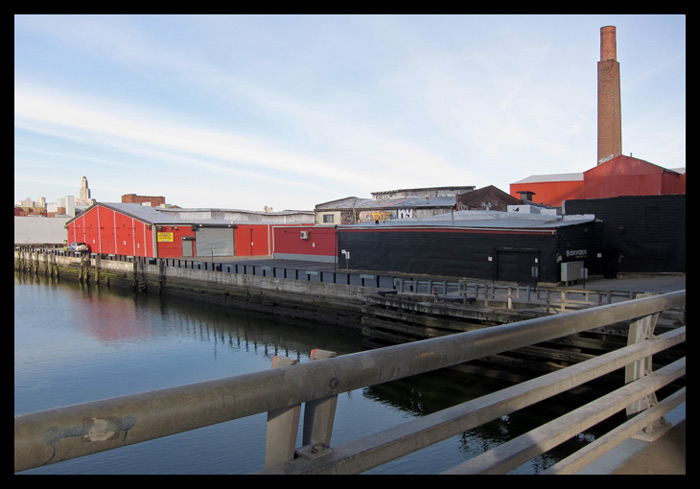
    As I crossed the bridge, I recognized the industrial building complex that housed the space that sponsored a fire performance I attended. For that evening, in a bizarre and unusual transformation, the metal working facility became the Gowanus Ballroom.

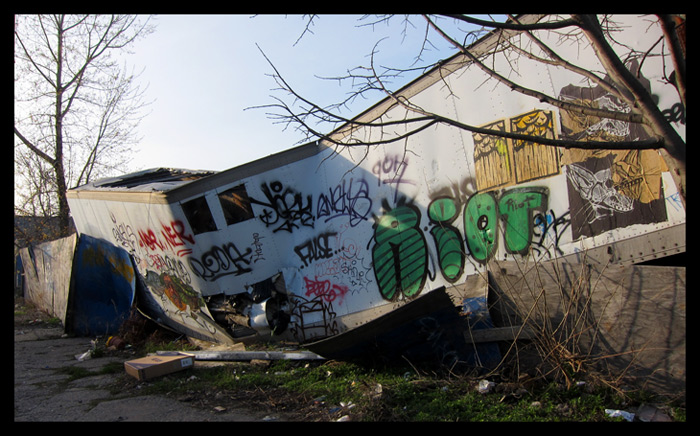
    As I approached the end of the short block, I was welcomed by a wrecked tractor trailer, folded in half and now being used as a canvas for graffiti.

    At the very end of street was an upright rowboat. A banner proclaimed:

    Welcome to the Gowanus Canal

    Brooklyn’s Coolest Superfund Site.

    It was not immediately obvious that the entire area was a boat launch for the Gowanus. However, a poster mounted inside the boat, Canoeing & Superfund Tourism Map, indicated that, indeed, the Gowanus was a Superfund cleanup site (designated by the U.S. Environmental Protection Agency) and this was the 2nd Street Canoe Dock. The map brimmed with enthusiasm and outlined 18 sites for the canoeist to explore.
    Looming in the distance across the canal was an enigmatic deserted building. Later, after my visit, I learned that this was the infamous “Bat Cave”, a story in itself.

    While exploring 4th Street, I passed a tiny, charming one-story house, perhaps a lone candidate in all Gowanus that could be called adorable.

    A woman was in front, tending to various chores. I assumed she was the owner and asked. She affirmed. I complemented her on her cute, tidy dwelling and asked, “Is this area considered Gowanus?” “Yes” she said. I offered what I had heard for some time in the media: “This area has been referred to as the future Venice of New York.” She laughed and said, “They have been saying that for a long time.” I agreed and canvassed the area one last time, wondering if and when Gowanus and its canal would live up to its promise as Little Venice

    Related: No Pane at All, Europe?, Not Under the Gowanus, Part 1


  • Only One Stop from Manhattan

    Perusing my archives, I came across this series of images, unused for this website. All were taken in DUMBO in 2006, the inaugural year for New York Daily Photo. The photo series illustrates the dramatic scenery in this Brooklyn neighborhood and what draws people there. The Brooklyn and Manhattan Bridges, East River and Manhattan vistas, a rocky beach, superb post-industrial architecture, and cobbled streets, all packaged in a sequestered corner of New York City, yet so conveniently located by public transportation. With so many pluses, it’s so easy to sell. You can hear the broker’s pitch now, flaunting his trump card – and it’s only One Stop from Manhattan


  • Island Nation

    Recently, while in Queens, I took a quick spin around Roosevelt Island. It had been years since my last visit, and the lure of an island is irresistible to me. Most of the city’s other smaller islands are inaccessible to the public. Roosevelt Island is located in the East River under the 59th Street (Queensboro) Bridge. However, the island is not accessible from the bridge directly. From Manhattan, the island can be accessed by the Roosevelt Island Tramway or, since 1989, the F train subway. Getting there by motor vehicle will necessitate a trip to Queens and then the short lift bridge, Roosevelt Island Bridge, which connects Astoria, Queens, to the island.

    Traffic is permitted on the island, however, auto traffic was not part of the island’s planning, and a number of the island’s primary sights, such as the lighthouse and the smallpox hospital, are accessible only by foot, bicycle, or public bus. The big draw here for the visitor are the spectacular vistas from around the island – Manhattan, the river, bridges, the tram, Big Allis, Queens, U Thant Island. On the island, there is the historic Blackwell House (1796), the Octagon (once the main entrance to the New York City Lunatic Asylum), the Blackwell Island Lighthouse, the Chapel of the Good Shepard, and the amazing, enigmatic ruins of the Smallpox Hospital.

    I always loved islands. At one time, I dreamed of visiting the South Pacific, perhaps living on a remote, idyllic tropical isle like Fatu Hiva. But New York City is the archipelago I have chosen, a world unto itself and virtually an Island Nation :)

    Related: Manhattan Island


  • They’ll Go Broke

    My mother had called very alarmed that a member of our extended family would go broke. He had been on a shopping spree. She accused him of being reckless with his money – he had purchased Calvin Klein sheets for his entire house. She did not understand the math behind the assets of the extremely wealthy. I went over some numbers with her and estimated the monthly return on the money that I guessed he might have. I showed her how he could likely buy a new house every few months with interest alone. In awe, she repeated this information to my father. However, she then just went on to show concern that this family member might still go broke.
    More recently, an incident echoed the same type of lunacy. A friend told me of a mutual friend’s concern that she was witnessing a myriad of NYU students charging every manner of food or small purchase and that surely they’ll go broke. This was more ludicrous than my mother’s comment since this woman was college educated and surely should understand the underlying economics. NYU now costs a small fortune and parents are typically funding educations and giving their children credit cards for everyday expenses. How are even hundreds of $5 coffees going to break the bank of a family spending $40,000 per year for tuition alone? They’ll go broke has become a private joke with the friend who told me this tale.

    New York City is awash in money, so much so that it befuddles the mind of the average wage earner. There are people who seemingly have access to an endless fountain of money. For them, the cost of things is completely irrelevant. Budget is not part of their vocabulary. Purchasing decisions are only based on what they want, not what they can afford. Even in a poor economy, expensive restaurants are packed.

    There is no better example of the wealth of city residents than Manhattan real estate. In July 2012, an apartment went on the market in Manhattan that had the highest asking price in history – $100 million. A townhouse here typically fetches at least $10 million. A two-bedroom apartment can run $2 million plus.
    Tuesday night I was strolling only a few blocks from my home in NoHo on the cobbled Bond Street when I discovered an very imposing building with an extremely ornate skeletal front. It was the ultimate in gleaming glitz with an enormous door. I noted the address – 40 Bond Street.

    The developer was no other than the legendary Ian Schrager, co-founder of Studio 54. Schrager lives in the property itself in a penthouse valued at least $50 million. Everything about the condo development with its signature Coke bottle-green glass exterior screams luxury – 11-foot ceilings, dual gas and wood-burning fireplaces, wide plank oak floors, top of the line everything, and concierge services provided by the Gramercy Park Hotel on 24-hour call.
    A cast aluminum gate – 140 feet long by 22 feet high – is graffiti-inspired. Apart from the 27 loft-style apartments, the building has five, three-story townhouses with 22-foot-high living rooms, front yards behind the gate along, and private gardens at the rear of the building. The 11-story property was designed by the renowned architectural firm and Pritzker Prize-winning Swiss duo Herzog & de Meuron in their first ever project in New York City. Opinions vary dramatically, as would be expected. Everything from positives to expletives. A block resident since 1958 called it “Frank Lloyd Wrong.”

    All this conspicuous consumption, flagrant displays of wealth, ostentatious trappings, and arrogance that often accompanies the rich New Yorker is what gives many a distaste for this city and everything and everyone in it.  An understandable feeling that in New York, it’s all about money. For these, there will be little concern whether the residents of 40 Bond Street are living within their means or They’ll Go Broke :)


  • Giraffes in a Canoe

    There are places that are decidedly the other side of the tracks, and Grand Street in SoHo has been one of those places. As SoHo gentrified, Grand Street, only a block from the honky tonk Canal Street, retained a frontier feeling. Rents remained much lower than Prince and Spring streets – prime SoHo. It was here that Broadway Panhandler relocated when their prime SoHo rent became too onerous.
    Even today, Grand Street retains vestiges of a former time and businesses that service the working class and industry. At the corner of Thompson Street, one can still find John De Lorenzo & Bro., Iron and Sheet Metal Contractor.  Across from the French Culinary Institute at 458 Broadway was the previous site of the Singer sewing machine company’s first headquarters and showroom, built 1857. At 175 Lafayette and the corner of Grand Street was a supplier that I once frequented often: Rudolph Bass Woodworking Machinery & Supplies, founded 1918. At 183 Grand is the John Jovino Gun Shop, a sole survivor of the gun district near the Centre Street police headquarters. At 176 Grand is the home of Lendy Electric, a classic hard-core New York-style contractor’s supply house.

    The street bridges a variety of neighborhoods – SoHo, Little Italy, Chinatown, and the Lower East Side. The street is home to Ferrara’s Bakery and Kamwo Pharmacy. Heading east through Chinatown, there are numerous Chinese and Vietnamese supply shops and restaurants. Further east, once will find Kossar’s Bialys and the Doughnut Plant. The merchants are a smorgasbord – a worthwhile excursion for any urban explorer. For a virtual walk down Grand Street and as a guide, I recommend NY Songlines.

    Tuesday night, a group of us discovered Loopy Mango at 78 Grand Street, strictly by happenstance. This quirky, eclectic retailer came as a very pleasant surprise. The shop sells home goods, furniture, antiques, textiles, clothing, gift, specialty yarns, and knitting and crocheting supplies. The owners, Waejong Kim and Anna Pulvermakher, met in a fabric painting class at New York’s Fashion Institute of Technology. Loopy Mango was founded in 2004 in a tiny storefront on Avenue B in the East Village. They moved to DUMBO and in 2010, they moved back to Manhattan to their current 2000-square foot shop at 78 Grand Street.

    Original 1880 Victorian shutters enclose four dressing rooms and are complemented by a tin ceiling detail. Continuing through the boutique to the backroom, one is greeted by a 15-foot skylight and purpose-built partition encased by replica ionic Roman columns. The interior of the space was designed and built by Waejong and her husband, Eric Schultz, an antiques dealer from Massachusetts. The shop also offers knitting classes and workshops.

    For an urban jungle safari, take a long walk down Grand Street. After all, where else do you find a place called Loopy Mango with seven Giraffes in a Canoe?


  • Vacancy

    Given the real estate values in New York City, it is completely baffling to see properties unoccupied for years. Perhaps some of the best examples in Manhattan are properties in the estate of Bill Gottlieb. I had the privilege of meeting this eccentric man in the 1980s when I was looking for commercial space for my business. I had been enamored with the prospect of renting a small one-story garage and was intrigued that all of them bore the name of Bill Gottlieb as agent/owner. I met him and toured a number of properties in his signature old station wagon with cracked windows taped together. Little did I know that this man’s estate was valued in the hundreds of millions.

    Recently, I read about the Spook House of Williamsburg on the Forgotten New York website. So, curious to see the place for myself, I took an excursion to 539 Driggs Avenue in Williamsburg, Brooklyn. The storefront appears to have been abandoned for some time and is framed with a weathered wood exterior. A flag graces the front door and venetian blinds cover all the windows. Little seems to be known about the property, and most online searches trace back to the Forgotten New York website, where information is sketchy. It’s another mysterious case in New York City real estate of unexplained Vacancy


  • Up the Ante?

    I once met a Brooklynite who insisted that Brooklyn was a city. The central defense of his argument was a sign on the Belt Parkway that proclaimed, “Welcome to Brooklyn 4th Largest City in America.” I explained to him that the sign was meant to say that IF Brooklyn was an independent municipality (which it was until 1898), it WOULD be the 4th largest, but that Brooklyn was a borough of New York City. Unfortunately, my words fell on deaf ears. The individual’s belief was resolute and like the fundamentalist Christian, he was taking a literal interpretation of the words. Metaphors were apparently not part of this man’s world, particularly in this case of civic pride which clouded all reason and his ability to see Brooklyn as anything other than the greatest place on earth.

    However, his pride is understandable. Brooklyn has some of the richest history in New York City and many of its most enduring icons, notable history, and contributions to American culture, whether film, TV, literature, music, art, or architecture. Coney Island, the waterfront, Brooklyn Heights, the Dodgers, the Brooklyn Botanic Gardens, the Brooklyn Museum, Brooklyn Academy of Music, DUMBO, Prospect Park, Green-Wood Cemetery, Pratt Institute. Brooklyn is also a badge of honor for many who have achieved worldly success and risen from inner city working-class roots. It’s a place that many are proud to be from.
    The legendary sign, which greeted motorists on the Belt Parkway in Brooklyn in the 1970s, achieved its iconic status in the opening title sequence of the popular TV series Welcome Back, Kotter. The show also launched the career of John Travolta, later to star in Saturday Night Fever, based in Bay Ridge, Brooklyn. The last remaining of the three versions of this sign found a home in Gargiulo’s restaurant after the retirement of Brooklyn Borough President Sebastian Leone. Gargiulo’s owner Nino Russo was persuaded by Borough President Marty Markowitz to donate the sign to the city. It now hangs in Brooklyn Borough Hall.

    I have seen street performers cleverly play on this borough pride and rivalry. While taking a contribution, the performer would ask and announce the borough from which the audience member was from, the amount, and also brandish the currency, taunting the audience and challenging someone from a rival borough to make a greater contribution. This would escalate to a virtual bidding war with single contributions going to $5, $10, or more. Some may say this is all in good fun, and certainly all participants are willing victims. However, I find this aggressive money pitch highly manipulative, akin to creating a bidding frenzy like that found in an auction, where bidders lose control. Nonetheless, it certainly illustrates the civic pride in the boroughs of New York City and that some are willing to pay hard cash for one-upmanship.

    Recently, I spotted the vanity license plate shown in today’s photo. I’ve got the KNGOFQNS here. Certainly there is someone from Brooklyn who can do better than that. Isn’t there anyone from the 4th Largest City in America who wants to Up the Ante?


  • This Hood is a Done Deal

    I recall a conversation many years ago with an artist who lived in Brooklyn and said that she found Manhattan over gentrified and fundamentally uninteresting. I was angry, defensive, and took this as sour grapes from someone who was not fortunate enough to live in Manhattan. After all, Manhattan was a mecca for so many human endeavors and the center of the universe, was it not?

    Unlike the stereotypical Manhattan resident, I have visited Brooklyn in Queens often. And, over the course of the last six years that this website has been in existence, I have spent much more time in the outer boroughs, exploring and canvassing for subjects and potential stories. Now, in fairness, I must admit that the cultural brew in Brooklyn and Queens feels much richer than that of Manhattan, which has become more much more business and tourist oriented. If you seek an authentic New York and ethnic enclaves, the outer boroughs are where you must go. Neighborhoods such as Jackson Heights, Astoria, Richmond Hill, or Flushing in Queens and Borough Park, Sheepshead Bay, or Bay Ridge in Brooklyn have virtually no parallel in Manhattan, save Chinatown. In these neighborhoods, you will find a variety of merchants and restaurants catering to the local ethnic groups.

    Regardless, Manhattan residents are a remarkably and classically xenophobic bunch, so you know things have changed when Manhattanites start traveling to Brooklyn for cultural and recreational activities. There are plenty of good reasons: the Brooklyn Museum, the Mermaid Parade, Coney Island, Dead Horse Bay, Floyd Bennett Field, the Queens Farm, the Queens Museum, Flushing Meadows – Corona Park, and perhaps one of the biggest draws and hottest neighborhoods in the five boroughs, Williamsburg.

    You know things have really changed when, on a weekend, one Manhattanite runs across the dyed in the wool East Village icon, David Peel, in Williamsburg, Brooklyn, who both have crossed that river into another borough looking for a change of pace. Walking down Bedford Avenue, the main commercial artery of Williamsburg, I spotted David in a local pizza parlor, wearing his signature John Lennon-styled sunglasses.
    The neighborhood has gone through remarkable transformations and even has a lively street scene with street performers, unusual outside of Manhattan. David knows me from our frequent meetings in Washington Square Park as well as the stories I have done including him as a subject. I spoke to him briefly about the irony of meeting in Brooklyn. He showed little surprise at all, knowing that Williamsburg was obviously the place to be. After all, New Yorkers love the hot new place and This Hood is a Done Deal :)


  • Another Time

    Every year, I miss or almost miss my favorite street fair. It is located arguably in the most bucolic setting in Manhattan – in the West Village, occupying Commerce, Barrow, and Bedford Streets between 7th Avenue South and Hudson Street. There are hundreds of street fairs annually in New York City. However, most of these are run by corporate entities. In 2007, I wrote about these fairs:

    This is the typical NYC street fair. To the uninitiated, it looks like fun. However, after doing a few of them, they are very boring. The problem is that you see the same vendors at virtually every fair, most of them of little interest – socks, gyros, small tools, bedding, Peruvian sweaters, imported crafts, CDs, smoothies, T-shirts, etc. The residents I know mostly ignore them, perhaps getting an occasional snack. A recent research group put it perfectly: “The fairs had lost all sense of novelty, catered too heavily to out-of-town vendors and failed to showcase the work of entrepreneurs and artists based in the five boroughs…The worst part is that they are uniformly bland.”

    Nothing much has changed. I typically avoid these fairs, yearning for something of quality.

    On Saturday, May 19th, I attended the 19th Annual BBC Village Crafts Fair and the 38th “Ye Olde Village Fair” – it was just the antidote to the street fair blues.
    The fair is sponsored by the Bedford Barrow Commerce Block Association (BBC), the oldest and largest block association in Manhattan. It has over 300 members and is easily one of the most active community organizations in New York City. Their efforts include tree plantings, historic building plaques, and the Annual Hudson River Boat Ride.

    One of the keys to the quality of merchandise sold at the fair is that participants are juried, something that New York City fairs could use more of. Left unchecked, street fairs end up pandering to the lowest common denominator – fast and easy money selling schlock.

    In past years, tables were set up for dining. Wine was served – a rare and extraordinary thing in New York, particularly to manage and prevent drunken revelry ala Duval Street in Key West, Florida. There is live music, fresh lemonade, and homemade ice cream. Vendors of quality crafts line the tree-shaded streets. This year’s festival was also blessed with absolutely perfect weather. I was transported to Another Time :)


  • An Exit Marked Memory Lane

    Do you want to look like a hero and everybody wins? It’s so easy. Just take a friend or two on a trip down THEIR memory lane, touring the special places of their youth. On January 11, 2012, I went on such a trip through East New York, Brooklyn, driven by an old friend. But now, I was to be the driver and guide.

    This was my unplanned agenda for Easter Sunday (after the Easter Parade), when I accompanied a friend and her mother to Bay Ridge, Brooklyn, for Easter dinner. Before dinner, we decided to take advantage of the extraordinary weather in the mid-60s and see the places of my friend and her mother’s where they were born and had grown up.

    This type of mission is not about efficient driving, nor will it necessarily be a tour of the scenic or architectural wonders of New York City. It will be punctuated by stops that have deep meaning only for your guests being toured and for the small number of others who at one time shared the same addresses.

    I accommodated every twist and turn, circling and back tracking, zigging and zagging, providing chauffeur services – convenient for them and enjoyable for me, since I was at one time a New York City taxi cab driver. Patience is required for such a mission, since often only foggy or partial memories are available as a guide to locating addresses. There were places which were of zero difficulty to locate, such as my friend’s former grade school, P.S. 102, and the church where her parents married, Our Lady of Angels.

    A special treat was Owl’s Head Park, a place which I had heard about and driven by but never actually walked in. This was special for my company, too, since my friend’s mother had taken her there as young as when she was one year old, their residence only one-half block away. The waterside park affords vistas of the bay of New York, the Verrazano Bridge, Staten Island, Memorial Pier, and the skyline of Manhattan. We took in the views while basking in the warm afternoon sun setting over the bay.

    Other stops were the former homes of parents, grandparents, brothers, and sisters – this is an Italian family with deep roots in this section of Brooklyn. Some exact addresses were known. For others, we became Big Game hunters, tracking our quarry. Details of buildings were examined, proximity to other buildings and shops, all with a singular goal – to identify with absolute certainty that, yes, THAT’S the place.

    Like a modern African safari, our trip through the urban jungle was to see and shoot our game with eyes and cameras only. Once positively identified, we would sit and look as my guests would ooh, aah, and reminisce. And that is how I spent my Easter afternoon. Starting on the highways of New York City, I watched the sign posts, looking for An Exit Marked Memory Lane :)

    Related Post: Wherever You Go, There You Are


  • Childhood Dream

    She said she wanted to find the “mushroom house” she knew as a child, a very special place where her father often took her growing up in Bay Ridge, Brooklyn. The memories of childhood are clouded and skewed, and I doubted that we would find such a house or, if we did, how long it would take. But her instincts were good, and what I truly anticipated to be a long and likely fruitless search mission turned out to be a very quick drive, almost like she was guided by a secret hand straight to our destination.

    But nothing would prepare either of us for what we saw. As I turned up 83rd Street and pointed out a “nice” house, she cried for joy, “That’s it.” It was much larger than her memory served her, and she was elated, to say the least. The home is extraordinary and, as I surmised, no secret at all. It was designated a historic landmark by New York City’s Landmarks Preservation Commission. It is known internationally and referred to variously as the Mushroom House, the Witch’s House, the Hansel and Gretel House, and, most commonly, The Gingerbread House. The AIA Guide to New York City calls it:

    A mansion disguised as a witch’s hideaway. Black Forest Art Nouveau. Bumpety stone and pseudothatchery make this Arts and Crafts revival one of Brooklyn’s greatest fantasies.

    The mansion sports 6 bedrooms and 6 baths and is 5743 square feet and sits on 10 acres – unfathomable for New York City. It is constructed of uncut stone. The roof, with its rolled edges, is covered in special asphalt shingles the color of thatch, recalling the thatched roofs of English country manors. Inside, it exudes old world charm with beautiful woodwork, pictorials set into walls, enormous fireplaces, and decorative elements using medieval stained glass from Europe.

    The home is located at 8220 Narrows Avenue and spans between 82nd and 83rd Street. It was built between 1916-17 for Howard E. and Jesse Jones House and designed by James Sarsfield Kennedy. Howard Jones was a shipping tycoon, president of James W. Elwell & Co. and also a director and later vice president of the Maritime Association Board of New York. The house has changed hands only a few times and made big news when it was put up for sale in 2009 for $12 million dollars by the owners, Jerry and Diane Fishman, who lived there for 25 years. From the New York Post:

    But Jerry Fishman said it has held a fairy-tale-like spell over him his entire life growing up in the neighborhood, where he was born and raised. “My mother used to push me in my stroller past the house and one time I got out of the stroller and tried to get into the house,” recalled Fishman, 62.

    When he was a student at Fort Hamilton HS — across the street from the Gingerbread House — Fishman said he would sit in his English class staring out the window at the house as if in a trance. “My grades suffered,” he recalled. And on his first date with Diane, Jerry remembers driving her by the home and telling her, “One day I’m going to own that house.”

    And he did. From the Wall Street Journal:

    Mr. Fishman, who grew up two blocks away from the house in the Bay Ridge neighborhood, had his eye on the house all his life. “As the legend goes,” he says, “I knew of this house when I was six months old, and I was attracted to it like it was candy.” As he got older, his fascination with the Arts and Crafts-style house only grew. “I would walk by it, drive by it on purpose just to look at it,” he says. His first date with his future wife, Diane, included a drive past the house and a vow. “I told her, ‘I’m going to own this house,” says Mr. Fishman, now 61.

    Built around 1917 when Bay Ridge was, as the New York Post puts it, “an oceanfront getaway for the city’s rich and famous,”  the Gingerbread House has only changed hands a few times. In 1980, just after the Fishmans bought a home nearby, it came on the market. “We ran over here, and we looked at the house,” Mr. Fishman says, But he was disappointed. Two elderly women had lived in the home since the 1930s, Mr. Fishman says, and many sections of the home needed extensive work that he and his wife could not afford at that time.

    When the home came on the market again in 1985, they pounced, even entering a bidding war. The day the Fishmans closed on the house, paying under $1 million, “was the most memorable day of my life,” Mr. Fishman says. “We had the Gingerbread House.”

    The Fishmans sold the house in order to relocate near their parents in Florida. The fairy tale home that cast a spell on at least two people from childhood. For them, the chapter is finally closed – Jerry Fishman and my friend both found their Childhood Dream :)

    More homes: Big Secret on Little Street, Love Is All Around, Part 1, Grisly Business, Todt Hill, The Feeling Passes, Head for the Hills, All the Way…, Affront to Dignity, Manhattan Beach, Itsy Bitsy, Bloomberg, Terrapin Chelsea Art Gallery


  • A Furrowed Brow

    I was walking with two friends, touring them by what I felt was the most beautiful prewar building in Greenwich Village: 43 Fifth Avenue. This architectural gem is a grand and elegant 1903 Beaux-Arts building which sports a distinctive mansard roof. The property just screams PARIS. I have learned that this building is not just my little secret but also, in fact, highly coveted. There is little turnover/availability of apartments, and a number of celebrities, past and present, have called it home.

    At the time, an entire floor was available at the unfathomable price of $17 million dollars (reduced from $25 million). That’s a lot of money for an apartment. It does however, buy you 13 rooms – 5 bedrooms, 4 1/2 baths, and everything imaginable, even with a recording studio.

    On the same evening, we strolled down my favorite block in the center Village: 11th street between 5th and 6th Avenues. As my friend Bill, also a long-time Village resident, and I concurred on the number of reasons that made this block special, a For Sale sign appeared for a small, exquisite townhouse. I joked that he and I would be buying the building in partnership, splitting the floors, and that he look up the price immediately on his iPhone. A quick search of the broker’s listing returned the bad news very quickly: asking price, $14 million for the small townhouse.

    And so it goes in Manhattan. Many non-city residents, accustomed to the idea of owning a house, are unaware that this cornerstone of the American Dream – private home ownership – is essentially unattainable here except for a very few who are able to come up with 10-40 million dollars. Even in the outer boroughs, single-family homes are quickly becoming unaffordable for any except the very well heeled. With few apartments currently under one million dollars in Manhattan, these prices for entire townhouse should come as no big surprise.

    So sales of these homes have become newsworthy events, often purchased by notables. Spending time at the Central Park boat pond years ago, I learned that Woody Allen had decided to join the ranks of home ownership, making the move from a Fifth Avenue penthouse apartment to the purchase of a property at 118 East 70th Street. From a Streetscapes article by Christopher Gray of the New York Times:

    In 1939, Fortune magazine called it “probably New York City’s most beautiful residential block,” and Paul Goldberger, in his 1979 book, “New York: The City Observed” (Random House), described it as having “a perfect balance between individuality and an overall order.”

    Regarding the property purchased by Woody Allen in 2006 for $26 million:

    The neo-Georgian house at 118 East 70th was designed by Trowbridge & Livingston in 1900, with a spectacularly wide fanlight; the rippling surface of the glass dances and glistens in the sun.

    So I toured the block in 2006 to see for myself what all the hoopla was about and why this one city block, between Park and Lexington Avenues, has been considered by some to be one of New York City’s finest. Today’s photos are from that visit. At the time, construction was under way on Woody’s house (lower left and center photos).

    I know what many of you are thinking. Manhattan is a very nice place, and 70th Street looks like a very nice block, but $26 million for a small house? Even as a long-time resident of New York City, and inured as I am to the lust for this borough and stratospheric prices, I share A Furrowed Brow :)

    Related Posts: Old New York (Part 1 and Part 2), The Feeling Passes, When Worlds CollideAir Rights, 121 Charles, Grove Court, The Dakota, Kerbs Boathouse


  • High Noon

    My tagline for this blog avoids a few very applicable cliches. It could easily read something like “New York City – a place of contrasts and juxtaposition.” True or not, it’s one of those claims that many want to make. I cannot argue that New York City leads the world in contrasts; travelers to places like Egypt speak of the extreme contrasts unknown in the United States, such as disembarking from a plane and seeing the pyramids of Giza, or camels and limos in the streets of Cairo.

    In the United States, we cannot compete with contrasts based on age. However, in New York City, there are remarkable cultural and ethnic pockets, with shops and services often juxtaposed in startling ways. Looking into my vault of photos, I found today’s images from July 2011, when I paid a visit to Woodside, Queens.

    On or near 55th Street, in two short blocks, you can have you taxes done, bookkeeping, find a notary, pray at the local Masjid Fatima mosque, or get your fresh fowl at the Bismillah Live Poultry. From their website:

    We are in business since 2002. All our poultry items are slaughtered Under Muslim rules & regulations (100% Halal). We are a proud member of Shariah Board of USA. All our chicken are naturally grown, no hormone or steroids used and they are tested by USDA.

    In this industrial warehouse district, you will also find Sapori d’Ischia, an Italian foods retailer that becomes a highly regarded restaurant at night. ABC has a rental facility there, as well as Saks Fifth Avenue.

    The live poultry business is always the biggest shocker for me to see in New York City. When I started this blog in 2006, I was particularly driven to show things of dramatically disparate natures. I had recalled passing a live poultry dealer on the Lower East Side, and one of my first postings was of a Live Poultry Market on Delancey Street, which I believe is now closed. At one time, there was even a live poultry dealer in the South Village, only blocks from my home. These things are often taken for granted at the time, and once gone, I begin to question my own memory of something so seemingly out of place in Manhattan.

    As I explored the streets of Woodside that Sunday in the hot summer sun, there was very little activity, even by locals. The streets were deserted. Some of the backroads hearkened to the Old West. At any moment, I expected tumbleweed to blow through, had there been a breeze. And maybe out of that New York-styled Wild West would be our own Wyatt Earp, just back from Masjid Fatima toting a sixshooter on one hip and live poultry from Bismillah on the other. And that’s New York City at High Noon :)


  • dinamic_sidebar 4 none

©2013 New York Daily Photo Entries (RSS) and Comments (RSS)  Raindrops Theme