• Mermaid Parade 2012, Part 2

    Posted on by Brian Dubé

    Pièce de Résistance (see Part 1 here)

    The costuming efforts of marchers in the annual Mermaid Parade run the gamut, from the simple but effective to the outlandish where no detail is left to chance. This year, as always, there were all the requisite sea creatures, maritime themed costumes, and, of course, plenty of mermaids. But in all the years I have attended, I have never seen the attention to detail as that in the costuming of Darrell Thorne and his partner.

    I strolled the boardwalk after the parade’s completion – a better time and opportunity to mingle and see closeup the various paraders and their costumes. I became aware of a huge throng. As I approached and worked my way into the crowd, I found what was essentially a feeding frenzy of photographers, elbowing and jockeying for position. I found the subjects of everyone’s fancy and awe – two individuals posing with the deliberate movements of experienced showmen and models, enjoying every bit of the attention, as they rightfully deserved for their extraordinary efforts.

    I spoke to one of the pair, who gave me his card which stated: Darrell Thorne –  Costume Makeup Performance. I subsequently learned that this was not Darrell’s first parade, nor was he a novice at his craft. As his card implied, this was the work of a professional, and in New York City, one expects the bar to be raised quite high in the world of fashion, costuming, and makeup.* For the 2012 Mermaid Parade, I had reached the summit with this Pièce de Résistance

    *I communicated with Darrell by email, and, typical of the many challenges to preconceived ideas one may have about New Yorkers, here is what I learned, in his own words:

    I was born the youngest of five boys in Branson, Missouri in 1976. When I was eight months old my father decided it was time to follow his dream of living off the land. He and my mother packed up their five children (the oldest being five years old) and moved to a tiny village called Red Devil, 300 miles north of Anchorage, in the Alaskan “bush”.

    The first five years of my life were spent living like the Swiss Family Robinson, but set in the pristine wilderness of Alaska, without running water, electricity, telephones, or many people to speak of, for that matter. One of my earliest memories is my father being away (on a hunting trip, I believe) and my mother at the window of our log cabin with a shotgun, all of us kids huddled around her as a black bear prowled in our front yard. The rest of my childhood was spent in tiny country towns in Missouri and Arkansas.

    I’m highly uneducated with no degrees beyond my high school diploma.  I studied dance seriously for several years and attended the Art Institute of Chicago for 1 (until I realized I didn’t actually have any money to do that).

    I’ve been in NY for 10 years – living in Bushwick for the past 3 (which I love).  After high school I spent time in Colorado, three years in Chicago, three in LA, and then to NY.

    I currently work as a hospital administrator by day at Beth Israel.  My hope and desire is to transition to a more creative career within the next few years.

    I have four older brothers and no sisters.  My parents are fundamental christians – my mother a retired school teacher and my father a jack of all trades.  My brothers are spread far and wide – one in LA, one in Denver, one in Portland and one in Helsinki.

    Growing up incredibly repressed in an extreme fundamental christian environment had a tremendous impact.  We never had a television, weren’t allowed to listed to pop music, and were largely isolated (psychologically) from our peers growing up. My parents belong to a small Calvinist religion called Independent Missionary Baptists, an extremely fundamentalist group who believe in Predestination and a 100% literal interpretation of the bible. Growing up there was no question that God was a stern and judgmental figure who would not hesitate to strike down and condemn to hell any and everyone who did not follow his commandments.

    WOW, Darrell, thanks for your candid revelations. Another lesson that in New York City, regardless of one’s instincts or insightfulness, it is best to Abandon All Preconceived Notions, Ye Who Enter Here.

    Previous Mermaid Parade posts: Mermaid Parade 2006 P1, Mermaid Parade 2006 P2, Mermaid Parade 2007 Part 1, Mermaid Parade 2007 Part 2, Mermaid Parade 2009, Mermaid Parade 2010, Mermaid Parade 2011 Part 1, Mermaid Parade 2011 Part 2

    Posted on by Brian Dubé

  • Mermaid Parade 2012, Part 1

    Posted on by Brian Dubé


    This is the 6th year I have attended and photographed the annual Mermaid Parade on the boardwalk by the ocean at Coney Island. Every year it is becoming larger and a little more difficult to negotiate through. I spent my time at the exit area for paraders, as you can see in my attached video. An entire city block is closed off, and with paraders milling about, it is much easier to mingle with and photograph parade participants. My favorite parade – highly recommended.

    The weather was beautiful and there was lots of creativity as usual, but in Part 2, I will reveal this year’s Pièce de Résistance

    See my complete Flickr gallery of parade photos here.

    Previous Mermaid Parade posts: Mermaid Parade 2006 P1, Mermaid Parade 2006 P2, Mermaid Parade 2007 Part 1, Mermaid Parade 2007 Part 2, Mermaid Parade 2009, Mermaid Parade 2010, Mermaid Parade 2011 Part 1, Mermaid Parade 2011 Part 2
    Posted on by Brian Dubé

  • The French Connection

    Posted on by Brian Dubé

    I had read that it was the dream of many Parisians to retire in Aix-en-Provence in the south of France, sometimes referred to as the city of a thousand fountains. It is also a city known for its many educational institutions. Its idyllic Mediterranean climate befits the Cours Mirabeau, the central artery running through the town. The wide street is beautifully shaded with double rows of plane-trees and flanked by elegant mansions built by nobility in the 16th, 17th, and 18th centuries.

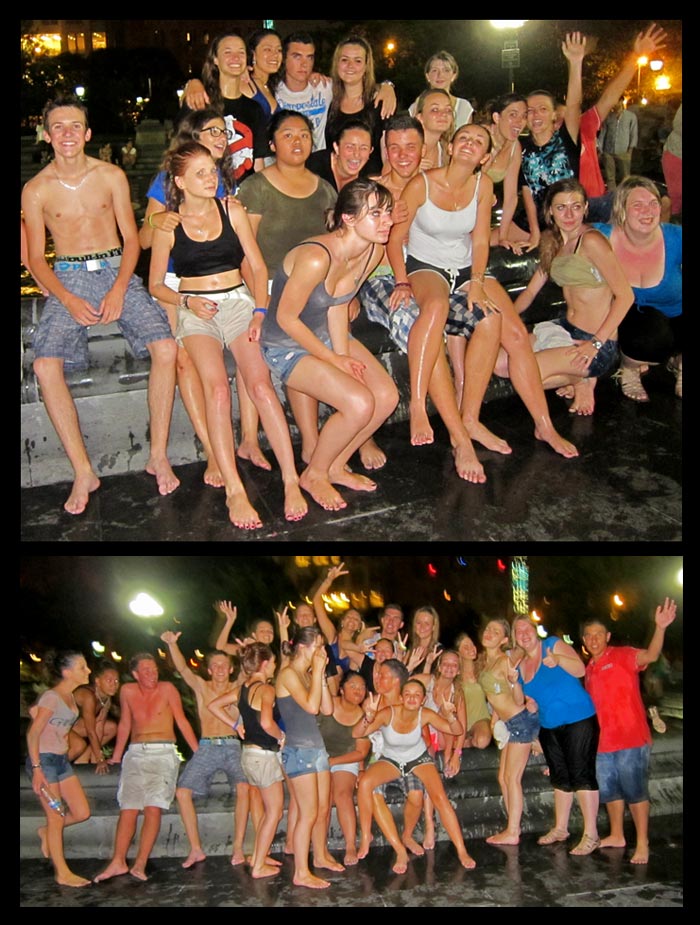
    This tunnel of greenery is accented by fountains and lined with cafes. It was here, on one visit to France, that I witnessed what I told was a tradition in town among students. A group of recent grads was cavorting along the Cours near a fountain. Soon it became a virtual water park, with boys grabbing girls, shrieking and writhing, and dowsing them in the fountain pool. I had mixed feelings about the entire happening, which tasted a bit like involuntary fraternity hazing. Were they really having fun or bending to peer pressure? But I make an effort to be as non-critical as I can of cultural differences when traveling, lest I become another ugly American, like the man I featured in So Where’s David?

    The last two days have been intolerably hot, with daytime temperatures near 100 degrees. There is little escape from summer heat in the city – New Yorkers find themselves shopping or staying indoors until the heat passes. Many, whether owing to lack of air conditioning or cabin fever, take to the streets and parks, invariably gravitating towards water. Such was the case last night in Washington Square Park.

    I was taken by surprise to see an enormous group of teenagers replaying the Aix tradition. Although cavorting in the fountain in Washington Square Park becomes de rigueur during heat waves, I have rarely seen instances of forced dunking and certainly not like Thursday night. Soon, dunked or not, virtually everyone was soaking wet.  I was also surprised that in 2012, it was still a guy-gets-girl thing, owing perhaps to France’s greater tenacity to customs rather than cultural change.

    I was intrigued at the grouping and asked a number where they were from. I was told Monaco. I learned, however, that this was said as a matter of convenience, since they expected few to know the smaller town they were actually from. I met Christophe Boule, a teacher of English, who was one of the four adults supervising this group of high school students. The students had finished their academic year and were on a class trip to New York City – an annual tradition for their school. They were staying at the youth hostel in Manhattan on the Upper West Side. They were in fact not from Monaco but from Menton, near the Italian border. Menton is a delightful small city on the coast which boasts the warmest climate in France. I had passed through it once and always wished to attend their annual lemon festival.

    When I initially approached Christophe and the other adults, they were understandably reticent and suspect of a stranger in New York City asking many questions. Their fears became slowly assuaged – my business card did a lot to establish credibility as a writer and photographer. After all, these things are often claimed by miscreants looking to get over on the innocent. One adult noticed that my last name was French. I confirmed that heritage. Now the attitude was rapidly changing.Our discussion turned to my enthusiasms about France, particularly my obsessions with medieval perched villages in the south. Now I appeared to be sérieux and truly interested in French culture.

    Soon, all was well. The Cours Mirabeau in Aix, the customary fountain dunkings, my passion for all things French, my obsession with French villages, my visit to Menton. How serendipitous and fortuitous. New York City is such a befitting set for a remake of The French Connection 🙂

    Posted on by Brian Dubé

  • There Was Cream

    Posted on by Brian Dubé

    If you’re looking for that small, quaint, authentic, great place known only to neighborhood regulars in New York City, most likely you are not going to find it. The nature of communication as well as print and electronic media makes it nearly certain that such a place would be discovered quickly both by patrons. And, savvy owners/management will learn all too quickly about the value of buzz and will market and promote it to near death. Or at least develop an attitude and arrogance, fueled by the lines to get in.

    This is the unfortunate reality. Nonetheless, I, like many, do seek out the “secret” New York and the special places that may have at least some of the old world charm that many of us love. Places at least not overrun by tourists. Admittedly, most of these quests are driven more by nostalgia and the belief that things were Better When.
    In a world of instant gratification and a city of endless eateries, snacking on the go, particularly ice cream, has become the norm. There are numerous high-quality artisanal makers of ice cream in New York City, many of whom I have written about – Cones, Van Leeuwen Ice Cream Truck, Amorino, etc. Most business is takeout or from trucks.

    Old-fashioned ice cream parlors are another matter altogether. Here, a number of factors conspire against their survival – trends, competition, a more mobile populace, escalating rents and costs, and high-quality packaged products available at stores everywhere.

    Most searches to find old and authentic business establishments will take you out of Manhattan into the outer boroughs. A recent journey to Brooklyn for a birthday celebration led me to search for an after-dinner dessert place. Ironically, unbeknownst to me or my dinner companions, the place I located online, Anopoli Ice Cream Parlor and Family Restaurant at 6290 Third Avenue, turned out to be the very same place they had frequented 40 years before, around the corner from where they had lived in Bay Ridge. It was quite the walk down Memory Lane for them – I love expeditions with NYC natives to the places of their youth. It’s a window to a world gone by.

    Anopoli was not just a restaurant or cafe, it was an old-fashioned ice cream parlor, which suited all of us quite fine – after all, who does not like ice cream? Searching for an old-fashioned ice cream parlor in New York City is nearly an exercise in futility – nearly all have disappeared. Only a handful survive in all five boroughs (including Eddie’s in Forest Hills, Queens), and this is one of them.

    As a topping, the owner, Manny, was on hand. Manny Saviolakis took over the place with his father Steve in 1995. Anopoli celebrates 115 years in business in 2012 – the business still has some elements of the original decor. Anopoli has not succumbed to the ill effects of being a living legend or enjoying iconic status. The atmosphere is decidedly casual and old-school. The prices and portion sizes are a great value, particularly by Manhattan standards. The service was good, and we were not rushed – unlike a trendy place, where one feels a tremendous pressure to vacate and make room for the masses of patrons waiting to get in. Here, I chatted with Manny and our waitress, who was a family friend.

    It was a very pleasant way to spend an evening. Everywhere you looked, whether frozen, whipped, or as wall decor, There Was Cream 🙂

    Related Posts: When Your Name is Mud, il Laboratorio del Gelato

    Posted on by Brian Dubé

  • In the Allagash

    Posted on by Brian Dubé


    I had been told about the Allagash since childhood – it was enigmatic. Few details were given, most likely because few were known, but the mind of the child went where no info was given. There were stories of big, scary woodsmen who would no doubt do something horrible and yet to be named to any visitor. I was all the more intrigued. On one visit to northern Maine, my uncle, a resident of Eagle Lake, assured me that those inhabitants would pose no problem at all. My father and mother remained steadfast in their view and threw their hands up in despair over a son who apparently was determined to explore the inner world.

    The Maine North Woods region (which some call the Allagash, a river and wilderness waterway) is an extremely large and unusual area, relatively unknown to outsiders and even to many current and former Maine residents, yet it occupies roughly one-quarter of the state, an area of over 5,000 square miles, approximately the size of the entire state of Connecticut.

    What is unusual is that the area is predominantly privately owned by a number of timber corporations. Within its borders, there are no towns, only unpaved lumbering roads. A small area, the Allagash Wilderness Waterway, a state protected region, lies within the Maine North Woods.
    The Maine North Woods is open to visitors – naturalists who go there to fish, canoe, and explore one of the most isolated and last true wilderness regions of the United States. It is accessible via various checkpoints and a very nominal entrance fee.

    And so it was some years ago that I did at last make the decision to visit the area. I had rented a room in Greenville, Maine, where I spent time at Kokadjo, a remarkable restaurant that left an indelible imprint on my mind. It was from Kokadjo that I left for my exploration – I was forewarned by the owner that the roads were troublesome and best not toured in a passenger automobile. Undaunted, I was spurred on with just another in a series of warnings that were falling on deaf ears. I left excited, arrived at the checkpoint, and, with little ado, was heading north. I quickly learned why this wilderness area was not a top tourist attraction. The roads are dominated nearly 100% by enormous lumbering trucks with precarious loads of cut trees. The clouds of dust left behind as trucks roar down the dirt roads is HORRIFIC – I soon learned that the only way to navigate these roads was to stop and wait until the dust cleared before resuming. It was tedious and tiresome.

    But, no worry, my tedium was to be short-lived – within an extraordinarily short distance, I felt and heard the telltale signs of a dreaded flat. I REALLY did not want to deal with changing a flat here in the Maine woods – my car was layered in dust. To add insult to injury, I had developed a worrisome chronic squeaking sound. I had no choice – there were no inhabitants, no towns, no service stations. I was on my own, and I already imagined the chorus of “I told you so” on the future retelling of this story to my family.

    I exited the car and stood behind it, mustering the will to deal with the filthy job of changing a flat in the hot sun on a car consumed with dust. I had not stood more than seconds when the driver of a lumbering truck stopped, assessed the situation, asked for my keys, opened my trunk, and began to change the flat without even asking if I needed help. I was shocked how this complete stranger rose to the occasion without request or any obligation to do so. This was classic Maine spirit – in an environment where just breaking down in the harsh winter can be fatal, locals have learned that working together and offering a helping hand is necessary.

    The truck driver’s handiwork was done in no time. He assured me that my experience was common on roads littered with nails and other debris. He also assured me that the squeaking sound was nothing serious – it was due to dust in the brake linings from traveling the roads there, another common occurrence in these parts.
    However, I was dismayed that the spare tire provided on cars was no longer a duplicate of the standard, like that of olden times, but was now a small “doughnut,” designed to be ridden only a few miles to get one’s flat tire serviced. So my exploration of the Allagash was to be cut short. Back I went to Kokadjo to see what the general store may offer in the way of repair.

    I had barely walked in the door, and the owner immediately caught my eye and asked if I had gotten a flat. I was startled by his precognitive abilities as I got my first round of “I told you so’s.” Frustrated by my initial defiance, the owner toured me through his small retail store, locating a patch kit and instructing me on its use and the repair of steel belted radial tires.

    On Saturday, May 19, 2012, I was cruising my neighborhood for a parking spot. The seasoned New York City street parker will not only scan for empty spots, but will also canvas for idling vehicles and pedestrians making their way towards parked cars. As I approached Duane Reade on Waverly Place, I noticed a man in a parked car. I asked if he was pulling out. He said he would be, but only as soon as he got a jump for his car, which now sported a dead battery.

    If there is a God, I was now being tested. Beyond getting a parking spot, would I help this man for the right reason? And if karma really is operative, would I be propelled to make a repayment for the act of kindness in the Maine Woods? Knowing this man’s plight, it would be unconscionable not to offer assistance. I carry jumper cables, and boosting a car battery is only a few minutes work. This was an opportunity to soften the harsh world of New York City, a place certainly not renowned for benevolent acts.

    I learned that the owner of the car, Hasan Sims, had called a friend for help. I suggested that he call his friend back to avoid an unnecessary trip. I also learned that Hasan worked the night shift at the neighboring Duane Reade and had taken a nap in his vehicle. In the few minutes we worked to start his car, we spoke openly about the various motivations I might have in helping him. I assured him that although getting a parking spot was the primary goal, I was working on something new – being a better person. Unfortunately, time did not allow me to to tell him that I also had a debt to repay for a deed done by an unknown trucker In the Allagash 🙂

    Note to the intrepid traveler: I was finally to explore the Maine North Woods on a future trip, entering from the north at the town of Allagash, near the Canadian border.

    More about parking: Nice Move, Kid, Pull Ahead, WFF ‘N PROOF

    Kindness and rudeness in New York City: Random Acts of Rudeness, Area Code 714 (Part 1 and Part 2)

    Posted on by Brian Dubé

  • The Hollowest of Victories

    Posted on by Brian Dubé

    They may not have hopes and dreams, but they do have trials and tribulations. There are arguments, debates, frustrations, jealousy, yelling, and crying. There are attachments, relationships, and concern for others. There is a pecking order and one-upmanship. Be assured, that although this is the world of the homeless – disenchanted and disenfranchised – in many ways, it is no different than any other world.

    It was gray, rainy, and cold. Much too cold to be swimming outdoors. As I walked through Washington Square Park, a homeless woman was determined to go in the fountain pool. Her friend was not gaining any ground trying to dissuade her.

    She screamed over and over that she wanted to go into the water as he tried to talk to her and restrain her. She sat on the fountain’s interior steps and descended one at a time. She was severely drugged and unstable but strong enough to resist her friend’s efforts at keeping her out of the water. At one juncture, he looked at me and threw his hands in the air in frustration. I said to him that it was too cold and she may likely get sick. He responded by telling me he had told her just that, but he had given up. In a world where no one cares whether she lives or dies, what is she to do? Make a scene and try to capture the attention of any willing to watch and listen.

    Yes, this predicament – the drugs, her friends, her dead end life – are all her own doing. It would be unfair to say that she is down on her luck – better said, she is just down on her butt. But no matter, because at that moment in time, her pain and frustration was just as real as yours or mine. The three of us were alone in the rain, with an occasional passerby. No one seemed to care. She is disposable and will likely not live long. We are better off without her, are we not? Out of sight, out of mind. In this type of conflict, which I have seen played out often enough, even if violence erupts, the police will not arrest her – to what end? They would be told to leave and take their misery elsewhere.

    She finally reached the bottom, soaked by rain, immersing herself into that cold pool of water. Like an obstinate child having a tantrum, I could see that she was not really happy at all. She had won a hollow victory, making the whole thing even sadder. Here, in a fountain surrounded by one of the world’s most affluent neighborhoods, it is likely that some watched this entire ordeal from apartments averaging 2 million dollars.

    Telling this story makes me feel a little worse. I kid no one if I try to pretend that I feel their pain. I have never been so down that I sat soaking wet, crying as I descended into a cold pool of water on a gray rainy day at the end of my rope with no hope. It was The Hollowest of Victories

    Afternote: Later that night, I saw them under the park’s arch, playing out another confrontation, her soaking wet, lying on the grates with her friend trying to reason with her.

    More stories of the homeless: Ask Tommy, Looking for an Angel, Usually. Maybe. Probably Not., Caught in the Rain, Any Questions?, Crusties Are People Too? (Part 1 and Part 2), On the Road, Cosmetics, Crustie, Dead to the World, Stephanie, Caravan of Dreams, Extreme Camping, Homeless Art Scene, The Art of Kissing

    Posted on by Brian Dubé

  • You Can’t Quit

    Posted on by Brian Dubé


    I was of conscription age during the Vietnam War. At the time, I was enrolled at NYU, a hotbed of political activism, radicalism, and antiwar protest. Everyone was terrified at the prospect of serving in a war that seemed to be a machine for taking boys, training them as soldiers, and returning them in body bags. The war and military defined the day and was first and foremost in everyone’s mind. A gruesome, disturbing poster hung on my dormitory room wall – the iconic color photograph of the My Lai massacre. At the top of the poster, the the question was posed:  Q. And babies?  At the bottom, the answer: A. And babies.

    Many would say that it was a time of unparalleled cowardice. Perhaps it was. Certainly such an unpopular war gave the best ammunition in defense of draft avoidance and draft evasion. By the war’s end, few defended it. Sadly, even returning soldiers were shown disrespect. I recall the glee when it was heard that the on-campus military organization, ROTC, was removed and their office destroyed.

    I had received a college deferment – common at the time for full-time students. However, in 1971, college deferments were terminated, and I was informed that I was now eligible for the draft. A lottery system had been instituted – numbers were assigned at random and then chosen for induction. The days of the year were represented by the numbers from 1 to 366. Numbers were then called in order – the higher the number, the more unlikely one was to be called. I, however, received number 37 – a virtual guarantee that I would be called. I was.

    I recall the week before my Monday appointment for a pre-induction physical. I was on pins and needles, and through some miracle of divine intervention, on Friday, one business day before the appointment, I received a letter notifying me that the appointment was cancelled – the military draft had been ended, in lieu of a new all-volunteer system.

    Given that history with Vietnam, the concept of volunteering for the military was inconceivable to me and my peers. Here, at the Times Square Armed Forces Recruitment center, we marveled at the audacity of such a presence, the choice of location, those willing to consider such an option, and the courage to enter its doors. I still am perplexed at who would choose to enter the center while at Times Square. Apparently, quite a few – historically, it has been the most active recruiting station in the United States. But it’s another time, and for many, the military is one of many career options, offering a paid education, employment, and benefits.

    The U.S. Armed Forces Recruiting Station has been a fixture in Times Square since 1946. In 1950, it was replaced with a new structure. In 1998, it was upgraded for a look that was more apropos for the neon glitz of Times Square.  The four branches of the military are represented, each with their own desk. The 520-square-foot building is situated in the traffic island bounded by 42nd Street, Broadway, and 7th Avenue, the busiest intersection in the United States.
    There are many opportunities in New York City. If you want to enlist in the Armed Forces, for your convenience, you can join right amidst the theater district and neon extravaganza of Times Square. Just remember, do it while you’re sober and after careful consideration, because You Can’t Quit 🙂

    Posted on by Brian Dubé

  • Walter Mitty

    Posted on by Brian Dubé

    In New Yorkers Gone Wild, I wrote of my high school English teacher, an extremely iconoclastic, outspoken, and controversial figure. He was, in many ways, our version of Dead Poets Society’s John Keating. He made a number of observations and recommended readings, all of which I took to heart, some more poignant and relevant in my life than others. Upon reading the Secret Life of Walter Mitty by James Thurber, he pointed out the value of becoming familiar with the character, telling us that we would encounter references to Walter Mitty later in life.

    This turned out to be one of the things of lesser value in my life – I never recall anyone referencing Walter Mitty. I have, however, met many New Yorkers who do have a secret life, an alternate persona, or a cover that does not reflect the book’s contents. These individuals were the inspiration for a series of stories I have written entitled Abandon All Preconceived Notions Ye Who Enter here.

    I have attended the annual HOWL! festival for a number of years. You can read more about it in my 2007 posting on the festival. Invariably I find something of interest, whether a band playing live music, a performance, a work of art, or an interesting character.

    It was at this year’s festival that I encountered a Mittyesque character exhibiting his work at the festival’s Art Around the Park. Exhibiting is the appropriate word to describe Rolando Vega, an attendee of the festival since its inception. Rolando’s getup was certainly flamboyant, reminiscent of André Johnson, aka André J., a man I wrote about in Out There and Fashion Forward.
    Rolando, however, is not in the fashion business, nor does he live an “artsy” lifestyle. He holds a high-level position in the corporate world and is a family man with two children. Rolando told me that he has worked since he was 14 and is a native New Yorker, having grown up in the projects of Red Hook, Brooklyn. Here, in today’s photos, you can see him as his alter ego, Chickinman, aka Walter Mitty 🙂

    Abandon All Preconceived Notions stories: Mark Birnbaum (Part 1 and Part 2), Gaby Lampkey (Part 1 and Part 2), Jenn Kabacinski (Part 1 and Part 2), Driss Aqil

    Posted on by Brian Dubé

  • Strike While the Music is Hot

    Posted on by Brian Dubé

    As I stood late night in Washington Square Park, the very faint sounds of violins began wafting over me and friends. Had I heard perhaps Ashokan Farewell, the haunting melody chosen by Ken Burns as the musical theme for his award-winning Civil War film series? I spotted two violinists across the park plaza and walked briskly in their direction. Here, late at night, one must strike while the music is hot. There are no guarantees how long anyone has played or will continue to play. If you like what you hear, better run and enjoy.

    It was apparent that these were no ordinary musicians. I suspected that they were accomplished interlopers, on some mission in New York City, and, given some down time, had decided to grace us with their notes, as visitors are often apt to do. I was right, and I learned that the couple were a brother and sister who were in town to do a commercial recording gig. They had not played together in 20 years, so we were also privy to a family reunion.

    I arrived as they were completing a song, and I asked if they knew Ashokan Farewell. Of course, they replied, and that they had just played it a moment before. They were, however, quite happy to play it again. I recorded a video:

    I spoke to them and was surprised to learn that both were professional classically trained musicians and were in New York City only for some days for the recording session. They were leaving the next day. I learned their names, John and Rebecca Patek, and took their contact information. From John’s website:

    John began playing the violin when he was two years old and hasn’t stopped since. Born and raised in Mequon, Wisconsin (a suburb of Milwaukee), John learned the art of performance at a young age through his involvement with both the Milwaukee Youth Symphony and the Homestead High School Orchestra.

    John continues to perform actively in Switzerland, Italy and in the Midwestern United States. He also teaches several group and private lessons.

    Rebecca Patek, from Wisconsin, began studying violin since she was 2 years old when she saw Itzhak Perlman playing violin on Sesame Street. She grew up playing classical violin and at 10 was playing with the Milwaukee Youth Symphony Orchestra. She became hooked on old time and bluegrass in middle school when her mom took her to a bluegrass jam at a local bar. Patek went on to study jazz violin and has won the Wisconsin state fiddle championship several times.

    From a recent correspondence with John:

    I was born in Milwaukee, WI in 1981 and grew up just north of Milwaukee in Thiensville, WI.

    I am lucky to be a musician.  I have my own private studio in Mequon, WI with about 15 students and I also teach at Milwaukee Montessori School. Currently I am a freelance musician based in Milwaukee but I was a member of the Madison symphony, I work as violinist with two different orchestras in Switzerland and am an active recording artist.  I have worked with television, film scores and various bands contributing violin and cello tracks.  I have worked quite a few non musical jobs but they only make me appreciate my life as violinist even more.  I suppose this is the story for so many musicians but whenever I get to play the violin in know I am one of the luckiest people in the world.

    I did my bachelors degree at the University of Wisconsin as a student of the late Vartan Manoogian, and did my masters degree at the Conservatory of Neuchatel in Switzerland studying under Stefan Muhmenthaler.

    I split my time between Milwaukee and Switzerland.  I have not lived anywhere else.  I have gotten to travel throughout Europe because of the violin touring with orchestras and studying.

    My Mom and Dad made sure that I had the best teachers, an amazing violin that I still play and was able to attend any summer festival i ever wanted. They love music and art and made sure that my sister and I were able to develop our talents and have a great time.  They took us to lessons before school, drove us across the summer camps across the country, to and from youth symphony rehearsals, got us on flights to Europe and made sure we practiced before we wasted time like we wanted to.

    Joan Rooney, one of my first violin teachers and Vartan and Stefan my teachers in College really made me realize how challenging and amazing playing the violin can be.  I have had great teachers in music and my other academic classes and I know that because of them I do a better job teaching.  I am able to combine all of their great guidance and ideas and share them with my students.  I only hope that I can inspire my students the way my great teachers inspired me.

    I was so glad to have made their acquaintance and heard some of their playing. On the streets of New York City, things are in flux, whimsical and temporal. To experiences those serendipitous pockets of joy, don’t deliberate, but Strike While the Music is Hot 🙂

    More music in Washington Square Park: Sirens of Culture, Mzuri Sings, Curse of the Mouth Trumpet, New York is Bluegrass Country, On the Road, Sieve of Darwin, Tune Out, Tune Up, Tune In, Delivery, Bluegrass Reunion, Fete de la Musique, New York State of Mind, Music Speaks for Itself

    Posted on by Brian Dubé

  • Just There for the Taking

    Posted on by Brian Dubé

    Nothing gives a good overview like a view over. I have always gravitated towards tall structures – some readers are familiar with my obsession over the Washington Monument, the Chrysler Building, the Arc de Triomphe, et. al. These aerial overviews give a good sense of the lay of the land. So many people have little sense of direction or scale – in New York City, it is particularly easy to get lost in the forest or jungle. I am frequently asked which direction is north in Manhattan, when anyone who has glanced at a map of the city would immediately see that the long axis of Manhattan and its major avenues are oriented north-south. And, of course, a glance at the sun’s position will often easily provide that answer, but this approach to orienting oneself is virtually nonexistent in the urban world.

    My first act as a child before coming to New York City was to acquaint myself with the city by looking at street maps. I was fascinated with locating (and hopefully later seeing in person) places I had heard of or depicted on TV. I was particularly intrigued with the opening sequence of The Man From U.N.C.L.E., which showed a nondescript laundromat that was secret headquarters for an international spy organization. Sadly, I was to learn that even the exterior shots were all done in a backlot in Hollywood.

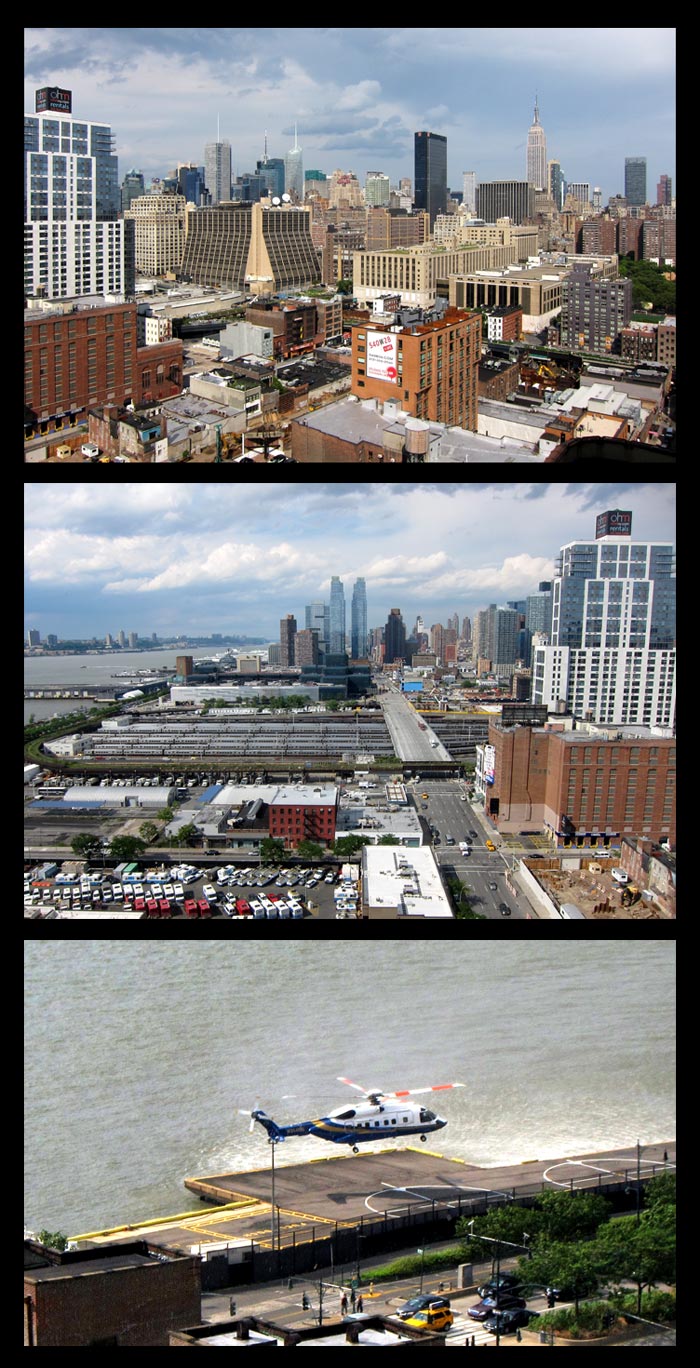
    In my travels through the myriad of businesses I have visited over the decades in Manhattan, I am sometimes privy for some moments to a spectacular view from an office or industrial space on a high floor. I was recently shopping for a sofa in the Starrett-Lehigh Building in Chelsea at 601 West 26th Street. The property is enormous, spanning an entire city block between Eleventh and Twelfth Avenues and between 26th and 27th Streets. The full-block freight terminal, warehouse, and office building was built in 1930-31.

    It was a Sunday afternoon, June 3rd. The neighborhood and building were essentially deserted. The showroom was small and spare. The whole experience was rather depressing until I moved towards the windows, which had unobstructed views North, East, and West. Helicopters were taking off and landing from the heliport, affording me the kinds of views I had hoped for when I originally visited. Looking northeast were the Chrysler and Empire State Buildings, as well as many lesser-known players in the game of one-upmanship by New York City’s tall buildings.

    With a view of midtown like this, I am often reminded of one of my favorite scenes in the film The Producers and the words of Zero Mostel as he tries to lure Gene Wilder into a moneymaking scheme and whispers over his shoulder, “All of these pleasures can be yours.” Like a small boy or girl looking down from atop the Empire State Building, where cars look like toys that can be picked up, when one has a sweeping vista of Manhattan’s cityscape like those in today’s photos, the industry, ambitions, drive, and achievements of generations of New Yorkers seems so tangible, Just There for the Taking 🙂

    Posted on by Brian Dubé

  • Night on Bald Mountain

    Posted on by Brian Dubé

    Fantasia was a highly controversial film for different reasons. Many objected to the strong imagery set to major pieces of classical music. They argued that imagery should be evoked by the music, not chosen and superimposed by a filmmaker, making indelible impressions and associations on the mind, particularly on those new to the music. Others argued, many of them well-seasoned classical musicians, that there is no great harm and that anything which brings the public and great music together is a good thing and worth the price.

    I straddle both sides of this issue – certainly there are pieces of music that I now associate with imagery from that film, i.e. Beethoven’s Pastoral Symphony and the dark, brooding images in Mussorgsky’s Night on Bald Mountain. Whether these associations have damaged my appreciation of this music, I have no idea. But from time to time, dark stormy weather brings back those images from Mussorgsky’s work as interpreted by Disney.

    There is no question that mother nature often plays second fiddle to the creations of men and women in New York City. Whether it is cultural or architectural, people do not come to this city for the climate. In Not Moving to Florida, I dismissed all four seasons in the city. In Weather Means Whether, I discussed how my friend from college, who had moved to California, made the observation that the East Coast has weather while the West Coast has climate.

    Whether this is valid, meteorologically speaking or not, I do not know. However, certainly one of the West Coast’s biggest draws is its pleasant climate and nature’s bounty, whereas on the East Coast, particularly in New York City, weather may enhance or detract from enjoyment of some city attractions, but it is not the allure.

    However, when dramatic natural events occur, their juxtaposition with the cityscape makes even the most resolute of New Yorkers pay attention. One is more likely to notice these events when in a natural setting, such as a public park, and where distraction from nature is at a minimum. When strolling the city streets, for most, it will take nothing short of Armageddon to take one’s eyes off the elements that make New York a great city. In July 2010, I was able to capture a spectacular bolt of lightning – you can see the photo below. In that story, Back to Our Main Feature, I wrote:

    Last night, there was a brief lightning storm dramatic enough to make many of us look up and say wow. But unlike our country brethren, who may spend a pleasant evening watching shooting stars, we rarely indulge these natural phenomenon for very long. Glancing up to the sky, seeing a spectacular display of lightning complemented by a waxing moon, we acknowledge when nature has spoken. Yes, like any great commercial, we hear you, but now, back to our main feature.


    Tuesday was another brooding New York City day. The sky was dark and heavy with well-defined storm clouds. Try as I may, images stormed my mind of Night on Bald Mountain 🙂

    Posted on by Brian Dubé

  • The Show Must Go On

    Posted on by Brian Dubé

    Chapter 1

    It’s Friday evening at the workday’s end. A coworker, Rigel Sarjoo, and I decide to have dinner. However, her time is limited – she also moonlights as a singer with a local band and must leave Manhattan by subway at 7:30PM for a show in Brooklyn. It is 6:30 PM, and we have exactly one hour to get to walk to a restaurant, eat, and pay our bill. We both were thinking the same two options – the newly discovered Meatball Shop, recommended by mutual friend Bill Shatto, or the old standby, Saigon Grill (now Saigon Market). They are both in the Village, but some distance apart. Here’s the dilemma: Saigon Grill is very good with lightning-fast service. However, we LOVE Meatball, but it is typically PACKED and it is Friday night. But it is also Memorial Day weekend – which means it may be dead. We take our chances with our first choice.

    Chapter 2
    It’s a long walk in the warm, humid weather – about one mile and we are nearly sprinting. Nothing worse than summer heat and humidity in the city. Meatball rarely has no wait. This is a big risk and we agree if they are too crowded that we will try Thali, a micro-restaurant nearby, saving us from a long walk to Saigon Grill. Thali is a new Indian restaurant located in a tiny space, formerly the home of another Indian restaurant. They specialize in Thali – a selection of different food items, served in small bowls on a round tray. It’s a great way to sample a variety of Indian dishes. We have eaten at the new incarnation once. It’s the backup plan.

    Chapter 3
    We arrive at Meatball. It’s MAYHEM as usual, with at least a 30 minute wait. I tell the hostess to forget it, and we leave. We walk a few doors down Greenwich Avenue, arrive at Thali, and the door is open. There is no A/C, and it is hot inside. Forget it. We are off to Saigon Grill, where we both agree we should have gone in the first place. It has the fastest service I have ever had in a restaurant in New York City. I have seen entire dinners served before friends have returned from the bathroom after ordering. We need that speed now, because it will be 7PM by the time we arrive.

    Chapter 4
    It’s another long hike to Saigon Grill. It’s 7PM, and now we have only 30 minutes. But we are greeted and taken to be seated immediately. There is A/C, the place is spacious, and there are numerous empty tables. This is why Saigon Grill is an old reliable. They never fail us for large groups or when in a hurry.

    Chapter 5
    As we are about to sit down, we hear our names being called. Our mutual friends Harvey and Hellen Osgood and Myra Smolev are eating nearby. We are, of course, invited to sit with them. The five of us cram around a table for four. No problem. It’s a nice follow up to a long hike in the heat and a series of restaurant disappointments. Dinner with friends. We are, however, still in a rush. Time is fleeting. My coworker and I do not need menus – we both know what we want and order immediately. Within a few minutes, our meals arrive. Friendly banter dominates the meal. It occurs to me now that all four of my dinner companions have been the subject of stories for this website.

    Chapter 6
    Our check has been ordered, received and the bill paid. It is 7:30PM on the dot. Rigel makes the rounds getting her good luck hugs and leaves for her show in Brooklyn. She should make it on time. It was a job well done, if not a bit harrowing.  My cell phone rings – I miss the call. It’s a number I do not recognize. I decide to return the call anyway. It is Kyle Petersen, a freelance worker who handles all of our social networking. He is a professional juggler and unicyclist. There is an emergency.

    Chapter 7
    He is scheduled to go on stage at 8PM at the Bowery Poetry Club. However, he is missing two silicone handsticks that he must have for a juggling routine in his show. There is nowhere that these can be had except at my shop, conveniently only a few blocks from the club. He is there now on the street – can I come down right now and open my shop and get him two handsticks?

    Chapter 8
    Oh man, I REALLY don’t want to do this now. I just left work 60 minutes ago. After all the running and sweating that I did, I do not want to go back to my office. It will take me 15 minutes to get there if I really hustle and leave instantly. But it’s his show, and it would be unconscionable for me to refuse. I tell my friends of the dilemma, my intentions, and the challenge in getting there in time. But there is good news.

    Chapter 9
    Myra conveniently happens to have her bicycle chained outside the restaurant and offers it to me! After that, I can ride it to her apartment building and just hand it to her doorman. No fuss. And she lives steps from my home, near Washington Square Park. We leave the restaurant and she unbolts her bike. However, a problem remains: I have a very heavy bag and a DSLR camera with no bag for it, and it’s not the best idea to bike with an unprotected camera. Hellen immediately offers to take both to her apartment, also one block away. I can pick both items up on my return. Excellent. Now every detail has been taken care of and I ride off, heading towards Broadway. I have owned and ridden bikes in NYC for my entire life here, and I love bike riding in Manhattan. This lemon is turning to lemonade. The ride to 520 Broadway in SoHo from Saigon Market is a breeze by bike. And fun. I am there in minutes.

    Chapter 10
    I arrive at my office. Kyle is nowhere to be seen outside. He is, however, inside the lobby. Perfect. He is shocked at how fast I made it. I tell him of my luck regarding Myra’s bike. He is fully dressed for his performance and ready for stage with a headphone mic on. This is like the NYC of moviedom. I hand him the bike. I take the elevator to the 3rd floor, unlock the door, disarm the security system, grab two black handsticks, rearm the security system, and run out the exit door and down 3 flights of stairs – all in one big sweeping motion. Kyle is nothing short of ELATED. He assures me: “You’re the man!” Thanks to the bike, it is only 7:45PM, and Kyle has a full 15 minutes to show time. We have seconds to burn.

    Chapter 11
    One more thing, Kyle, before you go. Give me a few SECONDS and pose for a photo with that bike because this evening’s events make one hell of a story. I snap a couple of shots, and he is off and running to the Bowery Poetry Club. My job is complete. I bike back towards the Village, arrive at Myra’s residence, hand the bike to her doorman, and walk two blocks to Hellen and Harvey’s. A quick elevator ride to the 11th floor, and I retrieve my camera and bag. Mission accomplished – it’s time for a stroll in the park and then home.

    Chapter 12
    By the next morning, I have nearly forgotten the episode. I examine my cellphone and find that my text memory is full. After deleting a few messages, I receive a text which had been sent by Kyle at 10:32 PM the evening before, apparently after his show. It proclaims: “Smash success. You saved my life.”

    Postscript

    It was a real New York City adventure, replete with frenetic rushing, two performers who have showtime pressures, turned away at a restaurant so trendy and crowded that patrons were waiting in the streets, a serendipitous meeting of friends, the fortuitous availability and offering of a bicycle, the helping hands of others, and someone who literally goes the extra mile – on Broadway. It’s what goes on behind the scenes in New York City when we say The Show Must Go On.

    Posted on by Brian Dubé

  • Another Time

    Posted on by Brian Dubé

    Every year, I miss or almost miss my favorite street fair. It is located arguably in the most bucolic setting in Manhattan – in the West Village, occupying Commerce, Barrow, and Bedford Streets between 7th Avenue South and Hudson Street. There are hundreds of street fairs annually in New York City. However, most of these are run by corporate entities. In 2007, I wrote about these fairs:

    This is the typical NYC street fair. To the uninitiated, it looks like fun. However, after doing a few of them, they are very boring. The problem is that you see the same vendors at virtually every fair, most of them of little interest – socks, gyros, small tools, bedding, Peruvian sweaters, imported crafts, CDs, smoothies, T-shirts, etc. The residents I know mostly ignore them, perhaps getting an occasional snack. A recent research group put it perfectly: “The fairs had lost all sense of novelty, catered too heavily to out-of-town vendors and failed to showcase the work of entrepreneurs and artists based in the five boroughs…The worst part is that they are uniformly bland.”

    Nothing much has changed. I typically avoid these fairs, yearning for something of quality.

    On Saturday, May 19th, I attended the 19th Annual BBC Village Crafts Fair and the 38th “Ye Olde Village Fair” – it was just the antidote to the street fair blues.
    The fair is sponsored by the Bedford Barrow Commerce Block Association (BBC), the oldest and largest block association in Manhattan. It has over 300 members and is easily one of the most active community organizations in New York City. Their efforts include tree plantings, historic building plaques, and the Annual Hudson River Boat Ride.

    One of the keys to the quality of merchandise sold at the fair is that participants are juried, something that New York City fairs could use more of. Left unchecked, street fairs end up pandering to the lowest common denominator – fast and easy money selling schlock.

    In past years, tables were set up for dining. Wine was served – a rare and extraordinary thing in New York, particularly to manage and prevent drunken revelry ala Duval Street in Key West, Florida. There is live music, fresh lemonade, and homemade ice cream. Vendors of quality crafts line the tree-shaded streets. This year’s festival was also blessed with absolutely perfect weather. I was transported to Another Time 🙂

    Posted on by Brian Dubé

  • Boom Boom

    Posted on by Brian Dubé

    My brother-in-law was at one time involved in drag racing. I was intrigued when he recounted the level of sound of these cars even when idling – that clothing would move due to the incredible sound pressure generated by machines running literally on rocket fuel – nitromethane. Since that conversation, I have always wanted to attend a race just to experience once what he described.

    However, I am not a lover of boom cars which cruise the streets of New York City. Perhaps you have encountered the Boom Car. These ear-splitting machines are old news. From the New York Times in 1990:

    Young people are converting cars into rolling radio stations by stuffing them with dozens of speakers, compact disk ”jukeboxes” and amplifiers capable of booming rock and rap music at decibel levels powerful enough to rattle neighbors’ windows, ruin their own hearing and assault their captive audience on the street. They are being spurred on by technological advances in automobile sound and by national competitions with names like ”Sound Quake” and ”Thunder on Wheels.” The equipment is being installed by shops with slogans like ”We Build Ground Pounders.”

    Unfortunately, these vehicles are the bane of most New Yorkers, the deafening sound being enjoyed primarily by the occupants of the car. The phenomenon is certainly not limited to the city. It’s a nationwide phenomenon that has citizens in an uproar and keeps legislators busy. Some of these systems boast over 1000 watts, powerful enough to shake the windows, the china, and the walls of home owners.

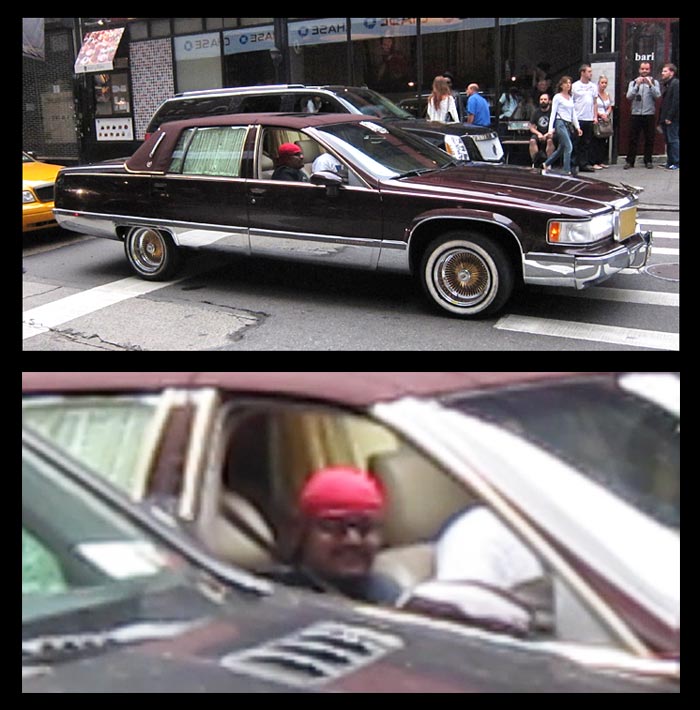
    Yesterday, while leaving my office at the corner of Spring Street and Broadway in SoHo, I saw a large Cadillac with curtained windows, looking more like a hearse than a regular passenger vehicle. I only had seconds to capture a photo of the sound mobile. I reached for my camera, snapped one photo, and got a few seconds of shaky video. I made my photography deliberate and obvious. As the car sped off when the light changed to green, the passenger smiled and acknowledged what he perceived as my tacit approval.

    According to noiseoff.org, an organization devoted to fighting noise pollution of all types, “People who drive boom cars consider it their right to play music at any volume they please. They regard their car as an expression of themselves and the louder it is, the bolder the statement that they can make. Boomers are typically lower-middle class males in their teens and twenties with some disposable income. They assume that their car will attract women and improve their social standing among their peers.”

    Technology is only going to make the problem potentially worse. Some are calling the enterprise the “noise industrial complex.” The advertising slogans, not typically familiar to outsiders, is unapologetic:

    “Disturb the Peace” (Sony)
    “All New Ways to Offend” (Sony)
    “Performance they’ll hear a mile away”(BoltOn)
    “Shake the living; Wake the dead” (Cerwin Vega)
    “…achieving the sound your neighbors fear” (Sony Xplod Car Audio)
    “Disturb, Defy, Disrupt, Ignite” (Pioneer Electronics)
    “Head-Splitting, Heart-stopping, Ear-shattering, Mind-numbing, Retina-detaching MX Audio Thunder 9500  Subwoofer” (MTX Audio)
    “Put the over forty set into cardiac arrest”(Prestige Audio)

    This type of noise, like the roar of the non-muffled straight pipes of motorcycles, is difficult to control, and prosecuting offenders is tricky – the varying sound level is difficult to measure, and the source is a moving target. So, as long as the appeal is there and big money is to be made selling the equipment, it looks like it’s going to be a Boom Boom 🙂

    More on noise: As Usual, Grace of a Boombox God, Too Too New York, Deaf Jam, Men Making Noise

    Posted on by Brian Dubé

  • New York Is Raccoon Country

    Posted on by Brian Dubé

    Like most places, there are always things to learn about one’s locale. However, in New York City, not only are there a myriad of things to discover, but many of them are also quite unexpected and seemingly antithetical to urban life. Like hawks or raccoons.

    And, of course, owing to New York’s huge population, there are always a small number for whom these things become more than curiosities or points of interest. For some, these things become a world unto itself, such as the red-tailed hawk, Pale Male, whose family attained a cult following and mythic status. To this day, 21 years after the first siting of Pale Male, an entourage of birders have a virtual encampment on the outer perimeter of the Central Park boat pond with a clear line of sight to the nest at 927 Fifth Avenue.

    Yesterday, at the Central Park Conservatory Garden, amidst one of the most bucolic natural settings in Manhattan, I was puzzled to find a number of people fascinated with a relatively unkempt patch of shrubbery on the outskirts of the garden. Suddenly, I noticed the object of their attention and cameras: a raccoon at close quarters in broad daylight.
    One man I spoke to told me that there were, in fact, many raccoons in Central Park and that residents on the west side of the park were in the habit of leaving food for a group of raccoons who resided in the area.

    By many, raccoons is are a considered a nuisance. Like many of the hardy, aggressive residents of the city, e.g. pigeons or squirrels, the dearth of other wildlife makes these types of scavengers the object of fascination for city residents as well as visitors, who are often found feeding squirrels in the parks.

    Raccoons are highly adaptable omnivores and have populated a large range of environments – I was surprised to learn that they inhabit many urban areas worldwide. It is estimated that as many as 300 live in Central Park.  New York City is a mecca for bookstores, restaurants, museums, architecture, the arts, fashion, music, and ethnic culture. And, for now at least, New York is Raccoon Country…

    Posted on by Brian Dubé


  • dinamic_sidebar 4 none

©2026 New York Daily Photo Entries (RSS) and Comments (RSS)  Raindrops Theme