• I Am a Liar

    I have written many times about my feelings regarding the good old days and how, often, fond memories of people, places, and things are really only that – fond memories. If one really examines the subjects of these memories and can be brutally honest, the reality was often not that great at all. And yet we hang on to and lionize scraps of the past, bemoan the loss of old retail shops, and express dislike for the new retailer in its place or perhaps a radical change in decor or operations of an old establishment. The realist, like Joe Plourde, looks life squarely in the face and judges strictly on merit and not on nostalgia. Read about Joe here.

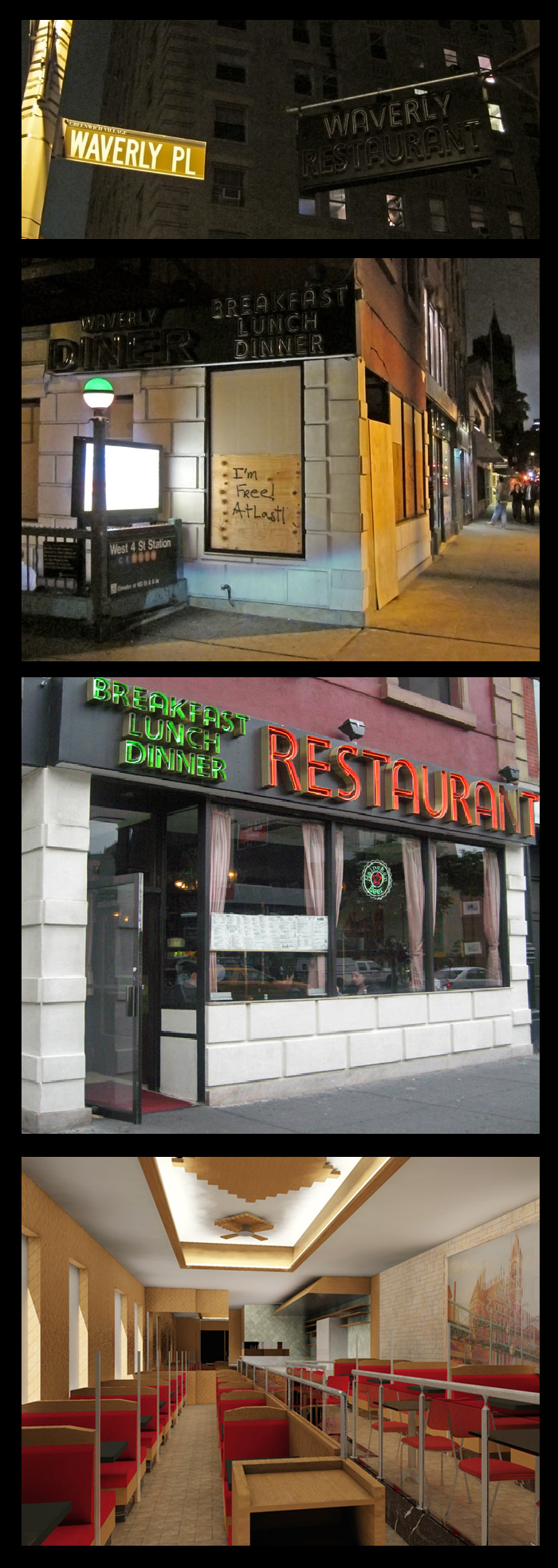
    On December 3, 2008, I wrote Greasy Spoon. However, I did not reveal that the subject of my poor diner experience was the Waverly Restaurant. I avoided mentioning the name of the diner for a number of reasons. One is that I avoid writing stories which essentially serve as negative reviews. There is nothing fundamentally wrong with helping the restaurant patron avoid the poorer dining establishments, but personally, I have decided to leave this type of reporting to the review sites, of which there are many good ones, such as Yelp.com.

    The other reason I avoided slamming the Waverly is that I, too, am a sucker for nostalgizing, the very type of person whom I characterized in paragraph one. The Waverly, good or bad, was a Village icon and landmark. To see it was a great comfort, a balm in a city of harsh extremes. To know that the Waverly was open 24 hours likened it to the Chinatown restaurant of Woody Allen – a constant, something steadfast and reliable.

    So recently, when I went by the Waverly and saw it boarded up, I was shocked and ALARMED. My first GUT REACTION WAS DISMAY. I bemoaned the loss. Regardless of how good or bad it was, who wants a homogenized New York City, populated only by chain stores?  It’s places like the Waverly that give New York its unique character.

    Then I saw and learned that it was closed for renovation. I was SO RELIEVED. Because, as you can see, I LOVE THAT OLD CRAP, and WHEN IT REOPENS, I’LL BE THE FIRST IN LINE. Really, in all of my writings and diatribes about the old and new, I have been lying to you. Yes, that’s correct, and I am willing to put it in writing. I am a LIAR.

    Photo Notes: The bottom photo is an artist’s rendering of the new Waverly Diner from the architectural firm of Jorge Fontan. The restaurant is being expanded into an adjoining commercial space and is undergoing its first renovation in the 30 years it has been open. The interiors will be fully renovated, keeping the original atmosphere while modernizing and enlarging the space.

    Related Posts: Nice Man on Death Row, Levi’s Film and Corn, Diner Be Aware of the Diner, Joe Jr’s

  • Ask Tommy

    Were it not for this website, I certainly would not have interacted with the many homeless whom I have in my travels throughout New York City. And I would have concluded, as most have, that their state is a product of lifelong misdoings, drug use, or sheer laziness.

    However, many homeless are quite ambitious, and many of the features I have done here illustrate that very clearly. Others, like Hakan Onor, whom I plan on doing a documentary on, have extraordinary stories and backgrounds, often which beg credibility.

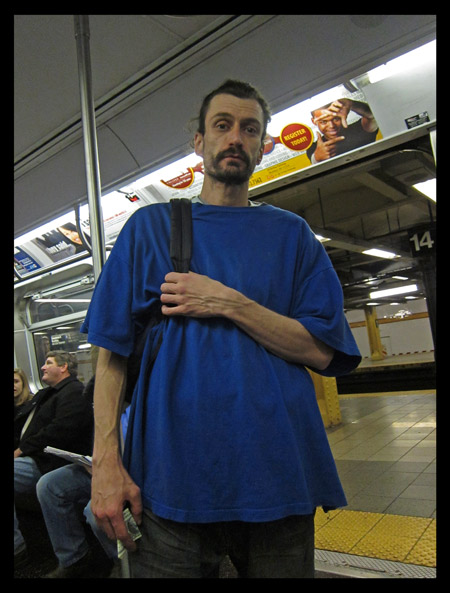
    Recently, on a short subway ride, a man entered our car and, like others, proceeded with a rehearsed solicitation, something that most regular commuters find particularly annoying. Not only do most feel such diatribes to be audibly disturbing, the spiels are also typically viewed with extreme skepticism, with claims and representations dismissed as just being part of another flavor of a New York City hustle or scam for money.

    I gave the man a dollar and introduced myself, telling him of my blog. We only had a few seconds. I learned his name, Tommy, that he was from New Jersey, that he was not a drug user, but, like many in his plight, was mentally disabled. He told me that he was schizophrenic and bipolar and that he typically goes on and off medications. He explained that the side effects from his various medications become intolerable, resulting in his discontinuing their use.

    Thus, his life becomes a roller coaster. This type of scenario can often be evidenced by the dramatically changing wardrobe and hygiene of many homeless, given that one is privy to seeing them on an ongoing basis. They are in and out of drug rehab or in and out of psychiatric treatment. I have seen the aforementioned Hakan looking extraordinarily nice in a sport jacket, well-groomed and sprightly, yet at other times barely able to function, pushing his belongings in a shopping cart, looking no better than Stephanie or Morgan on a bad day. Or, perhaps, they are all bad days, and the good days are just an illusion to the outsider. I forgot to Ask Tommy…

    Related Posts: Looking for an Angel, Usually. Maybe. Probably Not, Sleeping in Jeans, Homeless Art Scene.


  • Three-Toed Smoth

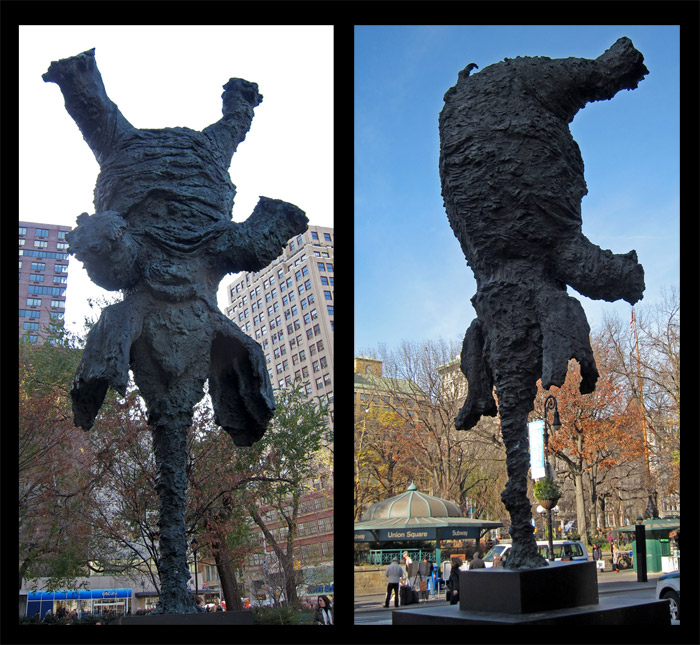
    The elephant looms large in the lives and minds of children. After all, children do naturally gravitate to the big, and what suits that better the world’s largest living land animal? Here, at Union Square, we have Gran Elefandret by renowned artist Miquel Barceló.* I’m sure many a child and parent have been enjoying Barcelo’s 26-foot sculpture.

    Marlborough Gallery is pleased to announce that the monumental sculpture Gran Elefandret, 2008, by renowned artist Miquel Barceló will be on view at the Union Square Triangle beginning September 13, 2011 through the end of May 2012. It is with great pleasure
    that the Gallery brings this monumental bronze sculpture to Union Square, a place that epitomizes New York’s unrivaled energy and serves as both a transportation and cultural bridge between uptown and downtown Manhattan. Barcelo’s immense Gran Elefandret, balances upright on its trunk, its four massive legs outspread searching for equilibrium. At twenty-six feet tall the sculpture brilliantly portrays an extraordinary, if not impossible physical and cultural feat; this contemporary monument believably captures with humor, scale and Spanish courage the essence of what a public monument can be today.

    To further communicate the gravity-defying feat beyond the surprisingly slim trunk and large body, Barceló imparts the mass and weight of the creature through the downward sag of the heavily wrinkled skin, the off-kilter positioning of the huge legs, and the complete overturning of the floppy ears. The highly textured surface of the elephant recalls the artist’s tactile paintings, in which he creates rich topographic, sculpted surfaces on canvas.

    I never had children, but I do love them. Not having them, many things are a novelty to me, like the spongelike absorption often found when children are exposed to new things. One of my most memorable examples of this behavior was subsequent to a class trip made to my business – see Little Burnt Out.

    I once made an acquaintance of a very learned and educated couple whose children had a frightening knowledge of things that I, as a child, barely had a cursory knowledge of. I recall going through a book of dinosaurs with one of their children, who was able to identify every one by name. At the time, I had read an article on the three-toed sloth and was fascinated by many of the facts surrounding this remarkable animal, such as its odorless nature and the extraordinary length of time it actually requires to make a journey down a tree, truly befitting its name being used as a metaphor for the slow.

    As the child attempted to elaborate on her knowledge of dinosaurs, I endeavored to communicate my newfound enthusiasm for the sloth. She appeared uninterested; I was not making an impression. Or so I thought.

    Some weeks later, a friend was on the phone with the mother of the child. At one point, she told me that someone had something to tell me. When I took the phone, the young girl whom I had met was on the other end. I don’t recall the conversation exactly, except that she was quite intent on telling me of her new found interest in the Three-Toed Smoth 🙂

    *Miquel Barceló was born in Mallorca in 1957. After studying briefly at the Arts and Crafts School of Palma and the Fine Arts School of Barcelona, he became involved with the conceptualist group Taller Llunátic, which opposed the stagnation of both the socio-political climate of Spain during the late 1970’s and the “official” art scene. Originally focusing on painting, Barceló worked at first in a non- representational style, influenced by Jackson Pollock, Willem de Kooning, and Cy Twombly. As his career progressed, he began to integrate figurative elements in his paintings, and started creating sculptures in both ceramics and bronze. The artist collaborates with the Fundación Vicente Ferrer and the Eyes of the World Foundation and participates in projects for Sahrawi refugee camps. He divides his time between Paris, Mallorca, and Mali.

    Related Posts: Kids, Childhood’s End, Bronx Zoo


  • Wild Ride

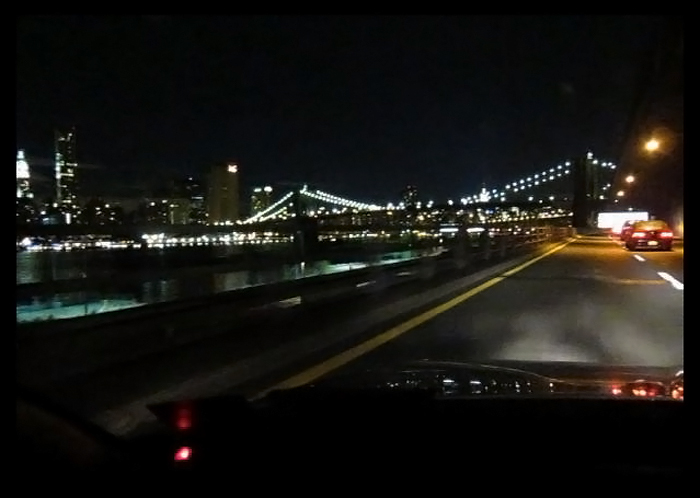
    Wednesday night, returning from Brooklyn, I was feeling a little wild, as is sometimes the case when I find myself driving in New York City and life is GOOD. Then the city just ELECTRIFIES me – I can feel its high voltage coursing through my body. Everything is RIGHT and I know I am in the world’s most exciting city.

    With no prior plan to do so, I suddenly just decided to pull out a camera and video record a leg of my journey with stream of consciousness narration as I drove. See the NYC skyline from the BQE. Cross the Manhattan Bridge with me, and then cruise the streets of Lower Manhattan, NoHo, and the Village. The footage is raw, jumpy, and a little out of focus at times. It’s not reality TV – it’s the REAL DEAL while on a Wild Ride >>>

    Posts referenced in the video: 212 and 2:12, New York Rockies, Sittin’ On Top of the World, No Sir, Pull Ahead, Childhood’s End, Public Theater, Astor Place Cube


  • Frontier


    It pays to be informed, otherwise you might, like I did in the 1960s, believe you “discovered” a little known, non-touristy area like Times Square (see story here) or that more recently, think you discovered a lesser known structure in Coney Island.

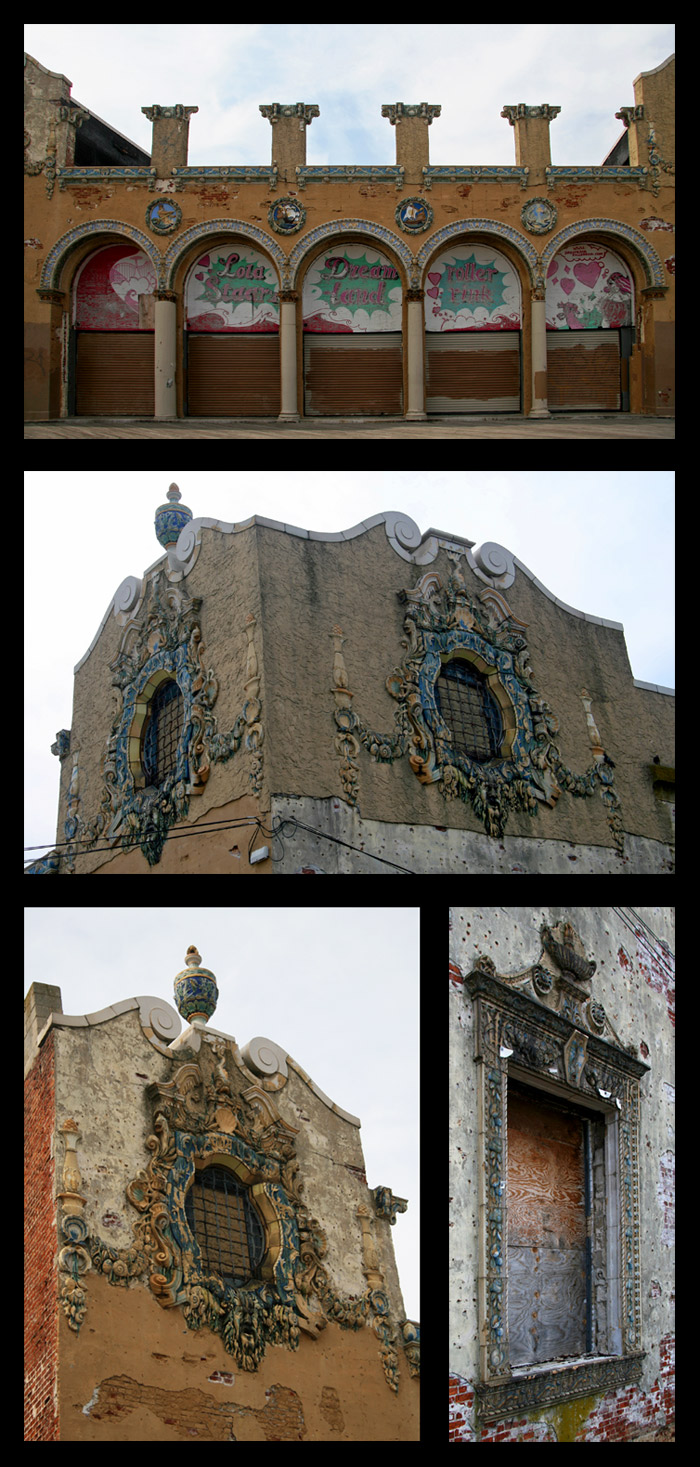
    On a recent excursion to Coney Island, my exploration took me a little off the beaten path. Many good things can happen when one Goes West. As I did so, past all the well known attractions and landmarks – the New York Aquarium, the Wonder Wheel, Luna Park, Nathan’s, the Cyclone, the area started to feel much like the frontier with abandoned lots and structures. It was at 21st Street and the Boardwalk that I happened upon a building which became more intriguing the more closely I examined it, thinking that I had made another secret “discovery.” Only today did I happen upon the photos I had taken and decided to investigate the structure, and I was soon to learn that 2102 Boardwalk was about as obscure as the Times Square of my youth.

    My search at the New York Times website brought up a Christopher Gray article. I knew now that the building was very significant, to be featured for Gray’s Streetscapes. I also was comforted that I was in good hands and would get accurate historical information from Gray. The building is described by the Times as “festooned with elaborate, colorful terra cotta nautical motifs, including Neptune rising from the sea draped in seaweed, European ships and intricate crustaceans and other sea creatures.” Here are some excerpts from the article:

    BUILT in 1924, the Childs Restaurant building at West 21st Street and the Boardwalk was one of the last gasps of elegance for Coney Island…In 1924 Childs, the quick-lunch chain known for its simple meals, built an imposing steel-framed restaurant building. Childs was founded in 1889 on Cortlandt Street in Manhattan by the brothers Samuel and William Childs, who sought to serve the rushing ferry crowds in downtown New York. By the mid-1920’s they were grossing $25 million a year from more than 100 branches, half of them in the New York area.

    William oversaw the operational end and Samuel handled the real estate side. Presumably it was Samuel who oversaw the restaurant chain’s trademark design in the 1910’s — storefront establishments that were white-tiled, efficient and clean, responsive to what The New York Times called the American ”lust for sanitation.”

    For their Coney Island building, however, the brothers brought in an elite architectural firm, Ethan Allen Dennison and Fredric C. Hirons, who had both studied at the École des Beaux-Arts in Paris. The architects embraced the Coney Island aesthetic with creative gusto. Against a soft gray stucco field they set a wild profusion of terra cotta ornament in varied colors, with a rooftop pergola apparently meant as a dining area.

    The Childs brothers’ earlier buildings had been objects of derision by architectural writers, and the sudden burst of ambitious design was unusual. Just after the new Coney Island Childs, the restaurant hired William Van Alen to design an Art Deco jewel-box restaurant, much altered but still recognizable at 604 Fifth Avenue, near 48th Street. It is now a T.G.I. Friday’s.

    The Childs chain sold the Coney Island branch in 1947, and Enrico Ricci, Robert V. Ricci’s father, bought the structure in the 1950’s. Since then the Ricci family has oper ated the Tell Chocolate Company from the building. It has kept up the stucco walls, removed graffiti, kept the building watertight and cared for the terra cotta. But with its windows sealed for factory use, the building has a forlorn air. Noticeable chunks of ornament have been removed, but large sections remain.

    The building was landmarked in 2003 and has been leased for various uses. From 2008-2010, the space was incarnated as Lola Staar’s Dreamland Roller Rink. For an in-depth article regarding this extraordinary structure, see here. In New York City, one can still Go West and find a little Frontier…

    Related Posts: Partial Remission, Parachute Jump


  • Des Moines

    It is no secret that New Yorkers top the list when it comes to arrogance and xenophobia. Perhaps one of the best visual representations is View of the World from 9th Avenue – if you are unfamiliar with it, see the photo and my story here. Even within New York City itself, you will find individuals who rarely go outside their neighborhood. For Village residents, there is a cliche: I never go north of 14th Street.

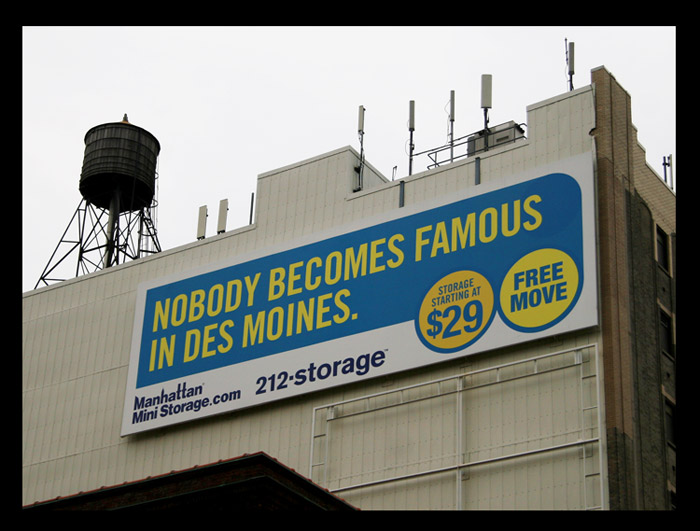
    In today’s photo, you can see an example of this thinking in an ad by local storage giant Manhattan Mini-Storage. In a crowded marketplace, the company has been successful in creating provocative ads that actually get talked about. Here are some samples:

    “Remember, if you leave the city, you’ll have to live in America.”

    “Oh, yeah, you’ll fit right in in Connecticut.”

    “Your closet’s so shallow, it makes Paris look deep.” [re: Paris Hilton]?”

    “In my father’s house, there are many rooms.” – John 14:2.  Clearly, Jesus was not a New Yorker.

    And from today’s photo: “Nobody becomes famous in Des Moines.” Slamming another city will certainly get attention, although the effect is most likely on the other city’s residents than on New Yorkers, who already believe that there is no other place worth living in, certainly not Des Moines, Iowa.

    I found a response to the ad and comments on a blog called Des Moines is NOT Boring with a story title: Really New York!? As one would expect, the readers of the blog were not pleased with the ad. The writer of the story states, “Apparently, closest [sic] space is at a premium in New York, yet the relation to becoming famous and Des Moines is still pretty unclear.” I agree with the writer that the precise thinking behind the statement is somewhat hazy, but I surmise that the implication is that there is plenty of storage space outside New York City, but it would do one no good to live there. Des Moines was a good target since many see the Midwest as a place of pleasant, mild-mannered people but quintessentially BORING.

    It is ironic that a blog and name would be predicated on a statement that Des Moines is not boring. Self-proclamations are typically indicative that the opposite is true. People who profess to be easygoing rarely are. And people who have to make preemptive defensive statements usually are what they claim to not be. When is the last time you saw a billboard stating that New York is NOT Boring or that Paris is NOT ugly?

    I do respect the quality of life that must exist in small cities. I have often fantasized about moving to a place like Boulder, Colorado, San Francisco, or Portland, Maine. But once you live in New York City, it’s hard to scale back. Most of us are here not just for the lure of opportunity but are also trapped by the Sirens of Convenience. It matters not whether anyone becomes famous in New York City or in Des Moines 🙂

    Related Posts: Uptown, Goin’ to Jersey


  • Leave it to the Critics

    One of my first art “discussions” was regarding a piece of work I saw on the streets in SoHo in the early 1970s. I recall it was a flat surface with an array of bolts – essentially looking like a bed of nails.

    Having done carpentry work, I felt that I did know something about bolts and that someone driving them into a board at different heights did not constitute art.

    However, an artist friend at the time, in a futile attempt to educate my boorish manner, informed me that what made it art was conceptual, not reducing it to its material elements. Like the defense once made by Marcel Duchamps, whom I did not know at the time – it was art because he said so. I was, nonetheless, not impressed – to me, bolts were just bolts.

    This type of installation art is controversial, even amongst those who are schooled and knowledgeable about fine arts. To put it bluntly, coming from someone who was originally a science guy, my question is whether there is any objective criteria for art and, if so, where does artisanship end and art begin?

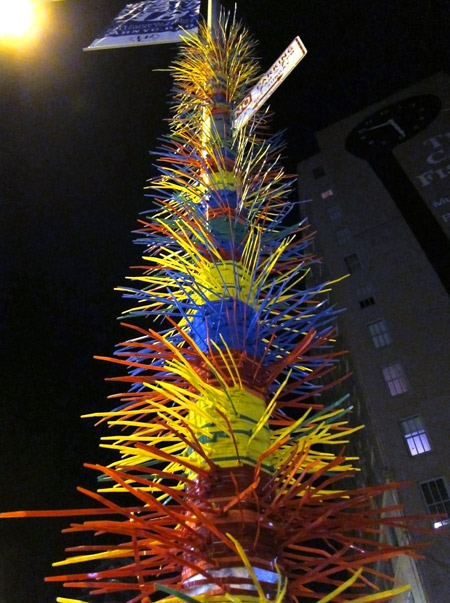
    Recently, I have noticed a number of lamp posts around Astor Place/ Cooper Union bedecked with colorful plastic cable ties. This, like the bed of nails, also challenges my beliefs of what constitutes art, since cable ties are another area of great familiarity to me – we use them regularly in my business.

    During my first exposures, it appeared to be whimsical, but after taking a number of photos, it occurred to me that there might be more to it. Sure enough, this is part of an art installation called Flaming Cactus. The Animus Arts Collective utilized 32,000 fluorescent colored wire ties around approximately 15 lamp and sign posts in Cooper Square. The project was done with cooperation from the Department of Transportation. It is permitted to remain in place until June of 2012.

    One person commented:

    The same art just went up on Spring St and in the Urban Plaza by Trump on Spring. It actually looks very nice in solid colors on the Trump lamp poles.

    However, another said:

    To me it’s cheap looking. It’s simplistic and inane, exactly the sum of its parts–zip ties on a light pole. It would look gaudy in a suburban shopping plaza. If bits of brightly colored cheap plastic brightens up your day then more power to you.

    Bolts, plastic cable ties, art, or craft – I leave it to the critics…

    Related Posts: I’m Really Good at Paper Mache, Surfaces and Surfing, Finger Painting, Acquired Taste, Real? Fake? Why?


  • World of Waiting


    It may be hard to understand why anyone 12 years old would covet a book on calculus, but I did. I loved books and reading in general, but I also loved mathematics and was intrigued by the meaning of the long S of integral calculus. My eighth grade teacher explained succinctly that it meant sum. Not particularly satisfied, I desired the book to have for my own, however, I was told by my parents that if I wanted it, I would have to earn the money and buy it myself. It was $2.95 and published by Barnes and Noble. I saved my money and, in time, came to purchase that book. I still have it.

    And so it is that I can never hate Barnes and Noble. And after all, they are a legacy business, founded in 1873, not an empire built on the latest fashion or frivolous merchandise. It is fashionable to hate Barnes and Noble, which is understandable. I do imagine that they have put many small independent book retailers out of business. However, I am doubtful that destroying small booksellers is corporate policy at Barnes and Noble but rather the unfortunate natural fallout when such a large retailer moves into an area.

    But in New York City, as elsewhere, the consumer has become very spoiled. Although many bemoan the fate of the small independent retailer and demonize the retail giants/chains, we all want huge selection, late hours, 7-day operations, low prices, liberal return policies, and a plethora of convenient locations. Who but the giants can offer such a thing? Comedian Todd Barry does material on the ironies of the attitudes of New Yorkers towards the corporate behemoths. You can read it here.

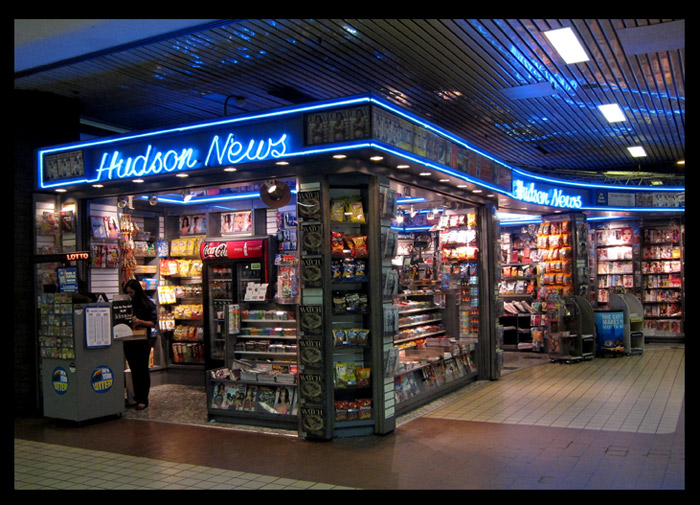
    My interest in books went beyond that first tome on calculus. I have always been comforted by books, magazines, and the stores selling them. So when I began discovering Hudson News shops in the airports and bus and train terminals around New York City (and eventually outside the city), I always found their neon signs a welcome beacon to reading materials.

    I was shocked and fascinated to learn that Keith Richards of the Rolling Stones, known for a life of excess, was an avid reader. His personal library has been featured in a book of libraries. He once remarked how surprised he was that Americans read so little. He discussed the reality of touring and how much waiting and down time there was between concerts and how he filled much of his time with reading.

    There’s a lot of waiting and down time in New York. In a city where most travel by public transportation, many fill their travel time with reading. Perhaps if I am lucky, someday I may meet Keith in Barnes and Noble or Hudson News as we fill our time in a World of Waiting.

    Related Posts: Who Can Believe It?, We Read at Night, Book Wars, The Strand


  • Business as Usual

    Do you trust me? Yes? Good.

    I’m going to tell you about a restaurant where you will not be disappointed. This is a place that locals love. There are restaurants that are very good and there are restaurants that are very expensive. But as diners know, unfortunately, expensive does not always equal good. Restaurants tend to be overpriced in New York City, and plenty of places offer the convenience of eating out only with high prices and just average food.

    North Square restaurant is located in the Washington Square Hotel at 103 Waverly Place in the Village. They run a TIGHT ship. Everything is professionally done. And lest we overlook the most important – the food is outstanding. The restaurant, like the hotel, is owned by the Paul family. The kitchen is headed by executive chef Yoel Cruz. You can find the restaurant’s website here.

    When my family announced that they were coming to New York City for Thanksgiving, I began perusing lists online of restaurants offering holiday specials. I was pleased to find that North Square was among those open and offering a prix fixe dinner. Only steps from my home, why go elsewhere? However, Thanksgiving was only two days away and, as I feared, it was fully booked. I returned on Wednesday in person in the off chance that there was a cancellation. Through some small miracle, a table for 4 was available.

    The 3-course Thanksgiving extravaganza was $55 per person, including a choice of appetizer, entrée, dessert, and coffee/tea – not bad in the scheme of things for this city, and a real value for the extraordinary selection of nine appetizers, ten entrées, and eleven desserts. Everything went without a hitch, smooth as silk. Our waiter, Nick, provided sterling service. The dining room was elegant and perfectly lit. We were not rushed at all, as is often the case on holidays in restaurants where patrons are often treated as cattle to be moved.

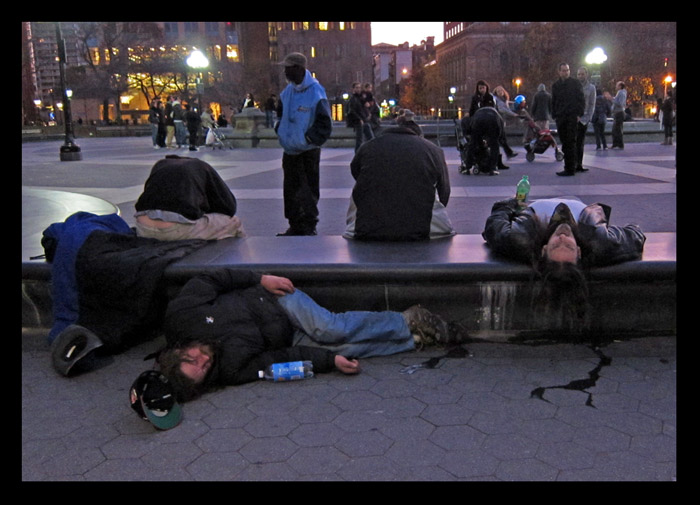
    After our meal, and before returning to Connecticut, my family and I took a quick stroll in Washington Square Park, which is footsteps away from the restaurant. It was a very pleasant afternoon where temperatures had reached 60 degrees. The park was more populated than is typical for a Thanksgiving Day. As you can see from the bottom photo, holidays make no difference for some, where it’s Business as Usual…

    Related Post: Pick Two


  • Looking for an Angel


    There’s no secret why anyone is at Port Authority Bus Terminal. As far as transportation, this is the home of the last option. Other than the Chinatown bus, the cheapest option. A nexus for people who have no other option, no other options at the time, or are between better options.

    Today is Thanksgiving, a day to give thanks. And if you are fortunate enough not to have to travel by bus, you have something to be thankful for. Most New Yorkers have, at one time, arrived by bus at Port Authority and know that there are much better places to be welcomed to New York City.

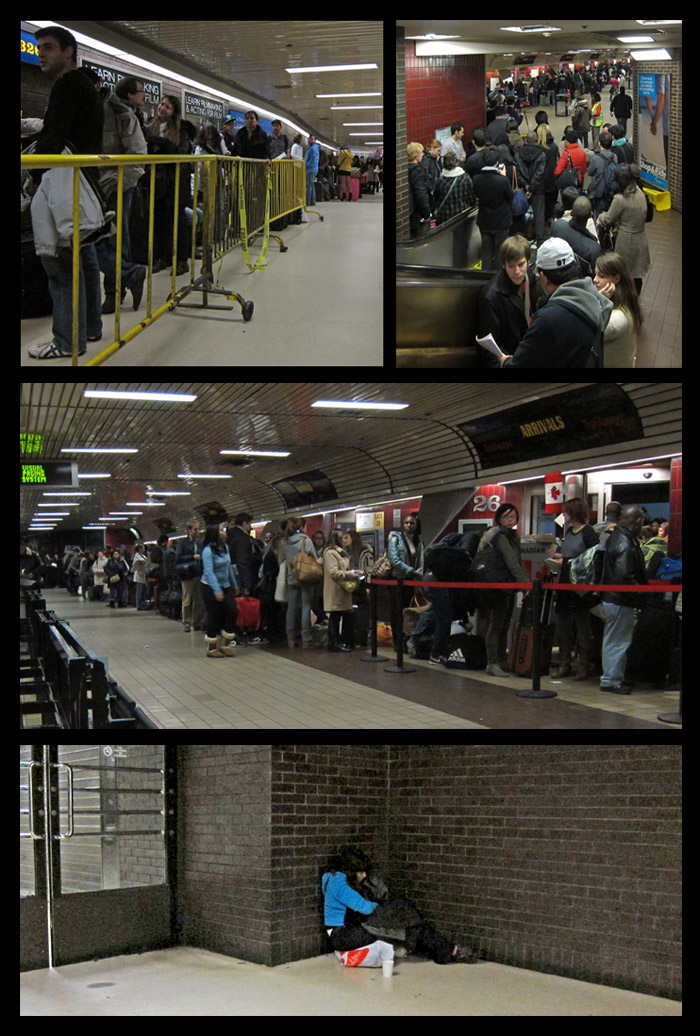
    In fact, I rarely put it this bluntly, but Port Authority is depressing as hell and, regardless of renovations, always has been. It is also a magnet for hucksters, hustlers, thieves, and the homeless. There are not too many smiles, and unlike a place such as Grand Central, you are never going to hear people say that they love Port Authority. This is the place that is truly inhospitable. There are no cushions here, nothing to soften against a city that can indeed feel harsh at times. If you want to experience the true grit of New York, head for Port Authority.

    I am not sure about many things, but I am sure that I was the only person who traveled to Port Authority last night, solely to carouse, peruse, and look for an angel based on the story a friend told me of an extraordinarily heart warming incident. She was traveling yesterday to New Jersey to see family with her elderly mother.

    Upon arrival at the terminal, she was approached by a homeless woman who offered to help. But this was not just a ruse or a quick task for money. This was HELP. She escorted them through the entire process, door to door. Carrying their bags, navigating through the crowds and corridors, purchasing tickets, and seeing them off. My friend was so moved that she told the homeless woman that she was an angel and, in the ensuing rush before boarding the bus, was able to extricate and give her $13 from her bag.

    So, last night at 10:15 PM, I went to Port Authority to find that angel. If you are reading these words and look forward to a miraculous outcome, i.e., that I found that angel and spoke to her and photographed her, then read no further. Because I did not find her.

    There were lines and crowds, as to be expected. No one was in a good mood. All had only one desire – to leave the terminal and get to their destinations for Thanksgiving. I did find one homeless woman eating in a corner. I told her of my mission and asked if she was perhaps that angel or knew of a homeless woman who might fit the description. She did not. I got the feeling that she thought I was insane. Perhaps she is right. Who travels willingly to Port Authority on the night before Thanksgiving, looking for an angel?

    Thanksgiving Posts: Thanksgiving 2009, Thanksgiving 2008, Horn of Plenty, Inflation


  • Waiting at Death’s Door

    Taking photos in public is a tricky matter, particularly in New York City with such an extraordinary number of extraordinary subjects, both human and inanimate. However, many individuals, including photographers, are unclear as to the exact nature of the laws or their rights regarding photography in public. Basically, any person or thing in public view may be photographed and the images published without giving consent, as long as they are for editorial purposes, i.e., they do not appear in an advertisement. There are mitigating circumstances, however, where a person has a reasonable expectation of privacy, such as shooting someone in a bathroom in a home who is visible from a public space.

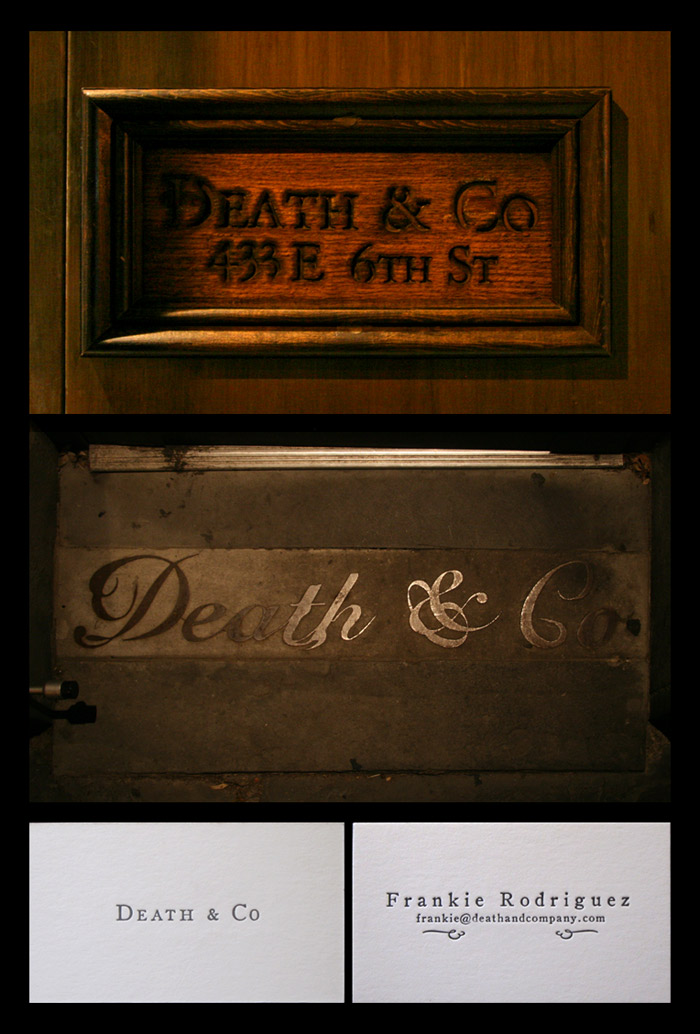
    Recently, while exploring the East Village at night, I came across an intriguing attractive storefront clad in wood. It was the classic, deliberately mysterious front with no windows and nothing to indicate what the place was. On closer examination, there was a small sign and matching nameplate set in the sidewalk that quietly proclaimed “Death & Co.”

    A lone couple waited outside to get in. I spoke to them – they were from out of the country and were told that they absolutely HAD to visit this place. I learned that it was a cocktail lounge – tres chic, trendy, and hard to get into. They were apparently told that they had to wait. I quickly slipped inside to get a look. It was an extremely striking interior but, ironically, had many free tables. I have no idea if the tables were reserved, however, it seemed reminiscent of the type of establishment that manufactures a sense of exclusivity and desirability by forcing prospective patrons to wait in line. This is a ploy long used by New York City nightclubs – places such as Studio 54 and the Mud Club were notorious for their policies of exclusion. Hordes would wait outside, each person hoping to be a lucky one chosen for admission.

    Soon, a young reservationist appeared with a clipboard. I was told that I could not take photos of the exterior. A slight altercation ensued. I informed her that I had a right to do so and that if she liked, we could call the police and review my rights to do so.

    She went inside and returned with the owner. He was quite polite and asked the reasons for my photography. I explained this website and gave him a card for New York Daily Photo. He apologized for his reservationist and agreed, of course, that I had the right to photograph a door on the streets of New York City. He gave me his card – a mysterious, understated thing with Death & Co on the face and Frankie Rodriguez with contact information on the reverse. He offered me the opportunity for a photo shoot of the interior at a future time before business hours.

    I promised to return. I asked the owner the reason for their notoriety. He answered that their drinks were very exotic, with unusual ingredients researched by the bartenders. Many reviewers online found Death & Co well worth the ordeal to get in. A number of others had similar issues as I did with the reservationist. Hey, but what do you expect Waiting at Death’s Door? 🙂

    Note about their name. From their website:
    In 1919, the Volstead Act brought a swift end to nightlife and the refined craft of the American bartender was outlawed. It was thought that to drink alcohol was to live a life shadowed by death. It was thought by some that these were death and company.


    Related Posts: In a Different Light, The Dark Side, The Core Club


  • Hakafot

    My contact with Jewish people was quite limited growing up in New England. Moving to New York City changed the equation dramatically. Here, it felt like the city was dominated by Jewish people. Their culture was everywhere – in the food, in the slang with a heavy use of Yiddish, in the professions. I grew to love the tight, familial nature of Jewish people. Nearly all of my best friends have been Jewish.

    One thing I quickly noticed was how Jews seemed to be having more fun. Their faith seemed to be virtually defined by celebration, and unlike the Catholic faith (which is how I grew up), many of the Jewish holidays were times to party. I often remarked how envious I was – the Jewish calendar had a minor holiday every few days and allowed for so many work days off.

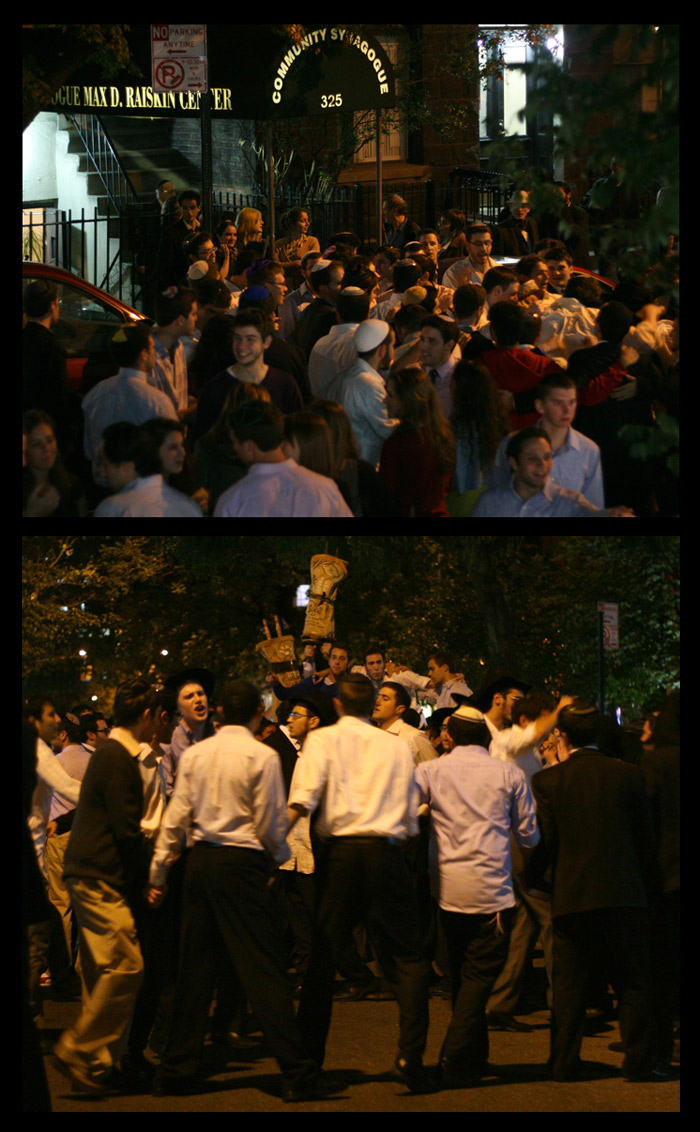
    Near my home is an NYU Chabad center. On October 20th, I noticed an inordinate number of students overflowing into the street. I had wanted to do a story on this center and the Chabad movement, so I inquired of one of the members if he thought photography would be allowed inside the center. He escorted me in and asked the Rabbi for me. I was told it would be possible, but any other time. Tonight was a big celebration.

    It was suggested that if I wanted to see and photograph a big celebration, I should head to East 6th Street, where Simchat Torah would be taking place. The holiday celebration culminates in the Rejoicing with the Torah and the dancing of hakafot (for more information, see here). For New York City in the East Village, this literally means Dancing in the Street for hours into the night.

    When I arrived, people were spilling out from the Community Synagogue Max D. Raiskin Ctr. at 325 East 6th Street. There were hundreds dancing, circling, and singing. I was asked to join in by one man. When I informed him that I was not Jewish, he told me it was no matter – everyone was welcome. There was a tremendous feeling of community. I was an interloper, secretly wishing that I had grown up with festival activities such as hakafot 🙂

    Related Posts: Chutzpah, Woody Was Right, Shalom, Bagels


  • For No Good Reason

    Service in New York City retail is a VERY uneven experience. Many single-location privately owned operations which are legendary have an attitude regarding customer service bordering on the arrogant. I have seen salesman curse customers for no good reason. And yet I have seen the same salesman as sweet as sugar. The reason? It often depends on how you approach the sales staff – your attitude, knowledge, and other factors. Retail sales can admittedly be very trying, however, a customer should not have to walk on eggshells or ingratiate or prostrate himself to assure good service. It should not be that way, but welcome to New York.

    The large, high-profile retailers or chains are much less inclined to risk reputation than a mom-and-pop operation working with a captive audience in a specialty. When a store attains iconic status in New York City, arrogance may often become a component of service. The differences become strictly a case of management style.

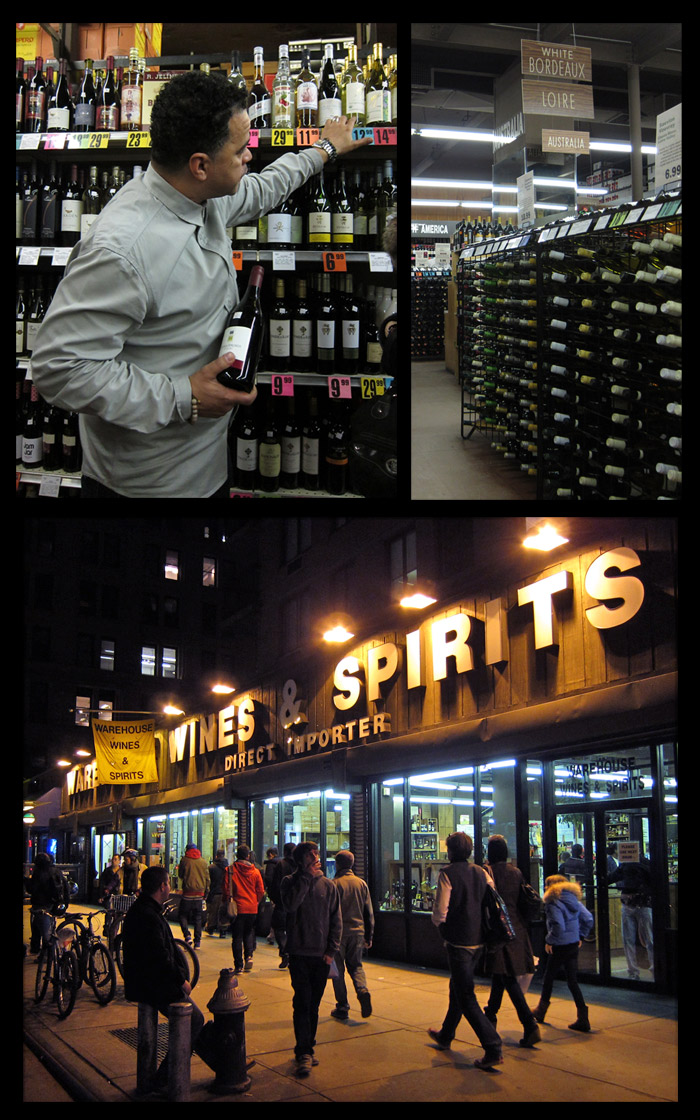
    If you read reviews of places like Warehouse Wines & Spirits at 735 Broadway, you will find a virtually inexplicably broad spectrum of reviews and customer experience, from one to five stars. Not unusual for a place like this, known for its very competitive pricing, often the lowest in town.
    What brought me to Warehouse recently was a very specific mission. A friend was desirous of exploring wine, however, their previous experience with headaches made them apprehensive. The subject of red wine headaches is debated. Many naturally occurring substances have been blamed – sulfites, tannins, histamines, and prostaglandins. Rather than wade through the literature, I decided that finding a wine salesperson with real customer experience regarding wine and headaches would be a simpler, more effective solution.

    As I entered Warehouse Wines, I approached and asked the first salesperson visible who might be the resident wine expert. He responded, “that would probably be me.” I told him of my mission, asking of his experience, if any, with wine headaches (sometimes referred to as red wine headaches, owing to the feeling that red wine is more problematic than whites). He made immediate suggestions and accompanied us to an area with a number of wine which, from his personal experience, were successful with his customers who previously had wine headaches. Although added sulfites have been implicated by some and dismissed by others, we chose an organic white.

    I was impressed by his knowledge and asked about his wine background. He introduced himself as Dennis Johnson and told me that he had worked 22 years as cellarmaster at the Windows of the World restaurant.*

    I was elated at my shopping experience at Warehouse Wine with Dennis. It is ironic that in New York City, I have become so inured to the unpredictable nature of customer service that I often feel that great service comes for No Good Reason 🙂

    *Windows on the World was a restaurant on the top floor of the North Tower of the World Trade Center.

    Related Posts: Trimmings for Sale, Instincts, We Don’t Do Windows, No Students After 1, Pick Two


  • Shop Class

    I was given the choice of making the pump lamp or a flying horse. I asked about making other things but was told those were the choices. I really didn’t want to make a pump lamp that much, but it was better than a flying horse wall plaque. I understand the need for discipline, training, and honing skills. This was shop class in 8th grade, where no independent thinking or creative expression is allowed. But it’s a shame, because I liked making things and would have gotten more involved in class. Eventually I would become a manufacturer.
    So, yesterday, I was very pleased to get the following email invitation for The Calling, a theater of fire and song:

    You are being called to a relatively secret place for a meeting of believers – a ritual for the arising. Out in gritty Gowanus in Brooklyn is an industrial complex down by the canal where much of the sculpted art you see in swanky galleries actually gets created. It’s a vast place, owned by ex-squatters and descended from the renegade forges and welding spaces of the LES of the 90s, and it opens it’s doors to Flambeaux Fire, Kai Altair and to you this coming Thursday. You will see it become a WONDERLAND.
    A landscape of flames, machines, and beautiful women as spiritual guides, set to the live music of Kai Altair, written & directed by Flambeaux and Kai.

    The email invite went on to say:

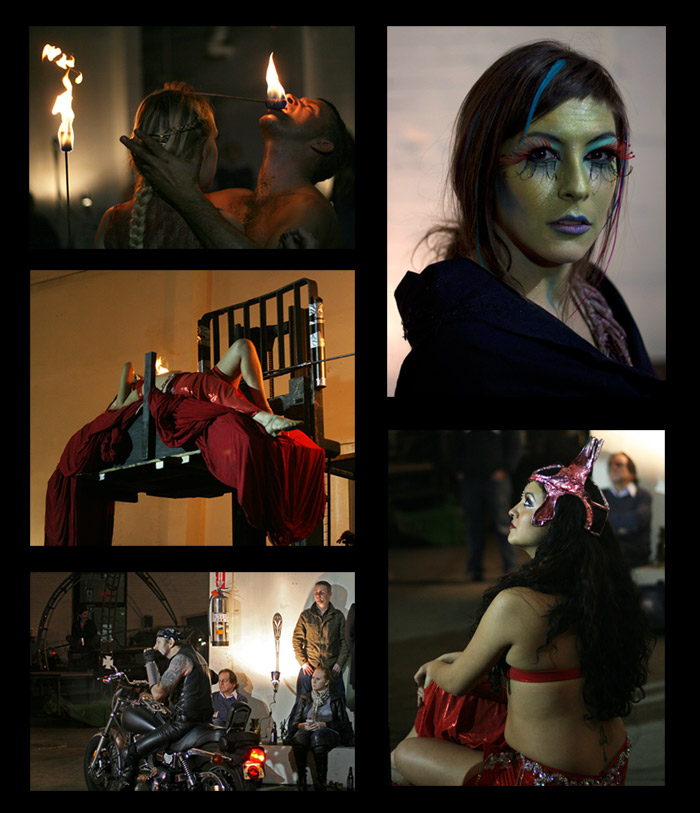
    Flambeaux presents The Calling, a Fire-and-Song Ritual with siren Kai Altair.
    A Journey into Seduction, Spirit and Transformation with ritual shows by Lady C, Serafina, Fayzah Fire, Ali Luminescent, Flambeaux, Tribal Bellydance by Angelys and Serena. Featuring the sculpture art of Adrian Landon and Doumbek byt Natalia Perlaza.

    What really intrigued me, was the location and venue, The Gowanus Ballroom. Gowanus is a very industrial neighborhood, and it certainly is not the type of place where one would expect to find ballrooms, chandeliers, and formal attire. The invitation also specified Serett Metalworks, so perhaps it would be a ballroom of a different sort. And it was.

    The space was difficult to find, as might be expected. There was no ballroom or 55 9th Street. I saw two women on the street and asked if they knew of this place – they did and directed me. The space was down, around, and behind.

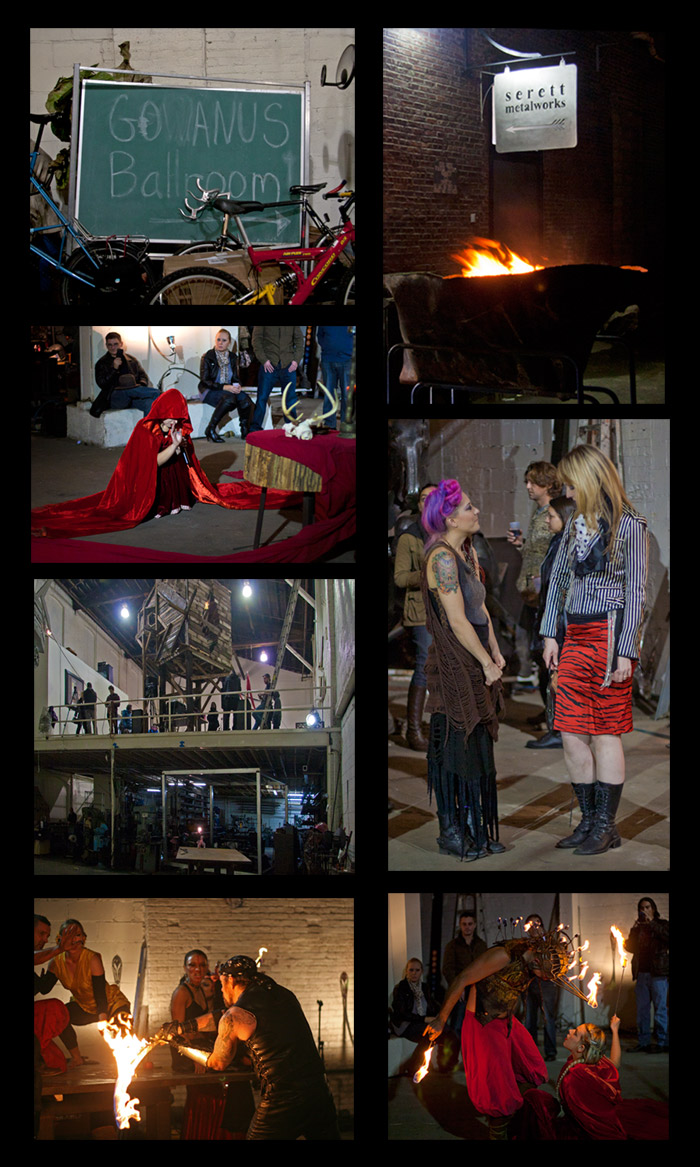
    I never read the email closely enough or thought about it, so I was surprised to find that the ballroom was actually an industrial space along the Gowanus Canal. I was greeted with an open factory space and an open cauldron of fire burning outdoors beneath a sign for Serett Metalworks. I knew we had arrived at the right place when I found Gowanus Ballroom written on a chalkboard.

    Inside was every manner of metalworking machinery along with a variety of metal sculptures, as promised in the email. There was an enormous loft space which afforded viewing from above and a wooden structure reminiscent of the Tower of Toys.

    Chris Flambeaux was busy milling about, making preparations for the show he had written. Performers and attendees began to filter in, dominated by the edgy artistic with the requisite piercings, metal, fanciful dress, dreaded hair, and skin art.

    The show started in a ritualistic, nearly occult manner, setting the tone for the entire night’s performances. Some of the acts I had seen at the QAS. This show, however, had a much more industrial flavor – fork lift trucks were used to deliver acts and even performed on them. One act featured villainous characters aboard a Harley-Davidson motorcycle, driven around the space. See my photo gallery here.

    Space being so precious a commodity in New York, this in not the type of event one would expect in the city. For years I had heard of these types of happenings – somewhat impromptu and unadvertised. I was always desirous to be in the loop and attend. There was drama, fire, seductive sirens, metal, and machinery. These guys should open a real ballroom or run a Shop Class 🙂

    Related Post: Not Of Them


  • The Magic Hour

    I grew up in New England, and even for residents, fall foliage was loved by all. The beauty in sparsely populated states, such as Vermont with large stands of deciduous trees, is such that many travel to and tour the area during “leaf peeping” season. When the conditions were right, my family would sometimes take a country drive. If the leaves and light were right, we were sometimes treated to jaw-dropping scenery.

    A popular cliche amongst photographers is that “it’s all about the light.” It is overused, but it is quite true. If you are around artists or photographers enough, you may also hear the phrases “magic hour” or “golden hour” – the period before sunrise and after sunset when the light is reddish. This light during autumn can lead to exceptionally beautiful vistas.

    Prior to the inception of this website and my photographic interest here, I paid little attention to the properties of ambient light – intensity, color, and changing quality over the time of day or cloud cover.
    Many of one’s intuitions about photography are wrong. A bright, sunny day is the worst time for shooting, particularly midday. Cloudy days give much better color. And the most coveted times for most landscape photographers is during the magic hour.

    Some, like photographer Ken Rockwell, will make claims of a rather extreme nature regarding the magic hour: “Glorious light only happens for 60 seconds or less any particular day, if it happens at all. If it happens at all, it usually happens sometime in a window 15 minutes before or after sunrise or sunset.” One must, of course, allow that not every photographer wants this particular golden light for every photo.

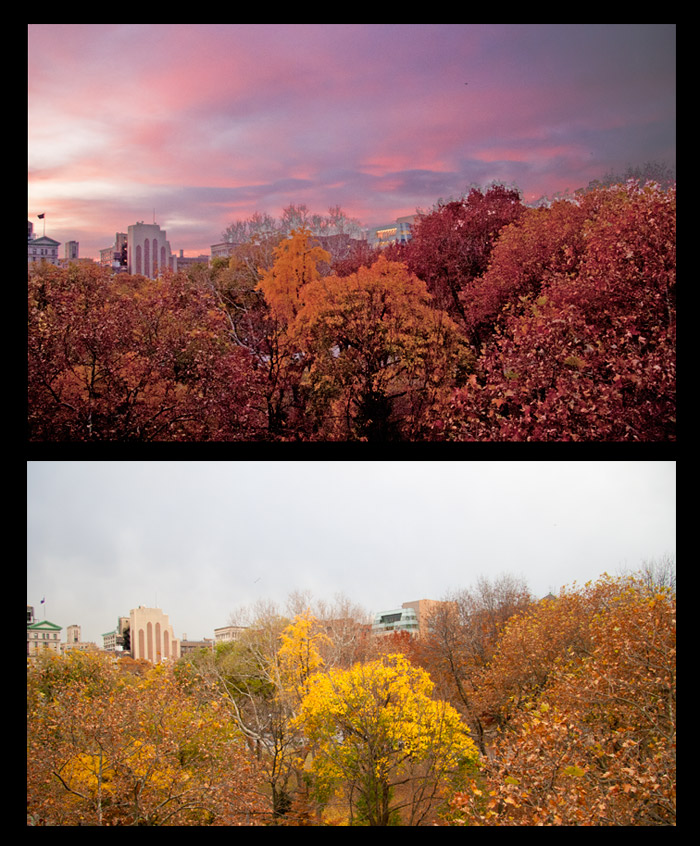
    Capturing this morning light requires being up at a very early hour, which I typically am. Two mornings ago, I was up before dawn and witnessed the extraordinary light of the magic hour illuminating the vestiges of autumn foliage. Everything was aglow in oranges and pinks, begging for a photo. Today, two hours later in the morning, you can see the dramatic difference (lower photo).
    Many New York City residents will never see this phenomenon, particularly in the morning – they are not at the right place at the right time to happen upon a natural setting during the magic hour…

    Related Posts: In a Different Light, Wood, Glass, Brass and Trees, Light and Lights, Mother Nature, Risk Not Living, Manhattanhenge


  • dinamic_sidebar 4 none

©2026 New York Daily Photo Entries (RSS) and Comments (RSS)  Raindrops Theme