• Meet the Artist

    Posted on by Brian Dubé

    As a Christian proselytizer once said to his audience in Washington Square Park, saying it doesn’t make it so. And believing something, doesn’t make it so, either. This is why, in spite of intense belief in Santa Claus by millions of children around the world, a red-suited man does not fly through the air pulled by a team of reindeer. To believe otherwise is, for an adult, self-delusion. And so I thought it was with artists.
    Until quite recently, I had little patience and tolerance for those who defined themselves as ARTISTS, as if they were a different class of people who truly thought and saw things differently than the rest. To hear them speak, one would be led to believe that true artists were also more principled, i.e. they would not “sell out” but were true to their art. They would not pander to the almighty dollar like the lowly businessman.

    All of this, I thought, was pure, unadulterated crap. In my mind, these people were posers, caught up in the image of being an artist and all its hipness and coolness. People who had some interest and ability in drawing or painting, but were failures in their ability to do productive work, and hence, sought to justify their failure by playing victim in a world that does not value art and reward artists. They were unambitious and unskilled and hid behind the moniker of ARTIST in order to cloak the truth. And they were bitter.

    Meeting Philippe Petit in the 1970s did nothing initially to dispel my notions. In fact, his posture as an artist was much larger than anyone I had met. He had a serious attitude and was fiercely iconoclastic. However, the man had done things that made me begin to question what I believed about artists. Although he was not incredibly wealthy, it would have been very unfair to consider him unsuccessful or unambitious. His walk between the Twin Towers in 1974 spoke for itself. His reputation as one of the world’s quintessential street performers was legendary – I witnessed his weekly street shows in the 1970s in Washington Square Park.

    Over a period of decades I had the privilege of hearing Philippe speak on numerous occasions and getting to know him as a client. I began to observe more closely those individuals who considered themselves artists, some of them in my employ. I saw that many were neither posers nor particularly interested in the cachet or image of being an artist, but that they were genuine people and genuinely different. Most were much more visually oriented than others, noticing aesthetic nuances that others never saw. It was not a matter of training or focus to prove something; it appeared to be the way that they were wired.

    I also reexamined my own life and saw that although I had been steered towards study in mathematics, a subject that I had some natural gift for, creativity was never really acknowledged and only found an outlet within the bounds of product design. As I began writing for this website for the last seven years, I have become much more acutely aware of the creative process. My thinking has changed. I believe artists exist. Although I still do not understand precisely what makes great art great, I accept that artists are behind it. Sometimes, when my analytical side is in abeyance, I see myself more akin in spirit to artists than scientists.

    Recently, I was invited to see Philippe speak about his latest book, Why Knot?, in Bryant Park. I photographed and filmed the entire presentation, which you can see in 4 parts here. He spoke with unbridled passion and love for knot making. He demonstrated as the audience made knots with him, using a red cord that had been provided for any attendees who wanted to participate. As always, his enthusiasm was infectious. He is an artist. Of course, my saying it does not make it so, either, and not every self-proclaimed artist is one. So, go see for yourself. If you have the opportunity, attend one of Philippe’s talks. And although the phrase has been rendered a cliché by book marketers, in Philippe’s case, you really will Meet the Artist 🙂

    Posted on by Brian Dubé

  • I see lines, gentlemen.

    Posted on by Brian Dubé

    I was astonished. Amazed. It was the first time since 1968 that I saw a restaurant surface being cleaned that needed no additional cleaning. I was at Nathan’s in Coney Island, and the stainless steel counter was already gleaming, yet it was being cleaned anyway. I was more astonished to find out that, according to Kiera, she and I shared a common corporate policy.

    I say astonished, because the policy I had in common was that of McDonald’s, where I worked while in high school in the late 1960s. The work atmosphere at the time was BRUTAL and our manager was relentless. He stood cross-armed behind the customers and regardless of the sales volume, he had a number of mandates, some impossible to meet. He wanted NO LINES, no matter how many people entered the store, even during mealtime rushes. He would terrify us by barking, I see lines, gentlemen. We would ramp up the speed of our serving as much as humanly possible. I recall a collision of two counter people who were literally RUNNING. The crash resulted in the contents of a triple thick shake forming a geyser. In order to further expedite our orders, we calculated order totals in our heads as we scurried about, picking up items in the very particular order prescribed by the McDonald’s corporation in our training.

    Another policy was that we were always to be in motion DOING SOMETHING. If nothing needed to be done, we were to clean. If all was clean, were were to clean more. The prospect of being fired for noncompliance was quite real in this zero-tolerance environment. I told Kiera and her coworker the story of my McDonald’s experience. I asked if they had a similar policy. She and her coworker affirmed, explaining her constant cleaning of the already clean counter.

    I remember the stress of working at McDonald’s to this day, and my thoughts go back to those harsh conditions whenever I see lackadaisical customer service, so common nowadays. Here, however, at Nathan’s in Brooklyn, I felt at home. Service was good, Kiera and the staff were polite, and there was lots of buffing of stainless steel counters with cleaning rags. It was a slow afternoon with storm warnings, so there was no waiting. No need for a manager barking behind us, I see lines, gentlemen 🙂

    More Coney Island/Nathan’s: Coney Island at Sunset, Hot Dogs and Fries

    Posted on by Brian Dubé

  • Dead Man Gawking

    Posted on by Brian Dubé

    Mention Ken Rockwell to photographers familiar with Ken’s website and pronouncements, and you will likely get mixed and strong reactions. He is seen by many as the master of misinformation. A tireless self-promoter. Some say a buffoon, but it matters not to him – his website gets enormous traffic, and Ken generates income from various forms of text-link ads and other sources. He is debated and critiqued on countless forums. The controversy, however, only fuels the traffic to his site.

    Ken’s assertions are often dramatic. However, no one can be wrong all the time, and even experienced photographers enjoy his site from time to time, sorting the wheat from chaff, often looking, as I do, for validation for things they already know, but just presented more emphatically, passionately, and authoritatively.
    On November 17, 2011, I wrote The Magic Hour, about that time of day that artists and photographers have also referred to as the Golden Hour, the hour before or after sunset when the character of the light is very unique, often bathing subjects in a spectacular golden/reddish light.

    This has led Ken Rockwell to make a number of outlandish statements:

    Glorious light only happens for 60 seconds or less any particular day, if it happens at all. If it happens at all, it usually happens sometime in a window 15 minutes before or after sunrise or sunset.

    Glorious light doesn’t happen in the day. It happens at sunrise and sunset. We call this “magic hour” in Hollywood.

    Most people sleep through sunrise. They lose half their potential shots. I have to get up at 3 AM, get out at 3:30 AM, get to the location at 4:30 AM, set up by 5 AM and wait for a 6 AM calculated sunrise. I’m crazy. Are you?

    Sunset is as tough. Most people are eating dinner while I’m out shooting. I have to jerk around my schedule, as well as the schedule of normal people with whom I travel, to be out at sunset. Photographers have dinner at 4 PM so they can be shooting at 6 PM. A bunch of us were photographing at sunset, and I thought something interesting might happen. The rest of my photography group took off for dinner while I stayed around in the dark. I got this shot, one of my all time favorites, while they were having dinner.

    If you sleep at sunrise and eat at sunset you’ll miss the only light that shows things the way I, and many others, like to see them. That’s why most people have never seen colors I show and think I’m making all this up in Photoshop. If I could get these results artificially I would, however one still has to trudge out and get this from nature the hard way.

    These colors don’t happen every day. They may happen once a month, once a decade, or once in a lifetime. This shot got the orange color in the sky 20 minutes after the sun set because of ash in the upper atmosphere from the eruption of Mt. Pinatubo in 1991.

    9 times out of 10 the sunrise is dull and a complete waste of time. While everyone else is eating dinner I’m out setting up hoping for great light at sunset, and again usually I get nothing. That’s why this takes patience.

    You can’t predict nature, even 5 minutes before. I can try, but I never know what’s going to happen. I have to be out there and set up every time. Sometimes what I expect to be dull turns out to be explosive, and sometimes what I expect to be incredible never happens. Nature changes minute to minute.

    You can’t expect God to create miraculous color any particular day just because you took that day off for vacation in Yosemite. You need to be out every single day.

    You don’t need to be in Yosemite: most of my shots are from my own neighborhood. It’s all about the light and color, not the subject. Ansel just happened to live in Yosemite and waited for clearing storms. It’s not Yosemite; it’s that he was there every day.

    Yesterday evening at about 8:15PM, I was walking the streets of the Village. It was a beautiful evening. As I gazed into the sky, I was startled by nature’s drama. Distant buildings both east and west were all aglow, virtually on fire, with the light of sunset. I knew from past experience that 6th Avenue looking south had virtually unobstructed views of the Freedom Tower. I hustled there, and sure enough, I witnessed the most spectacular evening light I have seen in this New York City vista. The Freedom Tower was in brilliant light, framed with Trump SoHo and, nearer by, the triangular shaped residential condominium building at 2 Cornelia Street, evocative of the Flatiron Building.

    The photo opportunity could not be missed, and I planted myself in the center of oncoming traffic during red lights. My reckless behavior inspired others, and soon there were no less than 6 people taking photos in the middle of the street. It was reminiscent of my Dead Man Walking, however, on this night, in the sunset glow of the Golden Hour, I was Dead Man Gawking 🙂

    More sunsets and spectacular sky views: Night on Bald Mountain, In a Fog, Moonrise Over Hernandez, Back to Our Main Feature, Fire and Ice, Who’s Getting Technical?, Mother Nature, Brooding

    Posted on by Brian Dubé

  • Very Slow

    Posted on by Brian Dubé

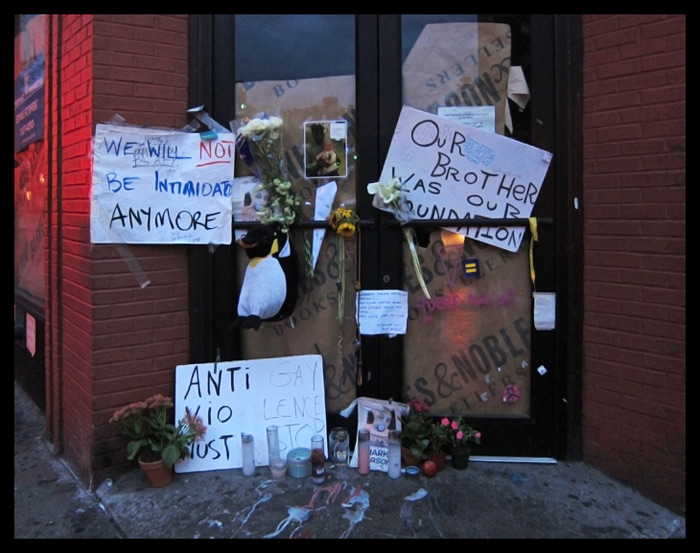
    On the evening of May 18th, I was walking with a friend near my home in Greenwich Village. As we passed the corner where Barnes & Noble recently closed, the area was cordoned off by the police and filled with onlookers. Upon inquiry, I learned that someone had been murdered. From the Gothamist:

    On Friday evening, a 32-year-old man was fatally shot in the middle of Greenwich Village in what police believe was “clearly a hate crime.” Brooklyn resident Mark Carson was walking with friend on Sixth Avenue near West 8th Street around midnight Friday when they were confronted by 33-year-old Elliot Morales and two others. “Do you want to die here?” Police Commissioner Ray Kelly said Morales asked Carson. Morales then allegedly pulled out a .38-caliber revolver and shot him once in the cheek.

    Carson and his 31-year-old friend were dressed in tank tops and cut-off shorts with boots. Police say when they first were approached by the suspects, Morales and pals started hurling gay epithets at them, including “Look at these faggots” and “What are you, gay wrestlers?” Even when Carson and friend started walking away, the suspects chased after them shouting “faggot” and “queer.”

    Kelly emphasized, “This fully looks to be a hate crime; a bias crime. There were no words that would aggravate the situation that were spoken by the victims. They did not know the confronter. There was no previous relationship.”

    You can read more from the New York Times here.

    In a way, it’s incredulous. That in 2013, when state after state are passing same-sex marriage laws, we would witness an anti-gay hate crime ending in murder, in Greenwich Village, New York City – one of the most liberal and gay-friendly neighborhoods and cities in the United States. Unfortunately, this incident illustrates all too well that racism, sexism, and bigotry are not easily eradicated and that while society and human rights evolve and change, that real change is Very Slow.

    Photo Note: An impromptu memorial established at the scene of the crime at the entrance of the recently closed Barnes and Noble at 396 Avenue of the Americas on the corner of 8th Street.

    Posted on by Brian Dubé

  • Plastic

    Posted on by Brian Dubé

    I saved articles, maps, and books of the island groups of Oceanica’s tropical regions – Polynesia, Micronesia and Melanesia. I became fascinated with islands like Fiji, Rarotonga, Tahiti, the Marquesas, Tonga, Bora Bora, Vanuatu, Cook Islands, Moorea, Yap, the Solomons, and the Marshall Islands.

    The palm fringed beach was iconic for me, symbolizing an idyllic, paradisical, tropical, fantasy world. Like many armchair travelers on the cold nights of the temperate zones, I dreamed of creating a self-sufficient life where I lived in a natural state, living off the fruits in my personal Eden, much like Thor Heyerdahl dreamed and wrote about in his adventure, Fatu Hiva. Not nearly as ambitious, I settled for numerous visits to many isles of the West Indies in the 1980s. What I found was disappointing – the real life of natives working to survive. Many of the most beautiful islands, like Dominica, were incredibly poor, with per capita yearly incomes of $200 at the time. Heyerdahl was also disenchanted rather than enchanted with the reality of island life. He and I both learned that home is truly where the heart is, not ….

    On December 17, 2009, in Manhattan Island, I wrote:

    One of my favorite t-shirts was designed with a tropical motif, including palm trees blended with a New York City skyline. Below it were the words Manhattan Island. Perfect. I love the tropics, islands, and New York City. The shirt is long gone, but the spirit of Manhattan Island remains.

    In recent years, however, I weary of the summer and the heat. I do not long for the tropical heat of the West Indies or of the South Pacific as I once did. But my love for the coconut palm remains. Here, however, on the other isles of New York City archipelago, I must settle for fake palm trees, like those in today’s photo on the manmade Water Taxi Beach on Governor’s Island. Like many other aspects of New York City life, enjoyment often takes imagination and, perhaps for some, lowers their expectations. The vistas are not like the magnificent mountains of Moorea, but instead the monoliths of Manhattan. The beach is not the naturally occurring white sand of the island atoll, but manmade. And palm trees do fringe the beach, but rather than grow and produce coconuts, they are Plastic 🙂

    More islands and tropical plants, real or fake: North Brother Island, Bamboo Big as Pipe, Banana Too, Winter Garden

    Posted on by Brian Dubé

  • People Live Here

    Posted on by Brian Dubé

    Between 1500-1700 B.C.E., the Minoan culture on the island of Crete had a highly developed waste management system with very advanced plumbing and places to dispose of organic wastes. Knossos, the capital city, had a central courtyard with baths that were filled and emptied using terra-cotta pipes. They had flushing toilets, with wooden seats and an overhead reservoir. In 320 B.C.E., Athens passed the first known edict banning the disposal of refuse in the streets. The early Greeks understood the relationship between water quality and public health.

    Public latrines date back to the 2nd century BC in Rome. They became places to socialize. Long bench-like seats with keyhole-shaped openings cut in rows offered little privacy. Sanitation in ancient Rome was a complex system similar in many ways to modern sanitation systems. Their waste treatment management practices were the most developed of any civilization prior to the nineteenth century and superior to that of the Dark Ages, where waste was disposed of in the alleys and streets.

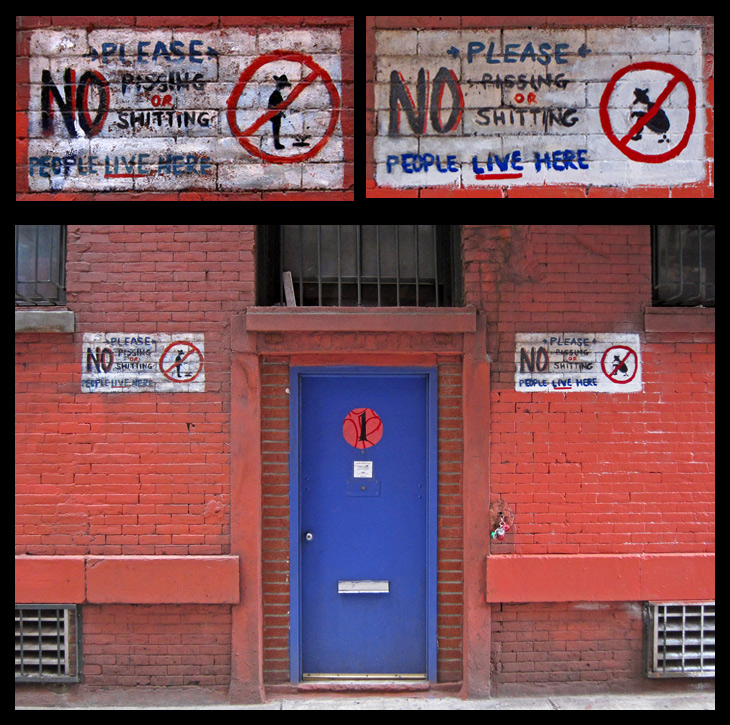
    However, it is 2013, and in a civilized world in the 21st century, one would not expect to need signs telling people that they should not defecate or urinate on the street in front of your home. But, as I have pointed out some time ago, many of the living conditions in New York City are not so much different from the Dark Ages.

    At number 1 Jersey Street, a small two-block alley in NoLita, the residents have had to remind the uncivilized how to behave in public with two signs, prominently displayed, that clearly state, both through written word and graphic illustration: Please. No Pissing or Shitting. People Live Here

    More on sanitation: Pickup Day, Livid

    Posted on by Brian Dubé

  • Bart

    Posted on by Brian Dubé

    His name was Bart, and he was quite mean and a bit of a bully really. I had nothing in common with him at all – he was a sports jock, and I hated sports. He forced me to play sports with him – but the brief sessions were just means of humiliation. And he reveled in it.

    Your question is, why would I tolerate this abuse? Answer: He had an Aurora slot car racing setup in his basement. This was a huge thing for the couple of us that befriended him – no one else we knew had such a thing. Vehicles of any sort, particularly FAST ones, have always been a big draw for boys, and we were no different. Whether rockets, planes, trains, or automobiles, the lure and fascination with all things fast and mobile was compelling and irresistible. Enough to endure the slings and arrows of an older bully.

    There was another draw, and that was his bicycle. We waited for the rare opportunity when Bart needed some part or thing. No matter what his need or fancy, we were ready to oblige because he had a bike, which he referred to as his “crate.” When we asked how we would get to a given store, Bart, being impatient to get whatever it was he needed, would invariably tell us, “Take my crate.” The errands were fraught with stress – we had limited time, or we would have to face Bart’s wrath. Nonetheless, it was a bike ride.
    Owning a bike was unquestionably a major rite of passage. Now, you had your own WHEELS. It was a first step towards independence. Now you could go places on your own. The next step would be at 16, learning to drive. But for most of us, one’s own car was not a reality and, at best, one may on occasion be allowed to drive a family car. And the responsibility and consequences of any mishap nearly outweighed the freedom that a car gave. There were no such concerns with a bicycle. Around 12, I got my own bike, and I needed to tolerate Bart no longer. I was a free man.

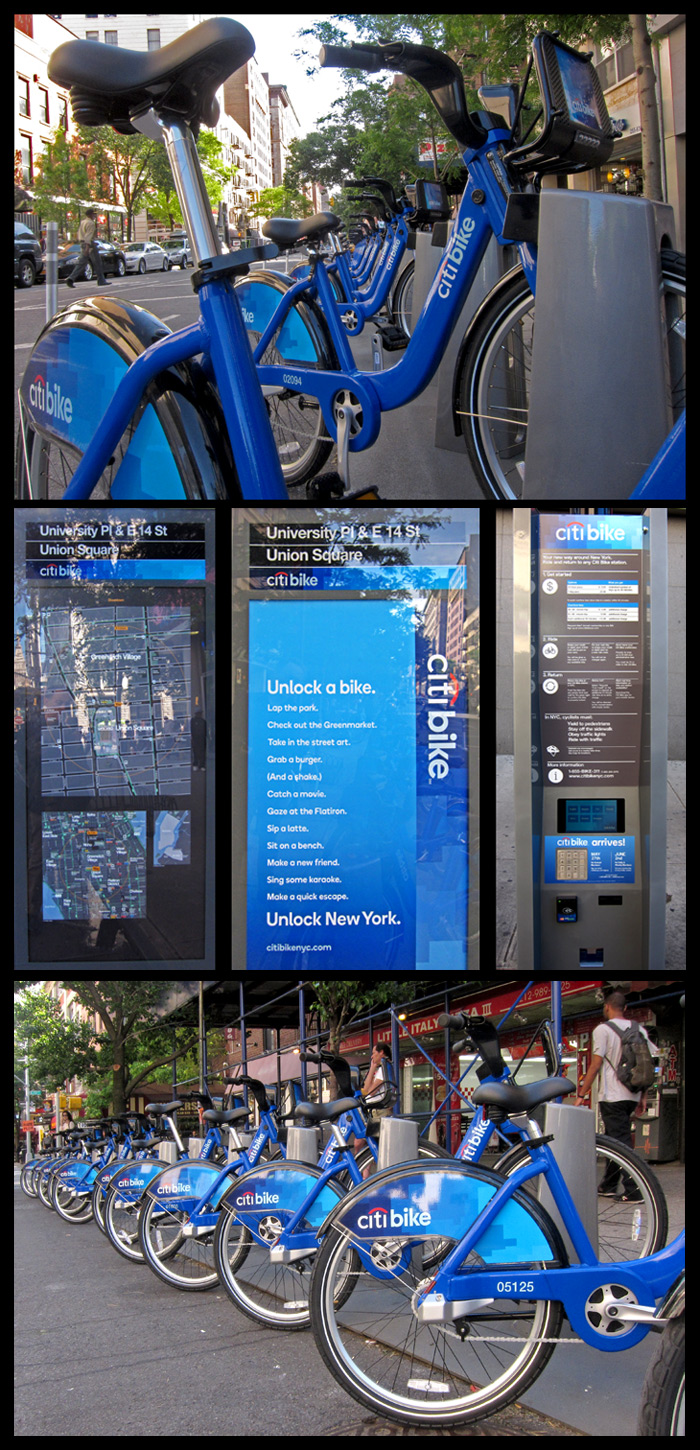
    The lure of that beautiful, simple, efficient machine is with us today. Over the entire time I have lived in New York City, I have owned a bicycle. However, storage in a small apartment, carrying it up and down stairs, and the need for locking up at a destination all conspire against frequent use. I have not used a bike in years. Citi Bike hopes to change all that with their new rollout yesterday of their bike share program. It’s a long time coming and a really big deal. I wrote about the plan’s announcement on October 25, 2011 in Last to See the Future. The New York Times says:

    For the first time, under cooperatively clear skies, New Yorkers sat astride the city’s first new wide-scale public transportation in more than 75 years: a fleet of 6,000 bicycles, part of a system known as Citi Bike, scattered across more than 300 stations in Manhattan below 59th Street and parts of Brooklyn.

    There were some snags, as to be expected. Many were desperately trying to activate a rental with their credit cards, unaware that the program is initially only available to those who preregistered online. Some registrants had not yet received their key. The map app showing station locations was not working. People were having difficulty locking the bikes on return.

    Also, the plan is often misunderstood. The motive is to provide transportation, not recreation. Base rental periods are for 30-45 minutes. Overtime is prohibitively expensive – $12 per half hour. Daily, weekly, or yearly rentals come with unlimited rides but not unlimited time per ride – all are subject to overtime charges.

    The bikeshare plan is controversial. Parking spots have been eliminated, and the cost to run the system is high. Some new Mayoral candidates are not in favor of the plan at all. Time will tell if the plan is logistically and financially viable. I plan to be an early adopter. No matter what setbacks the system may have, anything is better than borrowing a crate from Bart 🙂

    Posted on by Brian Dubé

  • A Different Kind of Sunset

    Posted on by Brian Dubé

    There are many, many juxtapositions and sharp contrasts in New York City. But, barring an occasional visit from the Mennonites, there is nothing quite like seeing Hasidic Jewish men in an urban setting. The beards, payot, rabbit fur hats, tzitzit, skullcap, and formal all black three-piece suits that are worn year-round and are particularly startling to see on hot summer days.

    For eons, I have admired the spectacular vistas of Manhattan while crossing the Williamsburg Bridge by car and had promised myself I would return by foot to take photos of the New York City skyline. So, armed with my camera, I finally made the pilgrimage across the Williamsburg Bridge via the bike and footpath from Manhattan to Brooklyn and back.

    It was evening, and an extraordinary number of Hasidim were making the passage from Williamsburg to Manhattan in small groups and large. At various moments, they dominated the view down the walkway. I saw two jogging across the bridge, still dressed in traditional attire. I was not the only one to take notice – as a group passed, a man next to me stopped, turned, watched, and then commented, “What was that about?”
    I am sure that visitors to the city are startled by such an apparent anachronism. I don’t find even the piercings and tattoos of urban youth quite as shocking – the phenomenon of extreme body art and mutilation can be seen around the world and is more and more common, whether in New York City or the suburbs. But the traditional, conservative dress of Hasidic Jews along with strict religious practice, rituals, and customs, such as closing on the Sabbath, are truly remarkable to see in a place like New York City in the 21st century. Enormous retail giants like B&H Photo forgo what I imagine would be substantial business by being closed Friday afternoon and Saturday.

    I got numerous interesting photos of the bridge structure, ships passing, graffiti, building rooftops, the Domino Sugar Factory, and people crossing. Ironically, the worst photos are what I set out to shoot – the skyline. Even though I timed my visit to take advantage of the sunset, none of the skyline photos, which needed to be taken through chainlink fence, were good. It was not at all what I set out to capture. The most interesting images were of men in black in the amber glow of the setting sun. It was, altogether, A Different Kind of Sunset

    Posted on by Brian Dubé

  • Wo Hop

    Posted on by Brian Dubé

    We always ordered bean sprouts with black bean sauce and vegetable chow mai fun. Incredible as it may sound, growing up in New England, I had never eaten Chinese before. Now, coached by our friend Dick, we were sophisticated. We knew what those menu items were, what to order, and most importantly, where to eat.
    Dick was a native New Yorker, introduced to us by Ferris Butler. He was much older and wiser, perhaps 25. He knew everything about New York City, because, after all, he was a taxi driver. And he assured us that the best Chinese in New York City was Wo Hop at 17 Mott Street in Chinatown. It never occurred to us to question him.

    Wo Hop, love it or hate it, is an institution, established in 1938. Reading various reviews, I found that many shared the same sentiments about the place and the reasons patrons eat there.

    Many of the people who dine at Wo Hop go there just to be reassured. Reassured that the restaurant that they long ago decided was the best in Chinatown is still there, and that the staff still remembers them.
    It’s bland, hastily prepared and gloppy with sauce. There are huge amounts of it and you suspect a lot of it began life frozen. It’s unreformed, Americanized Cantonese cuisine from the World War II era. Many a foodie will tell you that this is some of the worst food in Chinatown. The devoted, however, tend to find the dishes that please and bring them comfort and stick to them. … It still retains a certain romance of a bygone Chinatown, when such food and surroundings would have seemed exotic. Everyone knows about Wo Hop. But it still feels like a secret.

    Brian Silverman of New York Magazine says:

    Popular with the bridge-and-tunnel crowd and glassy eyed civil servants, this tiny subterranean dinosaur serves all the classics you loved in your youth: egg drop soup, chow mein, egg foo young, subgum vegetables. Much of the food is simply prepared and heavily battered. And corn starch-thickened oyster and black bean sauces rule. But there’s something comforting about it. Maybe it’s because day or night, Wo Hop is there for you with a bowl of wonton soup, brimming with wontons freshly rolled by the kitchen staff, or soy sauce-soaked chunks of brown roast pork—and not the food-dyed red pork you’ll get at other joints. Whatever you order, you will not leave hungry: Portions are elephantine and the food dense. And if you charge in here, post-clubbing, you may just exit up the stairs when the sun is breaking in the east.

    We used to visit Wo Hop at all hours, day and night. There was one waiter in particular who appeared to be working regardless of the time we visited. We nicknamed him “24-hour man.” Early evening, late night, early morning – he was there.

    Yesterday, on a visit to Chinatown, I felt compelled to visit. I took the steps down into the subterranean depths for the first time in decades. I felt as if I recognized one of the waiters, but it is doubtful that any of the staff has remained in a span of 40 years. No, I’m sure it was just a wave of nostalgia clouding my memory. Here, in New York City, in such a highly stressful environment, old, familiar places are a palliative. For many, Wo Hop is one stop in The Comfort Zone 🙂

    Posted on by Brian Dubé

  • Caffe Roma

    Posted on by Brian Dubé

    I have a friend, no longer living in the city, who was Italian, a native New Yorker, and lived near Little Italy. I recall once, early in our friendship, asking for suggestions for an Italian restaurant on Mulberry Street. He replied that, categorically, he would never eat Italian there. He cited mediocre quality and that he refused to pay to eat Italian food in a restaurant when he could make it much better himself. His wife concurred that he made a mean red sauce.

    Of course, restaurant patrons know that being able to make it yourself is no reason to be eating home. Many New Yorkers eat every meal out – not surprising given the affluence here and the staggering number of restaurants.
    If you are inclined to eat on the legendary Mulberry Street in the heart of Little Italy, forget being able to peruse menus unfettered. Here, you will be accosted by aggressive hawkers, making promises, offering deals, and assuring you that the food inside is excellent and that you will not be disappointed.

    Recently, a friend wanted to celebrate her birthday by taking a trip down memory lane and dining at SPQR, a place she had not frequented in many, many years. SPQR is an institution, massive and well-known. It never occurred to us to call before visiting to inquire if it was still in business. As luck would have it, when we arrived at 133 Mulberry, we found the place had closed and only recently in early 2013, after being in business over 30 years. As we stood dismayed by our misfortune, we were immediately approached by a staff member of an establishment directly across the street who assured us that much of the staff of SPQR had migrated to their kitchen, the food was excellent, blah, blah, blah.
    A bit put off by the predatory behavior, we strolled the street, settling on a place some short distance away. Dinner was acceptable, if not memorable.

    To heal the wounds of our unsuccessful initial mission, I suggested that we have dessert at Caffe Roma, the only place in the neighborhood that my aforementioned friend approved of, albeit decades ago. I had visited once eons ago, so, not knowing what to expect, I suggested that we lower our expectations.
    My dining companions were immediately pleased with Roma as we approached it, located at 385 Broome Street at the corner of Mulberry Street. The ambiance at Caffe Roma is decidedly olde New York – the place has been run by the same family and in the same location for over a century – since 1891.

    Surprisingly, the place was quiet and we were fortunate to get prime real estate, a table in the front corner window. We shared a number of desserts and found the place a pleasant respite from an otherwise very touristy area. Nearby pastry shop Ferrara’s is a good example of an establishment that many avoid for that reason. Like so many eateries in New York City, reviews of Caffe Roma range the gamut, particularly regarding service. We found it very pleasant, and if by choice or chance, you find yourself in Little Italy, and want to avoid feeling like prey, try Caffe Roma 🙂

    Posted on by Brian Dubé

  • Oy Vey!

    Posted on by Brian Dubé

    Sometime in the early 1970s, I found myself in the unenviable position of being in New York City with no place to live. For a time, I lived, or, better said, crashed, with a number of people in a variety of scenarios, living out of a suitcase.

    One brief stay was as the guest of four women, at least one of whom was clearly not a New Yorker. One evening, this girl was busy finishing her shower in the bathroom and overheard the Yiddish expression, Oy Vey iz mir, I’m chalishing (oh my, I’m fainting). Unfamiliar to her, we attempted to teach her how to say it. Her interpretation went something like: Ova schmear, allava hallashing. I wondered whether an ova schmear was some medical procedure unfamiliar to me. From the living room, we urged her to repeat it over and over. On each telling, she popped her head out of the bathroom and proudly volunteered, “Ova schmear, allava hallashing.”

    As she retreated, we laughed hysterically and secretly, never revealing how severely crippled her mispronunciation was, perhaps the worst bastardization of Yiddish I have ever heard. The scene was hilarious and reminiscent of a sophomoric prank in Wayne’s World where Mike Myers and Dana Carvey trick their mother to repeatedly announce a phone call from a mythical “Mr. Sphincter.”

    Some Yiddish is a rite of passage in New York City. Certainly a working knowledge of basic words and phrases is a necessity. The lack of familiarity is a dead giveaway that an individual is an out-of-towner. If you doubt how much Yiddish is part of the fabric of the city, note the sign on the Williamsburg Bridge which proclaims, Leaving Brooklyn, Oy Vey!, below which one finds the names of the Borough President, Marty Markowitz, and Mayor Michael Bloomberg, both Jewish. Williamsburg, Brooklyn, has the world’s largest enclave of Satmar Hasidic Jews, estimated at 60,000 of the world’s 150,000.
    The sign leaves no doubt of where you are. You should know that iz mir bears no connection to a schmear, which is a thin coating of cream cheese on a bagel, and that ova are eggs. And if you don’t, we New Yorkers can only say in despair, Oy Vey!

    Related Posts: Essen or Fressen?, Hakafot, Chutzpah, Bagels

    Posted on by Brian Dubé

  • The Knell Tolls for Thee

    Posted on by Brian Dubé

    The local news during the last several days could easily be called Ode to Joe’s Dairy as one publication after the next paid its respects to the passing of one of New York City’s icons. I felt so strongly about the importance of this small establishment that in February 2012, I made several visits, interviewed the owners, and made a short two-part video documentary – I have reposted them here.

    Joe’s Dairy, located at 156 Sullivan Street in this Italian area of the South Village/SoHo, is the type of place that gives New York its unique character. The real deal, a place family owned for eons. Although I referred to it as “stability in a world of change,” I knew full well that it was just a matter of time. The owner had told me, during my visit, that closure was inevitable. It’s a scenario replayed many times. Even when there are children, few wish to follow in their parents’ footsteps.

    The lure of money and everything NYC has to offer is much greater than spending long days making mozzarella. Often, parents want better for their children and discourage them from continuing the family business.

    Sometimes a detour is made, where, after a college education and work in the corporate world, a family member will return to continue the legacy of the family. This was the case with Nom Wah Tea Parlor. But this is the exception, not the rule.

    But let’s be fair. As Jill Eisenstadt so poignantly said, nostalgia is a heavy shovel. And, regardless of any romantic notions, who wants to slave over boiling vats trapped in a tiny kitchen, turning out over 1000 pounds of mozzarella, day after day? Watch my videos and tell me if you or anyone you know really wants to do this work. Nonetheless, as I passed by to photograph the shuttered storefront and read their letter of thanks posted on the window, I was saddened. It was, however briefly, a morning of mourning. Ironically, I had spoken to them only a year ago about the bells of St. Anthony’s across the street, how I had heard the sombre ringing for a funeral and had written a story, For Whom the Knell Tolled. And now, for Vincent and Anthony Campanelli, The Knell Tolls for Thee 🙁


    Posted on by Brian Dubé

  • Favorites, Part 1

    Posted on by Brian Dubé


    New York Daily Photo is now over 7 years old. Since 2006, I have posted nearly 2000 stories with accompanying photos. As would be expected, the output varies. Some stories were quite elaborate and took considerable work, sometimes days or weeks, to complete. A number were written in two parts, with Part 1 as a deliberate teaser.

    Over time, I wove more and more personal experience into the stories, drawing from everything in my life, both in New York City and where I grew up in New England. I made the story titles enigmatic to draw readers into the text to see how unlikely elements were connected. My greatest rewards were when my favorite stories resonated and became yours too.
    However, all of these favorites, most viewed and most commented stories, are buried in archives. So, my biggest frustration is how to mine this content and bring the best to you. Today I am launching the first installment of my and your Favorites

    Posted on by Brian Dubé

  • Blossom

    Posted on by Brian Dubé

    In Back To Our Main Feature, I wrote of how, in New York City, Mother Nature takes a back seat to the people and everything that people make and do. Certainly, no one lives in this city for nature’s splendor, nor do they visit as ecotourists. And at its extreme, I have heard remarks that champion its dirt and edge. During the battle over the renovation of Washington Square Park, some accused architect George Vellonakis as wanting to turn the park into a flower garden. Yes, it was an accusation, not praise – many of his opponents bristled at the thought of the park losing its edge by being beautified and, as they saw it, sanitized. In 2009, I wrote in Toronto:

    But many defend the edginess and grit of New York City as important, defining characteristics. I remember reading an article years ago speaking to this. The article was defending the edginess and made a suggestion for those who did not see the grit’s charm: “There’s a place for you. It’s called Toronto.”

    However, in small and large ways, there are many, many here who work to improve the quality of life through nature. There are community gardens, botanic gardens, flower shops, zoos, and parks, including some of the world’s most outstanding such as Central and Prospect Parks. Of course, nature’s cup does not runneth over in New York, and those seeking such things must look a little harder. For urban explorers willing to travel to New York’s hinterlands, one’s journey may be rewarded by beautiful places like Jamaica Bay Wildlife Refuge.

    The efforts can be seen everywhere. Abutting a nondescript brick wall aired by a building’s exhaust, isolated and forgotten in a small patch roadside choked with car fumes, within a park surrounded by towering glass and steel, flanking a dog run and public toilets, or growing along side an electrical junction box in Staten Island – make no mistake. Here, as everywhere, the human spirit can and will, like flowers in spring, Blossom.

    Posted on by Brian Dubé

  • No False Promise

    Posted on by Brian Dubé

    I am frustrated reading about fascinating places in New York City that are off-limits to the general public and seeing superb photo galleries from the brave and lucky souls who have visited. Places such as the abandoned City Hall subway station, inside the Domino Sugar Factory, North Brother Island, U Thant Island, and the top chamber in Washington Square Arch.

    There are numerous guidebooks to NYC that purport to be not for tourists, offering an insider’s view or secrets of the city. But the aforementioned places are the REAL secrets of the city – places that are inaccessible, on private property that will require trespassing, or just very remote and little known, like Dead Horse Bay, The Hole, or Willets Point. Urban explorers daring and brazen enough to risk arrest or mishaps have visited all these spots, and their travails are documented on the handful of websites inclined to cover such as undercity.org, gothamist.com, and forgotten-ny.com.

    One of the most intriguing to me is the ship graveyard in the Rossville section of Staten Island. The area is largely abandoned and sits quietly, secretly, and out of plain view behind a long strip of corrugated metal fence on Arthur Kill Road. From the New York Times in 1990:

    As with the fabled elephants’ graveyard, ships go to die at Rossville on Staten Island.
    For decades the Witte Marine Equipment Company, the lone remaining commercial marine-salvage yard in the city, has given mothballed, scuttled, abandoned and wrecked ships of all sizes a final port. Through the years it has become, an “accidental marine museum,” as a nautical magazine described it, with one of the world’s largest collections of historic ships.

    After hearing about this place for the first time, I viewed numerous photo galleries online of those who had visited and documented the adventure. The images of decaying ships with weathering wood and rusting metal were beautifully striking and haunting. I immediately made a trip to the area. However, an impenetrable fence, a barking dog, stories of a mean man, and no obvious coastal access kept me from exploring.

    On a recent visit to this area of Staten Island, I noted a patch of yard where some ships were visible – a teaser to the real shipyard. I respected the no trespassing sign and took a handful of photos from the roadside. My good behavior was rewarded – the owner of the property introduced himself as Tony and welcomed me to access his private property if I wanted to take photos of the famed tugboat/ship graveyard. He said many photographers had come before me, even that very day, and he was always happy to accommodate those who respected his property in advance. I was elated at the opportunity and told him that I would return soon when I had more time to make a full excursion. He pointed out his home nearby and told me to just knock. I have done my research as to where and how and examined maps and aerial views. Soon, courtesy of Tony, I will go back to explore for the first time and bring you those images here. And that’s No False Promise 🙂

    Posted on by Brian Dubé


  • dinamic_sidebar 4 none

©2026 New York Daily Photo Entries (RSS) and Comments (RSS)  Raindrops Theme