• Electrical Outlets, Part 1

    I recall a report card as a child where my grade school teacher commented, “Very curious child.” Being curious has its pluses and minuses. Like investing in stocks, there is a risk/reward ratio.

    I paid handsomely once when, curious about the nature of electrical outlets in the wall of our home, I decided to explore the receptacle with a set of my father’s keys. The result was quite shocking. I have been told that I spent some time running around the room fanning my fingers, exclaiming “whew” repeatedly. No additional punishment was necessary – a lesson concerning electrical outlets was learned.

    At other times, I have been well rewarded for my curiosity. My meeting with Walid Soroor in Jackson Heights is a great example, providing not only a story and photos but also a life experience I will remember and retell.
    I have an obsession at times with leaving no stone unturned and pressing myself to the edges or top of a place, uneasy with the thought that in not doing so, something might be missed. At the top of my must-do list were places such as Montauk, Cape May, Provincetown, Key West, the Eiffel Tower, the Washington Monument, the Empire State Building, and the last address on Fifth Avenue.

    Avenue D is the easternmost north/south avenue in Manhattan. The next stop going east is the the FDR drive and the East River. That made traveling to Avenue D in the East Village, of course, de rigueur, and my mission was completed soon after moving to New York City.

    The 1970s, however, was no time to be exploring Alphabet City. This was truly one of the most dangerous areas of the city, so my initial visit was toe-dipping at best. Risk/reward played a strong hand here. Rents were extraordinarily cheap, and I knew many who sought housing in this neighborhood. Residents, however, found themselves sharing not only the neighborhood but also, almost assuredly, their buildings, with drug addicts. Muggings were not just some abstract statistical risk but something that occurred with regularity to residents, both night and day.

    So my true exploration of this area came much more recently. Since the inception of this website, I have uncovered many a gem here, particularly the community gardens. For someone seeking a broad range of eating options, both in food and price, the East Village (and Lower East Side) is hard to beat.

    If you have not visited the far East Village, I would heartily recommend it. The area is ripe with nightlife, music, clubs, and bars. There are things of interest even as far east as the streets between Avenue C and D, but as far as Avenue D itself, it is perhaps the least interesting in Alphabet City. There is no need to actually visit Avenue D unless you have a history of exploring electrical outlets with your father’s keys 🙂

    Note: Tomorrow, we explore the ultimate in electrical power in Part 2.


  • Hua Mei Bird Garden

    My excitement in learning about the existence of the Hua Mei Bird Garden in Sara Delano Roosevelt Park was greeted with skepticism, particularly by those I know who are very familiar with Chinatown. Sara Delano Roosevelt Park is a ribbon of green extending from Houston to Canal Street, flanked along its length by Chrystie and Forsyth Streets and straddling both the Lower East Side and Chinatown.

    In these neighborhoods, however, most visitors, both New York City residents and tourists, do their business and leave – that business in Chinatown being primarily eating on or near Mott Street, Chinatown’s central artery, or shopping by day and visiting clubs by night in the Lower East Side’s vibrant community.

    The park here, however, is not a destination. The 7.8 acres is much more of a utilitarian urban space dominated by areas designated to various activities – basketball, roller skating, soccer, etc. The center of the park is cut by Delancey Street. On the south side, you will find the Hua Mei Bird Garden. See more photos here.

    In 1995, three men, a Chinese banker and two former waiters, approached Anna Magenta, who, with Federico Sabini, had started the Forsyth Street Garden Conservancy in 1994 to improve the park. With her help, they petitioned the Parks Department, and in 1995, the Hua Mei Bird Garden was hatched. Bird gardens are common in China, and there are even restaurants that cater to patrons with their birds in tow.

    Every morning, a group of Chinese men gather with their songbirds, finches, sparrows, and blue jays among them. But the raison d’être of this garden is the Hua Mei with its songs. On weekends, the population of men and birds reaches its zenith, with dozens of cages along the walkway and hanging from lines. Most of the birds’ owners are retired Chinese men.

    The Hua Mei is a fighting song thrush – in the company of other males, it fights, and for females, it sings. The distinguishing physical feature is a white line that circles the eye and extends towards the back of the head. The birds are kept in ornate handmade bamboo cages, frequently with a white cloth covering the cage to shield them from the impact of the city. The birds are imported from China and Vietnam – they are quite costly, requiring quarantine before being brought into a domestic environment.

    The gathering is a social one for both the owners and the birds. The Hua Mei needs exercise, and the owners take the opportunity to introduce the birds to each other while bird talk dominates the conversation…


  • Local Color

    The Howl! festival and its umbrella organization FEVA (Federation of East Village Artists) were the brainchilds of Phil Hartman, filmmaker and owner of Two Boots Pizza. Hartman was motivated to start FEVA to arrest what he saw as the rapid erosion of the spirit of the counter culture in the East Village. Learn more about Howl! at my 2007 posting here

    There are inherent contradictions with avoiding the commercialization and institutionalization of any successful counter cultural event such as Burning Man or Howl! Ultimately, these efforts do need some sort of financing and thus do not escape the grip of business. From the New York Times:

    Mr. Hartman, an entrepreneur whose main form of transportation is his bicycle, is not oblivious to the paradox of his ambition. “The idea of institutionalizing downtown culture obviously has inherent contradictions in it,” he acknowledged. “The counterculture isn’t dead but it needs some institutions to keep it alive.”

    As early as 1969, when Theodore Roszak wrote his groundbreaking work, “The Making of a Counter Culture ,” the notion of the free-spirited 60’s was being co-opted, patented and packaged. The process has become more sophisticated now, in an era when Bob Dylan became a shill for Victoria’s Secret – and Pepsi, which long ago recognized the marketing potential in the avant-garde, is a sponsor of the Howl! Festival.

    “Some people have gone so far as to say the counterculture was hopelessly naïve if it thought it could escape institutionalization, that nothing does” said Todd Gitlin, a professor of journalism and sociology at Columbia University and a former president of Students for a Democratic Society. “I have some sympathy with that argument. People will be glad to see their old Grateful Dead posters enshrined in a proper museum setting.”

    The success of the art community and events such as Howl! create more interest in neighborhoods such as the East Village and only exacerbate the problem of real estate development and rising rents. The older regime of artists hangs on, protected by rent-controlled and rent-stabilized apartments, but it is essentially impossible for any new generation of developing artists to get a foothold in an area such as the East Village/Lower East Side. New neighborhoods, such as Williamsburg, Brooklyn, become the new “art districts.” However, a desperate environment and rapid communication give these areas a very short window of opportunity. The lack of rent regulations in newly converted properties means that any favorable rents will last only as long as the length of a lease. Yesterday’s opportunity becomes today’s liability.

    Even in a  recessionary climate, New York City has virtually run out of affordable housing. Enjoy the local color while you can…


  • One Word

    There are many things performing vanishing acts in New York City – one is the single-business district and another is manufacturing. At Bari Equipment at 240 Bowery, both are alive and well.

    A unique feature of Manhattan has been the single-business district: diamond, flower, lighting, restaurant supply, photo, sewing machine, meatpacking, fur, and the garment district. Some of these districts are no longer, while others have all but disappeared. A handful still operate, such as the restaurant supply district on the Bowery between Houston and Delancey Streets. Here, you will find New York City’s primary marketplace for restaurant equipment – this is one of the most well-known restaurant supply districts in the country, offering some of the best pricing.

    The Bowery is Manhattan’s oldest thoroughfare, a part of the Lenape footpath prior to European settlement. In the 19th century, the Bowery became known for its music halls and theaters. By the 1920s-30s, the area was known as impoverished and remained a slum until late in the 20th century with the gentrification of the Lower East Side and East Village.

    If you have noticed the brand of pizza ovens while waiting for a slice in New York City, then most likely, you are familiar with the name Bari. Established in the 1940s by Nicola Bari, the business is still family-owned and -operated. It spans the better part of a block of the Bowery and now employs over 50 people. The company makes pizza ovens and refrigeration units used worldwide. Bari also supplies a broad range of restaurant equipment and supplies.
    The ovens are still manufactured in an adjoining building at their Bowery location. The deck oven, lined with stone, is the one typically seen in New York City pizza parlors.

    In the 1980s, I purchased an expensive racing bicycle from a real biking aficionado. Uneasy about making such a substantial purchase and fretting over the nuances and components, he assured me that becoming knowledgeable in the world of bicycles was easy. He told me, “You only need to know one wordCampagnolo.” Perhaps in the world of pizza ovens, you only need to know one word – Bari 🙂

    Note: Campagnolo is a high-end manufacturer of bicycle components from Vicenza, Italy. They have an unbroken record of winners of the Tour de France using Campagnolo from 1968 to 1998.


  • Affront To Dignity

    If there was a God of New York City, wasting space would be a mortal sin. In this city, we are obsessed with space. To find a convenient parking spot is considered a major achievement – worthy of announcement, with an expectation of hearty congratulations. Floor space, whether commercial, industrial, retail, or residential, is one of the key features of a place. For the city dweller, a visit to a museum is often as much about indulgence in space as it is about the art collection. In our homes, most of us optimize for efficient use of limited space. This is not a world known for foyers, entrance hallways, garages, basements, attics, and extra guest bedrooms. We even sell air rights in New York City – every cubic inch of 3D space is accounted for (see my story here).

    I recall having a conversation once with a relative who owned an industrial space in the suburbs and needed to expand. The solution was simple: tear down a wall and just build out. That seemed miraculous and inconceivable to me at the time, like a suprahuman act of creation.

    A terrace or garden is the ultimate spacial luxury in this city, as we add nature and the outdoors to sweeten the pot. Many high-rise apartments in New York City have tiny concrete slabs which, for the purposes of the real estate sales and promotion, are called “terraces.” This is laughable – you can see thousands of these affronts to human dignity dot the skyline of New York City. I’ve never seen anyone on them; often, they are used for storage and become aerial eyesores. It would be hard to argue that lack of use of these terraces is a wasted resource.

    However, in today’s photo, I submit to you evidence of a real space wasted. This wood-decked terrace is as large as many apartments, overlooks a quiet alley, and has good light, trees, plantings, and views of the Empire State Building. The terrace is attached to a two-floor apartment in an 1837 landmark brownstone. I know the tenants of this apartment and was told many years ago by the husband of the couple who lived there that he had not set foot in the space for 14 years.
    This outdoor space is still infrequently used. Most New Yorkers just drool at the prospect of an outdoor garden like this and fantasize about all the wonderful uses they would make of it. Some may argue that all outdoor terraces or gardens subject the users to a fishbowl effect -that there is virtually no privacy from the prying eyes of other apartment dwellers within eyeshot. I think in this case, many a New Yorker would welcome this invasion of privacy and find it no affront to dignity  🙂

    Related Posts: Seven Deadly Sins, Air Rights


  • The Hole

    Do you really want to be a pioneer? Find a place that may not quickly become overbought or overhyped? Then welcome to the Hole, a “hood” which I can assure you will not become the “next neighborhood” or be dotted with interesting cafes and nightclubs, like in Williamsburg, Brooklyn. See the photo gallery of my excursion here.

    I recently was forwarded an article by a friend on a small, virtually unknown area on the Queens/Brooklyn border known as the Hole. A handful of articles have been written, with features on sites such as Gothamist, Impose Magazine, Satan’s Laundromat, and Forgotten New York, which referred to it as “the true New York, this is NYC with pretense and artifice stripped away.”
    This wasteland certainly lived up to my expectations. I anticipated spending considerable time there, walking around, and photographing the area, but a few minutes there and I realized this did not have the charm of an abandoned ghost town in the West. This place truly was blighted, with outsiders clearly seen as outsiders.

    The Hole is a small triangular neighborhood bounded by South Conduit Boulevard, Linden Boulevard, and Drew Street, an area roughly five blocks by three blocks, surrounded by the neighborhoods of East New York, Ozone Park, Spring Creek, and Howard Beach. The area straddles Brooklyn and Queens, hence the reason the New York Times, in an article in 2004, said, “It is the closest thing New York has to a border town.” Ironically, the Hole also contains the “jewel” streets: Ruby, Emerald, Amber, and Sapphire Streets (now 78th Street).

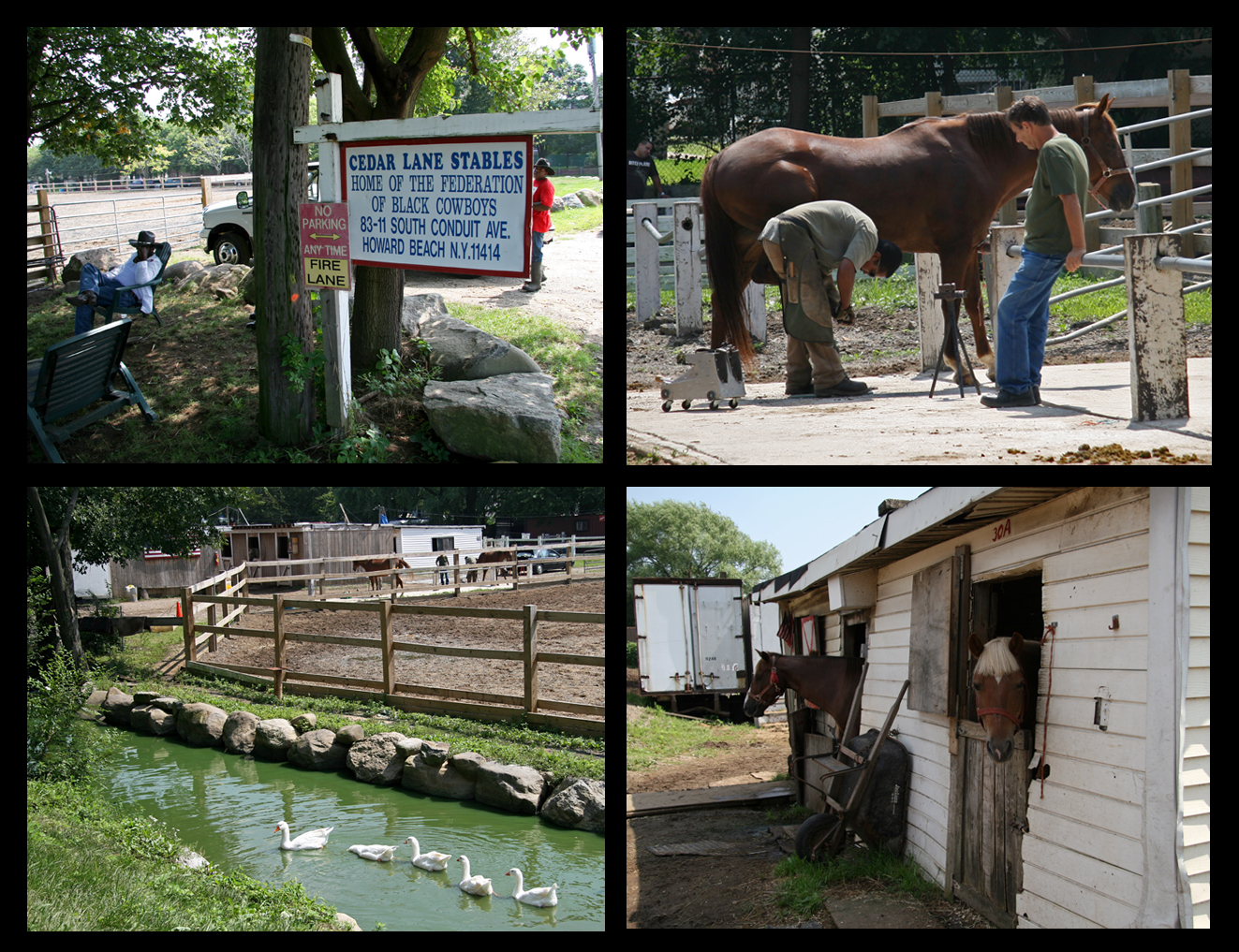
    There are a handful of houses, inhabited and uninhabited, strewn across an area of weeded open lots, flooded streets with stray garbage, and no sidewalks. At one time occupied by farms and horses, this was also the former home of the Federation of Black Cowboys.

    The term “Hole” has a literal meaning in this neighborhood, which lies below grade and only a few feet above the water table. It is built on landfill over Spring Creek and is subject to frequent flooding – you can see this in today’s photo. The area is also not incorporated into New York City’s sewer system – the handful of homes here use cesspools.

    Any apprehension or creepiness you may feel here is not unfounded – the area is most notorious as a dumping ground for bodies in mafia mob wars for over 50 years. There are stories of 200 bodies being found. According to the New York Times, a lot of Ruby Street between Blake and Dumont Avenues was a suspected Gambino family burial ground. Alphonse Indelicato, Phillip Giaccone, and Dominick Trinchera, of the Bonnano family mob, were murdered and buried in a vacant lot in the Hole.

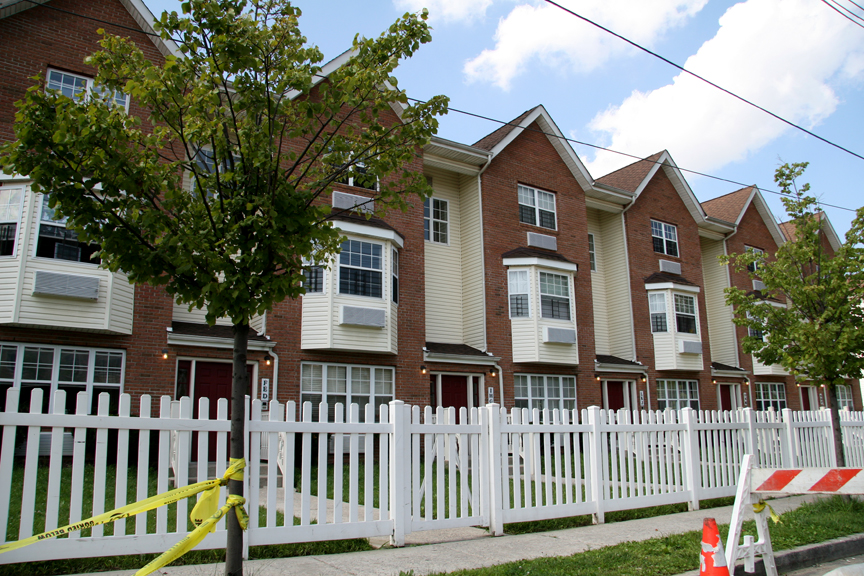
    There has been real estate speculation here – see the new row houses here on Ruby Street. However, projects here have stalled. The mountain of rubble in my photo series is an 8-acre plot which was slated to become Cobblestone Estates, a gated community. It is now in limbo – you can read about it here.


  • Black Cowboys


    If you are looking to visit the Federation of Black Cowboys in Howard Beach, Queens, be prepared for some circuitous circumnavigation. Even neighbors showed initial moments of puzzlement when I asked for precise final directions. The street address of 83-11 Conduit Avenue will not help you at all since the facility is on Cedar Lane, with one entrance on Linden Boulevard. (Update: A recent Google map search put the facility at 78-83 South Conduit Avenue.)


    I was quite elated when I finally found the entrance signs; I knew this would not be a typical Sunday afternoon in New York City. And it wasn’t. I was greeted by a handful of men in cowboy gear. Geese were wandering the property and a horse was being shod, while others were busy with various stable duties.

    The Federation of Black Cowboys currently has 34 members and 40 plus horses, stabled on 24 acres leased from the city since 1998. The ranch, Cedar Lane Stables, was part of a larger property, a vegetable farm owned by Herman and John Brockman. From the NYC parks website:

    The Federation of Black Cowboys was formed in 1994 when a group of diverse men came together out of their common love of horses and their desire to share the forgotten legacy of the Black West. African Americans played an immeasurable, yet often forgotten, role in the settling of the American frontier. Many African Americans made the journey west after escaping slavery, while others moved westward in wagon trains after emancipation.

    Many more moved during the exodus of 1879, when many African Americans, convinced that the end of Reconstruction meant the end of their chances for a successful life in the South, relocated to states such as Texas and Oklahoma. By the closing of the American frontier in 1890, there were 500,000 African Americans living in these two states alone. Many of these frontier settlers found employment as cowboys, a position essential to the economies of many western states.

    The non-profit organization, headed by Edward J. Dixon, has a primary goal to expose black children to the art of western horsemanship, the skills required to properly care for a horse, and the historical role of black cowboy in the old West. Read more here (updated 12/9/11). This is done through regular instructional programs, work release programs, prison visitations, parades, lectures, block parties, rodeos, and showdeos 🙂

    Note: I have a relationship with this world beyond photographs and a story. If you are curious about my friends in common, go here and here. My business activities are revealed here and here.


  • Eldridge Street

    In my story on January 12, 2009, Small Achievements, I wrote of those small, nagging, unresolved questions, not quite big enough to aggressively pursue, but not quite small enough to completely forget. They raise their head when a particular situation recurs, whereupon, enthused by the moment, you promise yourself that this time you will absolutely put the mystery to rest as soon as you get home.
    Of course, it is either then forgotten or put off to another time, unless you have a photo of the mystery you would like to feature on a website about New York City and, in fairness to your readers, you really must get to the bottom of this. Now you have that added impetus to get the doing done.

    One problem, however, with sharing a vista like this one is how you would go about taking a photo while driving in a moving vehicle. It’s easy when you return from Brooklyn on a beautiful day, everyone is on the road, and your vehicle is not moving because traffic is at a standstill, briefly interrupted with some inching forward.

    The bridges across the East River – Williamsburg, Manhattan, Brooklyn, and Queensboro – afford spectacular vistas of Manhattan, Brooklyn, Queens, Staten Island, and Roosevelt Island, along with streetscapes, waterscapes, the Statue of Liberty, Governor’s Island, and an articulation of buildings of the skyline of New York as far as the eye can see.

    Somewhere in all of this, there will be a glorious accident of perfect alignment. So it is with the vista from the western end of the Manhattan Bridge looking north, straight up this narrow one-way street, where you have a classic New York City juxtaposition: an unobstructed view of the Chrysler and Citicorp Buildings, framed by rooftop graffiti and the jingle jangle of the Lower East Side with a spattering of Chinatown. But the question for me has always has been, which street is that, so conveniently aligned?

    A little online forensic work identified the mystery thoroughfare, which runs eight blocks from Division Street at the base of the bridge to Houston Street and is wholly contained within the Lower East Side: Eldridge Street.

    Note: if you look carefully at the photo, you will notice a church on the right side – this is the Eldridge Street Synagogue, built in 1887 and a national historic landmark. It is one of the oldest synagogues in the United States built by Eastern European Jews. It is also home of the Museum at Eldridge Street, which presents the culture, history, and traditions of the great wave of Jewish immigrants to the Lower East Side with tours, exhibits, and public and educational programs.


  • Trash and Treasure

    What, in most places, would be an occasional chore or the domain of established businesses often becomes a cottage industry in New York City for the poor, homeless, disenfranchised, unemployed, or those living an alternative lifestyle: selling umbrellas on rainy days, sidewalk book selling, street vending, dumpster diving, and can/bottle collecting. Many of our problems or unfortunate circumstances in New York City become an Opportunity.

    Contrary to one’s intuition, can/bottle collecting is not necessarily the exclusive realm of the homeless. After reading about a man living in Windsor Terrace, Brooklyn, supporting himself and maintaining a small apartment on bottle/can collecting, I will no longer assume anything about those pursuing this activity. And those who are homeless can not so easily be characterized as a class of human which is insolent and indolent. Many are quite hardworking and ambitious. I would venture to say that “keeping busy” keeps a person sane and also gives a sense of self-respect, societal value, and entrepreneurial independence.

    I caught this older Chinese woman on Spring Street in SoHo during rush hour, her bags of cans and bottles balanced on poles across her shoulders. This mode of transport is not often seen in the city – can collectors typically have smaller caches or use carts when their booties grow.

    At one time, recycling in New York City was threatened – analysis showed that recycling was a net loser from a financial point of view. A well-known cover article appeared in the New York Times in 1996 – Recycling is Garbage by Jack Tierney.

    In 2002, Mayor Bloomberg suspended plastic and glass recycling, which, of course, incited outrage. In 2004, the decision was reversed. Since 2008, NYC has passed a number of recycling bills, making the city’s recycling program one of the most comprehensive and aggressive in the nation, including electronics and plastic bags. Rag picking, can collecting, dumpster diving, or eBay trading – times and techniques may change, but opportunity always lurks for those who seek it. For now, bottle/can collecting looks secure – as always, one man’s trash is another man’s treasure…

    Note: In researching this article, I came across a very interesting blog: invisiblepeople.tv. Here, you will find the stories of many homeless who have startling stories and backgrounds which may challenge stereotypical views of the homeless.


  • Randazzo’s

    The first time I went to Randazzo’s Clam Bar many years ago, I was accompanied by a friend who was a born and bred NYC Italian (from the Bronx) who said this food was just like his mother’s home cooking. Two other friends also came along, both born in New York City – one from Manhattan, one from Brooklyn (both Jewish). Three boroughs were represented – that’s very serious street cred. You don’t argue with that, and there was no need to, because we all enjoyed the food and experience.

    Randazzo’s, at 2017 Emmons Avenue in Sheepshead Bay, Brooklyn, has a history of over 75 years. It was founded by Helen Randazzo, and its roots can be traced back to 1916. Read more about them at their website here. The menu is Italian, specializing in seafood: lobster, scungilli, mussels, shrimp, clams, calamari, and Helen’s famous sauce.

    On my second visit, I was with my Brooklynite friend and his brother. They were coming in from out of town, and we had planned to eat at Randazzo’s as part of a day of adventure. Expectations were very high. For me, I wanted to solidify my connections with old, iconic New York City. For my old friends, nostalgia was a big element – to eat in Brooklyn, where they grew up.

    This is a very dangerous formula: high expectations and looking to recreate experiences. We wanted to love it. We had to love it. It was part of our special day, and we would expect nothing less than a great reunion.

    Our food experience was uneven. I’ve read dozens of reviews, all the way from one-star to five-star. I realize that a place like Randazzo’s can travel far on its own momentum and that things change. But I’m going back. And I will find things I like. Because nothing’s going to stop me from liking this place. You gotta problem with that? 🙂


  • Matters of Opinion


    The Al-Madinah School at 383 3rd Avenue in Brooklyn is in one of the most uninviting locations I can imagine: on a major thoroughfare, Brooklyn’s 3rd Avenue, abutting a Uhaul parking lot, and across the street from the Gowanus Canal – once a busy cargo waterway, now a polluted body mired with environmental concerns.

    In New York City, we make use of what space is available, and one can never judge by a place’s exterior. So I decided to do some reading about this private school. In reading about it, I came across a startling range of opinions in online reviews:

    The quality of academic programs is very good. The teachers are very much involved and enthusiastic about teaching the children.

    Al- Madinah school is the best school. My children first were in public school for six years and then are transferred to Al-madinah school. And I can tell the difference. now they are more behave and responsible and much much much better in Arabic, Quraan and islamic studies, and That all I need …

    Horrible!! never expected an islamic school to be like this..the islamic studies,quraan and arabic are good but other than that no!! this school is best for K-6 ! the students are very rude, mean,spoiled,careless, etc, some students if your lucky are nice! i dont reccomend any1 there..waste of money!
    Al-Madinah school is just not up to New York state standards. The ebviromenft for learning is filthy and tacky.

    The academic level is wary below standard, and the school should be for religioun only.

    Its very clean and Im glad that halal food is prepared on premises. Wonderful

    Al-Madinah is good in the islamic studies, arabic, quran course but it does not supply much in the academic course. I talk from 3 years of experience and I do not think this school is not so great nor good either.

    One thing that has puzzled me for as long as I can remember is how much human opinion can vary. I once remember a university professor asking us to consider for our next class the question, “If someone disagrees with you, do you feel they are wrong or have a different opinion?” This question goes to the heart of tolerance, moral relativism, and absolutism – ideas of enormous consequence, fueling nearly every debate, argument, or war.

    Some years ago, I occasionally spent time watching a fundamentalist Christian who used to proselytize on Sundays in the park. He posed the same type of question routinely: whether the individuals there considered themselves relativists or absolutists. Specifically, did they believe that there existed moral imperatives that were absolute and crossed all cultures? His belief was that most people claim to be moral relativists but in reality are absolutists. He would pose specific examples, and arguments would often flare up, even between couples.

    With the Al-Madinah School in Brooklyn, religious opinion of what is good, bad, right, and wrong is part of the curriculum. Outside their walls, the same opinions are made about the school itself. I leave you with a quote from Mark Twain: “The rule is perfect: in all matters of opinion our adversaries are insane.”

    Note about Al-Madinah: The school occupies a 5-story, 9000-square foot facility (part of it seen in the photo). You can see more, along with information about the school, here at their website. They offer education from preschool through high school.


  • Pomp and Circumstance

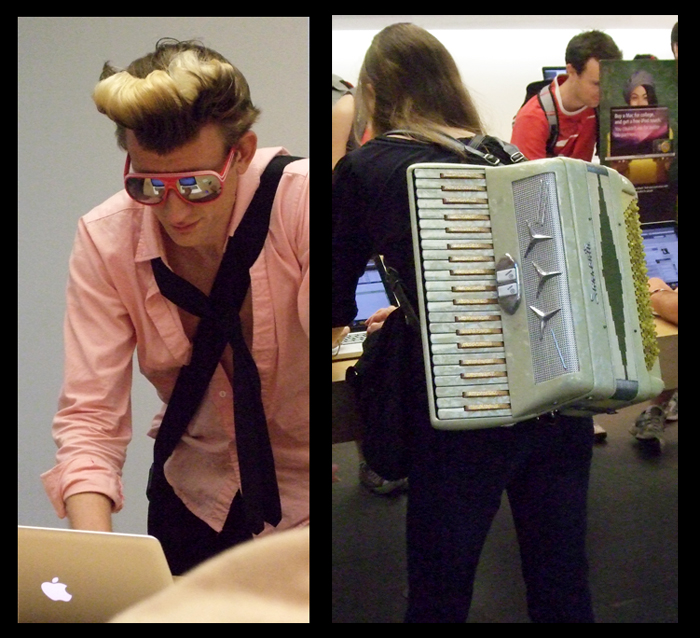
    I have a number of questions when I see people like this, particularly the man with the quiff – questions such as “Where are you going to go looking like that?” and “Where do you work?” Yes, on a Saturday night out or while shopping at the Apple store, you do look cool as hell, but once the novelty wears off at the workplace, who wants to be looking at this day in and day out? Even as a freelance associate or fellow artist, this is going to get old pretty fast. Are you going to be able to hold a conversation with this man and not be distracted by pink glasses, a pink shirt, and a blond-tipped pompadour that looks like the surf’s up at Malibu Beach?

    Now an accordion on your back is much more of a temporal and transitory thing. It’s really just an unusually large accoutrement which is likely not worn this way at home or at the workplace. There is a very good reason this woman is using an Apple computer with an accordion on her back; I just don’t know what it is. She probably was just playing her instrument or will be playing it soon. Or, perhaps she can’t afford a case. Perhaps she doesn’t want a case and finds it more convenient to carry on her back. Perhaps she wants people to know she is an accordionist.

    There are few stores in New York City with as self-assured an attitude (both from the staff and customers) like that of the Apple Stores. Some may bristle at the cult-like atmosphere – there’s a smugness of Apple users as being in the know, using the tool of choice, and willing to pay a premium for it. Iconoclasm has historically been a defining characteristic of both the company and its core adherents.  Apple has had a dominant role in the art community from early on. Under the circumstances, pompadours and accordions fit right in 🙂

    Photo Note: These photos were taken at the Apple Store in SoHo. Both individuals were in the store at the same time. Apple has an extremely liberal attitude regarding use of their computers. All have high-speed Internet access, and no restrictions are placed on use or time. Many stop here to check email or for any other variety of uses.


  • The Rockaways

    Just a subway ride away on the A train, you will find not a bay, inlet, or river, but rather, the Atlantic Ocean. This is the Rockaways, a peninsula, most of which lies within the borough of Queens, New York.

    The beach has an active surfing community – there are three surf shops in the area. The approach of hurricane Bill was seen by most as worrisome, but surfers heralded the storm as a joyful rare opportunity to surf the big waves. So, this seemed the perfect time to take a trip out to the Rockaways to catch some waves with a camera. Beaches were closed to bathers but open to surfers. See more photos here.

    The 6.2 mile boardwalk is a huge feature of the area, extending from Beach 9th Street to Beach 126th Steet. The central area of Rockaway Beach is fronted with large, hulking public housing projects, many of which became riddled with crime. There are new apartment condominiums newly built and in the works. Strings of closed stores line 116th Street, the main shopping district.

    Driving from one end of Rockaways to the other through the varied communities – Belle Harbor, Far Rockaway, Arverne, Neponsit, Rockaway Beach, Rockaway Park, Breezy Point, and Edgemere – is one of the most shockingly diverse demographic ranges of humankind I have seen, from lower to upper middle class. Driving amongst the virtual mansions in Belle Harbor, the ramshackle nature of central Rockaway seemed a flawed memory.

    I missed many of the interesting areas, such as the historic bungalows off the boardwalk at Beach 108th St. that have become summer rentals and the scenic area at the end of the boardwalk from 121st to 126th Streets. I intend to return and explore more of the area on foot.

    This is truly the land of the haves and have-nots, but the ocean and the boardwalk looms large and mitigates much of the area’s depressed pockets. The ocean is a curative for the human soul, and I believe all feel fortunate to have such a fine strip of ocean, sand, and boardwalk…

    NOTE: The Rockaways have a rich history: from 1902 to 1985, there was a large amusement park called Rockaways’ Playland. See a photo history here.


  • Secret Tunnel

    Did you ever have a nagging thought revolving around something unresolved? I recall reading in a secrets of New York City book that there was an underground tunnel in Chinatown, now some sort of shopping arcade. However, no one I knew had heard of such a place.

    I do love to find secrets in New York City. This is increasingly hard to do, so this mystery would typically make the prospect of search and discovery all the more exciting. However, in this case, all of the individuals I queried, including a long-time resident of Chinatown for 30 years and a few members of the Chinese community, had no idea as to what I was referring to. I began to seriously question whether such a thing existed.

    Some digging did finally uncover the existence of a tunnel on Doyers Street in Chinatown, but no address or precise location was given. I made an excursion to Doyers Street, a one-block alley between Pell Street and Chatham Square. This street, which makes a sharp 90° turn, was once known as the Bloody Angle, owing to the numerous shootings that took place there at one time. From the New York Times:

    Doyers Street, a crooked, one-block street off Pell Street in Chinatown that was near the Bowery and the notorious Five Points intersection, offered an ideal place for ambushes during the wars between the On Leong and Hip Sing tongs in the late 19th and early 20th century. Tabloids of the day christened the angle in the street, and the police said that more murders occurred on that spot than in any other place in an American city.

    I canvassed the entire street. There are many hair cutting salons on the street – it is sometimes known as “hair alley.” At 5 Doyers Street, mid-block, I found a staircase leading down below ground. It did not have the charm of a secret historic tunnel at all, but it was an underground passageway. I learned that this was known as the Wing Fat shopping arcade – a maze of quite nondesrcipt passageways with fluorescent lighting and acoustic tiled ceilings. A variety of merchants line the arcade: acupuncturists, dentists, a philatelic shop, and the office of Tin Sun metaphysics. The tunnel winds it way underground, leaving Doyers Street to exit in the lobby of the Wing Fat Mansion building at Chatham Square.

    This tunnel was apparently the main artery in a network of tunnels used by members of the Tong gangs as escape routes. It is interesting that there is no signage or advertising of this historic tunnel. In a way, it remains undiscovered…


  • Pet Pride Parade

    Money and privilege often lead to indulgence, and what better place than New York City to find businesses, products, and services oriented to those who want to give their pets all the special treats that they and other humans have?

    We have pet cemeteries and mausoleums, a pet bakery in Brooklyn (Buttercup’s Paw-Tisserie), a Parisian boutique for dogs (Zoomies), the Dachshund Octoberfest, pet spas with underwater treadmills, massage, and acupuncture, as well as homemade organic dog food and physical therapy. There’s doga (yoga with dogs) and dog dating.

    Medical treatments know no bounds – the Animal Medical Center of New York City is world-renowned. This veterinary hospital provides routine and emergency medical care for pets and also offers treatment for animals suffering from complicated diseases. The staff, which includes more than 90 veterinarians, utilizes an interdisciplinary team approach and combines expertise in 17 different specialties. The facility is open 24 hours a day, 365 days a year.
    And with all the stresses of the city lifestyle, pets may need psychotherapeutic treatment. No worry, however, because pets are now also getting psychoactive drugs.

    Of course, much of this is not really so much about the comfort of the pets but more often about indulging the neuroses, obsessions, and compulsions of the pet owners themselves. Fortunately, pets are typically happy to oblige.

    In today’s photo, we find our four-footed friend who sported his walking shoes and appeared to be quite content. Some dogs are fitted with shoes owing to their fragile nature and discomfort with cold or rain; others wear them because their owners desire for cleanliness in the home. Sweaters and other apparel are quite common with dogs in the city, where daily walks in all four seasons are necessary.

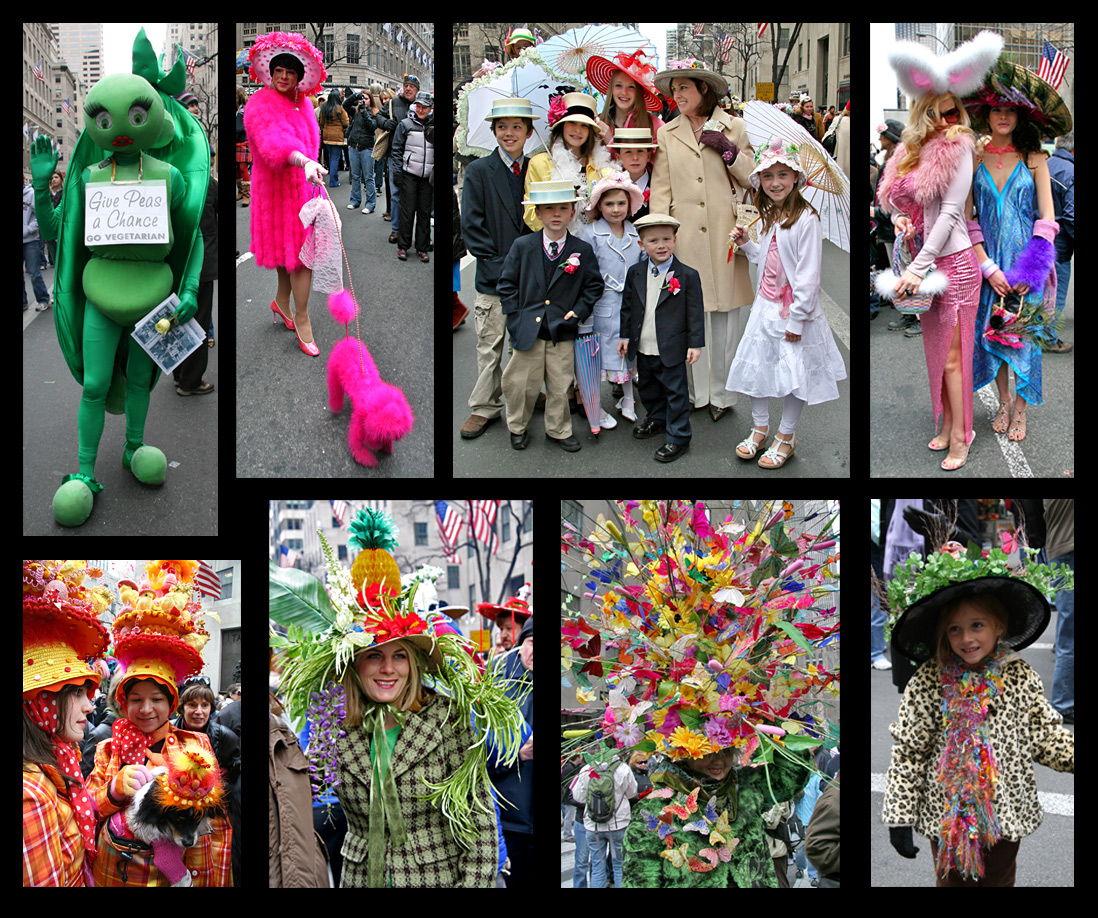
    We have a Dance Parade, Gay Pride Parade, Lesbian Parade, Easter Parade, Halloween Parade, Mermaid Parade, St. Patrick’s Day Parade, Hispanic Day Parade, Thanksgiving Day Parade, and Spring Madness. May we soon perhaps have a Pet Pride Parade?

    Related Postings: Dog Dating, Dachshund Octoberfest, Easter Parade, Wolfdog, Robin Kovary Run For Small Dogs, à la Chien, Spring Madness, Parasol, Dog Run, Zoomies


  • dinamic_sidebar 4 none

©2026 New York Daily Photo Entries (RSS) and Comments (RSS)  Raindrops Theme