• Whole Earth Bakery

    Posted on by Brian Dubé


    If you read the quote from my article on the Veggie Pride Parade, you know you will not find French chef Anthony Bourdain patronizing Whole Earth Bakery in the East Village. However, you will find a vibrant business at this historic shrine for veganism and vegetarianism, in business since 1978. This is the type of place New Yorkers have grown to expect. However, it is hard to imagine a place like this, catering to such a niche clientele, existing anywhere else.

    Peter Silvestri and his mother Filomena started the bakery at 70 Spring Street; in 1991, they moved to their current location at 130 St. Marks Place. There are cakes, cookies, and many other confections. In addition, there are soups, salads, and vegetarian pizza with whole grain crust.
    To be fair, I believe the degree to which many individuals like the foods there is largely a function of how important dietary concerns are to them. It is tough to compare the baked goods here with fine French or Italian pastries.

    Veganism and other variants on vegetarianism have reached mainstream society, but Whole Earth Bakery dates back to the days of late hippiedom and countercultural movements – back to the land and natural living.
    The bakery staved off the threat of eviction in 2006 and continues to live on. If you are in the area, drop in and be you own judge 🙂

    Note: Filomena Silvestri died in 2006 at the age of 94. She is survived by three children, five grandchildren, and great-grandchildren.

    Update: As of December 2012, Whole Earth Bakery is now closed.

    Posted on by Brian Dubé

  • Facts and Fiction

    Posted on by Brian Dubé

    When someone looks like this, photographers take notice. However, how to proceed? I discussed the dilemma of shooting people at close range in my recent posting, Walid Soroor.

    I pointed this man out to a couple of friends who agreed that this man’s appearance was definitely out there and blog worthy. A suggestion was made to approach him directly and ask his permission. Legally, photos taken in public for non-advertising purposes do not require permission, but cooperation, when you get it, not only makes the process immensely more comfortable but also leads to better photos and some nice side benefits. Like a name, biographical facts about a person, email address, and possibly the raison d’etre for their extreme style.

    Although wild speculation is a lot of fun, the person behind the surface is rarely who you imagine, and often, the truth is more interesting than fiction. I am comfortable approaching strangers, but I do feel that it requires a certain amount of “getting into character,” like an actor, selling myself, and convincing the subject that I am a serious person and that the photos will be used in a respectable manner.
    In this case, a brief introduction, along with a New York Daily Photo business card, sealed the deal, and my subject said, “Fire away.” I relayed the green light to my friend, photographer Bill Shatto, and the impromptu location photo shoot began.

    I learned that our subject, Jim Vehap, was born on the Lower East Side, an authentic New Yorker now living in Milwaukee with family. He is half Albanian and half Italian. His tattoos were done at the time of his 6-year stint in the Marines (Beirut 1983). The shirt was a bicycling jersey, and the origin of the plaid shorts was not discussed. I suggested he might consider modeling – he said others had recommended that he look into this. He asked how he might pursue this, and Bill acquainted him with the Ross Report, a industry publication which includes listings for casting agents, studios, talent agencies, and others in the film and TV business.

    Jim works as a paralegal and had interest at one time in pursuing a masters degree in theology. Quite an amalgam of contrasts. Not the man I thought at all – another case of facts more interesting than fiction…

    Photo Note: Look closely here and you will find an assortment of piercings – nipple, navel, and ears – and closeups of Jim’s tattoos, including ones reading Rare Breed and Rude Boy.

    Related Postings: Out There, Spike, Narcissism Gone WildSuperheroes, Snake Charmer, Circus Amok, Fashion Forward, Piercing Al Fresco

    Posted on by Brian Dubé

  • Shag Carpeting

    Posted on by Brian Dubé

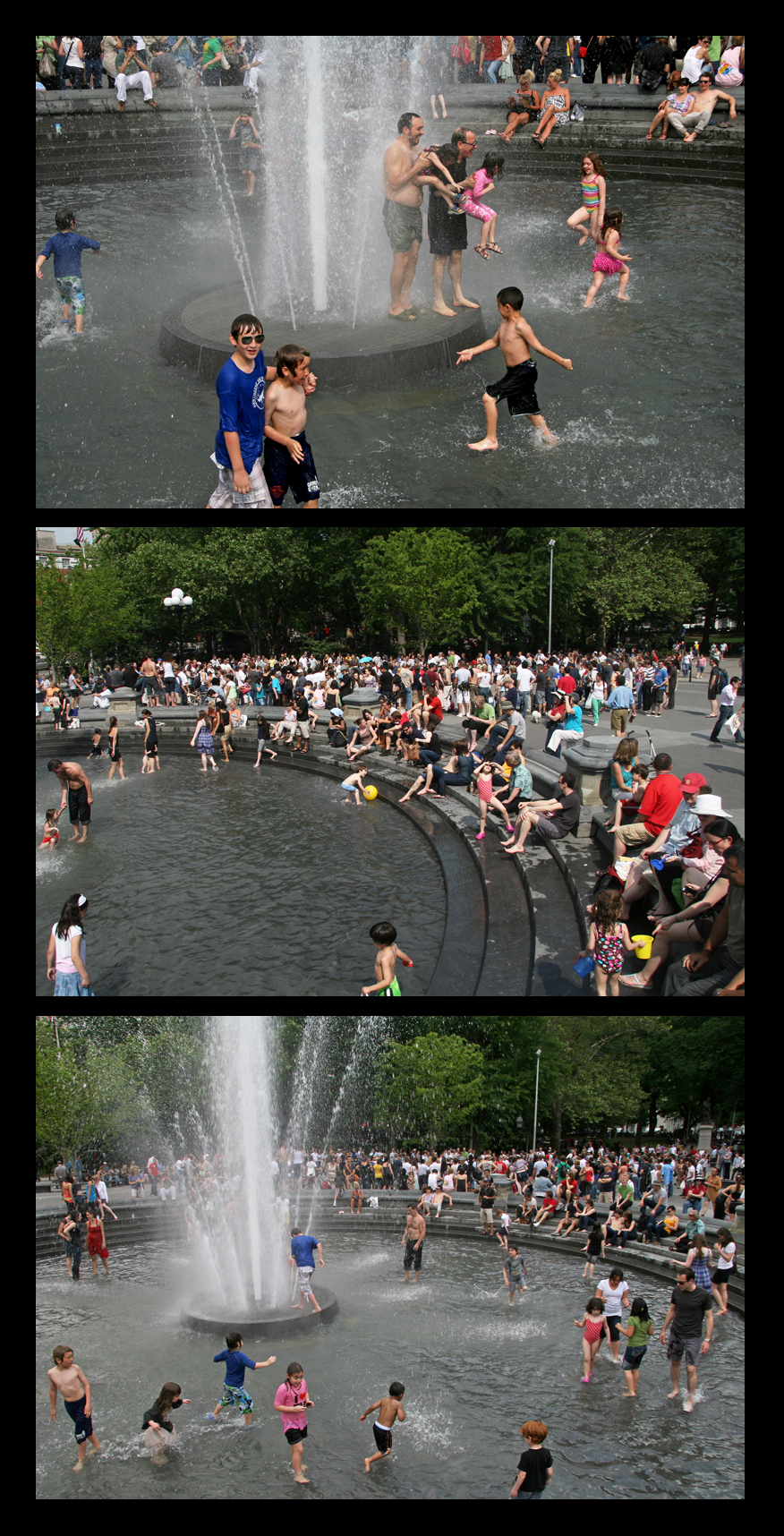
    The phrase of choice when I was growing up to describe extreme fun was having a blast. For a literal interpretation, head to the fountain in Washington Square Park, which was finally opened after being closed for one and a half years. It was perfect timing for some prematurely hot weather on a holiday weekend. It was a beach scene with all the accouterments, including children with sand buckets. See more photos here.

    The summer cooling method of choice when I grew up was the sprinkler. For those with no access to the beach or a home swimming pool, the announcement that our parents were going to set up and turn on the sprinkler in the yard was a cause for jubilation. In New York City, fire hydrants are officially made available – upon request, the fire department will put on a sprinkler head to a hydrant for the neighborhood’s children to cool off.

    There are other fountains in Manhattan, but the one in Washington Square Park, located in a residential neighborhood with a history of permissiveness, beckons to be used as a water park. Adults and children (and the occasional dog) play in the water with street clothes. Personally, I do not approve of children playing in the fountain water – this is far from a sanitary environment, with all manner of fluids and solids. There has been some controversy about the situation – dogs are officially banned, and signs stating such are soon to be posted. Tickets have been given out for the violation.

    This whole environment brings to mind shag carpeting in cheap motels. You never know what’s lurking beneath the surface – most likely, there is some accumulation of bits of food, humans, and other debris of unknown origin. Better not to look or think. The same applies to this fountain pool – who knows what’s really in that soup – better not to think or look too deep, just like with shag carpeting 🙂

    Posted on by Brian Dubé

  • Fleet Week 2009

    Posted on by Brian Dubé


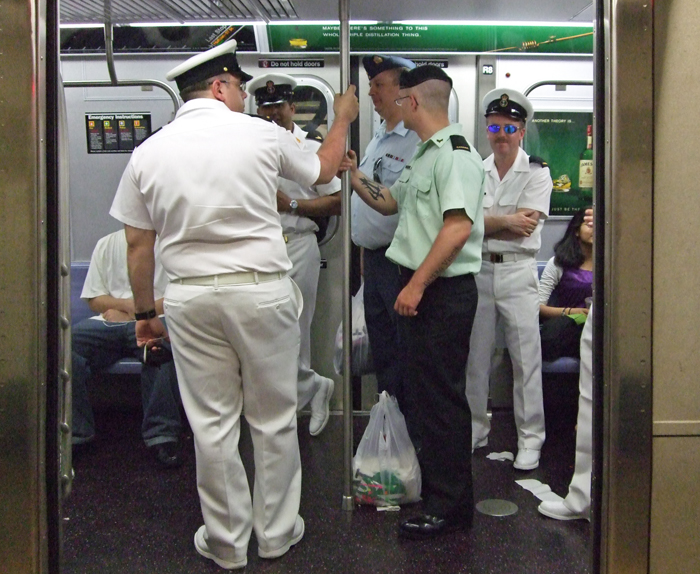
    If you have been in New York City in the last few days, you may have seen an unusual number of sailors on the streets of New York. This is Fleet Week New York City 2009, an annual event since 1984. Fleet Week is a celebration of the sea services – a United States Navy, United States Marine Corps, and United States Coast Guard tradition where active military ships dock in various major cities for one week.
    The event provides an opportunity for the citizens to meet Sailors, Marines, and Coast Guardsmen, as well as for the military to explore New York City.

    Fleet Week, which runs from May 20-27, includes dozens of military demonstrations and displays throughout the week. But the big attraction is the public visitation of the participating ships. The ships are docked in Manhattan at Pier 88 and 90 and in Staten Island. Here is the official site with all the details.

    This is a rare opportunity to board and tour these ships. If you are interested, get there early – the lines, particularly on Memorial Day, become hours long. See you there 🙂

    Photo notes: The Upper photo was taken on the B train in Brooklyn. The collage shows the ships which will be docked during Fleet Week NYC 2009.

    Posted on by Brian Dubé

  • Storefront

    Posted on by Brian Dubé

    As the world becomes more crowded and technology becomes more advanced, our spaces, places, and things become smaller. Waste and efficiencies are critical issues, particularly in a city like New York.
    Add our economic environment to the mix, and one can see why lavish indulgence is nearly a mortal sin. So what better icons for our time than the iPod Nano or a micro gallery like the Storefront for Art and Architecture?

    Storefront was founded in 1982 by Kyong Park as a nonprofit organization committed to the advancement of innovative positions in architecture, art, and design, with a program of exhibitions, artists talks, film screenings, conferences, and publications.

    This place is easy to miss – it is not only small but also off the beaten path. Storefront is located in a unique triangular ground-level space on Kenmare Street at a nexus of three very different cultural neighborhoods: Chinatown, Little Italy, and Soho. The space is nearly 100 feet long and tapers from 20 feet to 3 feet. Its most striking feature is the unique exterior wall with articulating panels which are rotated to open the space to the street.

    In 1993, Storefront commissioned a collaborative building project by artist Vito Acconci and architect Steven Holl. The project replaced the existing facade with a series of twelve panels that pivot vertically or horizontally to open the entire length of the gallery directly onto the street. The project blurs the boundary between interior and exterior and, by placing the panels in different configurations, creates a multitude of different possible facades. Now regarded as a contemporary architectural landmark, Storefront is visited by artists, architects and students from around the world.

    The Storefront has received many accolades from the media and art community. My posting Performance Z-A depicts a celebration of Storefront’s 25th anniversary in 2007 which was set in the Ring Dome Pavilion…

    Posted on by Brian Dubé

  • Butter and Ice Cream

    Posted on by Brian Dubé

    Sunday was Veggie Pride Parade II. I wrote about this in 2008 – you can read about it here. I was a practicing vegetarian for decades and have experimented with numerous diets, so I am sympathetic to the cause. I was a raw foodist in the early 1970s, drinking gallons of carrot juice per week. I have a library of books on extreme dietary practices, many rarely encountered today: fruitarianism, macrobiotics, mucusless diets, liquidarianism, raw veganism, and the ultimate in dietary deprivation: breatharianism (yes).

    I have a quote from chef Anthony Bourdain which I would like to share with you and which, although quite extreme, does express the feelings of many non-vegetarians. For those of you who are vegetarians, I suggest you skip this section.

    Vegetarians, and their Hezbollah-like splinter-faction, the vegans, are a persistent irritant to any chef worth a damn.
    To me, life without veal stock, pork fat, sausage, organ meat, demi-glace, or even stinky cheese is a life not worth living.
    Vegetarians are the enemy of everything good and decent in the human spirit, an affront to all I stand for, the pure enjoyment of food. The body, these waterheads imagine, is a temple that should not be polluted by animal protein. It’s healthier, they insist, though every vegetarian waiter I’ve worked with is brought down by any rumor of a cold.
    Oh, I’ll accommodate them, I’ll rummage around for something to feed them, for a ‘vegetarian plate’, if called on to do so. Fourteen dollars for a few slices of grilled eggplant and zucchini suits my food cost fine.
    — Anthony Bourdain

    I can’t say I embrace this statement, but it does point out one problem with most vegetarian diets – they are driven primarily by health concerns, ethics, religious beliefs, or animal rights, philosophies which involve deprivation and do not revolve around the palate. This is why ultimately, most do not stay with diets like veganism for very long. The vegan movement has become quite trendy in recent years – read my article here.

    Food is one of the most important parts of any culture, and any dietary practices that restrict one from partaking in those foods will, for most, become intolerable over time. Gradually, more taboo foods are introduced. Semi-vegetarian diets attempt to straddle both sides of the aisle with variations such as lacto, ovo, lacto ovo, pollo, pesco-vegetarianism, and flexitarianism.

    I have sat at many a dinner table or restaurant only to nibble or eat side orders. A trip to France became, as one vegetarian observer put it, “avoiding the omelet.” My diet now is more oriented towards health and less dogmatic.

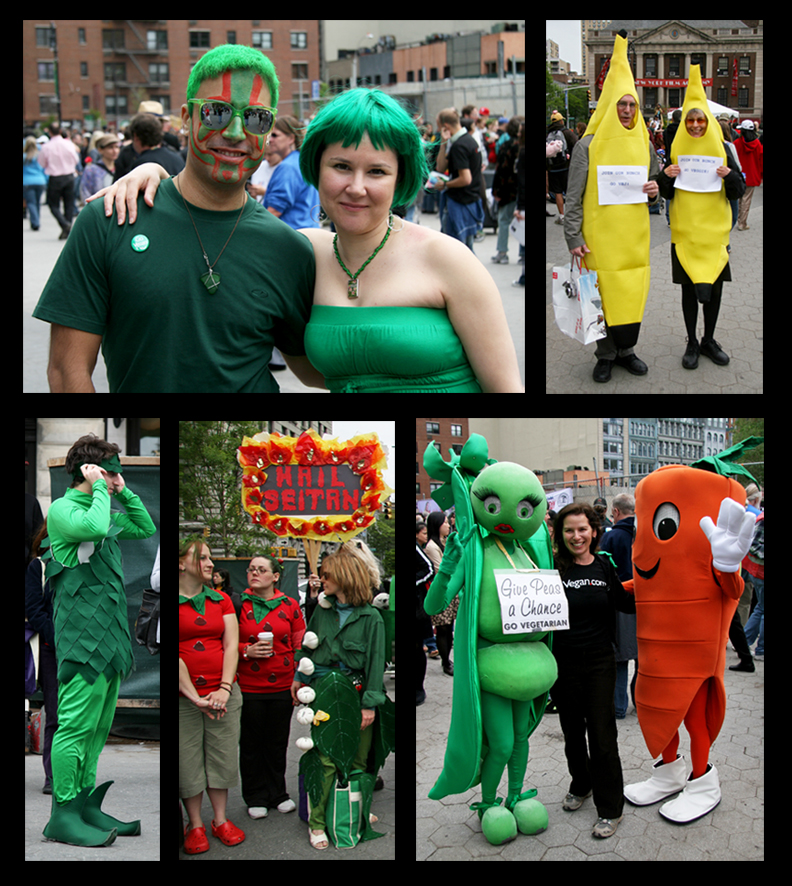
    The 2009 parade was not particularly large – I think that at this point in time, the message falls on deaf ears. Most will not make the sacrifices to become vegetarian, and many of the valuable contributions made by the vegetarian movement have been absorbed into mainstream culture. Large supermarkets now have an extensive line of natural food products – unthinkable 30 years ago. Successes like Whole Foods Market, the retailing natural foods international chain, demonstrate that peas have been given a chance but most still want butter and ice cream from time to time 🙂

    About the Photo: There were some fun creative characters. Many important fruits and vegetables were represented: Join Our Bunch (banana costumes), Give Peas a Chance, Hail Seitan, Warning Hunters, Unicyclists Against Animal Abuse, Meatrix, Jolly Green Giant, and a host of green.

    Posted on by Brian Dubé

  • Warm and Fuzzy

    Posted on by Brian Dubé

    I have very strong memories of school as a child outside the city – carrying books, walking home, erasers with chalk dust, blackboards, recess, homeroom, the cafeteria, homework, lockers, report cards, being called on, tests, passing notes. As I got older, there was the familiar sight and sounds of children in playgrounds with the familiar chatter and laughing.

    I am sure many children growing up in New York City have many of these experiences, but for those of us without children, the world of children and school is virtually invisible. As I wrote in Mary Celeste, schools and playgrounds do exist, but depending on where one lives and typical daily routines, most will never see them or children at play, and even when you do, there is so much competing for your attention that everything is diluted.

    So when you see a cardboard box being toted through the streets of NYC, you pay little attention. However, when you see that it is being carried by a mother and her young daughter, you take notice. And when it is quiet at night and you hear faint squeaking coming from the box, you run after them because – could this be the sound of live animals?
    Yes it was. I found a mom and her girl with a box of young chicks – I was told that it was part of a school project.

    They were quite happy and eager to share their little bundles of joy and offered to let me handle one chick (and grab a couple of quick photos with my point and shoot). I believe this is the first time I have actually picked a baby chick up – ironically, on the streets of Manhattan. I’m glad I stopped them. It was a warm and fuzzy experience and a nice way to end the day – a bit of fur now and then is cherished by the wisest men 🙂

    Note: In May 2008, I welcomed an entire school class on a field trip to my business. It was quite an outing – see Little Burnt Out here.
    There are a number of other posts on children here: Mary Celeste and Heart Warming.

    Posted on by Brian Dubé

  • Dance Parade 2009

    Posted on by Brian Dubé


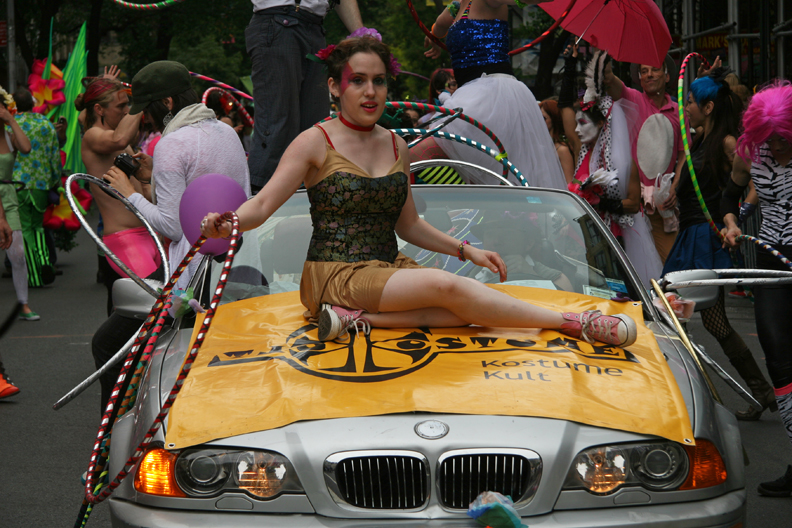
    Saturday was the 3rd annual Dance Parade. Many asked me the reason for the parade – they seemed perplexed. I answered, “to celebrate dance.” I’m not sure a parade needs more of a reason – perhaps so many are estranged from celebration and unmitigated fun that something of this nature grates against their being.

    The parade started at 28th and Broadway and headed south, finishing in Tompkins Square Park for the Dancefest from 3-7pm with continuous performances on stage. The other participants did plenty of milling and strutting along, with numerous spontaneous performances.

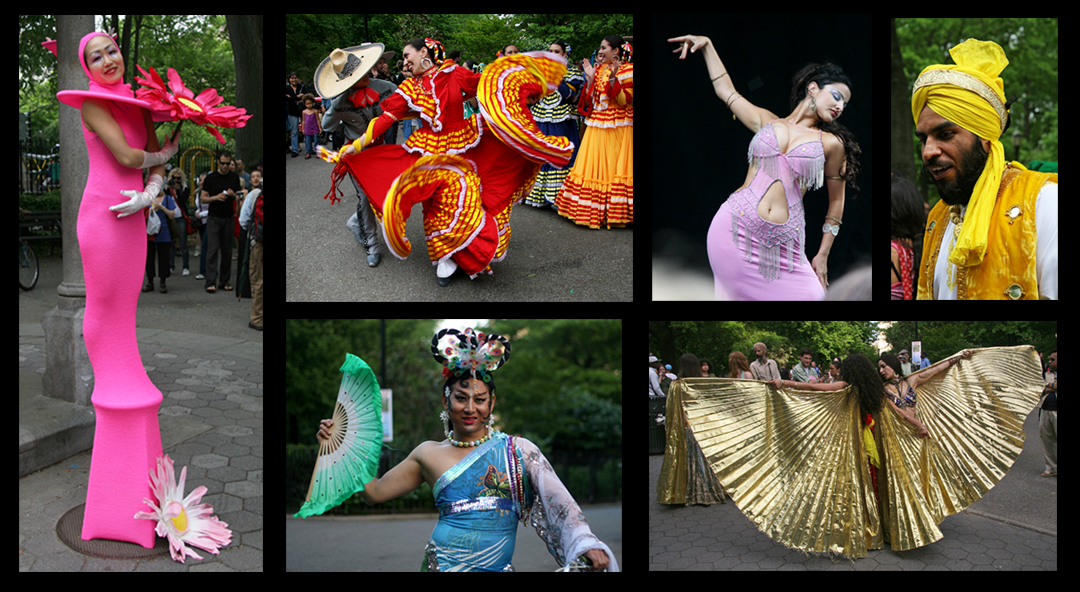
    Every imaginable type of dance was represented with broad ethnic diversity. There was Samba, belly dancing, swing, Korean traditional dance, Polynesian, Indian, Nepalese, Afro Latino, Mexican Folkloric, modern, tap, jazz, disco, ballet, plenty of hoop dancers, and other creative works. Dance lessons were offered, and after parties were thrown around the neighborhood.
    The parade itself had many participants who were not really dancers but, true to New York City style, no one was policing or jurying marchers. Only the desire to be involved was required.

    I thought one of the most striking ensembles was Shir Dance – see their website here. Four women did two living statue movement pieces – the colors and images were quite striking. You can see more images of them and others in my gallery of parade photos here

    Posted on by Brian Dubé

  • Verdant Oasis

    Posted on by Brian Dubé

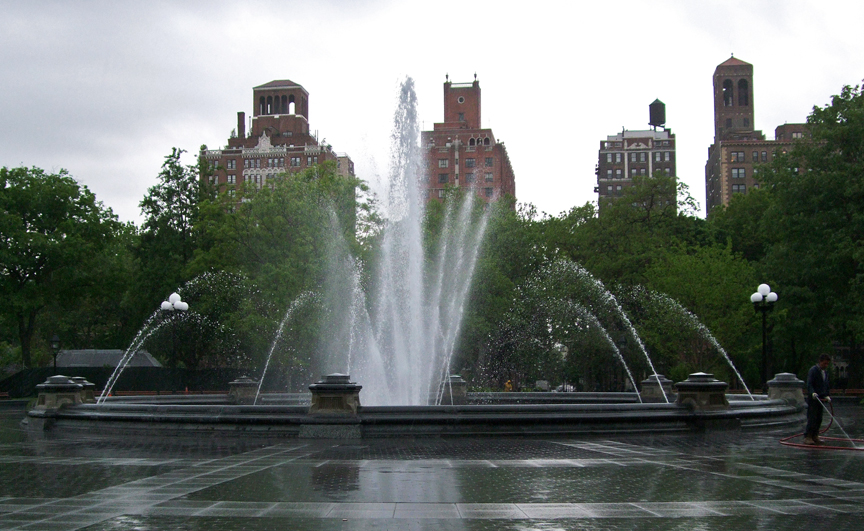
    Frequent users of Washington Square Park have been eagerly awaiting its reopening. It has been closed for one and one half years, since November 2007. The renovations were a contentious battle – I wrote about it in Jeopardy. There were lawsuits and fighting over the big stuff and the little stuff too: size of the plaza, moving the fountain, height of fences, width of walkways, removal of mounds, trees, grass, plants – no stone was left unturned.

    The reconstruction is being done in phases. The first (approximately 2/3rds of the park) is the largest and includes the fountain and plaza area. So its reopening has been highly awaited, particularly by local habitues such as myself and a number of friends.
    In the last few weeks, the fountain has been tested – I have chanced upon it twice. Yesterday morning I took a photo through a hole in the chainlink fence.

    The entire renovation process has been less transparent to the community than many would have liked, and its reopening is mired in secrecy. Even at this late date, no one appears to know the date of its reopening. There are speculations and rumors. Some say it will first open uneventfully, with an official celebration later. Surprising, being that this is a relatively major event.

    Historically, the park has been a center for cultural activity – music, chess, scrabble, art, street performing, skateboarding, filming, parades, marches, protests, rallies, concerts, and a myriad of events, both regular and spontaneous. Numerous local eccentrics. And, of course, still plenty of drug dealing. The park also serves as New York University’s de facto campus, so students are abundant.

    It seems certain that the park will open within the next week or so. Keep an ear to the ground or an eye to this website. When it opens, visit soon – everything is green, beautiful, and immaculate. I see it outside my window now – a verdant oasis awaits you…

    Related postings: Out There,  Hawk Fest, Evening Arch, Twelve Tribes Arrive, New York Nymph,  Bluegrass Reunion, Cloud Appreciation, I Am LegendBirds Sing at Night, Rats Gone Wild, Piercing Al Fresco, Police Riot Concert, Artiste ExtraordinaireComfort and Joy, Livid, Flash of Light, Delivery,  Conflux, Dog Run, Sounds of Summer, Krishna, Spring MadnessBack to Boyhood, Hookah, Lockout, Danger and Caution, Obama, YouTube Meetup, Dachshund Octoberfest, Music Speaks for Itself, Park Night, Petanque, Washington Square North, Nested Embraces, Left Bank New York, Fashion Forward

    Posted on by Brian Dubé

  • Not Going Anywhere

    Posted on by Brian Dubé

    This is the first time I have seen wrestling in a park in New York City. I found it an appropriate metaphor – living in New York City is often a contact sport, and in many respects we do wrestle our way through life here. Much of my life seems to be finding ways to navigate the shoals, looking for ways to soften the blows of the city. There are great conveniences living here; the depth and breadth of products, food, entertainment, and culture is perhaps unequaled. However, it does come at a price, and the population density both giveth and taketh away. A New Yorker I know, born and bred in Brooklyn, once said that New York City was the punishment for living. A bit harsh, perhaps. She now lives in California.

    Why do New Yorkers do it? What type of people would want to live here, bear the slings and arrows, and fight their way through daily life? Perhaps the individual’s T-shirt in the photo, which reads “Psych Ward,” offers a possible answer.

    I am reminded of a business owner who was asked the question, “Do you ever think of selling your business?” to which he answered, “Every day.” For those of us who are business owners, this is stating the obvious. I might speculate that on a similar note, I have often been asked, in response to my whining about some aspect of the city, particularly real estate costs and lack of space, “Do you every think of moving out of the city?” My answer is, I would guess, the same as that of many fellow residents: “All the time.”

    The number of times that I have “planned” to move from the city, fantasized, or looked at homes all over the planet are innumerable. Most residents I know speak of moving with a smugness about how easy it would be and often with an assuredness of how they will be doing this soon. I remember a Brooklyn resident who had returned from Santa Barbara, California. He was on a rant about why there was no good reason not to move there immediately. Except that he would not.

    But all this is just retelling the obvious, and although some move away and others retire elsewhere, the biggest obvious fact to many of us here about these whiners and malcontents is that like most dyed-in-the-wool New Yorkers, they are not going anywhere

    Posted on by Brian Dubé

  • White Castle

    Posted on by Brian Dubé

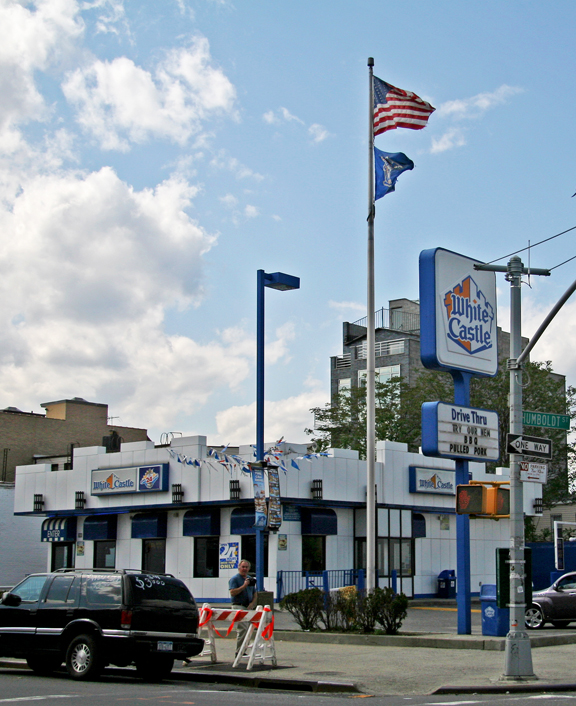
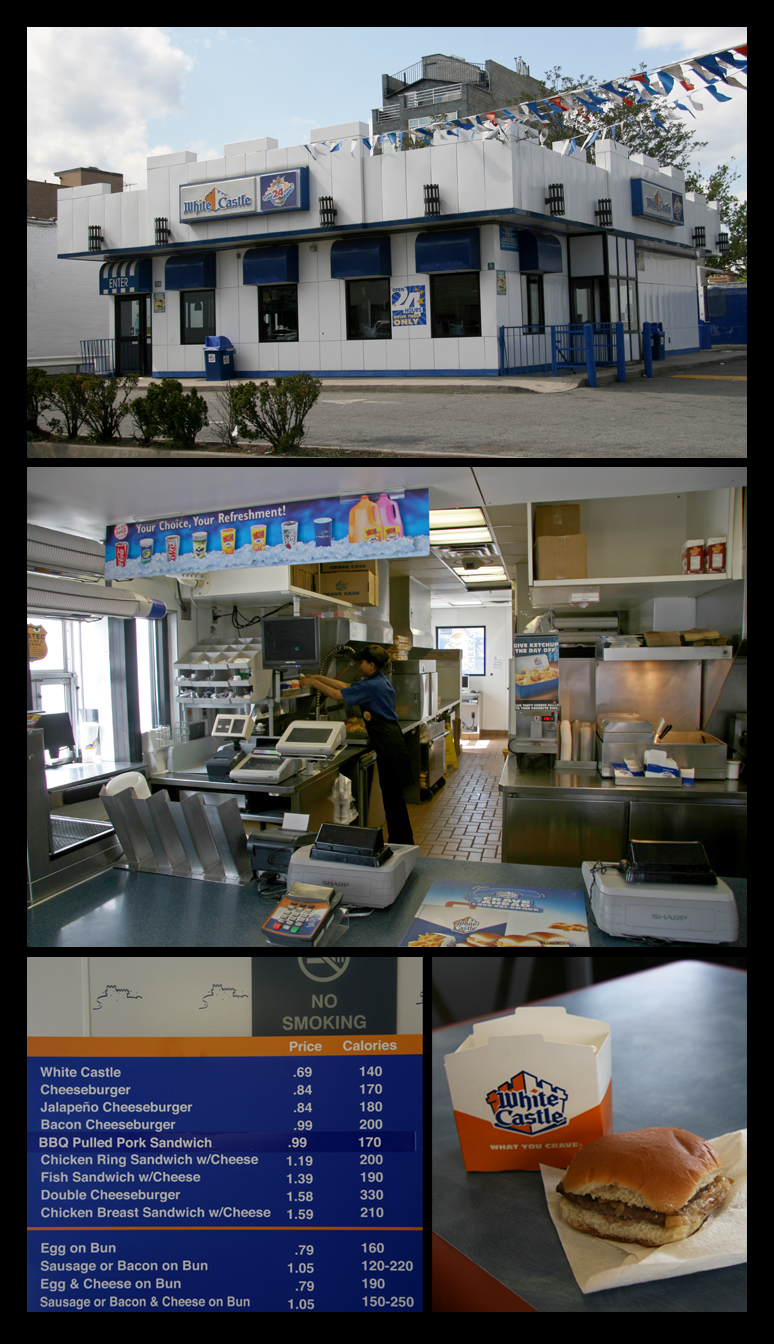
    Not so long ago, you had to make a pilgrimage to find a fast food restaurant. In 1970, there were no McDonalds in Manhattan. When I first moved here to attend university, a group of us traveled to the Bronx to have the White Castle experience. Eating those little square inexpensive hamburgers (known as sliders – officially Slyders) was the perfect novel activity for a college student. White Castle was an alien experience – something more akin to the suburbs or outer boroughs. Its white porcelain enamel exterior with crenelated roofline resembled a medieval castle (said to be modeled after the Chicago Water Tower.)

    The protective romantic attachment that some had surrounding White Castle has all the earmarks of the New York City landmark institution, such as egg creams or Coney Island. Perhaps its length of time in the city (there has been a White Castle in Bayside, Queens, since 1932) and the fact that it predates any other fast food chains here give it a false sense of being a New York original, akin to Nedick’s or Nathan’s. And New Yorker’s are used to taking credit for many firsts, so why not White Castle?

    But, in fact, White Castle is a national chain and was started in 1921 in Kansas by partners Walter A. Anderson and cook Billy Ingram. However, the chain has maintained a much lower profile and rate of expansion than other fast food restaurants – to date, it has 380 plus locations nationwide, compared to 13,000 for McDonald’s.
    From the New York Times:

    Few people seem to realize that White Castle was America’s original fast-food chain: its first outlet opened in 1921, 27 years ahead of McDonald’s. Indeed, White Castle was the key player in turning the hamburger into America’s national meal.

    Its little square burgers and turreted restaurants have become something of a pop-culture punch line, stuck somewhere between white-trash chic and ironic kitsch.

    So it was last weekend on our adventure to Jackson Heights that we came across this White Castle at the corner of Metropolitan Avenue and Humboldt in Brooklyn – more photos here. A few mandatory burgers were consumed by my companions as I sampled some French fries. In all, the place was clean and tidy and the staff extremely friendly. It was a good first White Castle experience for one of our group who was new to the food chain. Our hats are off to the management here…

    Posted on by Brian Dubé

  • Salad Bowl

    Posted on by Brian Dubé

    Some argue that the view of America and even New York City as a melting pot is largely a myth and an outmoded idea. Immigrants do not settle across the country or the city in a uniformly distributed way. What we have would be better described as cultural pluralism and multiculturalism, and that a salad bowl is a better analogy than a melting pot.

    New York City is remarkably diverse, but on close examination, a walk through the many neighborhoods of this city will reveal segregation based on ethnicity and social class/income. Remove students and visitors from the equation, and you will find some areas quite homogeneous as far as actual residents.

    I leave it to you to sort out the details and make judgements regarding melting pots, salad bowls, demographics, and the census. If you want to see the best New York City (and some say the world) has to offer as far as ethnic diversity is concerned, head to Jackson Heights, Queens. I wrote a number of articles about this area in 2007 – see the links at the bottom of this article.

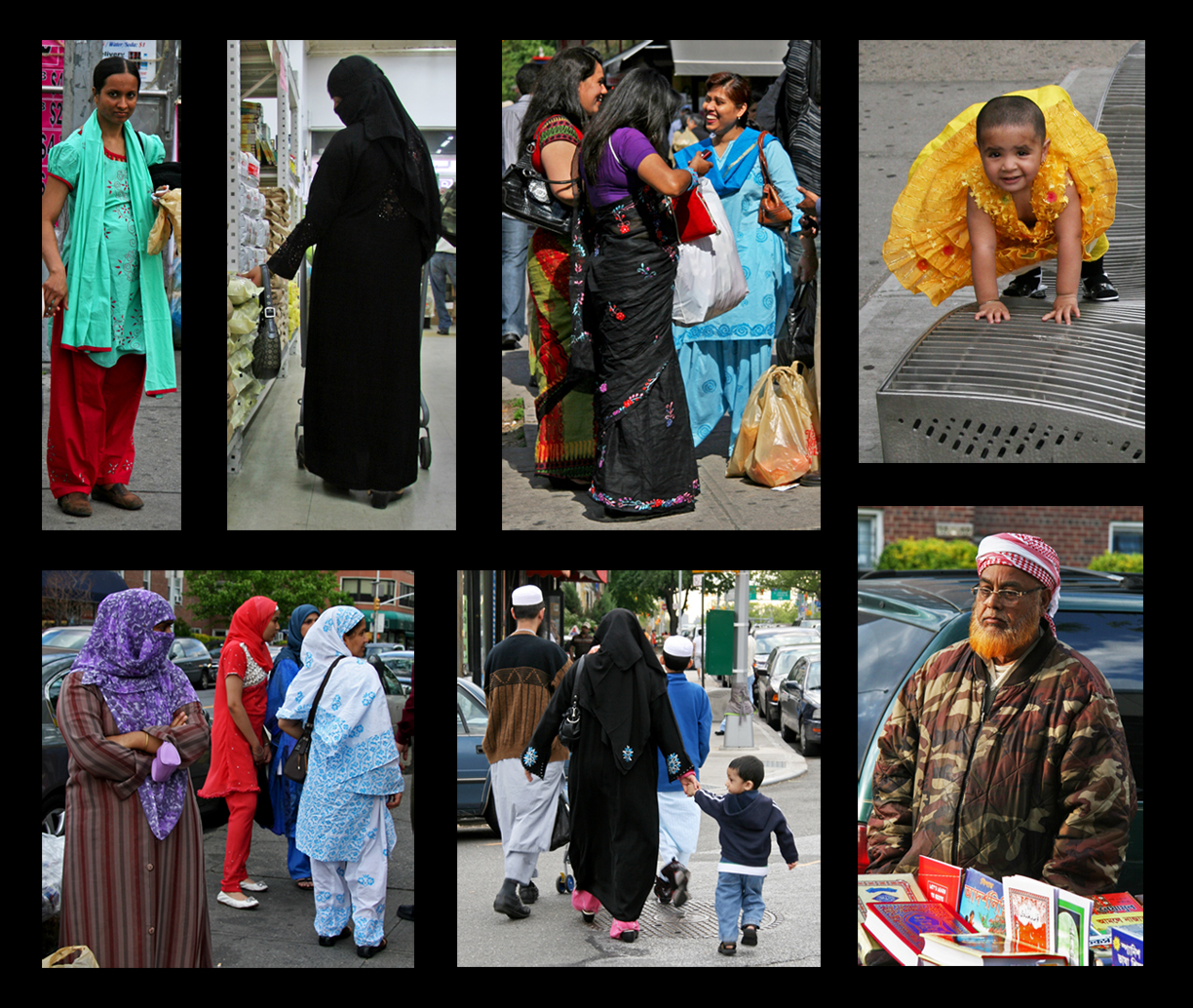
    The most striking thing about a visit to this neighborhood is the extraordinary numbers of people who are wearing traditional non-western dress. Turbans, Saris, Burqas, and other unusual dress dominate the streets and shops, which themselves are a menagerie of merchants featuring products and foods catering to these varied cultural groups. Food alone is enough of a reason to visit Jackson Heights.

    As I worked on the numerous photos for today’s collage, I found myself battling and attempting to crop out one thing in many of the photos. The common and unifying element in this multi-cultural extravaganza? The universal constant appears not to be the speed of light but rather an item to carry ingredients of a salad bowl – the ubiquitous plastic shopping bag…

    Related Postings: Jackson Diner, Jackson Heights, Indian Gold, The Patel Brothers

    Posted on by Brian Dubé

  • Walid Soroor

    Posted on by Brian Dubé

    Three men sat at a table next to us at the Delhi Heights restaurant in Jackson Heights, Queens. One of them had a very mysterious aura, a near sinister smile, and an unusual confidence. His face had a strength of character that was not typical at all. But we were in one of the most ethnically diverse neighborhoods in the world, so it was not strictly an ethnic issue. This neighborhood is populated with an array of cultures and colors, but there was something about his presence that signaled something different.

    I asked my photographer friend, whose back was facing the subject, to steal a glance. He did and confirmed my sentiments. The situation begged for a photo, but photographing people in public is tricky and, at point blank range in a restaurant without permission, is not appropriate. It is at best met with tolerance, at worst met with unknown consequences. It is not public space, and restaurant owners want the privacy of their customers respected.
    My imagination had already created wild scenarios of who this might be and what he did. When he stepped out of the restaurant, I pondered my options and decided on a strategy to involve his friends.

    I got up, approached their table, told one of them that I found the man who stepped out extremely interesting looking, and asked whether he thought his friend would be amenable to having a photo taken upon his return. His response was that he would ask. And my instincts were right. The mystery man was actually a singing superstar in Afghanistan. Upon his return, a short conversation ensued in a language foreign to me, but the smiles needed no translation, and it was clear that permission had been granted. No surprise, now knowing that this man spends his life in front of the public and cameras.

    He was quite gracious, and conversation traveled across tables as I shot. He complimented my camera.  I responded that my friend was armed with a much better tool: a Nikon D3. He noted that it is the man behind the camera, not the camera itself, that made a good photo. He was familiar with our photo equipment and said he was also a videographer.

    Still, there were some pieces of this puzzle yet to be explained. Why the odd smile – almost a sinister grimace? I overheard him say that he had just gotten dental work done – he spoke of getting a perfect job, $8000 worth of work. Local anesthesia and numbness would explain his unusual facial expressions. However, this was itself puzzling. Who gets that much dental work done on the road away from home?

    I was told that a dentist at his performance was so pleased with his performance that he offered to do extensive work at no charge. He would be returning to New York for completion of the work. We exchanged email addresses and names. His name? Walid Soroor. A immediate search when I arrived home confirmed what I had been told. Walid’s brother, Waheed Soroor, has a full page entry in Wikipedia where Walid is cited. YouTube has numerous videos of Walid performing internationally. His companion, who negotiated on my behalf, is acclaimed tabla artist Qais Ulfat. The third member of the group was their manager, completing a real life entourage – see here.

    All the pieces of the puzzle had now come together. I reflected on how I was not only guilty of poor detective work but also had once again misjudged a book by its cover. Another lesson about the surprises behind the faces of New York, this one brought to you courtesy of Qais Ulfat and Walid Soroor 🙂

    Related Postings: Jackson Diner, Jackson Heights, Indian Gold, The Patel Brothers, Only In New York

    Posted on by Brian Dubé

  • Attention

    Posted on by Brian Dubé

    “Oh, have I got your attention now? Good.” This line, spoken by Alec Baldwin in his famous sizzling speech in the award-winning film Glengarry Glen Ross, would be appropriate for our friend in the photo, could he only speak. But having a large, inflated rat sitting in front of your business or building will certainly get your and the public’s attention, so no worry that this rat is mute.

    These rats have been seen on New York City streets since 1997. Local 79 of the Construction and General Building Laborers claims to have been the first to introduce the rat to New York City in 1997. They are not unique to the city, but we are the largest consumers and users of the rat invented by Big Sky Balloons and Searchlights of Plainfield, Illinois. At any given time, a number of the union rats are deployed around town to deliver a message about employers whose business practices have bestowed upon them the honor of induction into the family of rats.

    In 1990, Don Newton, an organizer for a Chicago bricklayers union, went to Big Sky looking for a more effective way to to get the attention of nonunion employers. Owner Mike O’Connor proposed the idea of creating a large inflatable rat, and “Scabby the Rat” was born. Big Sky has since produced hundreds of rats used throughout the country, along with hundreds of other inflatables such as the “Greedy Pig,” the “Corporate Fat Cat,” skunks, bulldogs, and cockroaches.

    Some victims have retaliated, such as a larger cat looming over a rat by Radio City in 2005 or the anti-union dinosaur which was placed in front of the AFL-CIO’s headquarters in Washington, D.C. in 2006 by the Center for Union Facts to symbolize their belief that unions were outmoded and would become extinct.
    The numerous articles regarding these rats show the price range escalating – now ranging to nearly $10,000 for the biggest rat. I suppose everything is subject to inflation 🙂

    Film Note: Glengarry Glen Ross – Highly recommended drama, screenplay adaptation from a play of the same name by David Mamet. It will forever change your view of sales. Warning – strong language.

    Posted on by Brian Dubé

  • Men Making Noise

    Posted on by Brian Dubé

    There is a big surprise coming to New York City. I say surprise because many residents are unaware that phase one of the High Line project will open in a few short weeks. Even those who are aware of the project most likely do not have this foremost in their minds. The project is elevated out of view, so it proceeds without notice. The High Line is the conversion of an abandoned elevated railway to parkland. It extends from the Meat Packing District to 34th Street – a distance of 1.45 miles. I wrote about this project previously in High Line Portrait Project. It has been likened to the Promenade Plantée in Paris, built on an abandoned 19th-century railway viaduct. It promises to be a major contribution of greenspace. The figure in the photo is a ironworker who was cutting apart a warehouse abutting the High Line.

    I grew up with a strong work ethic and a family cynicism surrounding most workers. My father was a wood cutter in northern Maine, a remote, sparsely populated area with severe winter weather. The state has a fiercely independent spirit with a strong element of individual self-reliance. After moving south to Connecticut, he viewed most workers whom he typically encountered with disdain. His comment about municipal workers was that you could easily spot them – one man in a hole and 10 men above standing around watching him. My own view of tradesmen is much less harsh.

    There are some things in life that are rarely questioned, such as the benefits of education, the rights of a pregnant woman, and, at one time, the word of a doctor. To that I might add a man making noise. If you look busy and make enough noise, people assume that serious hard work is being done.

    My take on laborers and noise became an an inside joke at my office many years ago. When anyone, hearing some ill defined racket, would ask, “What is that?”, I would respond, “Men making noise. That’s what men do.”
    To those who might question my sanity, I say move aside please. A Mainiac is coming through to do some work 🙂

    Posted on by Brian Dubé


  • dinamic_sidebar 4 none

©2026 New York Daily Photo Entries (RSS) and Comments (RSS)  Raindrops Theme