• Category Archives Slings and Arrows of NYC
  • Tanglewood Anyone?

    The same teacher who was the subject of my story Cello Class was also the woman who warned me one spring that there she would NOT be giving lessons over the summer because she refused to spend summers in New York City. Anyone here on a full time basis sees ample evidence of a mass exodus of many residents during the summer months, with benefits to those willing to stick it out. Restaurants that typically require reservations now have empty tables, streets now have readily available parking spots, tickets are available for shows normally sold out.

    Of course, nothing comes without a price, and much as Vermont looks like paradise until one spends a winter there, New York City is quiet and easy during the summer for good reason. The relentless heat turns the city literally into a concrete jungle, now including steamy tropical weather, without any respite, save air-conditioned spaces.  Nearly everyone on foot finds themselves making pit stops in cool shops, many nearly vacant with unusually attentive salespeople who well understand your reason for visiting – after all, they are also likely thinking the same thing – why I am in New York City during the summer heat? In this jungle, one will not find fruit hanging from trees but instead will find the waste of such foods littering the streets, where walking becomes a slalom between shoppers and mountains of garbage. The season that so many love can be a living hell in New York. After all, the best thing about summer is being outdoors, the very thing near impossible to enjoy here most days here until evening, if that. There are no cool mountains to ascend and no refreshing ocean breezes.

    Summer music festivals, which combine the joys of the season outdoors with musical performance, can be found throughout the world. We do have such in the parks of New York – Central Park’s Summer Stage, Prospect Park’s Celebrate Brooklyn, Washington Square Park Music Festival, Tompkins Square Park Police Riot Concert, among the larger. There are also many many other music festivals as there are street fairs, parades, and a plethora of activities. The problem is that a blistering day makes these all but intolerable, and years of attending these makes one realize that although, as I have heard many a New Yorker extol, there are perks of summer festivities here, nonetheless, the environment leaves much to be desired. The seasoned New Yorker who has spent too many summers here begins to ruminate on where one would have, could have, and should have been, like Tanglewood.

    If you have been to an outdoor concert like Tanglewood in the Massachusetts Berkshire mountains, you know what I mean. Here, one can lie on a clean lawn with a candlelit picnic, perhaps with wine, while lying under a black sky popping with stars on a summer evening and the sounds of world-class musicians wafting over, accompanied by cool evening breezes. On the other hand, for many, the urban equivalent will be lying on the hard, filthy asphalt ground of a well-lit park, trying to listen to musicians who compete with others in a small space as well as deflecting crusties, the homeless, drug addicts, and miscreants of every persuasion. Fights occasionally break out between many of the disenfranchised, understandably frustrated by their lot in life, only exacerbated by the unabated summer heat and humidity which lingers all night. The occasional police vehicle arrives to settle the differences of those who would be pointless to arrest, while at other times, an ambulance arrive to collect the maimed who will only be repaired and released to replay the same violent scenarios at another time. Tanglewood Anyone?


  • In the Allagash

    Posted on by Brian Dubé


    I had been told about the Allagash since childhood – it was enigmatic. Few details were given, most likely because few were known, but the mind of the child went where no info was given. There were stories of big, scary woodsmen who would no doubt do something horrible and yet to be named to any visitor. I was all the more intrigued. On one visit to northern Maine, my uncle, a resident of Eagle Lake, assured me that those inhabitants would pose no problem at all. My father and mother remained steadfast in their view and threw their hands up in despair over a son who apparently was determined to explore the inner world.

    The Maine North Woods region (which some call the Allagash, a river and wilderness waterway) is an extremely large and unusual area, relatively unknown to outsiders and even to many current and former Maine residents, yet it occupies roughly one-quarter of the state, an area of over 5,000 square miles, approximately the size of the entire state of Connecticut.

    What is unusual is that the area is predominantly privately owned by a number of timber corporations. Within its borders, there are no towns, only unpaved lumbering roads. A small area, the Allagash Wilderness Waterway, a state protected region, lies within the Maine North Woods.
    The Maine North Woods is open to visitors – naturalists who go there to fish, canoe, and explore one of the most isolated and last true wilderness regions of the United States. It is accessible via various checkpoints and a very nominal entrance fee.

    And so it was some years ago that I did at last make the decision to visit the area. I had rented a room in Greenville, Maine, where I spent time at Kokadjo, a remarkable restaurant that left an indelible imprint on my mind. It was from Kokadjo that I left for my exploration – I was forewarned by the owner that the roads were troublesome and best not toured in a passenger automobile. Undaunted, I was spurred on with just another in a series of warnings that were falling on deaf ears. I left excited, arrived at the checkpoint, and, with little ado, was heading north. I quickly learned why this wilderness area was not a top tourist attraction. The roads are dominated nearly 100% by enormous lumbering trucks with precarious loads of cut trees. The clouds of dust left behind as trucks roar down the dirt roads is HORRIFIC – I soon learned that the only way to navigate these roads was to stop and wait until the dust cleared before resuming. It was tedious and tiresome.

    But, no worry, my tedium was to be short-lived – within an extraordinarily short distance, I felt and heard the telltale signs of a dreaded flat. I REALLY did not want to deal with changing a flat here in the Maine woods – my car was layered in dust. To add insult to injury, I had developed a worrisome chronic squeaking sound. I had no choice – there were no inhabitants, no towns, no service stations. I was on my own, and I already imagined the chorus of “I told you so” on the future retelling of this story to my family.

    I exited the car and stood behind it, mustering the will to deal with the filthy job of changing a flat in the hot sun on a car consumed with dust. I had not stood more than seconds when the driver of a lumbering truck stopped, assessed the situation, asked for my keys, opened my trunk, and began to change the flat without even asking if I needed help. I was shocked how this complete stranger rose to the occasion without request or any obligation to do so. This was classic Maine spirit – in an environment where just breaking down in the harsh winter can be fatal, locals have learned that working together and offering a helping hand is necessary.

    The truck driver’s handiwork was done in no time. He assured me that my experience was common on roads littered with nails and other debris. He also assured me that the squeaking sound was nothing serious – it was due to dust in the brake linings from traveling the roads there, another common occurrence in these parts.
    However, I was dismayed that the spare tire provided on cars was no longer a duplicate of the standard, like that of olden times, but was now a small “doughnut,” designed to be ridden only a few miles to get one’s flat tire serviced. So my exploration of the Allagash was to be cut short. Back I went to Kokadjo to see what the general store may offer in the way of repair.

    I had barely walked in the door, and the owner immediately caught my eye and asked if I had gotten a flat. I was startled by his precognitive abilities as I got my first round of “I told you so’s.” Frustrated by my initial defiance, the owner toured me through his small retail store, locating a patch kit and instructing me on its use and the repair of steel belted radial tires.

    On Saturday, May 19, 2012, I was cruising my neighborhood for a parking spot. The seasoned New York City street parker will not only scan for empty spots, but will also canvas for idling vehicles and pedestrians making their way towards parked cars. As I approached Duane Reade on Waverly Place, I noticed a man in a parked car. I asked if he was pulling out. He said he would be, but only as soon as he got a jump for his car, which now sported a dead battery.

    If there is a God, I was now being tested. Beyond getting a parking spot, would I help this man for the right reason? And if karma really is operative, would I be propelled to make a repayment for the act of kindness in the Maine Woods? Knowing this man’s plight, it would be unconscionable not to offer assistance. I carry jumper cables, and boosting a car battery is only a few minutes work. This was an opportunity to soften the harsh world of New York City, a place certainly not renowned for benevolent acts.

    I learned that the owner of the car, Hasan Sims, had called a friend for help. I suggested that he call his friend back to avoid an unnecessary trip. I also learned that Hasan worked the night shift at the neighboring Duane Reade and had taken a nap in his vehicle. In the few minutes we worked to start his car, we spoke openly about the various motivations I might have in helping him. I assured him that although getting a parking spot was the primary goal, I was working on something new – being a better person. Unfortunately, time did not allow me to to tell him that I also had a debt to repay for a deed done by an unknown trucker In the Allagash 🙂

    Note to the intrepid traveler: I was finally to explore the Maine North Woods on a future trip, entering from the north at the town of Allagash, near the Canadian border.

    More about parking: Nice Move, Kid, Pull Ahead, WFF ‘N PROOF

    Kindness and rudeness in New York City: Random Acts of Rudeness, Area Code 714 (Part 1 and Part 2)

    Posted on by Brian Dubé

  • The Hollowest of Victories

    Posted on by Brian Dubé

    They may not have hopes and dreams, but they do have trials and tribulations. There are arguments, debates, frustrations, jealousy, yelling, and crying. There are attachments, relationships, and concern for others. There is a pecking order and one-upmanship. Be assured, that although this is the world of the homeless – disenchanted and disenfranchised – in many ways, it is no different than any other world.

    It was gray, rainy, and cold. Much too cold to be swimming outdoors. As I walked through Washington Square Park, a homeless woman was determined to go in the fountain pool. Her friend was not gaining any ground trying to dissuade her.

    She screamed over and over that she wanted to go into the water as he tried to talk to her and restrain her. She sat on the fountain’s interior steps and descended one at a time. She was severely drugged and unstable but strong enough to resist her friend’s efforts at keeping her out of the water. At one juncture, he looked at me and threw his hands in the air in frustration. I said to him that it was too cold and she may likely get sick. He responded by telling me he had told her just that, but he had given up. In a world where no one cares whether she lives or dies, what is she to do? Make a scene and try to capture the attention of any willing to watch and listen.

    Yes, this predicament – the drugs, her friends, her dead end life – are all her own doing. It would be unfair to say that she is down on her luck – better said, she is just down on her butt. But no matter, because at that moment in time, her pain and frustration was just as real as yours or mine. The three of us were alone in the rain, with an occasional passerby. No one seemed to care. She is disposable and will likely not live long. We are better off without her, are we not? Out of sight, out of mind. In this type of conflict, which I have seen played out often enough, even if violence erupts, the police will not arrest her – to what end? They would be told to leave and take their misery elsewhere.

    She finally reached the bottom, soaked by rain, immersing herself into that cold pool of water. Like an obstinate child having a tantrum, I could see that she was not really happy at all. She had won a hollow victory, making the whole thing even sadder. Here, in a fountain surrounded by one of the world’s most affluent neighborhoods, it is likely that some watched this entire ordeal from apartments averaging 2 million dollars.

    Telling this story makes me feel a little worse. I kid no one if I try to pretend that I feel their pain. I have never been so down that I sat soaking wet, crying as I descended into a cold pool of water on a gray rainy day at the end of my rope with no hope. It was The Hollowest of Victories

    Afternote: Later that night, I saw them under the park’s arch, playing out another confrontation, her soaking wet, lying on the grates with her friend trying to reason with her.

    More stories of the homeless: Ask Tommy, Looking for an Angel, Usually. Maybe. Probably Not., Caught in the Rain, Any Questions?, Crusties Are People Too? (Part 1 and Part 2), On the Road, Cosmetics, Crustie, Dead to the World, Stephanie, Caravan of Dreams, Extreme Camping, Homeless Art Scene, The Art of Kissing

    Posted on by Brian Dubé

  • The Show Must Go On

    Posted on by Brian Dubé

    Chapter 1

    It’s Friday evening at the workday’s end. A coworker, Rigel Sarjoo, and I decide to have dinner. However, her time is limited – she also moonlights as a singer with a local band and must leave Manhattan by subway at 7:30PM for a show in Brooklyn. It is 6:30 PM, and we have exactly one hour to get to walk to a restaurant, eat, and pay our bill. We both were thinking the same two options – the newly discovered Meatball Shop, recommended by mutual friend Bill Shatto, or the old standby, Saigon Grill (now Saigon Market). They are both in the Village, but some distance apart. Here’s the dilemma: Saigon Grill is very good with lightning-fast service. However, we LOVE Meatball, but it is typically PACKED and it is Friday night. But it is also Memorial Day weekend – which means it may be dead. We take our chances with our first choice.

    Chapter 2
    It’s a long walk in the warm, humid weather – about one mile and we are nearly sprinting. Nothing worse than summer heat and humidity in the city. Meatball rarely has no wait. This is a big risk and we agree if they are too crowded that we will try Thali, a micro-restaurant nearby, saving us from a long walk to Saigon Grill. Thali is a new Indian restaurant located in a tiny space, formerly the home of another Indian restaurant. They specialize in Thali – a selection of different food items, served in small bowls on a round tray. It’s a great way to sample a variety of Indian dishes. We have eaten at the new incarnation once. It’s the backup plan.

    Chapter 3
    We arrive at Meatball. It’s MAYHEM as usual, with at least a 30 minute wait. I tell the hostess to forget it, and we leave. We walk a few doors down Greenwich Avenue, arrive at Thali, and the door is open. There is no A/C, and it is hot inside. Forget it. We are off to Saigon Grill, where we both agree we should have gone in the first place. It has the fastest service I have ever had in a restaurant in New York City. I have seen entire dinners served before friends have returned from the bathroom after ordering. We need that speed now, because it will be 7PM by the time we arrive.

    Chapter 4
    It’s another long hike to Saigon Grill. It’s 7PM, and now we have only 30 minutes. But we are greeted and taken to be seated immediately. There is A/C, the place is spacious, and there are numerous empty tables. This is why Saigon Grill is an old reliable. They never fail us for large groups or when in a hurry.

    Chapter 5
    As we are about to sit down, we hear our names being called. Our mutual friends Harvey and Hellen Osgood and Myra Smolev are eating nearby. We are, of course, invited to sit with them. The five of us cram around a table for four. No problem. It’s a nice follow up to a long hike in the heat and a series of restaurant disappointments. Dinner with friends. We are, however, still in a rush. Time is fleeting. My coworker and I do not need menus – we both know what we want and order immediately. Within a few minutes, our meals arrive. Friendly banter dominates the meal. It occurs to me now that all four of my dinner companions have been the subject of stories for this website.

    Chapter 6
    Our check has been ordered, received and the bill paid. It is 7:30PM on the dot. Rigel makes the rounds getting her good luck hugs and leaves for her show in Brooklyn. She should make it on time. It was a job well done, if not a bit harrowing.  My cell phone rings – I miss the call. It’s a number I do not recognize. I decide to return the call anyway. It is Kyle Petersen, a freelance worker who handles all of our social networking. He is a professional juggler and unicyclist. There is an emergency.

    Chapter 7
    He is scheduled to go on stage at 8PM at the Bowery Poetry Club. However, he is missing two silicone handsticks that he must have for a juggling routine in his show. There is nowhere that these can be had except at my shop, conveniently only a few blocks from the club. He is there now on the street – can I come down right now and open my shop and get him two handsticks?

    Chapter 8
    Oh man, I REALLY don’t want to do this now. I just left work 60 minutes ago. After all the running and sweating that I did, I do not want to go back to my office. It will take me 15 minutes to get there if I really hustle and leave instantly. But it’s his show, and it would be unconscionable for me to refuse. I tell my friends of the dilemma, my intentions, and the challenge in getting there in time. But there is good news.

    Chapter 9
    Myra conveniently happens to have her bicycle chained outside the restaurant and offers it to me! After that, I can ride it to her apartment building and just hand it to her doorman. No fuss. And she lives steps from my home, near Washington Square Park. We leave the restaurant and she unbolts her bike. However, a problem remains: I have a very heavy bag and a DSLR camera with no bag for it, and it’s not the best idea to bike with an unprotected camera. Hellen immediately offers to take both to her apartment, also one block away. I can pick both items up on my return. Excellent. Now every detail has been taken care of and I ride off, heading towards Broadway. I have owned and ridden bikes in NYC for my entire life here, and I love bike riding in Manhattan. This lemon is turning to lemonade. The ride to 520 Broadway in SoHo from Saigon Market is a breeze by bike. And fun. I am there in minutes.

    Chapter 10
    I arrive at my office. Kyle is nowhere to be seen outside. He is, however, inside the lobby. Perfect. He is shocked at how fast I made it. I tell him of my luck regarding Myra’s bike. He is fully dressed for his performance and ready for stage with a headphone mic on. This is like the NYC of moviedom. I hand him the bike. I take the elevator to the 3rd floor, unlock the door, disarm the security system, grab two black handsticks, rearm the security system, and run out the exit door and down 3 flights of stairs – all in one big sweeping motion. Kyle is nothing short of ELATED. He assures me: “You’re the man!” Thanks to the bike, it is only 7:45PM, and Kyle has a full 15 minutes to show time. We have seconds to burn.

    Chapter 11
    One more thing, Kyle, before you go. Give me a few SECONDS and pose for a photo with that bike because this evening’s events make one hell of a story. I snap a couple of shots, and he is off and running to the Bowery Poetry Club. My job is complete. I bike back towards the Village, arrive at Myra’s residence, hand the bike to her doorman, and walk two blocks to Hellen and Harvey’s. A quick elevator ride to the 11th floor, and I retrieve my camera and bag. Mission accomplished – it’s time for a stroll in the park and then home.

    Chapter 12
    By the next morning, I have nearly forgotten the episode. I examine my cellphone and find that my text memory is full. After deleting a few messages, I receive a text which had been sent by Kyle at 10:32 PM the evening before, apparently after his show. It proclaims: “Smash success. You saved my life.”

    Postscript

    It was a real New York City adventure, replete with frenetic rushing, two performers who have showtime pressures, turned away at a restaurant so trendy and crowded that patrons were waiting in the streets, a serendipitous meeting of friends, the fortuitous availability and offering of a bicycle, the helping hands of others, and someone who literally goes the extra mile – on Broadway. It’s what goes on behind the scenes in New York City when we say The Show Must Go On.

    Posted on by Brian Dubé

  • Boom Boom

    Posted on by Brian Dubé

    My brother-in-law was at one time involved in drag racing. I was intrigued when he recounted the level of sound of these cars even when idling – that clothing would move due to the incredible sound pressure generated by machines running literally on rocket fuel – nitromethane. Since that conversation, I have always wanted to attend a race just to experience once what he described.

    However, I am not a lover of boom cars which cruise the streets of New York City. Perhaps you have encountered the Boom Car. These ear-splitting machines are old news. From the New York Times in 1990:

    Young people are converting cars into rolling radio stations by stuffing them with dozens of speakers, compact disk ”jukeboxes” and amplifiers capable of booming rock and rap music at decibel levels powerful enough to rattle neighbors’ windows, ruin their own hearing and assault their captive audience on the street. They are being spurred on by technological advances in automobile sound and by national competitions with names like ”Sound Quake” and ”Thunder on Wheels.” The equipment is being installed by shops with slogans like ”We Build Ground Pounders.”

    Unfortunately, these vehicles are the bane of most New Yorkers, the deafening sound being enjoyed primarily by the occupants of the car. The phenomenon is certainly not limited to the city. It’s a nationwide phenomenon that has citizens in an uproar and keeps legislators busy. Some of these systems boast over 1000 watts, powerful enough to shake the windows, the china, and the walls of home owners.

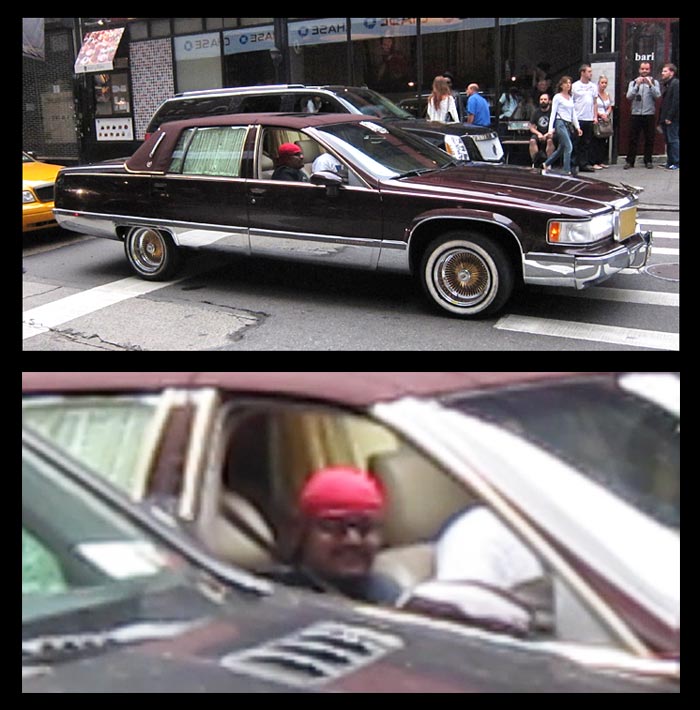
    Yesterday, while leaving my office at the corner of Spring Street and Broadway in SoHo, I saw a large Cadillac with curtained windows, looking more like a hearse than a regular passenger vehicle. I only had seconds to capture a photo of the sound mobile. I reached for my camera, snapped one photo, and got a few seconds of shaky video. I made my photography deliberate and obvious. As the car sped off when the light changed to green, the passenger smiled and acknowledged what he perceived as my tacit approval.

    According to noiseoff.org, an organization devoted to fighting noise pollution of all types, “People who drive boom cars consider it their right to play music at any volume they please. They regard their car as an expression of themselves and the louder it is, the bolder the statement that they can make. Boomers are typically lower-middle class males in their teens and twenties with some disposable income. They assume that their car will attract women and improve their social standing among their peers.”

    Technology is only going to make the problem potentially worse. Some are calling the enterprise the “noise industrial complex.” The advertising slogans, not typically familiar to outsiders, is unapologetic:

    “Disturb the Peace” (Sony)
    “All New Ways to Offend” (Sony)
    “Performance they’ll hear a mile away”(BoltOn)
    “Shake the living; Wake the dead” (Cerwin Vega)
    “…achieving the sound your neighbors fear” (Sony Xplod Car Audio)
    “Disturb, Defy, Disrupt, Ignite” (Pioneer Electronics)
    “Head-Splitting, Heart-stopping, Ear-shattering, Mind-numbing, Retina-detaching MX Audio Thunder 9500  Subwoofer” (MTX Audio)
    “Put the over forty set into cardiac arrest”(Prestige Audio)

    This type of noise, like the roar of the non-muffled straight pipes of motorcycles, is difficult to control, and prosecuting offenders is tricky – the varying sound level is difficult to measure, and the source is a moving target. So, as long as the appeal is there and big money is to be made selling the equipment, it looks like it’s going to be a Boom Boom 🙂

    More on noise: As Usual, Grace of a Boombox God, Too Too New York, Deaf Jam, Men Making Noise

    Posted on by Brian Dubé

  • The Sounds of Music

    Posted on by Brian Dubé

    Hear this story as a podcast:

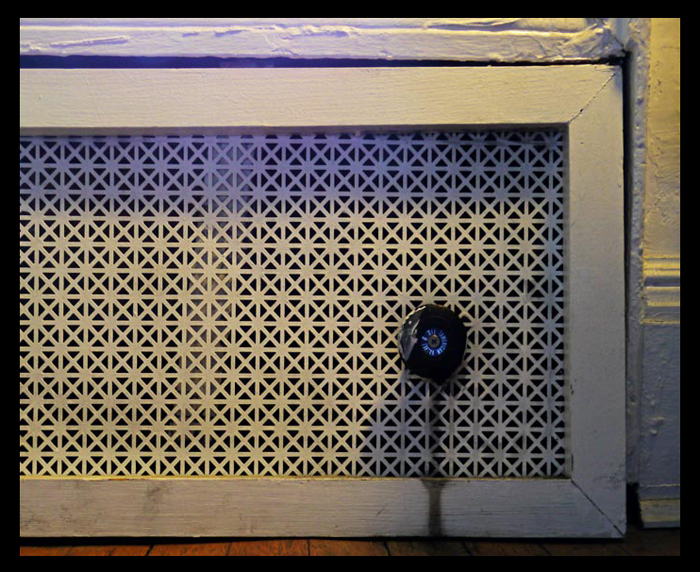
    In the 20th and particularly the 21st century, one would expect concern over proper operation of heating systems to be a thing of the past. But, as I wrote in The Dark Ages, most steam heat systems work abominably in New York City, running too hot or too cold without indoor thermostats.

    The spring and fall are particularly tricky times in or out of the heating season (October 1 through May 31). Even within the heating season, when outdoor temperatures rise, tenants find themselves in the situation where the outdoor temperature is not really warm enough to warrant no heat at all, yet none is provided and it is too cool indoors. For private homeowners outside the city, a little blast of heat in the morning is just what is needed to take the chill out. Here, however, in these transitional periods of late spring and late fall, whether one gets that welcome little bit of heat is subject to the discretion of the landlord and/or building staff. Often a complaint or two from those who are most intolerant will spur a supertendant to turn on the heat for a time.

    Often, I have resorted to a small electric heater for early chilly mornings, but at best, these will only provide a very small area of comfort – nothing competes with a building’s steam system for getting the job done right.
    So my nose and ears are typically piqued in hopes that I discern those unmistakable telltale sounds and smell of heat coming up. The characteristic squeals, hisses, spits, and clanking are all harbingers of good things to come. Perhaps perplexing to the urbanite how heating issues could be of such importance, the thing to understand is the tenant’s lack of control, regardless that someone maybe paying thousands of dollars per month.

    Admittedly, city residents are typically spoiled by heat rising to the 80s indoors during prime heating season, so these cooler temperatures during late spring and fall may often be in the low 70s, certainly not “cold” by suburban or rural standards, where homeowners must pay for fuel themselves and are not spoiled by excessive heat.

    But here, after a week of nippy mornings in mid-May, electric heaters, and heavy robes, I had all but given up hope for any steam heat this season. But then, at 6:24 AM, that familiar family of sounds began, at first nearly inaudible, teasing my senses whether it was my imagination, or was, as I had hoped, heat coming up. Soon, it was clear that someone in the building staff had made the decision to bless us with a much-needed shot of warmth. A quick check confirmed that, in fact, heat was coming up and that it was real, not imagined. The familiar orchestra of hisses and squeals became louder and to my ears was nothing less than The Sounds of Music 🙂

    Posted on by Brian Dubé

  • The Ride from Hell

    Posted on by Brian Dubé

    Preparation

    I do believe that one of the reasons that civic improvements are not made in a timely manner is that legislators do not suffer the slings and arrows on a daily basis. The comfort of insulation will do a lot for apathy, and mornings outside in January without a coat will do a lot to propel someone to light a fire.

    Even for those who grew up poor or working class, once removed, the frustrations become distant memories for those in office. But if they, like their constituency, had to rely on mass transit for their daily commute and experienced delays, rerouting, and other abuses, they would likely be first at bat for change. To depend 100% on public transportation and suffer the anxiety, stresses, and horrors of the system on a long term basis will grind many down, even the seasoned, tolerant New Yorker with a cast-iron stomach. I have known many residents who have been driven to near wit’s end over a life time of transit travel. Some, as several of my employees, have sworn off subways entirely, opting for bicycle travel, even in winter.

    Saturday, April 21, was a beautiful sunny day, and I was to visit a friend in Staten Island. My car was in disrepair, so this would be the first time in my life where I would travel to a destination within Staten Island using public transportation. The X1 express bus was the logical choice, providing nearly door-to-door service for $5.50 one way. My friend warned me that this was the only sensible option.

    However, I decided that given the weather, I would take the ferry and the SI Railway.  I had never taken the SIR, and I was particularly excited to do so and document the trip. This means a three-legged trip: a subway to South Ferry, the ferry itself, and the Staten Island Rail to my final destination.

    Descent to Hell

    It started out innocently enough, with plenty of good cheer. It was, however, to become the ride from hell. Distracted with my cameras, iPad, and trip planning, my first mistake was getting on the subway on the uptown rather than downtown side. This was infuriating because at the Sheridan Square station, there is no underpass, so anyone making this mistake must leave the station, exit to the street, and reenter the other side, paying another fare – there is no provision for a free transfer under these circumstances. I was pissed as hell at my stupidity and even more so to give the NYC Transit Authority another $2.50 for no good reason.

    As I descended the downtown stairway, I had just missed a train. Adding insult to injury, I was angrier yet, and my first leg to South Ferry was already delayed waiting for the next train. The change to the ferry at South Ferry went smoothly, and the ride at sea afforded ample opportunity for scenic photos and video. The Staten Island Ferry comes highly recommended – it is FREE and affords vistas of the East River bridges, the Manhattan skyline, Ellis Island, Brooklyn, New Jersey, the Verrazano Bridge, and the Statue of Liberty.

    I had been warned by my friend that the travel option of choice was the X1 bus, not a three-legged workaround. I had told her that in this instance, I preferred the scenic route and, apart from my mishap taking the wrong train, it was looking like I would be heir to bragging rights for my decision to take the ferry. I was armed with photos and video to show her, which would just be further evidence that in NYC, there are different strokes for different folks. I had calmed down appreciably and was ready for my rail trip.

    Hell Hath No Trains

    When I arrived in Staten Island at the St. George terminal, I learned that due to construction, the SI Railway was not running from the ferry station. BIG disappointment. I was informed that there was a free shuttle bus to the first station on the line. This would make it a 4-legged trip. Additionally, no one could tell me where the shuttle bus was, including every driver of the local buses I could find. My patience had worn thin, and I decided to forgo the railway and take the local bus, the S79. Another big disappointment, and I was fed up.

    Hell Hath No Buses

    I was alone at the bus stop with one other passenger. It was desolate, and as I waited, time crawled by. I tried to ameliorate my anger, looking to my friend waiting at home for sympathy by making more and more frequent cellphone calls to her to complain. She was the perfect and willing shoulder to cry on, a classic New York cynic who hates all things New York City and has nothing good to say about public transportation. Of course, I got the obligatory “I told you sos,” but even she became incensed as the delay became nearly inexplicable. Over an hour had passed, and there was no S79 bus to be seen. The crowd of passengers had become large, but virtually no one appeared agitated at all.

    All’s Hell That Starts and Ends Hell

    The delay became extreme, and I paced like a wild animal. It was nearly ONE HOUR AND 30 MINUTES to wait for a local bus on a Saturday night! As I was to return that night and it was now after 9PM, I even considered getting back on the ferry and returning to Manhattan. My friend was not pleased with the prospect of an aborted visit, and neither was I. I continued to wait, and at last an S79 pulled up.

    There was still little show of anger even amongst those who had waited for nearly as long as I had. There was neither an apology nor an explanation from the driver nor confrontations from the passengers as they silently boarded the bus. On board, I tried to recruit a sympathizer or two for what seemed to be an unconscionable act. In my conversation with one resident, I learned that delays like this are not uncommon, and he seemed resigned to his plight. He, as well as his fellow passengers, looked calm and collected. For them, it was business as usual for the ride home. For me, and I wish for a public servant, it was truly The Ride From Hell 🙁


    Posted on by Brian Dubé

  • Caps and Floss, Part 2

    Posted on by Brian Dubé

    (see Part 1 here)

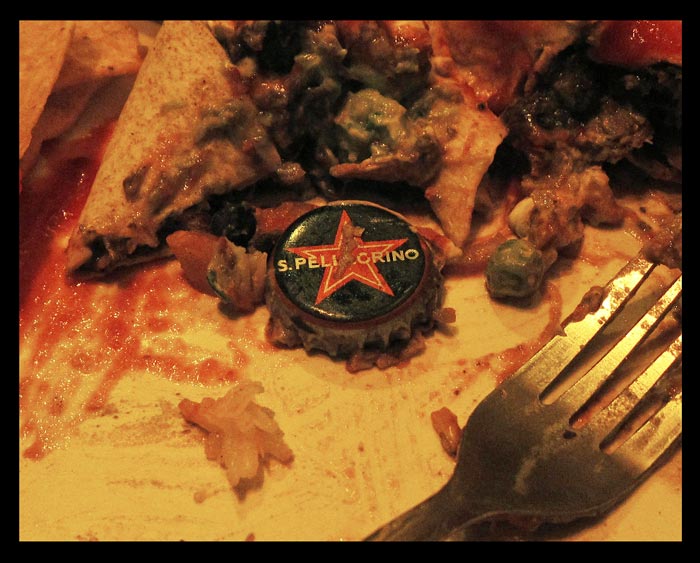
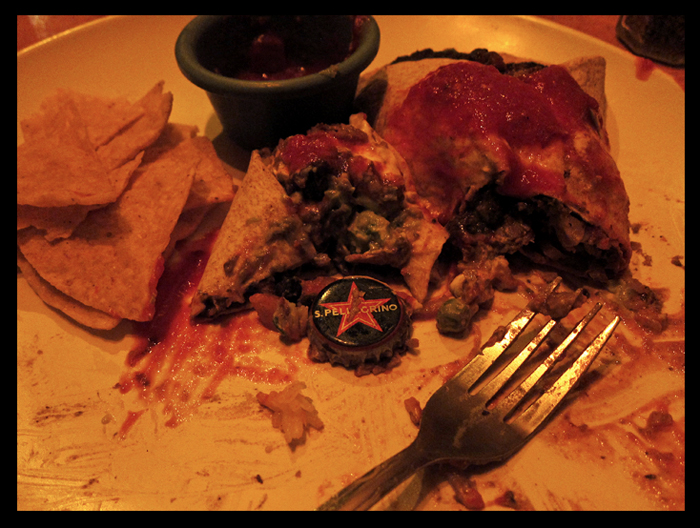
    I am somewhat cautious while eating, but no one expects a metal bottle cap in their entree. I bit down reasonably hard on that San Pellegrino cap. After extracting the culprit, cursory examination of my teeth with my tongue appeared to indicate that all was well. I discussed with my dining companion what we thought the staff’s reaction might be. Our waitress had known me over 15 years – I assumed that, at the least, I would not be charged for my meal.

    I called her over, showed her exhibit A, and she was mortified. She immediately swept the dish away and said that of course, the entree was coming off the check. As I left, more apologies followed me out the door. It was a good story and laughable incident really. Or so I thought.

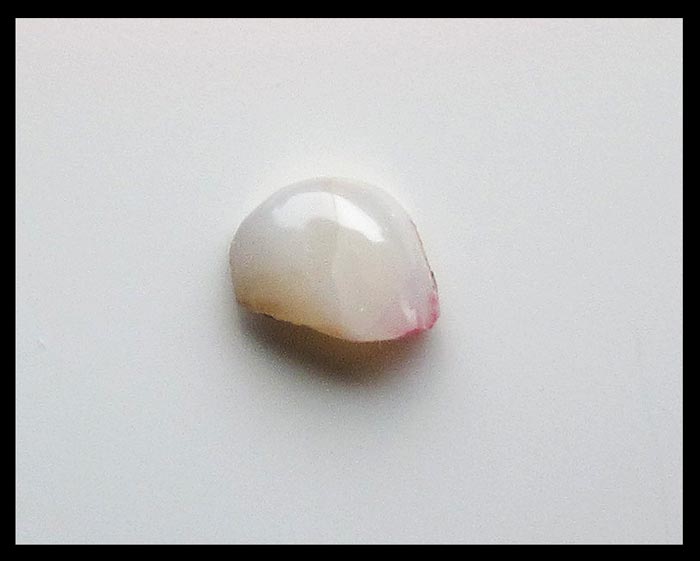
    However, soon after, while eating at home, I felt a small hard object in my mouth. My heart sank as it appeared to be a piece of tooth. A quick run of my tongue along the area where I had bit into the bottle cap quickly confirmed my worst fear: a piece of a tooth, which must have cracked against the metal cap, had now broken off. Unfortunately, I have enough experience to know that this will likely mean a crown (cap) and possibly more. I used to have anxiety over dental procedures – particularly doing crowns, root canals, etc. However, my only anxiety now, apart from losing natural teeth, is the time and cost of doing such things. Modern dentistry should be relatively painless, except for the impact on your pocketbook.

    I visited the restaurant the next day, telling the waitress of my misfortune and that, unfortunately, it looked like we were talking MONEY. I asked if she thought the owner had insurance to cover such a thing. We exchanged numbers, she said she would contact the owner, and a few days later, the owner called. We discussed the incident. He contacted his insurance broker, who also called to arrange a meeting. I told him I had a dental appointment scheduled and suggested that we touch base after that. He agreed.

    So, tomorrow morning I am off to the dentist to learn what the fate of my tooth will be. Beware the frequent restaurant goer in New York City – the more often you eat out, the more likely it is that you may find undesirable items in your food or drinks. I hope after these tales that you continue to see your meals as treasure hunts, not minefields, and that you find more pleasant ingredients than Caps and Floss 🙂

    Posted on by Brian Dubé

  • Caps and Floss

    Part 1: The Good News 

    Anyone living in New York City for over 40 years, as I have, will have experienced many slings and arrows of outrageous fortune. And here, in these pages, I endeavor to bring you not only the slings and arrows, but those which are truly outrageous.

    For many New Yorkers, as well as visitors, one of the greatest things about the city are its restaurants. I have met many who eat all of our meals out. This would seem to be a tremendous luxury, but it need not be. The range of prices in the thousands of eating establishments here provides ample opportunity to find meals at virtually any price imaginable.

    Over the thousands of times I have eaten in NYC restaurants, it would be expected to have had unpleasant experiences, but nothing tops a story told to me by a close friend, Leslie, and her visit to a popular restaurant with her husband, Michael. In her tale, not only was the initial offense outrageous, but the response of the management was as well.

    Finding things in one’s food, such as hair, is never pleasant, and in a restaurant, there is the added element that it is someone ELSE’S stuff in your food, only made worse if one’s imagination runs wild as to its source. So how would you like to find DENTAL FLOSS in a glass of drinking water? I will let Leslie tell the story in her own words:

    When we asked to see the manager, he came over and sat down quite casually at our table like we were friends (had never met him before), leaning back in the chair like he owned the place, and asked what was the problem. Michael asked him to look at the glass of water he had received from the busboy. The manager looked at it, saw the dental floss, stuck his hand in the water, pulled out the floss and threw it on the floor…lightly saying, “Well, we don’t have to look at that anymore.” If I remember correctly, he did not remove the glass. I suppose he apologized, and then left without offering anything. He seemed quite unconcerned about the seriousness of the entire situation. Between that and another time a few months later, I believe, when Michael’s knee stuck to the wall because of someone’s left over blob of jam, he refused to ever go back!

    For years, I have relished the opportunity to use Leslie’s story to amplify my own, if and when something like this might happen to me. I did not exactly wish such an occurrence, however, I now see misfortune as an opportunity to tell a story and make lemonade from a sour experience. And fate befell me on Friday, April 20th.

    I was eating in a local haunt that I have frequented for decades. I have wearied of much of the food there and, like many places, I have narrowed my choices to just a few items. There, I typically order their Mexican entrees, specifically the enchiladas. However, I was to learn that an enchilada is the perfect vehicle for delivering an unwanted gift – what better food item then a corn tortilla rolled around a filling to entomb a surprise? And surprise it was when I bit into something large and hard. As I spit it out, nothing prepared me for the sight of a METAL BOTTLE CAP. It was no comfort that someone had selected a finer bottle of water, San Pellegrino.

    But what I have recounted so far is the Good News. I was soon to learn that this would not be my last unpleasant encounter with Caps and Floss

    See Part 2 here.


  • As Usual

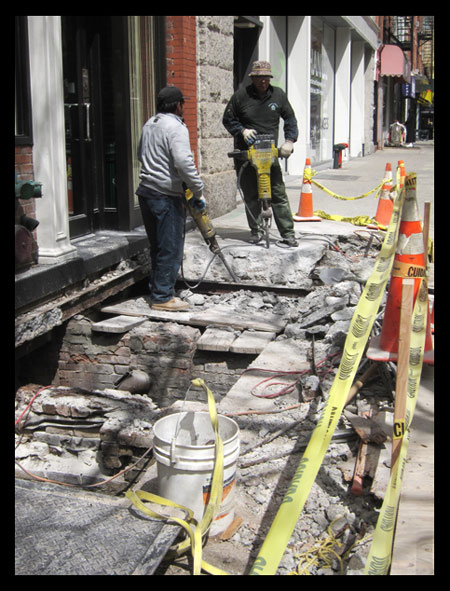
    I did use a jackhammer once for a few days while working a summer job. It was one of the most unpleasant work experiences I have ever had, and I have done a number of unpleasant tasks. I am always so disturbed to see workers using this tool – I cannot fathom how anyone could use such a thing for hours at a time on a daily basis. Even with safety equipment, face masks, and hearing protectors, the impact and damage to the body must be tremendous.

    New York City is an exciting and dynamic place. But dynamism means change, and that means construction. Sometimes it feels like construction at every turn.
    Exacerbating the entire mess is that the city is so densely populated that construction must be done at inauspicious times and places while the city goes about its business. Subways are 24 hours, so service must often be rerouted and disrupted, much to the chagrin of daily commuters.

    This is the city that never sleeps. And why would you try with a jackhammer outside your window? A train or subway is about 100 decibels. A jackhammer is 120 – 130 decibels. At least it is no louder than a jet plane at takeoff, which measures 130 decibels or greater.

    Efforts have been made to develop a quieter jackhammer. In 2000, Brookhaven National Laboratory worked on a helium gas gun device called the Raptor, which was to be much quieter than any conventional diesel-powered compressor-styled device. The noise levels on the newer gun were claimed to be substantially less. However, the device was not as promised, the project appears to be stalled, and so for now, it’s carpal tunnel syndrome, white finger, and bruises for the workers. For the rest of us, it’s deafening noise, As Usual

    Related Posts: Not ReallyToo Too New York, Deaf Jam, Men Making Noise


  • You’re Not in Nevis

    In the early 1980s, I was obsessed with tropical islands and was visiting the Caribbean nearly every winter. Often, I would island hop, traveling to two islands in one trip on a 10-day vacation.
    In December 1983, I was with my sister and brother-in-law, visiting both Nevis and Monsterrat. We arrived at the Nevis airport, and I proceeded to rent a car. I wrote about my experience in The Point of Impact on October 25, 2010:

    I was completely dumbfounded when, in renting a car at the tiny airport, I was only asked when I would return. There was no paperwork or contracts, the only requirement to show a drivers license. The owner of the vehicle confirmed our agreement as to the rate ($25 per day), asked when I would return the car, and just handed me the keys.

    Upon arriving at my inn, the first question I had was to the inn owner about this car rental transaction – the most puzzling and lackadaisical I have ever seen in my life. He said to be assured, the owner would know my whereabouts at any given moment. I asked how that was possible. He told me that Nevis was a very small place (the island nation only has a population of 12,000), and everyone knew everything. I asked how any problems would be resolved. He assured me that everything would be fine, just don’t have an accident. This was not comforting at all.

    What I did not mention in this story is the larger issue of theft. Effectively there was none, for the same reasons the renter of the car was unconcerned about details of who I was. If everyone knows everyone in a small island, stealing will be difficult to accomplish without getting caught. If I steal your TV, how will I keep it a secret without living a cloistered life? Word travels like wildfire and learn of the theft immediately, all eyes will be on the lookout, and invariably, someone will learn of its new home.

    This is not unlike the small rural town in an isolated area, where the Golden Rule is even a more powerful operative, perhaps more so than the threat of punishment in being found out. In New York City, however, we have the polar opposite situation. This is a place where thieves can easily mix without fear of discovery. Opportunity knocks at every turn, and every prudent New Yorker never lets their guard down completely. Rituals and habits become second nature – without conscious effort, we guard our handbags, lock our doors, and never leave anything in sight in an automobile. We rotate watch over belongings in restaurants as turns are taken to use the bathroom.

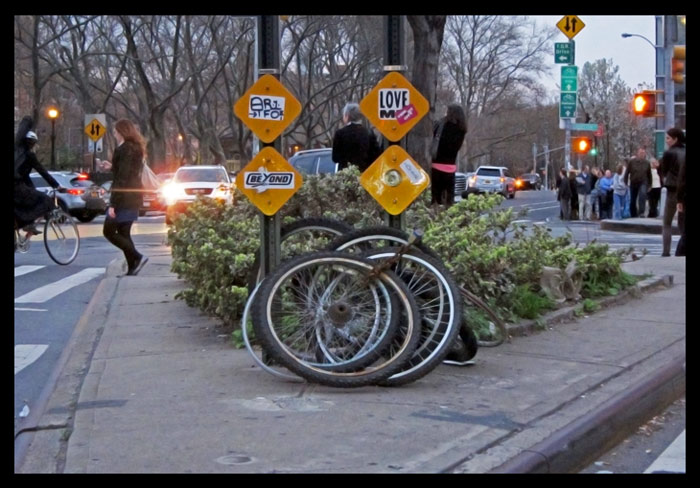
    And we chain our bikes. However, chaining by one wheel will not do the job – a bike less one wheel is a worthy candidate for theft. Best to lock both wheels and the frame altogether, or the frame and one wheel, carrying the other wheel with you. Even a wheel alone may be stolen.
    There are places, such B&H Photo, where you know You’re Not in Kansas. In today’s photo, we have a cluster of front and back bicycle wheels chained together. A bit of a mystery, but one thing for sure – one glimpse and you know You’re Not in Nevis 🙂

    Related Posts: Last to See the Future, With Impunity, One Screw, Street Cred, Orange You Glad


  • Catch the Worm

    Posted on by Brian Dubé

    It was an invaluable lesson, but at that hour of the morning, I did not want a lesson. I wanted desperately to sleep. Oh Lord, I would do anything for sleep. The last thing I wanted to hear at that ungodly hour were diatribes about early birds and worms.

    It was the late 1960s, and I needed a summer job. Unemployment was at record highs, and there were no jobs. So my father was able to arrange a summer job with his construction company. There was, however, a small hitch. It was located nearly 20 miles from home, he worked nights, and I had no vehicle. We were able to find someone in town who was traveling to work in the mornings to one of the companies’ other facilities. So, this meant 3 rides – the first to the man’s home, then a ride with him to one company location, and finally, a ride with a truck driver going to my final destination. This series of rides required getting up early. Real early.

    My ride with the older man was torturous. I tried to nap, which he found comical and amusing. His need to lecture prevented me from sleeping. I was a captive audience with no options but to listen, struggling to keep my eyes open. The only thing I remember is his admonition that EARLY BIRD CATCHES THE WORM. But I was not an early bird, saw no value in being one, and had no interest in worms. Let others have the worms. Please, TAKE ALL THE WORMS AND LET ME SLEEP.

    Much later in life, I came to learn the value of being an early riser and the joy in that quiet time before the morning rush. Although in a city like New York, there are certainly different styles, I also began to see rising early as one of the traits of the aggressor and as one key to many’s success.

    Growing up in New England, I was certainly blessed with an array of bird species. However, the aggressors made themselves most well-known – crows, starlings, sparrows, and bluejays. But in New York City, in the harsh, competitive environment, the aggressors and survivors dominate.

    Here, many of the birds which I see most commonly are the aggressors that I saw growing up in the countryside: starlings, sparrows, pigeons, and the occasional crow. However, today is the first time I recall ever seeing a bluejay in New York City. Bluejays are noisy and notorious trouble makers. They are aggressive to humans and other birds, which they have been known to attack or kill. They also have a reputation as thieves, stealing the eggs, chicks, and nests of other birds. Sounds like the character traits of many New Yorkers.

    Diligent birders keep logbooks of their sightings. My logbook is one of aggressors and survivors and includes salesmen making cold calls, lawyers, real estate brokers, investment bankers, street hustlers, businessmen, rats, pigeons, squirrels, cockroaches, and those who look well -uited and/or have adapted for city life. Today, I round out my collection of sightings with the bluejay.

    Be it birds, plants, animals, or people, the meek do not inherit New York’s earth, only the aggressors and survivors. On April 9, 2006, I wrote New York Survivor about the London Planetree, a good example of a survivor in New York City’s Sieve of Darwin.  It was, appropriately, on a London Planetree, that this morning I sighted my first bluejay and that he, like New York’s other aggressors, was up early, ready to Catch the Worm 🙂

    It’s hard, but worth it. Read more of my take on city life in Unforgiving, Ye Who Enter Here, Steaming Masses of New York, I Know, Jungle Lovers, and Dwanna.

    Posted on by Brian Dubé

  • A Bit Like You and Me

    I used to have a friend who was an eternal malcontent. He chased happiness, convinced that he would find it first in Hawaii, then in California. But really, he was miserable and managed to find misery everywhere he went. In Hawaii, he found one of the worst areas and left soon after bemoaning his misfortune. Always the victim.

    But he was born and raised in Brooklyn, New York, a city that many aspire or dream to live in. He did not see his own good fortune. More than any other single person or incident, this friend poignantly illustrated the nature of unhappiness and that even in New York City, it is easy to be unhappy, regardless of all the people, places, and culture.

    There are people who actually believe that places, money, or things buy happiness. They may not say it directly, but it is evident in their words. If had this or that, if I lived there instead of here. You know someone like my friend for sure. And perhaps, like the lyrics from Nowhere Man by the Beatles, at times, you may find – isn’t he a bit like you and me?

    I hate when people ask, “How are you doing?” because it is a perfunctory question with no intent to hear the truth. I am going to be honest with you in a way that very few are. I really don’t want to write today, and I have nothing much to say. But the “daily photo” is an obligation, and until such time I change the premise, I will meet that obligation. Worse than Seinfeld’s show about nothing, this is a story about not wanting to write a story.

    Yesterday, I was not in a great mood. I reflected on what I might do for today’s story. I had neither any good ideas nor any good photos. I had a personal conflict and was miserable. How will I possibly keep up the standard for writing and taking photos with an attitude like that?

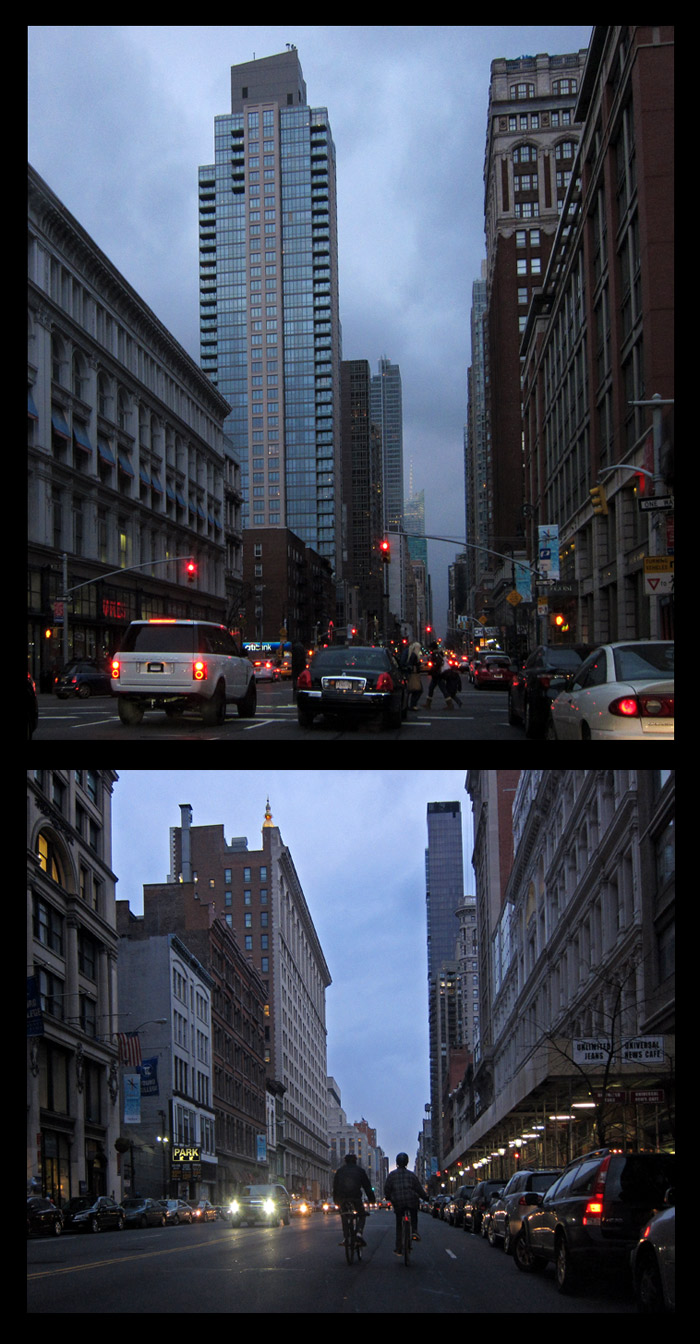
    As I drove in Manhattan to move my vehicle, I felt weighed down by the leaden skies of the city. It was gray and gloomy with a raw cold. I only left home in the late evening. What little light remained was cast from a winter sun hanging low in the sky behind a solid mass of clouds. New York City was no joy at all. Skyscrapers along Sixth Avenue were not uplifting at all but just seemed to be humiliating and adding insult to injury. So dreary, it was reminiscent of northern Maine, where my family grew up. Only living in the Arctic Circle during the Dark Time seemed worse.

    People were scurrying about in an obligatory way, getting through the cold like our Nordic brethren, killing time while waiting for spring and better weather. The best I could muster is an idea to take a photo of the gray day for a blue story. It’s time for a remake of that song in honor of my old friend and anyone feeling the blues. Let’s call it Unhappy Man with the same refrain – Isn’t he a bit like you and me 🙁

    Related Posts: The Loneliest Number, A Story About Nothing, Not Moving to Florida, Dwanna, Duffy


  • Essen or Fressen

    It was sometime in the 1990s, and my best friend was my CPA, doing all my business and personal accounting and tax preparation. At one particular meeting, he looked over some numbers, virtually as Zero Mostel did in the Producers, seeing the possibility for greed. My friend observed that for a particular deduction, there was an opportunity to “double dip,” i.e. take the deduction twice.
    The lure of saving money at tax time is a strong motivator, and knowing my friend was very aggressive tax-wise, I asked whether we should do such a thing. He replied with something that neither of us recall exactly but I remember as an English translation of a Yiddish saying: pigs eat and hogs choke. What I am sure about is what he intended: take the deduction once as the law provides, not twice.

    I called my CPA friend and other Jewish friends this morning, and there is no such Yiddishism. The only Yiddish phrase that appears to possibly apply is Tiere fressen, Mensche essen (animals eat, people eat). In German, fressen and essen both mean “to eat,” but fressen is used for animals. In connection with people, fressen is considered derogatory. In Yiddish, however, it means nothing more than enthusiastic overeating. Nonetheless, pigs eat and hogs choke is what often comes to my mind whenever there is opportunity for greed, and such an opportunity presented itself on February 3rd.

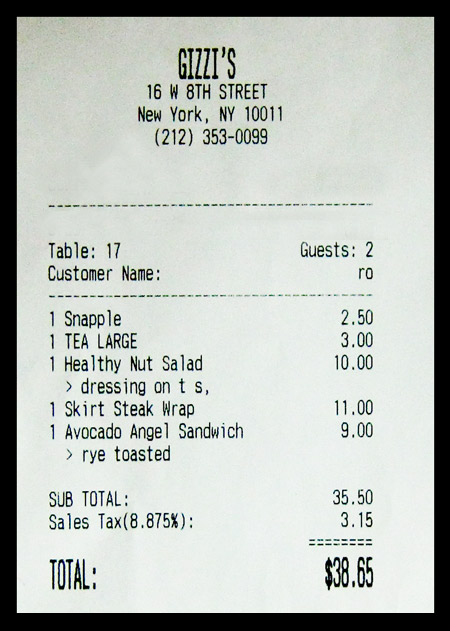
    Three of us ate at a local cafe in the Village. Service there has declined – foods are out of stock, things are forgotten, mistakes are made, free WiFi has been eliminated, laptops banned, etc. We love the convenience and live music, so we continue to go.
    On February 3rd, I ate dinner there with two friends. Our first disappointment was that they were out of both foccacia and ciabatta bread for the sandwich we chose. It’s not that I am a snob and require these breads, but at $9 for a sandwich, it would be nice for the cafe to have the gourmet breads which they advertise. But alas, this is Gizzi’s, which is forever out of something. When we received the check, there were two errors. One, a large tea had been paid for previously, so $3 should be removed from the bill. However, we had ordered two slices of cherry pie at $4.50 each, which the waiter forgot to add.

    So, this check offered some interesting options. We had three choices:

    1) ESSEN: Ask to accurately correct it – take the tea off and add the slices of pie – pay an additional $6.00 (+ $9.00 – $3.00)
    2) Pay the bill as is – save $6.00 (+ $3.00 – $9.00)
    3) FRESSEN: Ask that the $3 for the tea be removed AND not mention that the two slices of pie – save $12.00 by double dipping (-$3.00 – $9.00)

    The dilemma was furthered compounded by the poor service and lack of breads, making it easy to justify short changing the cafe. So, presented with styles of eating and bill paying, what’s your style? Essen or Fressen?

    Related Posts: The Way You Like It, War Against Disservice (Part 1 and Part 2), Take It, Toches ahfen tish!, Fit-ty Fi, Pick Two


  • Love to Lug

    Do not believe for a moment that New Yorkers do not envy many things about living in the suburbs or countryside. We extol the benefits and wonders of the city ad nauseum, however, the conveniences of suburban living are many, and and it is no wonder that outsiders wonder how and why we put up with city life. And if you want to live here, you had better want to walk and love to lug.

    There is the lugging of laundry. Very few have washer/dryers in their apartments. In larger buildings, there are typically laundry rooms in a common area. In smaller buildings, laundry must be carried to the nearest laundromat – sometimes blocks away.

    Owning a car is a luxury few can afford. Street parking is a nightmare, garage parking an extravagance – $400 per month and up. This means shopping for everything is typically done on foot and requires lugging things home. Public transportation is superb, however, the distances from subway and bus stops to final destination will always require walking, often significant. The subway system is virtually free of elevators; only the occasional escalator relieves the tedium of up and down staircases to reach the bowels of the train system.

    Many smaller buildings, particularly townhouses and tenements, have no elevators, so walking several flights of stairs daily is the norm for millions of New Yorkers. Shopping in the city for those of us living in walkup apartments will add insult to injury – we will be required to walk the streets and walk up flights of stairs while lugging laundry or other necessities of life. However, all the required walking is a forced exercise for city inhabitants, and so what may seem burdensome and tiresome really has health benefits.

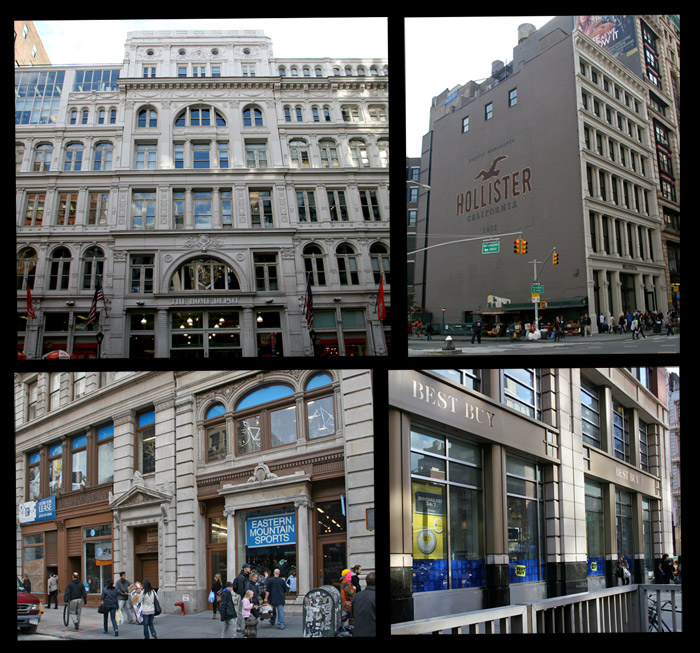
    Large chain retailers also have their own difficulty of acquiring adequate space. The challenges and costs are huge, and these large retailers are late comers in the New York City retail landscape. Many of these huge stores occupy architecturally beautiful spaces, almost of necessity since these are the only types of buildings with enough open space to accommodate their needs – places like Home Depot, Trader Joe’s, Kmart, Costco, and Best Buy. Some take creative approaches, like EMS, who acquired a number of contiguous spaces across adjoining buildings. Others, like Hollister or Apple, stage a coup by acquiring an entire building, permitting spectacular interior design.

    For most hardcore New Yorkers, all these things are minor inconveniences for living in the world’s greatest city for those who want to walk and love to lug 🙂

    Related Posts: Unforgiving, Ye Who Enter Here, I Know


  • dinamic_sidebar 4 none

©2026 New York Daily Photo Entries (RSS) and Comments (RSS)  Raindrops Theme