• Tanglewood Anyone?

    The same teacher who was the subject of my story Cello Class was also the woman who warned me one spring that there she would NOT be giving lessons over the summer because she refused to spend summers in New York City. Anyone here on a full time basis sees ample evidence of a mass exodus of many residents during the summer months, with benefits to those willing to stick it out. Restaurants that typically require reservations now have empty tables, streets now have readily available parking spots, tickets are available for shows normally sold out.

    Of course, nothing comes without a price, and much as Vermont looks like paradise until one spends a winter there, New York City is quiet and easy during the summer for good reason. The relentless heat turns the city literally into a concrete jungle, now including steamy tropical weather, without any respite, save air-conditioned spaces.  Nearly everyone on foot finds themselves making pit stops in cool shops, many nearly vacant with unusually attentive salespeople who well understand your reason for visiting – after all, they are also likely thinking the same thing – why I am in New York City during the summer heat? In this jungle, one will not find fruit hanging from trees but instead will find the waste of such foods littering the streets, where walking becomes a slalom between shoppers and mountains of garbage. The season that so many love can be a living hell in New York. After all, the best thing about summer is being outdoors, the very thing near impossible to enjoy here most days here until evening, if that. There are no cool mountains to ascend and no refreshing ocean breezes.

    Summer music festivals, which combine the joys of the season outdoors with musical performance, can be found throughout the world. We do have such in the parks of New York – Central Park’s Summer Stage, Prospect Park’s Celebrate Brooklyn, Washington Square Park Music Festival, Tompkins Square Park Police Riot Concert, among the larger. There are also many many other music festivals as there are street fairs, parades, and a plethora of activities. The problem is that a blistering day makes these all but intolerable, and years of attending these makes one realize that although, as I have heard many a New Yorker extol, there are perks of summer festivities here, nonetheless, the environment leaves much to be desired. The seasoned New Yorker who has spent too many summers here begins to ruminate on where one would have, could have, and should have been, like Tanglewood.

    If you have been to an outdoor concert like Tanglewood in the Massachusetts Berkshire mountains, you know what I mean. Here, one can lie on a clean lawn with a candlelit picnic, perhaps with wine, while lying under a black sky popping with stars on a summer evening and the sounds of world-class musicians wafting over, accompanied by cool evening breezes. On the other hand, for many, the urban equivalent will be lying on the hard, filthy asphalt ground of a well-lit park, trying to listen to musicians who compete with others in a small space as well as deflecting crusties, the homeless, drug addicts, and miscreants of every persuasion. Fights occasionally break out between many of the disenfranchised, understandably frustrated by their lot in life, only exacerbated by the unabated summer heat and humidity which lingers all night. The occasional police vehicle arrives to settle the differences of those who would be pointless to arrest, while at other times, an ambulance arrive to collect the maimed who will only be repaired and released to replay the same violent scenarios at another time. Tanglewood Anyone?


  • Sounds of Summer

    It is just after sunrise at 6:00 AM as I write this with an open window facing Washington Square Park. Incredible as it may seem, in the most densely populated city in the United States, apart from the occasional auto passing, the dominant and only sound is a chorus of crickets. This is one of the many joys in store for the early riser in New York City, or perhaps for those who have yet to sleep. Yes, even in Manhattan, amidst concrete, glass, and steel, we got insects. Many a night I have been plagued by mosquitoes, both in parks and even in my apartment.

    One summer evening in Washington Square Park in 2006, I was curious as to what insect it might be that was making a particular clicking sound that I had heard many times before. Friend Bill Shatto, an avid photographer of insects, told me he was relatively sure that it was a katydid. I had heard the word, but was completely unfamiliar with its appearance or anything else about it. In the most miraculous and serendipitous moment during that very discussion, a large green insect lighted in the central plaza of the park, away from any foliage, and sat unfettered. Using online images, we confirmed that it was a katydid (lower photo) – the only one I have seen in my entire life. It appeared to be injured – one leg was missing. It was capable of flying yet seemed uninterested in such. In fact, Bill was actually able to pick it up and place it more strategically on his hand. I took a number of photos, which have laid in my archives for the last 6 years.

    Recently, conversation turned to a much louder insect which as a child we commonly referred to as heat bugs. The cicada. The lone buzzing song, increasing in volume, was never pleasant to me as it typically dominates the air waves on hot, humid summer days in July and August.* The sunnier, hotter, and more blistering the day, the louder the cicada seemed to buzz. Recently, in the very same park, a conversation ensued about a very audible background noise which I recognized and confirmed with my friends was assuredly the sound of the cicada. As miraculously and serendipitously as six years before, a large insect lighted on the central plaza. A cicada. Seemingly unbothered by our presence as we approached it, I was able to get a number of photos, even with supplementary illumination using an iPhone. Even in Manhattan, a shrine to concrete and the manmade, here and there at the right time and place, if you listen closely, you can hear the Sounds of Summer 🙂

    *Male cicadas have loud noisemakers called “tymbals” on the sides of the abdominal base, using to produce a mating song. Some cicadas produce sounds up to 120 dB (SPL), among the loudest of all insect-produced sounds. Their song is technically loud enough to cause permanent hearing loss in humans, should the cicada sing just outside the listener’s ear. Conversely, some small species have songs so high in pitch that the noise is inaudible to humans. Species have different mating songs to ensure they attract the appropriate mate. In addition to the mating song, many species also have a distinct distress call, usually a somewhat broken and erratic sound emitted when an individual is seized. A number of species also have a courtship song, which is often a quieter call and is produced after a female has been drawn by the calling song.

    More insects: Guessing Game, Back to Boyhood


  • Coney Island at Sunset

    Things look better or worse at different times of day or night, season or weather conditions, particularly New York City with its very uneven landscape. It is especially unattractive on hot, humid summer days when the dirt, litter, and grime become foreground and little beauty remains. When blizzards blanket the city, it can be seen with a rare pristine quality – everything unsightly is hidden from view, leaving a fresh, new, white wonderland where everything is enhanced. In the spring, we share the feeling of renewal with our country brethren. In the autumn, cool weather and clear skies provide a welcome respite from a hot summer in the city.

    Recently, friends from Kansas were visiting the city. As is typically the case, their prior visits were dominated by the attractions in Manhattan. I volunteered my services and suggested a personal tour of Brooklyn. One member of the family had a long time interest in seeing Coney Island. Perfect – it was a beautiful summer evening, and I would time it for sunset. On the trip back, I would make certain to travel via the Belt Parkway, with vistas of the Verrazano Bridge, the Statue of Liberty, and spectacular views of Manhattan from the promenade in Brooklyn Heights. We also toured Dumbo and returned via the Brooklyn Bridge. Such an itinerary is guaranteed to elate any visitor and affords prime photo opportunities.

    Coney Island has been in decline since the 1950s. Recent efforts at revitalization has improved the area, however a seedy pall still hangs over the area, and depending on time and one’s mood, the amusement park can still be depressing. The boardwalk, abutting the Atlantic Ocean, is a constant positive, as are some of the historic rides, such as the Wonder Wheel and the Cyclone. We took a ride on the Wonder Wheel – always a joy with spectacular vistas of the ocean, boardwalk, the Manhattan skyline, and, of course, the amusement park itself.

    This particular outing was my first in the evening, and we were blessed with a extremely spectacular sunset. The dimming light was just perfect to obscure the area’s blemishes while the bright lights of Nathan’s and the various attractions turned the entire environment into a menagerie of lights, all bathed in a red aura with deep blue sky and pink/orange highlights and clouds. We were all taken by Coney Island at Sunset 🙂

    See my complete photo gallery here.


  • Page or McCarren

    If I was a lucky boy, I was given 20 cents and could go TWICE. Two swim sessions of childhood bliss. Each session at the Page Park Pool in Bristol, Connecticut, was 10 cents and lasted one and a half hours – two sessions back to back meant 3 hours. There was a 3-meter diving board and an area that was marked DEEP, 9 feet and 11 feet in the center of the diving area.  The pool was gifted to the city of Bristol in 1950 by Dewitt Page, industrialist and philanthropist. It was 110 feet by 75 feet – quite huge by any standards and for a small town, a rarity and nothing less than a dream come true.

    We swam every way imaginable. We threw our brass locker tags into that pool to see who could retrieve it first. We swam under water with our eyes open and looked around. We did tricks. We held our breath as long as possible while swimming under water, pretending we were any of a number of ocean creatures. We swam laps. We lay on the bottom of the pool, under 11 feet of water looking straight up. By the time the whistle for the session’s end was blown, our eyes were bloodshot. My hair was so thick from chlorine-rich water that for a day or more, I was unable to run my fingers through it, even with shampoo.

    We climbed and jumped off the 3-meter diving board. Standing at the edge of a board at such a height was frightening, and the jump, for all to see, was a job well done. The 3-meter board is no longer there – only a single 1-meter board. There was a viewing mezzanine where I enjoyed watching as much as my parents enjoyed watching the antics of me, my sisters and friends. There was an evening session for adults. And, of course, there was a concession stand.

    We splashed as much as humanly possible. In fact, we endeavored to turn jumping into water into a science, doing cannon balls, swan dives, belly flops, and our tour de force, the can opener or Jack Knife, which, when done properly, can create an enormous geyser.

    Growing up without air conditioning left few options for relief from the summer’s heat. There was running through the sprinkler if Mom was gracious enough to set it up and turn it on. But everything paled in comparison to that pool. Once I moved to New York City, I confined my swimming to the ocean, something I had grown up without, with visits to Fire Island, Jones Beach, Rockaway, and Coney Island.

    There is something a tad creepy about the public pool, particularly in New York City where, much like the shag carpeting of a cheap motel, one wonders what acts have been committed, the former hygiene of its occupants, and what really is in that water. Best not let the imagination run wild.
    On June 28th, 2012, the enormous McCarren Pool reopened after a 50 million dollar renovation. The public pool, on the Greenpoint/Williamsburg border of Brooklyn, opened during the depression under the administration of Mayor Fiorello Laguardia and parks commissioner Robert Moses. It had lay dormant for 21 years, and used alternately as a performance venue:

    McCarren Pool was the eighth of eleven giant pools built by the Works Progress Administration to open during the summer of 1936. Mayor Fiorello LaGuardia attended the dedication on July 31, 1936. With an original capacity for 6800 swimmers, the pool served as the summertime social hub for Greenpoint and Williamsburg. The building’s vast scale and dramatic arches, designed by Aymar Embury II, typify the expansive and heroic spirit of New Deal architecture. The pool was closed in 1984 but in 2005 the site was resurrected as a performance space, first through a modern-dance performance by Noemie Lafrance, and subsequently as a world-renowned music venue that saw many high-profile concerts until the summer of 2008, when Parks began work to renovate the pool.

    Sadly, and some would say expectedly, within a week of the pool’s opening, enthusiasm was dampened by a fight between bathers and lifeguards, necessitating police action. Other incidents have occurred. Harsh critics predict the pool will see a slide back into its former decline.

    In 2010, I returned to Page Park and was pleased to see the pool refurbished and still in operation. The attendant was very gracious, allowing me into the locker room and pool area while fully dressed. As I took photos, I reflected on those glorious days where the pool was the highlight of my summers. I had always sensed as a child that this pool was a great gift to have in one’s hometown. As I grew older, I saw how truly special and what a privilege it was to have grown up with such a public amenity, affordable to all in the community. I hope those children in New York City, as well as elsewhere, will have fond memories they will carry for life of a summer pool, whether Page or McCarren…

    For another variant on the public pool, go here.


  • Sunners and Shunners

    One of the most popular summer activities of my generation was to go to the beach to get tan. Women lubricated their skins with baby oil and virtually fried under a blazing sun, rotating to roast every square inch, sure to leave no skin untanned. Men strutted about with tan musculature, also perfectly and evenly toasted.

    New York City has a plethora of beaches – Coney Island, Brighton Beach, Manhattan Beach, Riis Park, and the Rockaways, all accessible by public transportation. My personal choice was always to venture a bit further out of city limits to Jones Beach and Robert Moses on Fire Island. For those who did not want to leave home, there was tar beach – the NYC rooftop. From the New York Times:

    “Tar beach,” as all roof rats know, is the urban alternative to the Hamptons on a hot summer day; it’s as near as the flight of stairs outside the apartment door. The 1930’s seem likely as a birth date, because it was around then that the suntan became fashionable for the masses. According to “The City in Slang” by Irving Lewis Allen, getting a tan on tar beach was often the preparation for a trip to Coney Island. “By the 1940’s,” he wrote, “city rooftops, those ersatz beaches, were given the fictitious place name tar beach, alluding to the black tarred and graveled rooftops.

    And absolutely de rigueur was the need to get color. Come springtime, examination of each other’s skin invariably led to comments like you need some color, I need to get some color, or some other variant expressing the dire need of a suntan. The desire for light or dark skin color is both time and culture based. Dark skin has been associated with the lower class, where work would have commonly been outdoors. In Asia, light skin is still prized for this reason. White skin has been desirable until the 20th century, when the therapeutic benefits of the sun and vitamin D began to be recognized. Coco Chanel is often credited with the desire for darker skin when she accidentally got sunburnt visiting the French Riviera in the 1920s. From that time on, sunbathing became popular as we saw the bikini of the 1940s and Coppertone’s iconic ad with a little blond girl and her cocker spaniel tugging on her bathing suit bottoms, sunglasses, sunscreens, and SPF.

    Recently, an old college friend and native New Yorker (now transplanted out west) was making one of his periodic visits to NYC. Inevitably, his love of the ocean means a requisite visit somewhere to a city beach. On this visit, three of us found ourselves touring the beautiful seaside community of Belle Harbor on the Rockaway Peninsula of Queens.

    After decades of seeking the suntan, we now live in a world of ozone depletion and concerns of premature aging and skin cancer. Whereas 30 years ago we would have set ourselves up on the beach in order to maximize sun and get some color, we now canvassed the boardwalk for any scrap of shade.

    At Beach 118th Street, we found a small spot against the back railing of the boardwalk by a lone conifer tree with just enough shade for the three of us. Here, we spent the afternoon in gorgeous weather chatting about old times, relationships, and other matters, some grave and some inconsequential, enjoying the peacefulness and beauty – rare commodities in New York City. As the day passed and conversation ensued, I reflected how, as always, some things remain the same, some change, and some change back. A lone lifeguard under a bright orange umbrella joined us in a world that has seen Sunners and Shunners…

    More on beaches: Teleportation, The Hamptons, Plum Beach, The Shore


  • Culture Fix

    I grew up in a town where, regardless of the fact that it has a population of 61,000, THEY ROLL UP THE STREETS AT NIGHT. Even on Saturday, it is like visiting a ghost town of the West. There is virtually nowhere to eat other than fast food and nothing to do except cruise the streets in despair. No wonder the youth of America is bored out of their minds in suburban USA and turn to drugs and sex. And no wonder that places like New York City became a mecca for those who crave culture in all its variants. I understand that there are many options out of the city and also an inner world to explore – I was an avid reader and also extremely active and social. However, there are limits to how much blood one can extract from a stone, and many of our suburbs are virtually devoid of cultural activities.

    So, in 1969, I, like many, made my way to a somewhat bigger town called New York City. Here, I found everything I had dreamed of and more. That young boy still lurks within, starry eyed and excitement bound, and, from time to time, I need a jolt of electric current and a culture fix. I rekindle those first moments when everything was ALIVE at any hour, day, or night and the feeling that anything is possible. Perhaps you even have a hankering to see a grown man dressed as a macaw, dancing about, while accompanied by a band called Moon Hooch, featuring a saxophonist with an enormous cardboard tube shoved into it.

    I took a walk recently to Union Square, where, regardless of season, time, or weather, you are guaranteed to see humans in all manner of activities. Steps from street level to the park on the south side of Union Square provide impromptu stadium seating and is one of the best spots in New York City for people watching. The square is surrounded by merchants and is one of the city’s major transportation hubs. Historically it has also been a major meeting ground, a place to see and be seen and ideal for those with a political agenda or need to bring a message to the masses. The place is abuzz with people and energy.

    It was here, on July 4th, 2012, at 12:17 AM that I found a grown man dancing in a macaw suit accompanied by a rock band. I was to learn that the performance was not spontaneous nor the product of birdbrains. It was a campaign on the part of Rock the Osa to raise awareness about the development threats facing Costa Rica’s Osa Peninsula, home to the area’s last virgin rainforest and “the most biologically intense place on earth.”  Marco Bollinger the Macaw and Eytan Elterman the Sea Turtle have nearly reached their target of $25,000 by dancing to produce the documentary project, 2.5 Percent, a film promoting conscious travel in Costa Rica.

    Moon Hooch is a Bushwick, Brooklyn, based band which has played regularly in the NYC subway system. The three band members, James Muschler, Mike Wilbur, and Wenzl McGowen, met at the New School, where they studied music. Moon Hooch plays cave, a style of house music. After only a year, they have produced an album, toured nationally, and worked for a TV company.

    As with everything else in New York City, things are often more than they seem. It’s where preconceived notions are best left in the checkroom. And all the better – it just means more opportunity for someone needing a Culture Fix 🙂


  • no title entry linkThis entry has no title posted on July 26, 2012


  • The Big Mouth Does

    Philip Garbarino promoting his book, The Devil Repents.

    Many people do not like New Yorkers for a number of reasons. In all fairness, for a number of good reasons. New York is a city that is brash with people who are aggressive and competitive. It’s a sieve for success, filtering out those who can’t make it here or, like Dwanna, those who just don’t want to make it here. It is the ideal home for the self-centered, the narcissist who wants the largest possible audience to fan his or her flames. It is perfect for attention mongers and drama queens. And for those who prevail, it is a place where someone can make it big.

    I am always astounded at how the real estate market here manages to be buoyed up regardless of the economy. The average 2-bedroom apartment in Manhattan sells for $2 million. A New York Times article reports that in Brooklyn, there is a shortage of single family brownstones with bidding wars driving up prices beyond the listing price. With pricing like this, obviously this is a city where many have achieved material success. It is also a home to the megalomaniacal or where it may at times be difficult to distinguish between the enormous success and the megalomaniac. It is a place where one truly must abandon preconceived notions or be faced with people like Mark Birnbaum, who, despite appearances and notions to the contrary, is who says he is and has done what he said he has.

    Recently while in Washington Square Park, my attention was drawn to a man with a huge crucifix, dressed as the devil. Such a thing will provoke interest and garner attention. There was no shortage of onlookers or those seeking photo ops with Satan. I learned that this was Philip Garbarino, promoting his first book of a trilogy, The Devil Repents. The book is selling directly from Philip’s website. Chapter One can be found for free there as well. An ebook is available from Amazon. I spoke to Philip briefly and videotaped the conversation. Garbarino was eager to mention his acting credit in the film The Bronx Tale, directorial debut of Robert De Niro.

    I have no idea as to the quality of the writing or what Philip’s aspirations are. Although perhaps not a necessary condition to success, in a city where everyone and everything is screaming to be heard and seen, self-promotion is a more likely road to success than a quiet unassuming demeanor or the meek, with Donald Trump as perhaps the best example. I do like real estate magnate Barbara Corcoran’s pithy and poignant remark:

    In New York City, the meek don’t inherit the earth. The big mouth does.


  • The Engine Room, Part 2

    The Pratt Cats (see Part 1 here)

    The Pratt Cats

    As we entered the very first Pratt building, I was greeted by a cat slinking from a classroom into the hallway. A curious sight, I was informed by our guide Leslie that this was one of the Pratt Cats. Pratt Cats? I was intrigued.

    Later, when we toured the Engine Room, we encountered another cat. My attention was drawn to a windowed wall in the engine room where there was an entire display of championship ribbons from the numerous awards won by Pratt cats at cat shows. Nearby was a collage of photos, names, and descriptions of a number of these cats – Nicky, Willy, Higgie, Art School, Teddy, Prancy, Big Momma, and Lestat.

    Chief Engineer Conrad Milster informed that each cat tended to be somewhat territorial, occupying a particular building or area. The cats are fed and tended for privately. As I left the East Building and the Engine Room, I encountered Conrad outdoors, who pointed out the lilliputian Feline Staff Entrance at the base of the building’s exterior wall.

    The naming, championship ribbons, poster, informative article, and the small entrance made it clear that the feline population at the institute is not a loosely associated, changing population of strays. Quite the contrary. These cats are well-known amongst the student population and have names, identities, recognition, and social status. They have a bit of attitude, expected of any New Yorker, particularly when associated with one of the world’s finest design schools. They’re not just any cats, they’re The Pratt Cats 🙂

    More cats: The Catman, Urban Mitts, Lost and Found, Kitty


  • The Engine Room, Part 1

    A Meeting With Conrad Milster

    I recently spent a day exploring Brooklyn with two longtime friends, Leslie and Greg.  I had desperately wanted to revisit and introduce to others both the Wilburg Cafe and Salerno Service Station, which I recently featured. The cafe offered a great brunch menu, and Salerno Service was one of the most remarkable businesses I have been to in New York City. I now had two victims willing to retrace my steps. On our ride towards Williamsburg, we approached Pratt Institute. Leslie, a regular reader of this blog and subject of the story White By Design, offered a guided tour of some special spots within a few of the buildings. She had spent time as a student doing graduate work at Pratt. Visiting the school at this time of year turned out to be a great suggestion. It was a hot summer day and the campus was quiet with virtually no security, and so, our tour of the interior of some of the university’s buildings went unfettered.

    I have been to Pratt a number of times for the annual juggling festival, and my experience there was limited to the exterior grounds with their sculptures and the ARC Sports Complex. On this outing, I toured the campus, a number of buildings, and the library with its magnificent stairwell. But, in the East Building (bottom photo), there was a treasure known to most students but only to a handful of outsiders – the engine room. I had been told that the room was noteworthy, however, I was quite taken upon actually entering.

    The place exuded old world charm and history. A gallery surrounded the dark-red reciprocating steam engines. The power plant is one of the most historic in the region and has been designated as a National Mechanical Engineering Landmark by the American Society of Mechanical Engineers. The three generators, which burned number 6 oil and produced 120 volts of direct current, were installed in 1900. They were some of the last operating in the United States. The plant ceased generating power in 1977, remaining for standby emergency power until very recently. It is now fully retired.

    At one end of the room, a lit office behind a windowed door beckoned. As I approached, I saw hand lettering on the glass which read: Chief Engineer C. Milster. It was the perfect photo op – an older man sat in direct view framed by the lettering. His demeanor certainly spoke engineer, but given the age of the facility and the door’s typography, it seemed rather unlikely that this man was the very same C. Milster. As I stood outside the office for a moment contemplating, the man waved for me to enter. I went in.

    Conversation ensued, and I quickly learned that my gracious host was, in fact, Conrad Milster, now 76, who has run the facility since 1958. Conrad now maintains the school’s mechanical systems. As we chatted, it became abundantly clear that Conrad was quite passionate about the engine room and answered any and all questions.

    I felt quite privileged to meet him – Conrad is more than an employee. He is a legend and integral part of the fabric of this wonderful antique environment. But I also had noticed that other things were afoot, and I was to learn, as you will in Part 2 of this story, about the curious nature of inhabitants of numerous buildings of Pratt and The Engine Room…


  • A Place for Cappuccino

    I am one of few inhabitants of planet earth that has never had a cup of coffee. How and why such a thing could be is as much a mystery to me as to anyone else, So, my enjoyment of coffee and all its seemingly endless variants, has been vicarious. I do, however, love a good cafe, and New York City, could arguably be the epitome of cafe society in the United States. I have had ample opportunity over the decades to accompany many a coffee lover to the numerous cafes of the city.

    In the late 1970s and early 1980s, my sister and her husband made frequent trips from their home in Connecticut to the city. My brother-in-law had what could be fairly said to be a serious coffee addiction, and there was no better place to fuel such a habit. At that time, not so very long ago, there were no Starbucks and in Connecticut, and there were no cafes either. Something like cappuccino was a real specialty, a rarely found beverage, perhaps available in the best of Italian restaurants, virtually nonexistent where they lived in central Connecticut. Their returns home were always wrought with sadness, knowing full well that they were returning to the cultural and cappuccino black hole of the burbs.

    Even gourmet beans, now a commodity nearly everywhere, were much harder to find out of the city – my sister and her husband would purchase ground coffee from specialty merchants such as Gillies in the Village and transport them back home. Visits to New York for my sister and her husband were pilgrimages to the mecca of cuisines, and their days here were punctuated by coffee stops. On one visit, we made a visit to Caffe Reggio, which I had learned was New York City’s oldest cafe and located on MacDougal Street, only a few blocks from my home. I recall that we were very disappointed with the desserts. To most neighborhood residents, this block of MacDougal is to be avoided, owing to its very trashy character, over crowding, and plethora of poor quality food establishments. It is perhaps the most touristy block in the Village. I learned my lesson, never to return to Caffe Reggio.

    Last night, three of us were caught in a rain storm on MacDougal Street with neither umbrellas nor any interest in going home. Our ritualistic nightly Washington Square Park stroll appeared to be rained out. We stood under a shop canopy and began looking at indoor options. My companion pointed out Caffe Reggio, which loomed large conveniently right across the street. I was very averse to visiting, but, given few other nearby options, gave way.

    The lure of this cafe is obvious. Apart from its location, one step inside and one can feel old world charm literally exuding from the walls.This is the Village’s (and the city’s) oldest cafe, established in 1927. In a short time, I unwillingly succumbed to its ambiance.  The lighting was superb for photography and even served my point and shoot camera well.

    Reading online and the cafe’s literature, I learned a number of startling things about Caffe Reggio. The walls are covered with an array of artwork, some of which dates back to the Italian Renaissance period. Among the works is a dramatic 16th century painting from the school of Caravaggio. There are antique benches, all of which can be sat upon, and one of which belonged to the Medici family bearing the Florentine family crest.

    The centerpiece, however, and Reggio’s claim to fame and pièce de rĂ©sistance, is a magnificent espresso machine made in 1902 and used for years to make cappuccino.  Its ornate chrome and bronze exterior houses an impressive marriage of engineering and design. Cappuccino first became popular in Italy at the beginning of the last century, and soon after was introduced in America by the original owner of Caffe Reggio, Domenico Parisi. This explains the meaning of the store signage and motto “Original Cappuccino,” which I have seen for decades, yet the meaning of which I never really pondered. For most visitors, its history is of no interest and remains unknown. It’s somewhere to get out of the rain, an historic fixture in New York’s cafe society, and, of course, A Place for Cappuccino 🙂

    More cafes: Tangerine Dream, When Your Name is Mud, Gotta Get Out, Think Coffee, Olive Tree Cafe


  • Busy Busy

    You’ve met the type – the answer to “How are you doing?” is invariably a serious “Busy busy,” always said with a very serious sense of self-importance, akin to the demanding schedule of the CEO of a multinational corporation. Often, these types of individuals find idleness to be frightful and sinful. Constant motion and activity provides great comfort and obviates the need to feel, play, or further explain one’s life. I grew up like that.

    In Devil’s Playground, I wrote: “And then there is the busy busy ethic, a defining characteristic of our culture and particularly a place like New York, an ethic that basically says any and all busyness is good and is sufficient to justify one’s existence.”

    For those who hold this ethic dear and need validation that others share their compulsion, a trip to Times Square will satisfy nicely. Here, day or night, 24/7/365, we will find all manner of activity and industry. A place where everyone is Busy Busy 🙂

    More on Times Square: Eye Candy, Branding Gone Wild, Work and Play, National Drama Queen, Devil Ups the Ante, Let’s Have a Parade, Wake Up Call , Full Circle, Times Square Ball Drop, Density and Intensity, The Naked Cowboy


  • Up Up We Go

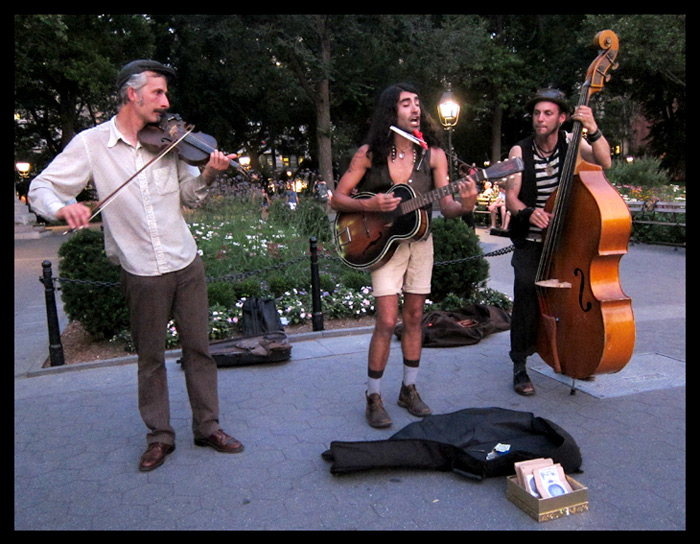
    I was tipped off by a friend that I might want to hurry to see this group of musicians from New Orleans. He referred to them as a “crusty” band. They certainly have the signature attendant dog, and there is a vagabond character to the group which is hard to define in many ways. The group is a moving target with a non-specific stable of individual members. However, regardless of any nomadic similarities, Up Up We Go did not appear to me to embrace the hapless, nihilistic lifestyle of the crust punks.

    The core member of Up Up We Go is Salvatore Geloso, originally from Brooklyn, New York. His unique, impassioned style of delivery with highly animated facial expressions is what prompted my friend to bring them to my attention.

    My first encounter with them was in Washington Square Park. A full ensemble was playing with an acoustic upright bass, accordion, violin, guitar, and a saw. Salvatore plays guitar, kazoo, and provides the lead vocals. I have seen saw players before, but they always seemed to be more of a novelty or curiosity. Here, in Up Up We Go, the saw was truly used melodically, adding a wonderful musical element to the melange. I was entranced by the music and must say that this was one of the most entertaining music ensembles I have seen on the streets of New York City. Their music, original or that of fellow musicians, was very catchy – I have been listening to The Pony Song for over 3 weeks.

    Unfortunately, the group is hard to nail down, as they are not based in New York. Being the magnet that this city is means that this is a place where talent comes and goes. The group’s name is an apt metaphor for the vanishing act we will see soon. I hope it applies as well to future success for Salvatore and the band members of Up Up We Go 🙂

    More street performers in Washington Square Park: Strike While the Music is Hot, Sirens of Culture, Mzuri Sings, Crooks and Perverts, Curse of the Mouth Trumpet, Impossible, Catch Em If You Can, Sieve of Darwin, Tune Out, Tune Up, Tune In, Artiste Extraordinare, One-Man Band, New York State of Mind, Music Speaks for Itself


  • Quality Under the Hood

    I once handcrafted leather products. It was at this time that I met Jim Murnak, someone who invoked such awe that I featured him in a two-part story (see Part 1 here and Part 2 here). I sold my wares to a number of retailers, some with an upscale clientele. One husband and wife team owned two locations in the West Village, each managing their own shop. The husband, Walter, hailed from Great Britain and was a mentor of sorts to me. I was young, very impressionable, and knew nothing about the world. My mind was like a sponge for all the wisdom he could impart.

    I would make deliveries of product in person to the wife’s shop, and often, I would take the opportunity to visit Walter’s shop around the corner. I looked forward to my visits with great anticipation, as invariably we would become engaged in some conversation regarding craftsmanship, quality, or international travel, of which I knew nothing. He often contrasted the American versus the European mindset. He did much to foster the concept of the ugly American, the archetype that I profiled in So Where’s David? One day, he made a statement which echoes to this day. “Brian, you are seeing the first generation grow up that does not know quality because they have never seen it.”

    A bit harsh perhaps, but with some elements of truth. In an age of branding, merchandising, marketing, and with a tidal wave of product, who can really understand materials and design and, hence, know quality? Who would recognize elements of shoddy design, like the use of sheet metal screws in plastic, machined metal versus castings, or brass plated versus solid brass buckles? The degradation and cheapening of product is well illustrated by wood veneers, where the surface layer has gone from 1/8″ thick to 1/64″ or even less, giving the very word veneer an unwarranted bad name.

    Saddest to me are those with buckets of money, particularly the nouveau riche, who suddenly have the means to purchase anything they desire. I recall a TV tour of a rap star’s home where an extraordinary kitchen had only drawers of candy and a refrigerator with shelves of soda and beer. For these nouveau riche, quality is frequently defined strictly by brand and what costs more. Conspicuous consumption is the order of the day. I find it sad, because as a manufacturer, I see that those with extraordinary means often seek the “best” with little regard or knowledge of what it really means, often just parroting back some key buzz words regarding the product specifications. Manufacturers fine tune down to minute detail, yet most goes without care or appreciation, only to be tossed aside for the next new toy. However, I suppose there is no need to look under the hood of a car if you don’t know understand what you are looking at.

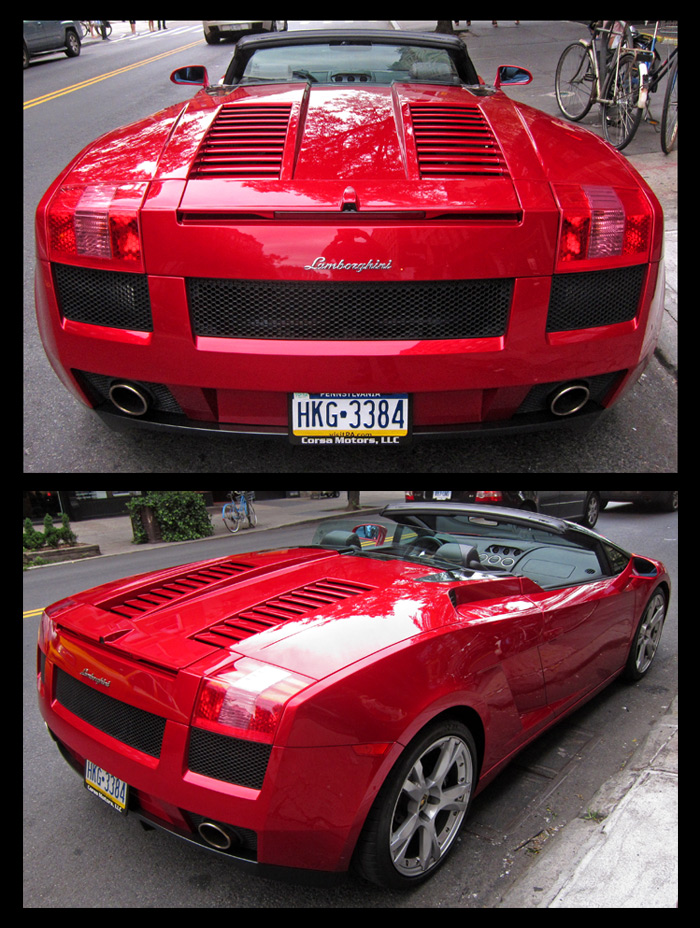
    There are things whose mere existence scream finest and most expensive, such as the Lamborghini, costing hundreds of thousands of dollars. Even in New York City, the sight of one of these vehicles raises eyebrows. In a virtual sequel to my story, “Who See the Red”, I spotted the bright red Lamborghini in today’s photo on West Broadway in the heart of SoHo. Heads turned, and some even had photos taken of them with the vehicle.

    For the New Yorker, it is also perhaps the audacity and the height of deliberateness to park a Lamborghini in the streets – even a convertible left open. It not only says the obvious, that someone can afford such a luxury, but also that the owner is so cavalier about money that he or she is perfectly comfortable leaving an asset of this size on the streets of New York City, subject to theft or vandalism.

    But here perhaps, beyond image and panache, there at least may be some good news. I want to believe that a Lamborghini is a product that is more than just an expensive brand and that there is real Quality Under the Hood

    More cars: Boom Boom, Itching and…, Nice and Olds, Hoopmobile, Mint Condition


  • Jack and Jill

    Are you familiar with a “Jack and Jill” party? No? Good. Because I don’t suggest you learn about them first hand, unless you want to see how love and marriage can be reduced to the almighty dollar. I have been to several, and not to seem insensitive to those of lesser means, I found them tacky and embarrassing. A Jack and Jill is essentially a wedding shower, however, unlike the traditional bridal shower, it is attended both by the bride, groom, men, and women. Essentially, anyone who wants to come can – the more the better, because the Jack and Jill (sometimes called a stag and doe) is a party and fundraiser to raise cash for the engaged couple. Often, a ticket must be purchased to attend, and all manner of games and activities are to be had, including raffles and the dollar or money dance.

    At the last I attended, I had to suffer through a money dance, a ritual that can also be found at some wedding receptions. Here, guests get the opportunity to dance with the bride-to-be for a dollar. After a spin around the dance floor, typically, another male guest cuts in by tapping the shoulder of the man dancing and takes over. After a time, the money accumulates, and our bride can be seen to be gleefully clutching a wad of one dollar bills. At the Jack and Jill I attended some years ago, the groom stood before a microphone after the dance, shaking the bundle of bills in the air while announcing specifically how much had been made, while guests applauded and cheered. I was mortified.

    When I was younger, there seemed to be an unabated parade of weddings, showers, and other marriage-related events. Invariably, Jack and Jills were mentioned in a matter-of-fact way, intoned to signify that such a thing was de rigueur. Jack and Jills are behind me now, and although some variety of them may exist somewhere in New York City, I have not heard of them, nor been invited. The only wedding celebrations I witness these days are those that I see in public places – in the streets, in the parks, and coming in and out of churches. If you spend enough time in the parks of New York City, you will invariably encounter wedding parties in photo sessions, particularly Central Park, a perennial favorite.

    It is not surprising that couples would want to utilize Central Park as it is replete with romantic, idyllic spots for wedding photos – the Loeb Boathouse, the Bow Bridge, the Shakespeare Garden, Belvedere Castle, Strawberry Fields, Cherry Hill, Cedar Hill, the Pond, the Harlem Meer, Bethesda Terrace, and the Conservatory Gardens. A permit is required for parties over 20 and can be had for $400. On a recent visit to the gardens, a group was galloping down the green with the bride and groom joyfully bounding along with them. Although I did not ask, I expect they had no Jack and Jill 🙂

    More weddings: Speaking in Tongues, Just Married, The Perfect Gift, Love Is All Around Part 2


  • dinamic_sidebar 4 none

©2026 New York Daily Photo Entries (RSS) and Comments (RSS)  Raindrops Theme