• Category Archives Animals
  • You Always Find Something

    Posted on by Brian Dubé

    Some years ago, I was visited by a customer who was quite complementary to the manner in which I ran my business and the quality of my products. He had vocalized this on the internet. I thanked him. It is always heartening to hear complements in a world of high expectations.

    Conversation ensued, and I was very surprised to learn that the man was a military helicopter pilot. I have no idea of what it takes to earn such a position, but I was reasonably sure that this must be a highly coveted and competitive job for the very skilled with the right stuff. This was an easy opportunity to return a complement, which I did. He did not deny my observations.

    On a subsequent visit, he returned with his girlfriend, also a military helicopter pilot. Wow. Certainly this must be a rarity for a woman in the armed forces. I was awed really and so impressed. What an unique couple.

    The man offered to tour me privately around a military installation in Brooklyn, where they were based. But I was forewarned that as a civilian, as much as he would like to, I would not be allowed to fly in a military helicopter. I understood and had expected that.

    I told a close friend who was fascinated with military technology about this encounter. I invited him to come along in the event I were to take this man up on his offer and visit the military base. He was ready to go at a moment’s notice. I pointed out to my friend however, that we would of course not be able to board or fly in a helicopter. To which he replied, with no equivocation, that it was no problem because even at a dog show, you always find something.

    This statement was so poignant – I could not agree more. It was just a restatement of something I had always said – things are not boring, people are boring. It’s what you bring to the table or experience.

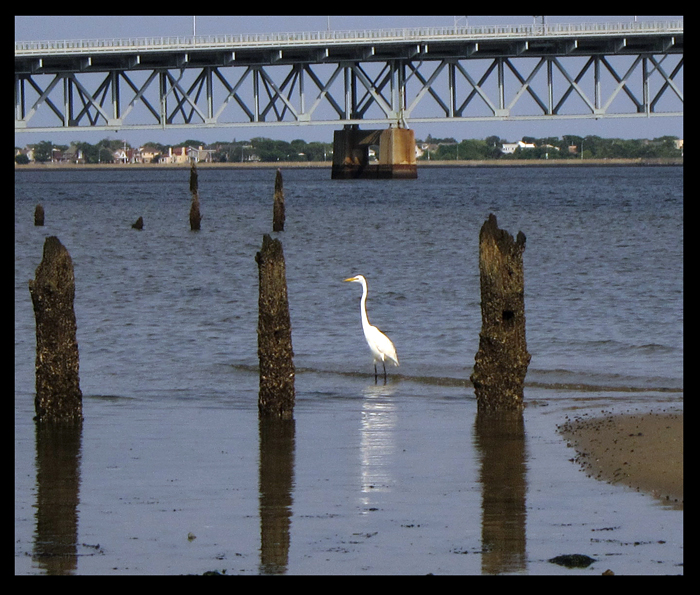
    New York City’s table is already filled with a staggering array of goods. But if you really want to mine the gold here, don’t just settle for what’s already on the table. Take an interest in the cracks and crevices. Talk to strangers, the homeless, and crusties too. Go to The Hole and Dead Horse Bay, where you may sight an egret, like that in today’s photo. Explore Far Rockaway, a place few want to visit.  If your lucky, you will meet Walid Soroor in a Jackson Heights restaurant, Mark Birnbaum strolling in his signature cadence, Ferris Butler wandering the streets a bit confused and even André, who, I am sure you will agree, is a bit OUT THERE. In the park, you may sight a Nymph. Come to these pages for ideas and inspiration.

    If you’re feeling a little bored or perhaps do not have the time to venture far afield, just look at little harder. Bring your attention to the city around you. Investigate how graffiti artists etch glass in the subway or marvel at the chewing gum on the streets. Because even at a dog show, you always find something 🙂

    Related Posts: Mark Birnbaum Pt. 1, Ferris Butler Part 1, Gaby Lampkey Part 2, Fashion Forward
    Posted on by Brian Dubé

  • The Legal Answer or the Practical Answer?

    Posted on by Brian Dubé

    I have a friend, Paul Fryd, who is an attorney in New York City and, on occasion, over the years, has provided phone advice in difficult situations. His initial mantra to any question was predictable, even irritating – because he was right and I usually did not want to hear it. When I presented the details of any problem, his first response was, “What do you want first – the legal answer or the practical answer?”

    I rarely liked the practical, sensible business answer. Like settling with someone who was clearly wrong, yet paying them anyway to expedite the matter and move on, rather than wasting more time and money in legal fees to see “justice” being served.

    Freedom and exercising it can be equally frustrating. Legally, we do have freedom of expression, but in practice, these freedoms are not always so easily exercised. There are many ways to effectively eliminate or subdue people who act and think differently in a community, including police intimidation (see Criminal Suspect here).

    The Statue of Liberty stands in Upper New York Bay as an icon to American freedom. Within the context of the United States, for many, New York City stands as a place to chase their dreams and also to exercise freedom to express themselves in any manner they choose without fear of ostracism. Here, New Yorkers are extremely tolerant, even embracing and nurturing eccentricities that elsewhere would be untenable. In the case where behaviors are even technically illegal but benign, laws are often not enforced.

    Unfortunately, money is also part of the freedom equation, and the economics of living in New York City is closing the window of opportunity for many who would like to live here and exercise various lifestyle choices unfettered. However, for those who are tenacious and adequately driven, living in New York City for the person of average means is still possible, albeit requiring some resourceful thinking and a willingness to compromise a lot.

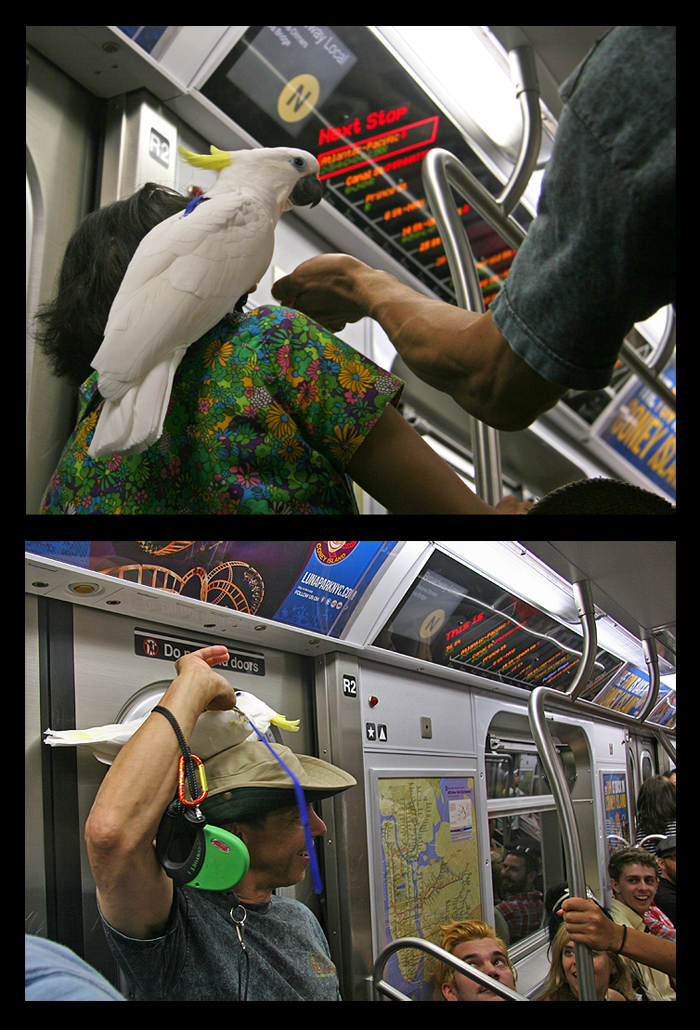
    Why be a martyr on Main Street in Anytown, USA, when in New York City, riding the N train from Coney Isand with a cockatoo will be met with either indifference, amusement or delight? I have seen a wide range of very unusual pets in public in New York City, many of them illegal to own. Can you ride the subway in New York City with a cockatoo? What do you want first – the Legal Answer or the Practical Answer? 🙂

    Other Related Posts: Extra! Extra! Read All About It“The Women”, New Yorkers Gone Wild, False Assumptions

    Posted on by Brian Dubé

  • Drooling and Slobbering

    Posted on by Brian Dubé


    Emotive forces play a large part in our lives, often trumping the “sensible.” We eat too much or the wrong foods, date the wrong people, choose careers with dim prospects, buy things we don’t need. New York City has its own brand of impractical indulgences – driving in SUVs and living with huge dogs in small apartments.

    Seeing a New Yorker with a Great Dane, Mastiff, Great Pyrenees or Irish Wolfhound is not as rare an occurrence as one might expect. New Yorkers like to think big, and dogs are no exception. However, everything about these critters is big – size, weight, smell, hair, food consumed, excretions and slobbering. Many weigh more than their owners, as I imagine is the case in today’s photo. A large dog dominates an apartment space. Many describe the experience as living with a roommate.

    In 2004, the New York Times ran a story, Rooming With the Big Dogs; 140-Pound City Pets and the People Who Love Them. Parts of the story were incredible, others bordering on the hysterical. The Times story tells of a married couple, Barry Kellman, his wife Shane, and their English mastiff, Brutus. During her pregnancy, Shane threw the dog out. Determined to keep him, Barry began boarding him. As costs mounted, he rented an apartment for Brutus at $1800 per month. From the article:

    To meet Brutus is to appreciate the challenge of living with him. He slurps water from his bowl like a horse at a trough. He urinates with considerable force and stamina. ”This goes for about 15 minutes,” said Paul D’Amato, the doorman of his building. ”He’s a tank.”

    Brutus also drools constantly: when he walks, saliva swings like a pendulum. When he shakes his head, it flies onto the walls, the front door, Mr. Kellman’s clothes (the dry cleaning bill is about $400 a month), and in places not to be believed.

    ”Every now and then you’ll see something hanging from the ceiling,” said Mr. Kellman. He once found it in his shoes. But Brutus’s charm is undeniable. His trusting eyes and massive head bring to mind E.T., the extra-terrestrial.

    When his marriage ended, Kellman moved into Brutus’s apartment. It must be a case of love and marriage, because I just could not deal with all that Drooling and Slobbering 🙂

    Related Posts: That Should Cover It, Blessing of the Animals, Water 4 Dogs, Pet Pride Parade, à la Chien, Zoomies, Robin Kovary Run for Small Dogs, Dachshund Octoberfest, Wolfdog, Dog Dating, Dog Run

    Posted on by Brian Dubé

  • Close Encounter of the New York Kind

    Posted on by Brian Dubé


    New Yorkers take things seriously. The populace is large enough to support subcultures of every interest imaginable. Interests become obsessions. What better obsession than the things we have so little of – wildlife. Wildlife in a city like New York is limited and dominated by pigeons, rats, mice, squirrels and common birds. So when real wildlife of a different kind appears, it’s BIG news.

    Perhaps one of the biggest wildlife stories in recent years was the nesting of red tail hawks at 927 Fifth Avenue. The first to make home there was Pale Male in 1991. The nearby boat pond in Central Park was an ideal viewing spot and became a birder’s paradise. See my story here. The lineage continues to this day. The interest has spawned international press coverage, films, websites. To this day, 10 years later, birders are still found regularly on location with the requisite telescopes.

    On February 7, 2007, I photographed a red-tailed hawk feeding on the remnants of a pigeon on my air conditioner overlooking Washington Square Park. At this rare opportune moment, I was able to capture a photo through my window from only inches away. The photo received tremendous traffic as would be expected. See the photo and story Hawk Fest here.

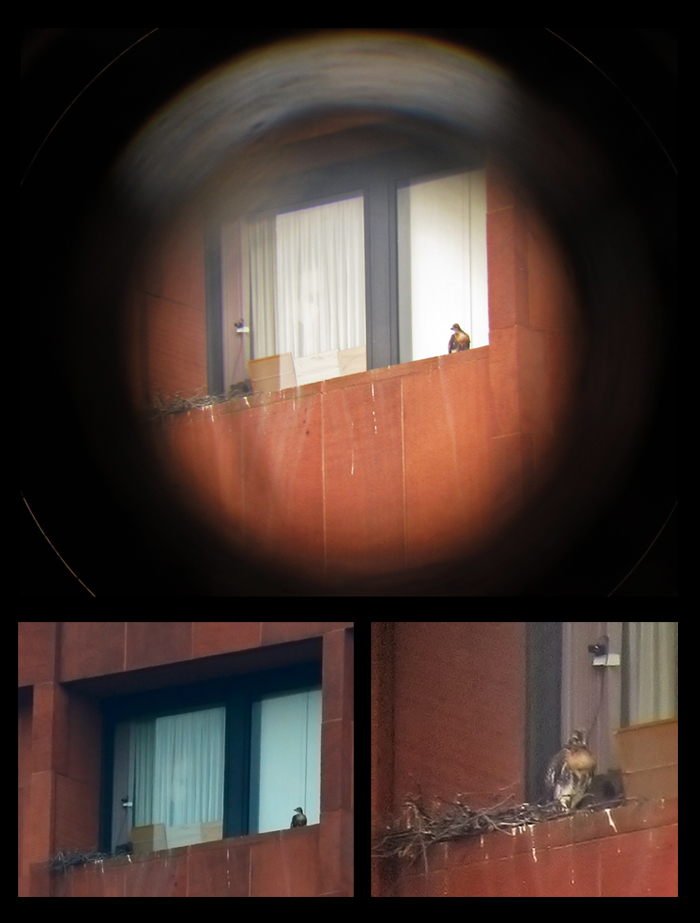
    Since that time a number of red-tailed hawks have been sighted around the park. The coup de grâce, however, was the recent nesting of a hawk on the windowsill of the Bobst Library building. The window chosen was none other than that of the president of New York University himself, John Sexton. Many speculate the roost was chosen for the same reason it is the location of the president’s office – the 12th floor perch affords sweeping views of the entire park, perfect for a bird of prey.

    The real story here however, is the nesting and mating of Violet and Bobby (violet is the official NYU color and Bobby after the Bobst library) and the birth of offspring. Yesterday, during a Be Fit NYC event, the parks department had set up a telescope for viewing of the hawks. I was able to capture a photo with a camera up against the scope.

    The New York Times set up a webcam to keep an eye on the family. The cam provides a live stream, free and 24/7. Check it out here for a Close Encounter of the New York Kind 🙂

    Related Posts: That Should Cover It, Peregrine Falcons, Light on Bobst

    Posted on by Brian Dubé

  • That Should Cover It

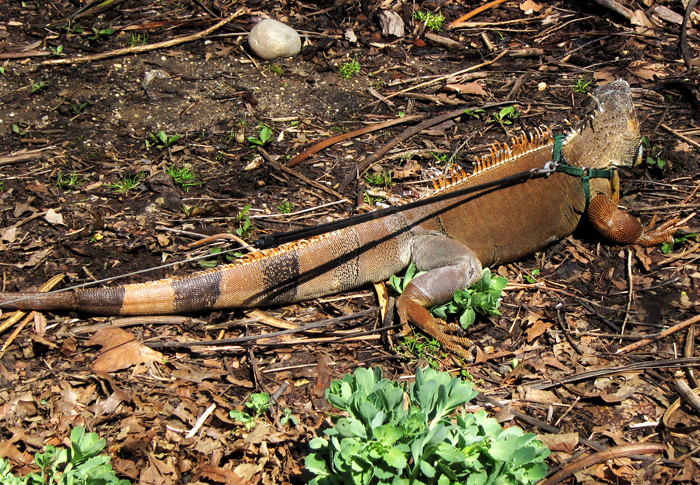
    On Sunday, April 17, two photographer friends and I were strolling in Washington Square Park where a man suddenly appeared with an enormous leashed iguana, which he proceeded to walk on the lawn. As we were taking photos, the owner became immediately hostile, demanding $3. We stopped. One of our group, however, pointed out that this was a public park and there were no restrictions regarding photography.

    This was not my first encounter with someone who displayed exotic pets in the parks of New York City. In 2006, I featured a story and photos about a man with a small trio of exotic animals that he marketed as photo ops to passersby (see Snake Charmer here). I also once witnessed a large Albino Burmese Python, slithering along in Central Park (see here).

    But I had suspicions regarding the iguana owner’s edginess – that he might have had some concern other than losing potential modeling fees for his critter. I never did investigate the laws regarding exotic pets in the city. A quick search and I learned that housing an iguana as a pet is a violation of the New York City Health Code. There is so much rumor mongering and misinformation in life, I have decided to reprint the code here in its entirety, exactly as written, directly from the New York City government website. So here, in the spirit of Everything No, is article 161.01 – Wild Animals Prohibited:

    (1) All dogs other than domesticated dogs (Canis familiaris), including, but not limited to, wolf, fox, coyote, hyena, dingo, jackal, dhole, fennec, raccoon dog, zorro, bush dog, aardwolf, cape hunting dog and any hybrid offspring of a wild dog and domesticated dog.

    (2) All cats other than domesticated cats (Felis catus), including, but not limited to, lion, tiger, leopard, ocelot, jaguar, puma, panther, mountain lion, cheetah, wild cat, cougar, bobcat, lynx, serval, caracal, jaguarundi, margay and any hybrid offspring of a wild cat and domesticated cat.

    (3) All bears, including polar, grizzly, brown and black bear.

    (4) All fur bearing mammals of the family Mustelidae, including, but not limited to, weasel, marten, mink, badger, ermine, skunk, otter, pole cat, zorille, wolverine, stoat and ferret.

    (5) All Procyonidae: All raccoon (eastern, desert, ring-tailed cat), kinkajou, cacomistle, cat-bear, panda and coatimundi.

    (6) All carnivorous mammals of the family Viverridae, including, but not limited to, civet, mongoose, genet, binturong, fossa, linsang and suricate.

    (7) All bats (Chiroptera).

    (8) All non-human primates, including, but not limited to, monkey, ape, chimpanzee, gorilla and lemur.

    (9) All squirrels (Sciuridae).

    (10) Reptiles (Reptilia). All Helodermatidae (gila monster and Mexican beaded lizard); allfront-fanged venomous snakes, even if devenomized, including, but not limited to, all Viperidae (viper, pit viper), all Elapidae (cobra, mamba, krait, coral snake), all Atractaspididae (African burrowing asp), all Hydrophiidae (sea snake), all Laticaudidae (sea krait); all venomous, mid-or rear-fanged, Duvernoy-glanded members of the family Colubridae, even if devenomized; any member, or hybrid offspring of the family Boidae, including, but not limited to, the common or green anaconda and yellow anaconda; any member of the family Pythonidae, including but not limited to the African rock python, Indian or Burmese python, Amethystine or scrub python; any member of the family Varanidae, including the white throated monitor, Bosc’s or African savannah monitor, Komodo monitor or dragon, Nile monitor, crocodile monitor, water monitor, Bornean earless monitor; any member of the family Iguanidae, including the green or common iguana; any member of the family Teiidae, including, but not limited to the golden, common, or black and white tegu; all members of the family Chelydridae, including snapping turtle and alligator snapping turtle; and all members of the order Crocodylia, including, but not limited to alligator, caiman and crocodile.

    (11) Birds and Fowl (Aves): All predatory or large birds, including, but not limited to, eagle, hawk, falcon, owl, vulture, condor, emu, rhea and ostrich; roosters, geese, ducks and turkeys prohibited or otherwise regulated pursuant to § 161.19 of this Code, the Agriculture and Markets Law or applicable federal law.

    (12) All venomous insects, including, but not limited to, bee, hornet and wasp.

    (13) Arachnida and Chilopoda: All venomous spiders, including, but not limited to, tarantula, black widow and solifugid; scorpion; all venomous arthropods including, but not limited to, centipede.

    (14) All large rodents (Rodentia), including, but not limited to, gopher, muskrat, paca, woodchuck, marmot, beaver, prairie dog, capybara, sewellel, viscacha, porcupine and hutia.

    (15) All even-toed ungulates (Artiodactyla) including, but not limited to, deer, antelope, sheep, giraffe and hippopotamus.

    (16) All odd-toed ungulates (Perissodactyla) other than domesticated horses (Equus caballus), including, but not limited to, zebra, rhinoceros and tapir.

    (17) All marsupials, including, but not limited to, Tasmanian devil, dasyure, bandicoot, kangaroo, wallaby, opossum, wombat, koala bear, cuscus, numbat and pigmy, sugar and greater glider.

    (18) Sea mammals (Cetacea, Pinnipedia and Sirenia), including, but not limited to, dolphin, whale, seal, sea lion and walrus.

    (19) All elephants (Proboscides).

    (20) All hyrax (Hydracoidea).

    (21) All pangolin (Pholidota).

    (22) All sloth and armadillo (Edentata).

    (23) Insectivorous mammals (Insectivora): All aardvark (Tubildentata), anteater, shrew, otter shrew, gymnure, desman, tenrec, mole and hedge hog.

    (24) Gliding lemur (Dermoptera).

    I think that should cover it 🙂


  • Pecking for Pita

    On April 27, 2010, I wrote Tired of Crumbs about the plight of many street performers and other independent artists. However, for many other members of the animal kingdom, crumbs are more than a metaphor, and living off the discards of others is literally the means of survival. In a city with as large a population as New York, the amount of refuse disposed is enormous, affording life support for many.

    A lover of Middle Eastern food, I was pleased to have the good fortune to run into Damascus Bakery while strolling through the Vinegar Hill neighborhood of Brooklyn. It was Sunday, so the business operation was closed, however, just outside the factory, there were a large number of pigeons busy atop dumpsters covered with heavy tarps. They seemed particularly industrious, and I had suspicions as to what was going on. Lifting up a corner of one tarp revealed exactly what I expected – the dumpster was entirely filled with pita bread, all polybagged, which I assume had been disposed of for a good reason.

    The pigeons were undaunted by the tarp and had successfully pecked holes through it and the plastic bags holding the pita. Perhaps not as dramatic as the Hawk Fest I witnessed on my window ledge in 2007, but nonetheless, this was a food fest.

    Damascus Bakeries is a 3rd generation business, currently run by Edward Mafoud, grandson of Hassan Halaby, who started the business on Atlantic Avenue in 1930 and introduced Syrian bread, aka pita, to America. In addition to a variety of flavors and sizes of pita, the bakery also produces Lavash Wraps, Panini, and Roll Ups. I hope to visit and tour their factory in the future.

    In New York City there are many means of survival. At the corner of Gold and Water Streets in Brooklyn, for these pigeons, it’s Pecking for Pita 🙂


  • Blessing of the Animals

    Where would you expect to see llamas, cows, pigs, turtles, snakes, iguanas, horses, rabbits, goats, geese, donkeys, raptors, sheep, ferrets, dogs, and cats walking or being carried down the center aisle of a Gothic cathedral? At St. John the Divine’s annual Blessing of the Animals. Unfortunately, I missed this grand daddy celebration – I only became aware of it after its occurrence, when told by a friend who correctly assumed that this would be something I would not miss and would share with readers here.

    When New Yorkers decide to embrace something, they pull out all the stops, for an over-the-top, quintessential, nonpareil event. The huge population of the city in tandem with a no-holds barred spirit virtually guarantees this. The old adage applies to New Yorkers quite well – If you’re going to do something, you might as well do it right.

    Blessing of the Animals honors St. Francis of Assisi, patron saint of animals. This is celebrated by many Catholic and Episcopalian churches on the Sunday on or about his feast day, October 4th. Legend has it that St. Francis spoke to birds, tamed a wolf that was terrorizing a small village, and on his deathbed, thanked his donkey for carrying and helping him throughout his life, and his donkey wept.

    St. John the Divine has been celebrating Blessing of the Animals since 1985. The highlight is the procession of the animals, with as many as 4,000 creatures making the journey down the aisle with their owners for a ritual blessing. Every imaginable species is represented. One year, an 8,000 pound elephant from Ringling Brothers Circus made the walk.

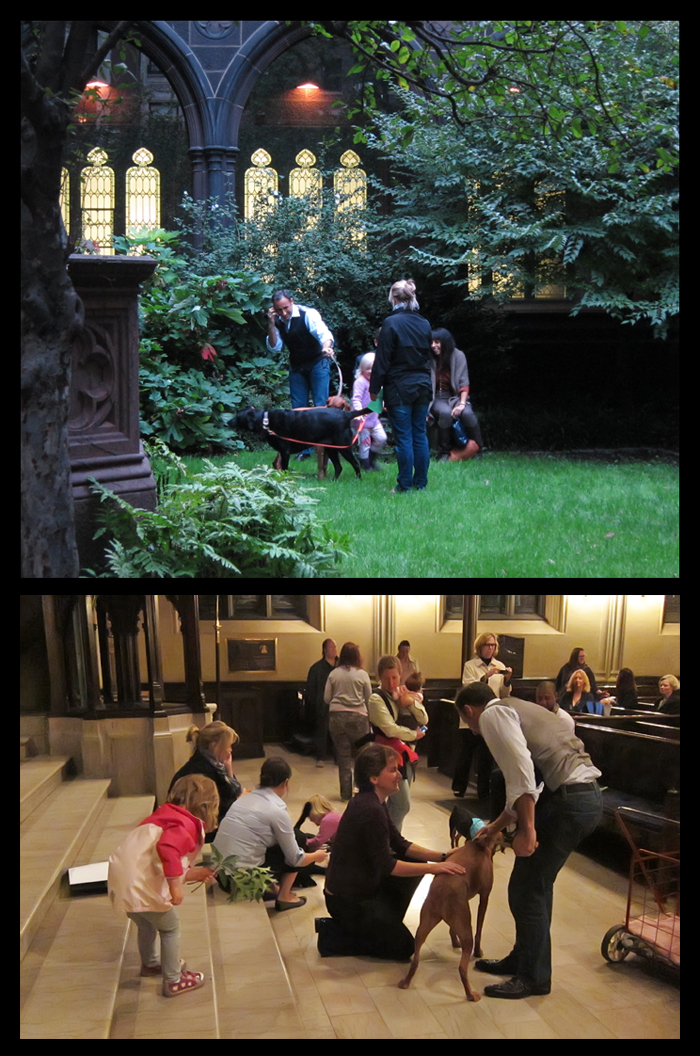
    I did discover, however, that a local church, the First Presbyterian at 12th Street and Fifth Avenue, was conducting a ceremony on Wednesday the 6th, affording me the opportunity to attend a ceremony for the first time. It was quite a surprise to see our furry friends sharing the pews. The number attending was much smaller, of course, than St. John’s extravaganza, but for those attending with their beloved pets, blessings do not come in sizes 🙂


  • When Jungles Collide

    I have often likened New York City to a jungle and am certainly not the first to do so. But this overused metaphor typically refers to the concrete jungle of man’s creations. However, at certain times in certain places, there are small pieces of the natural world to be discovered for urban explorers.

    In many of the New York City parks and gardens, surprises abound in the world of flora and fauna. In 2009, there was even a New York City Cricket Crawl, described as an aural expedition and a celebration of life in the leafy jungles of urban and suburban NYC and surrounding area.

    I’ve been listening to the sounds of summer for years, never knowing my cicadas from my katydids. But at least I know crickets. Some New Yorkers appear to be so out of touch with the natural world that they cannot even hear the natural sounds around them or perhaps have tuned them out. One evening, I pointed out the incredible din of crickets in Washington Square Park to a friend. Surprisingly, they could actually not hear what I was talking about. Perhaps inured to the sound or perhaps unable to isolate from the city’s ambient hum.

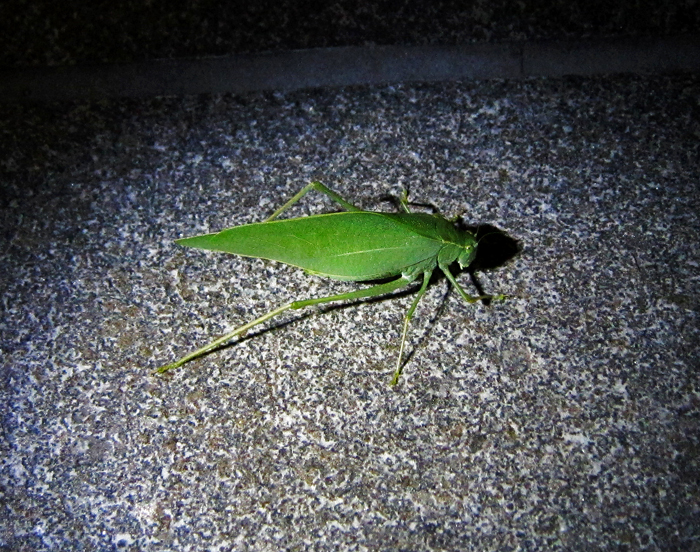
    Last night, as a number of us watched the amazing magic of Constantin, a katydid came jettisoning through the Washington Square arch. I followed it, not expecting to see it at rest, but it did light nearby on the cobblestone. I signaled to others to come observe this rare event. The katydid appeared to be stunned, perhaps lost from the foliated areas of the park. One of our group was able to produce a flashlight and illuminate our subject. I captured this photo, and we then moved the katydid to a garden area of the park and he (or she) flew off.

    For a few moments with a katydid on granite, we saw, well-illuminated by spotlight, the ultimate juxtaposition when jungles collide 🙂


  • Guessing Game

    I like guessing games.

    I have had an idea stewing for some time – an experiment of sorts, inspired by an article I read in the 1980s. The author of the article put forth a provocative hypothesis regarding writing, which I have thought about for years and discussed recently with a writer friend and regular reader of this website. Your answers to the last question at the end of this posting will test this hypothesis.

    Today there is something completely unique about the writing of this story, unlike any other since the inception of this blog in 2006.

    This idea, however, preceded any photos taken, and I have not been able to fathom in the least what image to use in conjunction with this idea.

    Appropriately (for a guessing game), I had the image of a butterfly of unknown species archived since August 1, 2010. The butterfly lighted on the pants of a friend in the park. Deprived as we are in New York City of such a rare occurrence of nature, the event became a paparazzi photo op, with the snapping of cameras and jockeying for turns at shooting.

    Recently, I showed this image to my photographer friend Bill Shatto, who identified it immediately (Bill’s specialty is the macro photography of insects – you can see his work here). Strangely enough, in a bizarre twist, the name of this butterfly is perfectly suited to this Guessing Game.

    So, if you like guessing games:
    1) What is the name of this butterfly?
    2) What is unique about the writing of this story?
    Afterthought: It occurred to me after completing this that not only is the identity of the person in the photo also not revealed, but I also don’t recall who it was. Layers of mystery.

    Answers: There were some very interesting analyses. Yes, it was the first time that I asked a question. But the real difference was that this posting was inspired by an article I read by an individual who claimed he could tell the difference between something written on a computer using a word processor versus something written without, the idea being that the need for more careful and thoughtful composition before committing to typewriter or pen/pencil would make itself obvious in the finished product.

    My story was written completely using pencil and paper. There was no editing of any sort on a computer, only the final transcription. I am not sure if I see an apparent difference myself.

    The butterfly is a Question Mark – common to urban parks, and named because of the silver markings under its wings, a curved line and a dot, resembling a question mark. See here.


  • Water 4 Dogs

    One of the problems with dogs in New York City is using the word dog in the same sentence as problem. I have done that twice in the first sentence, so I imagine that I am in trouble already with dog owners.

    Lest I be characterized as a dog hater, which is in the same realm as child haters, I do like dogs. New York City has 1.4 million dogs, which, I think it’s fair to say, poses numerous problems and difficulties, the issues of toiletry being one of the biggest to non-owners.

    In 1978, New York City, under Mayor Koch’s administration, passed Health Law 1310, the first enforced “poop scoop law” in the country. Prior to that time, the city streets were a virtual minefield of animal waste, and a walk on the sidewalks or in the streets necessitated constant vigilance and agility, or you had to be prepared for the unpleasant task of shoe cleanup.

    The city is not particularly hospitable to living creatures, be they plants or animals, dogs included. Days alone at home in small apartments and leash laws do little for their psychological well being. Dogs need off-the-leash time, and now parks have hours and specific locations for this activity. Many parks have also provided dog runs which include toilets.

    New York is a city of work-arounds, accommodation, innovation, adaptation, and resourcefulness. Dogs need drinking water, and in this summer’s heat wave, the need is often dire. Owners prepare and respond to this need in a variety of ways, often carrying water. Others, caught unprepared, often enter retail shops and ask for a cup. Recently, I have noticed the frequency of a preemptive solution: many shop owners providing a bowl on the street with a sign like that in the photo, Water 4 Dogs 🙂

    Other Dog Postings: a la Chien, Wolf Dog, Dog Run, Dog Dating, Robin Kovary Run for Small Dogs, Pet Pride Parade, Spring Madness


  • White by Desire

    Posted on by Brian Dubé

    I can’t say that New Yorkers have an exclusive on making impractical choices, but examples do abound that give evidence that it is at least a worthy contender in any competition for foolish choices. Trends and fads drive residents of this city as much as anywhere else, where it often seems that displays of extreme lack of sensibility is its own form of rebellion.

    And what better way for some to display that defiance by sporting a large dog with roots from a climate completely antithetical to that of New York City? Breeds inappropriate in any number of ways for city life, or ones requiring extreme maintenance.

    I recall the 1980s, when the Shar Pei, with its heavily wrinkled skin, was all the rage. Rapid breeding resulted in many health problems, such as allergy-induced skin problems. Many required eye surgery, with some owners seeking the skills of a eye surgeon for people. I rarely see the Shar Pei here any longer. Akitas were also quite popular at one time. Now I often see the Shiba Inu, a small hunting dog from Japan with a cute, foxlike appearance.

    On Sunday, I met Sofie, a beautiful, cheerful, friendly Samoyed – a breed originating from Siberia that is a nomadic reindeer herder. They have a dense double coat, which means lots of hair shedding. They are very youthful, energetic dogs with a desire to pull sleds and a love of the cold. Perfect for the Manhattan apartment resident, n’est-ce pas?

    Their cheerful nature and beautiful white coat, for many, outweigh any practical considerations. The breed’s ear-to-ear smile has given the Samoyed its alternate name, “smiling sammy.”

    In fairness, after speaking to the owner, I found that Sofie is very well cared for. It is possible to keep a dog like this healthy and happy in a New York City apartment with work, and many pet owners are ready, willing, and able to do whatever is necessary.

    Samoyeds are extremely well-insulated. Sofie actually loves sleeping in the snow. In their native environment, Samoyeds kept their owners warm at night by sleeping on top of them. The dog’s owner told me that once it begins to get warm at all, she runs her air conditioning 24/7.

    I was surprised to learn that early Samoyeds also came in black – white has become dominant due to popularity. If not for the constant care and responsibility, I could easily fall for the cheerful charm of the Samoyed. I, like many others, do love that white color, and the Samoyed that we see today, more than White by Design, is White by Desire 🙂

    Note: For lovers of white, see my stories White by Design, White by Design 2, and White by Design 3.

    Posted on by Brian Dubé

  • Lost in that Wool

    Posted on by Brian Dubé

    Please click to play the waltz, Lost in the Lonesome Pines, to accompany your reading.
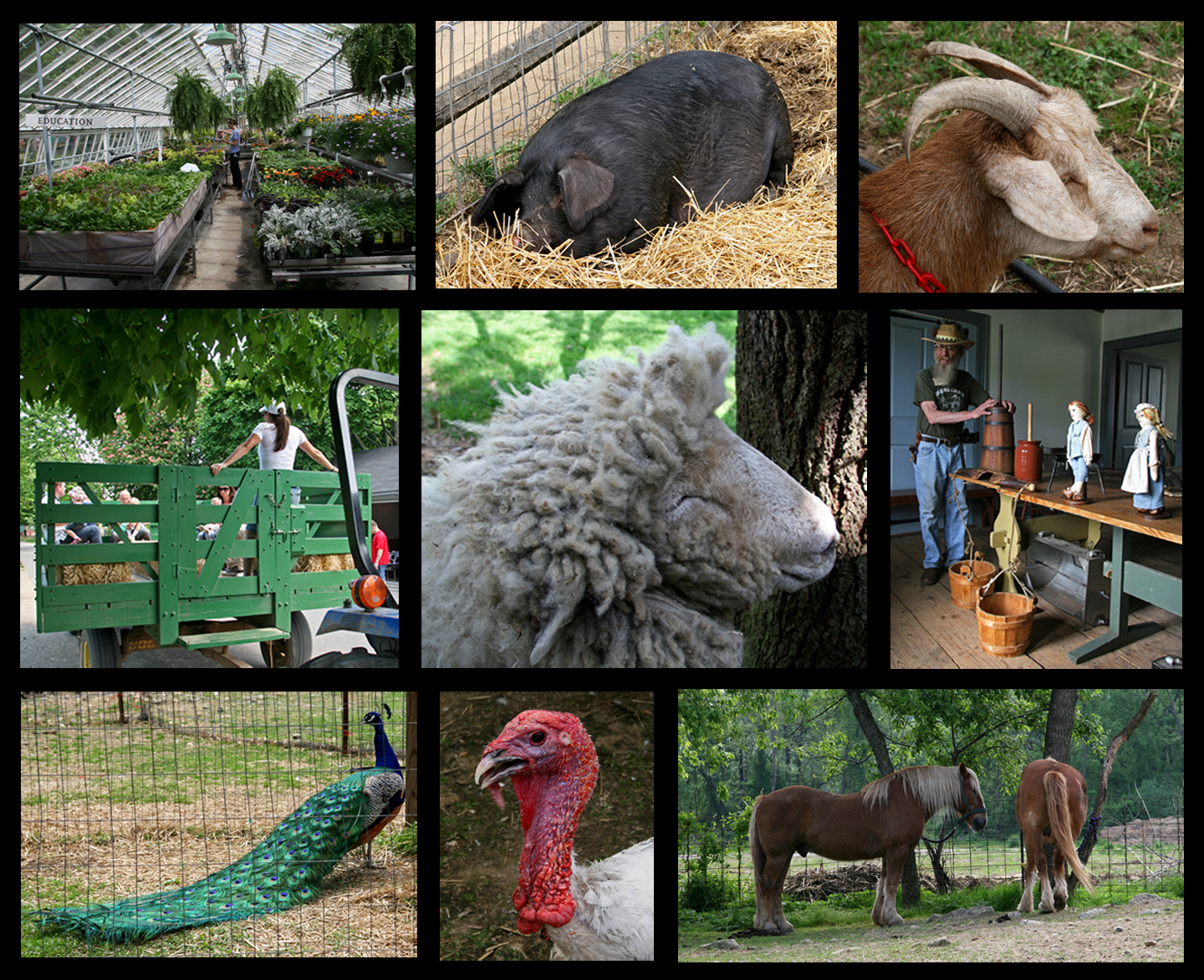
    Want to take a hayride? Mingle with sheep, goats, chickens, cows, horses, peacocks, pigs, and geese? In New York City? No, this is not a petting zoo.

    Welcome to the Queens County Farm Museum, New York City’s largest remaining tract of undisturbed farmland. A working farm dating back to 1697, it encompasses a 47-acre parcel that is the longest continuously farmed site in New York State. The site includes historic farm buildings, a greenhouse complex, livestock, farm vehicles and implements, planting fields, an orchard, and herb garden.

    We had a free tour of the Adriance Farmhouse with our guide, Mister Marty. Flemish-styled, the house dates to 1772 and is the centerpiece of the farm complex.

    And everything is free – tours, hayride, butterfly garden, and cavorting with the animals. This place came as a huge surprise. I had heard vagaries about a farm somewhere in Queens. Actually, this place is right on a major thoroughfare – 73-50 Little Neck Parkway in Floral Park. It is open 7 days a week, all year. There is admission only on days with special events. See the farm museum website here.

    I always relish the opportunity to pet sheep. I had competition with others, however – there was a group of us jockeying for position to get lost in that wool 🙂

    Posted on by Brian Dubé

  • Someone is There

    If today’s photos look rather unassuming, welcome to another episode of Content is King. This is one of New York City’s best examples of all work and no fanfare.

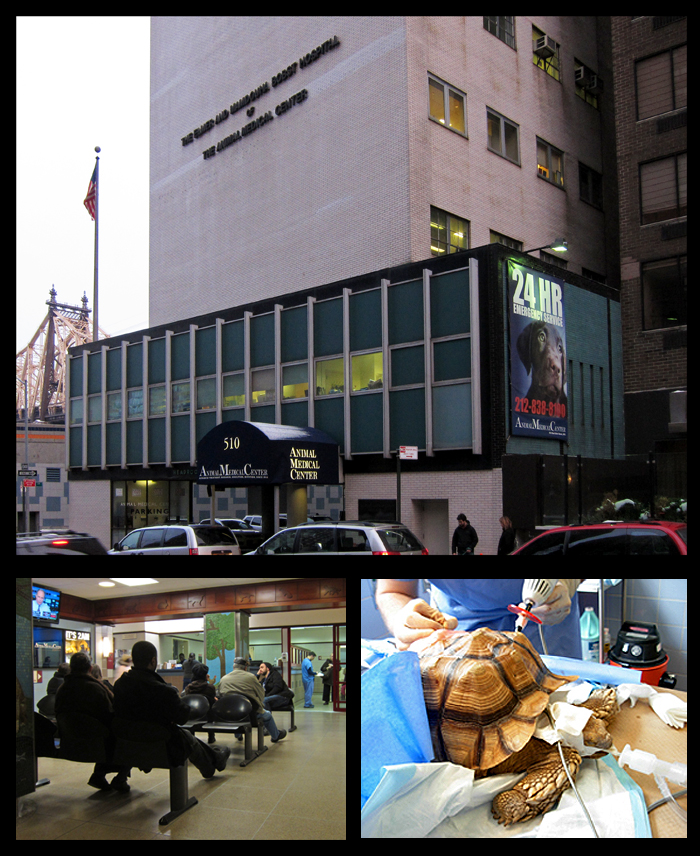
    This nondescript, 9-story building at 510 East 62nd Street, sandwiched between the back of the Bentley Hotel and the FDR Drive, is home to the Animal Medical Center, a place that for the last hundred years has been “the place to go” for emergency animal care and treatment of exotic pets. It has been best known for those who want to treat their pets and for whom money is no object.

    The Animal Medical Center is not just a veterinary clinic. It is is a full-blown hospital with MRIs, CT scans, radiation therapy, cancer treatment, hemodialysis clinic for pets with kidney disease, and a rehabilitation clinic with an underwater treadmill. There is a full range of specialties – dermatology, diabetes, endocrinology, hematology, neurology, oncology, radiology, etc. There is an Avian and Exotic Pet Service, which treats birds, rabbits, ferrets, guinea pigs, turtles, snakes, lizards, and small rodents.

    One of the huge pluses here is that the hospital is open 24/7, and anyone can walk in for emergency care at any time without an appointment. Until very recently, the center has essentially been the only game in town. But recently, competitors have entered the arena: NYC Veterinary Specialists and Fifth Avenue Veterinary Specialists, both offering a 24-hour emergency room and high-tech equipment. See a New York Times article here on the competition.

    Experiences at Animal Medical Center are extremely varied – pet owner reviews range the gamut. Many feel that the center has rested on its laurels a bit too long. Some are furious, while others sing nothing but the highest praises. With so many vets, interns, and patient load, it can be expected that patient experience will vary. A frequent complaint is the high fees generally incurred there. However, it should be understood that many of the procedures taken are not typically done for pets at all and have the same costs as those done for human patients. Ironically, I also see many negative reviews and similar complaints for the NYC Veterinary Specialists, surprising for the new man on the block.

    Pet owners are a very touchy bunch. Many are intolerant of anything less than the best care and attention. AMC is a large facility and definitely has a bureaucratic feel, with layers between the pet owner and doctors. Long hours in the waiting room, a more impersonal reception, and surprises at the cashier’s window, although not excusable, are also not surprising with such a large operation in a big city and an international reputation. News has it that there will be a campaign to improve patient relations.

    Everything said and done, it is still comforting that places like this exist and that day or night, when there is an emergency, someone is there…

    Photo Note: The photo at the lower right is from the AMC website.


  • Paraíso


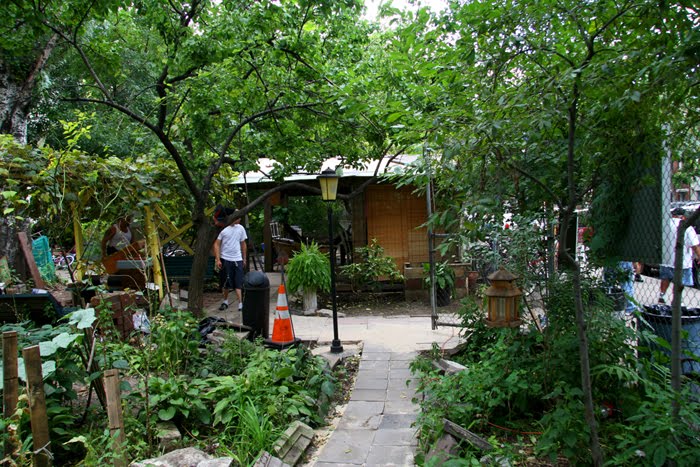
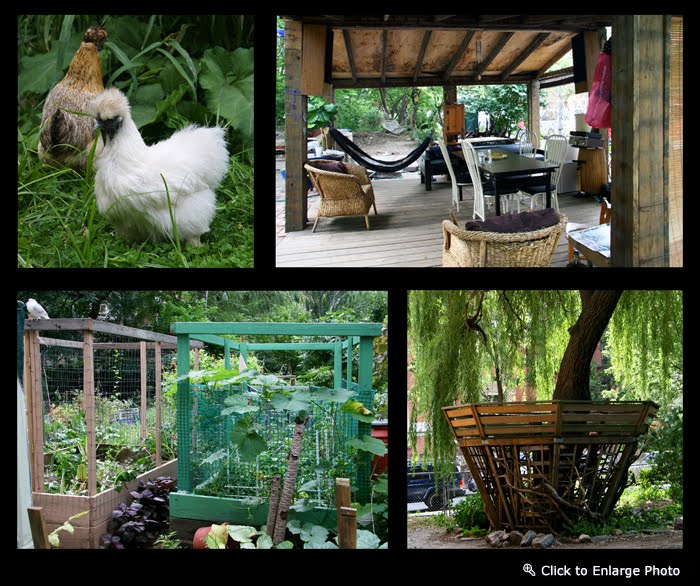
    Where can you find a rooster, chickens, ducks, rabbits, a turtle pond, a dog, herbs, grapes, tomatoes, and other produce being grown locally, with an octagonal tree house built at the base of a willow tree? In Manhattan, at El Jardin del Paraiso on East 5th Street between Avenues C and D.

    Normally, this area, deep in the heart of the very East Village, will be not be visited by visitors or residents of New York City. Even outsiders, slumming in the neighborhood, will not typically venture further east than Avenues B & C.

    The East Village is a mecca for community gardens. Many of these are absolutely extraordinary, idyllic urban oases. Some small, some larger – El Jardin is very large, extending through 5th to 4th streets, with an entrance at both streets. There is an open air cabana with a table, seating, and a hammock. Numerous awards and achievements have been bestowed upon El Jardin del Paraiso, including The National Wildlife Award and the Molly Parnis Dress Up Your Neighborhood Award. Read more at the East Village Parks Conservancy garden’s website here.

    In my tour of the garden, I encountered Cano, a local resident who was taking matters into his own hands. He complained of lack of progress on the part of those who manage the community garden. I have been witness to this type of community infighting and stalled efforts, so my sympathies were with him. He has invested over $10,000 of his own money to date and has recruited a few others to rehab the garden, which is now in a state of disrepair. He did not appear to be a power-hungry local activist spinning information to wrest control of the garden.

    A visit to the Jardin’s website shows a last update in 2006, so I got a sense that whatever visions and projects there were for this plot, momentum and drive do appear to have been lost. There is still a calendar, however, of events/activities in the garden.

    They say paraíso, I say paradise 🙂

    Photo Note: The white bird is a Silkie, a breed of chicken with unique, fluffy feathers. The chicken is known for its docile nature and is often kept as a pet. The flesh is dark blue/black and. although somewhat unappealing to the Western palate, is considered a delicacy in Asia.
    Origin of the Silkie is China/Asia.

    Visit the following related links: Shangri-La, Devil’s Playground, La Plaza Cultural Garden, Grapes, Stay Lean Stay HungryUrban Oasis, Alberts GardenWest Side Community GardenBird Country, Hua Mei Bird Garden


  • Hua Mei Bird Garden

    My excitement in learning about the existence of the Hua Mei Bird Garden in Sara Delano Roosevelt Park was greeted with skepticism, particularly by those I know who are very familiar with Chinatown. Sara Delano Roosevelt Park is a ribbon of green extending from Houston to Canal Street, flanked along its length by Chrystie and Forsyth Streets and straddling both the Lower East Side and Chinatown.

    In these neighborhoods, however, most visitors, both New York City residents and tourists, do their business and leave – that business in Chinatown being primarily eating on or near Mott Street, Chinatown’s central artery, or shopping by day and visiting clubs by night in the Lower East Side’s vibrant community.

    The park here, however, is not a destination. The 7.8 acres is much more of a utilitarian urban space dominated by areas designated to various activities – basketball, roller skating, soccer, etc. The center of the park is cut by Delancey Street. On the south side, you will find the Hua Mei Bird Garden. See more photos here.

    In 1995, three men, a Chinese banker and two former waiters, approached Anna Magenta, who, with Federico Sabini, had started the Forsyth Street Garden Conservancy in 1994 to improve the park. With her help, they petitioned the Parks Department, and in 1995, the Hua Mei Bird Garden was hatched. Bird gardens are common in China, and there are even restaurants that cater to patrons with their birds in tow.

    Every morning, a group of Chinese men gather with their songbirds, finches, sparrows, and blue jays among them. But the raison d’être of this garden is the Hua Mei with its songs. On weekends, the population of men and birds reaches its zenith, with dozens of cages along the walkway and hanging from lines. Most of the birds’ owners are retired Chinese men.

    The Hua Mei is a fighting song thrush – in the company of other males, it fights, and for females, it sings. The distinguishing physical feature is a white line that circles the eye and extends towards the back of the head. The birds are kept in ornate handmade bamboo cages, frequently with a white cloth covering the cage to shield them from the impact of the city. The birds are imported from China and Vietnam – they are quite costly, requiring quarantine before being brought into a domestic environment.

    The gathering is a social one for both the owners and the birds. The Hua Mei needs exercise, and the owners take the opportunity to introduce the birds to each other while bird talk dominates the conversation…


  • dinamic_sidebar 4 none

©2026 New York Daily Photo Entries (RSS) and Comments (RSS)  Raindrops Theme