• White House of Ill Repute

    The White House has had its Presidential scandals. Much has been well documented, and the home can be seen in photos everywhere.

    However, there is another White House riddled with much darker doings in the past, located at 177 Benedict Road in Staten Island, NY, the former home of the notorious crime boss Constantino Paul Castellano. I journeyed to Staten Island to see the place for myself, and I believe these are the only photos you will find of this home.

    In 1976, Big Paul Castellano succeeded Carlo Gambino (after his death) as head of the Gambino crime family, the largest Mafia family at the time in the United States.

    Paul was born in Brooklyn in 1915, the youngest of three. He dropped out of school in the eighth grade and learned to be a meat cutter in his father’s butcher business. His life of crime began early – Paul also ran numbers for his father.

    In the 1920s, Staten Island was sparsely populated and isolated – an ideal dumping ground for mafia victims as well as a place for bootlegging, extortion, loansharking, gambling, drug-dealing, and smuggling, activities which emerged on the waterfront. By the mid-20th century, Staten Island became a residential enclave for Mafia dons, providing the seclusion they needed. In the 1980s, law enforcement officials estimated the number of “made” Mafia members living on Staten Island at around 60, with names  such as John Gotti, Aniello Dellacroce, Salvatore Gravano, Frank DeCicco, Thomas Pitera, Costabile Farace, and many others.

    Castellano’s enormous mansion, a replica of the White House of the United States, was built in 1980 in Todt Hill on Staten Island.
    At the time Castellano moved into this estate with his family, a Columbian housemaid, Gloria Olarte, began working. A full-blown love affair between Paul and Gloria developed under the eye of Castellano’s wife, Nina. Although Mafiosi are known to keep a goomatta on the side while married, Castellano’s behavior became more overt and problematic.

    Knowing that Castellano conducted business from his home, the FBI planted bugs in Castellano’s home in 1983 with the help of Olarte, who had been upset with the way her affair with Paul was going. Olarte let an FBI agent into their home, posing as a repairman. Over 600 hours of conversations detailing the Gambino family business were recorded.

    Others in the organization were also not pleased with Castellano and his more mainstream business approach. On Dec. 16, 1985, Castellano and his driver, Thomas Bilotti, were murdered outside of Sparks Steak House at 210 East 46th Street, between Second & Third Avenues in Midtown Manhattan. The hit was ordered by John Gotti, who controlled the family until his 2002 death in prison. The gangland-style murder was particularly shocking, occurring as it did during rush hour, in midtown Manhattan, and in modern times.

    Not to be upstaged, New York City is proud to be home to its own White House of Ill Repute 🙂


  • No Sir

    Last evening, I was discussing the disarmingly polite ways of the southern American with a friend who has recently been vacationing there regularly (see my story, Luray Caverns, about my first experience there as a child). When working with customers on the phone, as I have over the years, I have noticed that with men from the South, every question I have asked in respect to their order has been answered with “Yes, Sir,” or “No, Sir.” Perhaps they have not traveled the roadways of New York City, where they may quickly want to trade their polite phraseology for some more appropriate expletives.

    There are vistas common to New Yorkers who travel by car which are not often seen in photos, as they can only be seen by a vehicle on a roadway. The photo was taken in Brooklyn from the Brooklyn-Queens Expressway, heading north with views of the Brooklyn Bridge and Manhattan with the Empire State Building. The Brooklyn Heights promenade (with similar views of the city) looms overhead to the upper right. This view is particularly beautiful at night.

    Prudent or not, I have resorted to shooting while driving to capture images with varying results. Digital cameras with various auto settings and the ability to immediately review shots make getting an acceptable “Hail Mary” possible.

    On a recent excursion to Staten Island, a photographer friend was giving me a first ride in his new Mini Cooper. With its diminutive size, it is a popular car around New York City. My atypical position as passenger and the challenge of shooting overhead with no sunroof begged for at least an attempt at getting an acceptable photo while moving.

    The vista in today’s photo is one known to every Brooklynite or traveler who has plied his or her way between Brooklyn, Manhattan, and Queens, using the infamous BQE. The beautiful views are rare and welcome eye candy and respite from a city plagued with unattractive, utilitarian highways usually snarled with traffic.

    The BQE, the FDR, the Cross Bronx, the LIE, the Van Wyck, the Grand Central, the Prospect, and the Belt. If you live and travel in this city, an acronym or truncated name for a highway is more than adequate to identify these common roadways. Any highway in New York which gives as much trouble to and tries the patience of the traveler, as these roads typically do, does not need to be addressed any more politely than with the shortest possible title. No Sir 🙂


  • Veneer of Their Lives

    From time to time, I need a reality check to put things in perspective. At one time, I occasionally turned to a good friend who had moved to the West Coast. He had a very worldly perspective, having traveled extensively to all corners of the globe. See Weather Means Whether here.

    As I have written in stories such as The Dark Ages, New Yorkers often have to tolerate very poor living conditions, even when paying substantial rents or purchase prices for apartments. Among residents, this is often a source of humor, jokes, and sarcasm. The non-resident or visitor often sees displays of wealth in New York, but these glimpses of the city are just a veneer and often do not give the full picture.

    The single biggest factor in living in this city, regardless of whether a person owns or rents, is that with little exception, the vast majority of residents live in multiple-unit dwellings, i.e. apartment buildings. In this environment, you lose control. Tenants above, below, and to the sides of you are a perennial concern and often a source of noise etc., frequently with little recourse.

    On one occasion, said friend was in my apartment when I was feeling particularly shut in and frustrated by my various living conditions. Having a sense, however, that things could be much worse and that perhaps I was rather an ingrate, I asked him his honest assessment of my abode. After a moment or two of thoughtful contemplation, he said that in the scheme of things, I had a pretty good situation.

    Romanticizing the past can also be a case of seeing only a veneer. In Better When, I discussed the illusory sense that times were better in the good old days.
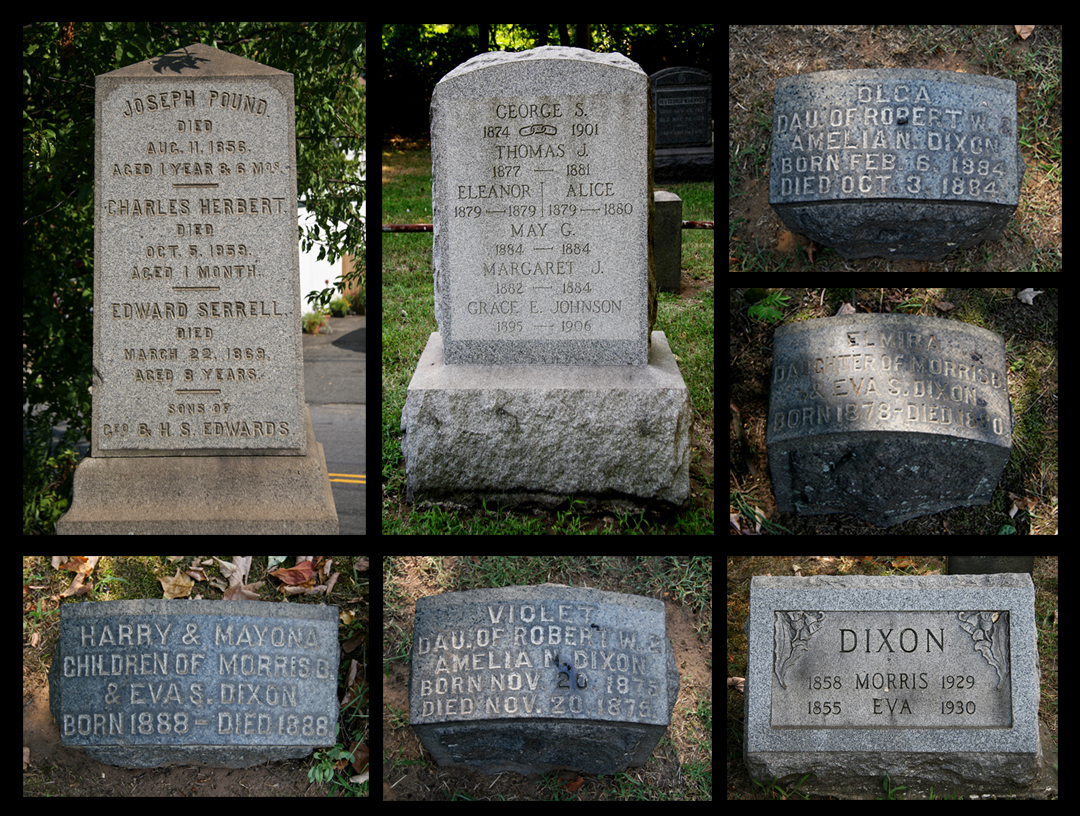
    Strolling through St. Luke’s Cemetery, on Arthur Kill Road in the Rossville section of Staten Island, provided the reality check I needed. A photographer friend who accompanied me pointed out how many grave stones of children there were. (If you click to enlarge the photo, you can read the inscriptions). As we strolled the graveyard, I found it quite sobering, particularly the family of Morris and Eva Dixon, whose many children lived only some months to 3 years. I was heartened by their own headstone (lower right photo), noting that they were born 3 years apart (1855 and 1858) and died within one year of each other (1929 and 1930). I hope the Dixons had their joys as well as misfortunes and that these headstones serve only as a veneer of their lives…


  • Water 4 Dogs

    One of the problems with dogs in New York City is using the word dog in the same sentence as problem. I have done that twice in the first sentence, so I imagine that I am in trouble already with dog owners.

    Lest I be characterized as a dog hater, which is in the same realm as child haters, I do like dogs. New York City has 1.4 million dogs, which, I think it’s fair to say, poses numerous problems and difficulties, the issues of toiletry being one of the biggest to non-owners.

    In 1978, New York City, under Mayor Koch’s administration, passed Health Law 1310, the first enforced “poop scoop law” in the country. Prior to that time, the city streets were a virtual minefield of animal waste, and a walk on the sidewalks or in the streets necessitated constant vigilance and agility, or you had to be prepared for the unpleasant task of shoe cleanup.

    The city is not particularly hospitable to living creatures, be they plants or animals, dogs included. Days alone at home in small apartments and leash laws do little for their psychological well being. Dogs need off-the-leash time, and now parks have hours and specific locations for this activity. Many parks have also provided dog runs which include toilets.

    New York is a city of work-arounds, accommodation, innovation, adaptation, and resourcefulness. Dogs need drinking water, and in this summer’s heat wave, the need is often dire. Owners prepare and respond to this need in a variety of ways, often carrying water. Others, caught unprepared, often enter retail shops and ask for a cup. Recently, I have noticed the frequency of a preemptive solution: many shop owners providing a bowl on the street with a sign like that in the photo, Water 4 Dogs 🙂

    Other Dog Postings: a la Chien, Wolf Dog, Dog Run, Dog Dating, Robin Kovary Run for Small Dogs, Pet Pride Parade, Spring Madness


  • Never Cut a Board

    I have nothing against wood. In fact, I did carpentry work for years. But there is a permanence to working in stone and steel that I always admired and envied. Perhaps this is what led Tony Soprano’s Uncle Junior to once correct Tony, because Tony believed his grandfather was a carpenter. Proud of their lineage as Italian stone cutters and knowing that the family’s work would stand for even thousands of years, Uncle Junior admonished him: “He never cut a board in his life – he was a stone mason.”

    Sculptures in bronze and buildings in masonry certainly have a permanence that makes the design considerations a serious matter. And yet, with this and all the hoops that sculptors and architects must go through, it is often amazing the types of projects which are finally approved, executed, and installed as public art, or built as residential or commercial structures.

    I developed tremendous respect for I. M. Pei after seeing a documentary which showed how seriously he took his commission to build the glass pyramid entrance for the Louvre Museum in Paris. He understood full well his responsibility for generations to come, the multitudes and masses who would see this work every day juxtaposed against the Louvre museum, and images which would undoubtedly be found everywhere. After receiving the commission, Pei asked French President François Mitterrand if he could take several months off to study French history.

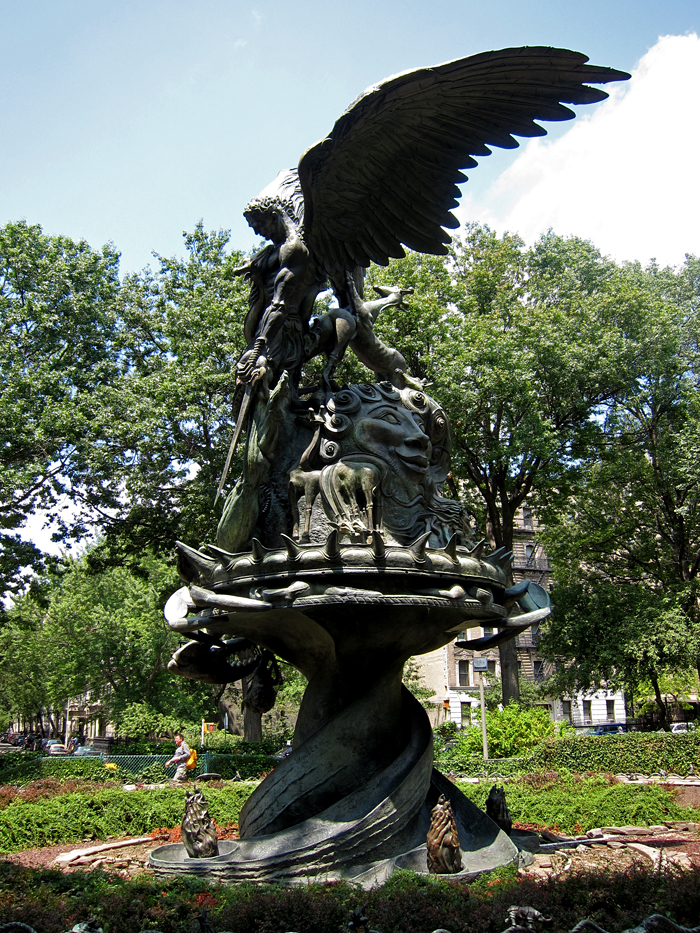
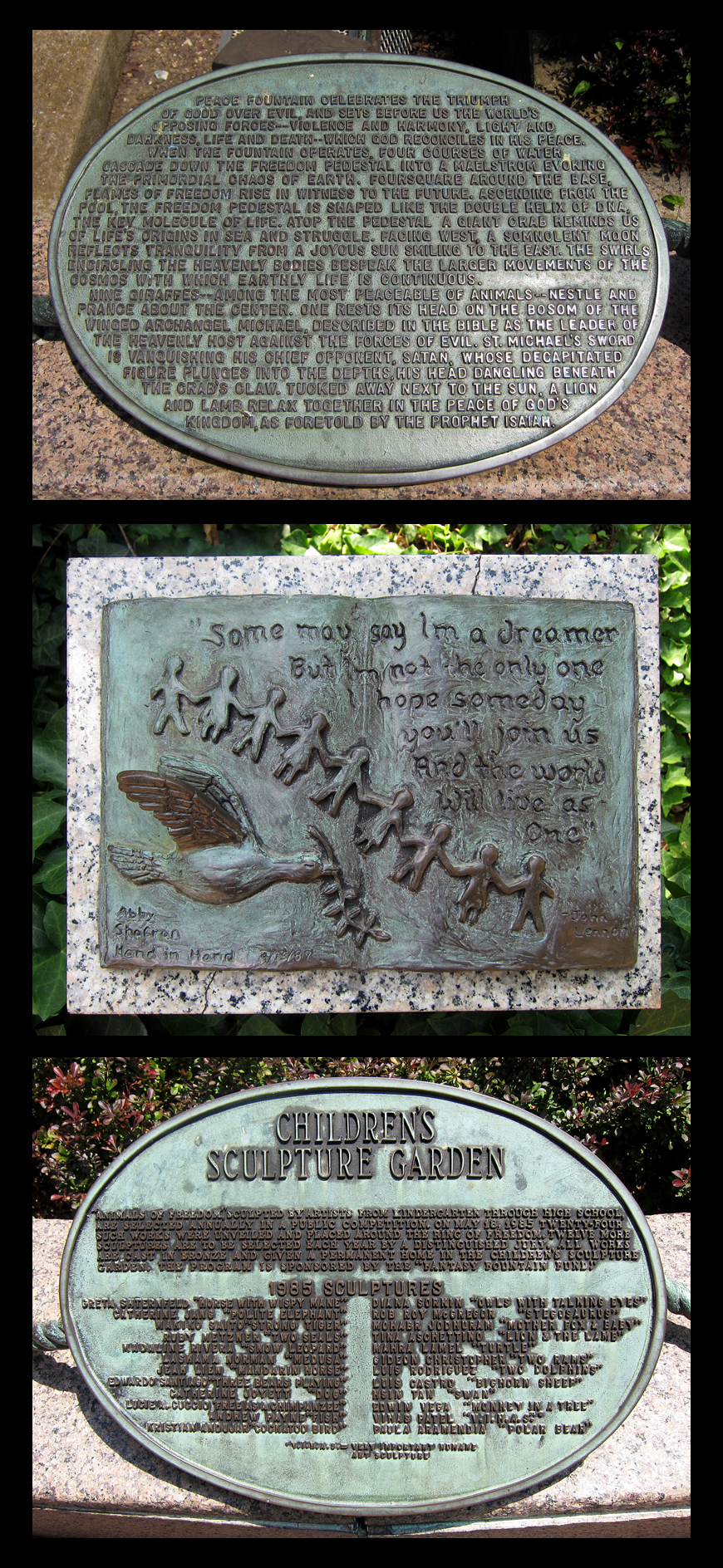
    Adjoining the the Cathedral of St. John the Divine in a small plaza is Greg Wyatt’s Peace Fountain. The bizarre work in bronze is 40 feet tall and is an amalgam of various figures, including giraffes, a sun and moon face, a crab, lion, and lamb, all resting on a base shaped like a DNA double helix. A figure of the archangel Michael, who has just finished beheading Lucifer, stands in the center. The sculpture represents the triumph of good over evil. For a full explanation, read the inscription and see additional photos here.

    The area around the fountain is surrounded by various plaques depicting various artists, philosophers, and thinkers, most accompanied by a quote by the individual. There is also a children’s sculpture garden with various animal figures created by school children.

    I wonder if I.M Pei or Greg Wyatt are the types of men who have never cut a board?


  • Bridge and Tunnel

    Whenever I look at or cross the Verrazano Narrows Bridge, I can not help but reflect on the 1977 film Saturday Night Fever, starring John Travolta, who plays the lead character, Tony Manero, a 19-year-old Bay Ridge, Brooklyn, resident. This coming-of-age story is laden with metaphors, with the Verrazano Bridge being, literally, the largest one. It is also the location of a tragic suicide of one of Tony’s friends, Bobby C., who cannot cope with his girlfriend’s pregnancy. In one climatic scene, Tony and his friends engage in a series of acrobatic antics on the Verrazano Bridge. Feeling hopeless and hungering for attention, Bobby C. falls to his death in a final display of one-upmanship.

    The bridge is an apt metaphor for the link between juvenile and adult behavior. The Verrazano also serves as a visual metaphor for the pejorative slang expression, bridge and tunnel, an elitist phrase used by Manhattanites to characterize those as “lesser class,” who commute in from the outer boroughs, New Jersey, and Long Island for cultural or social reasons. Appropriately, this term first appeared in print in the same year as the making of the film, 1977, in the New York Times.*

    In the final scenes of the film, Tony confides in his girlfriend, who lives in Manhattan, that he wants to make a break with his past and move there also. Tony’s recognition of his behavior and redemption is a refreshing break from what at times feels like a monument to misogyny.

    If you have not seen this film, I recommend it. It was both a mirror of and an influence on the culture of the time. The film is steeped in New York City imagery as well as clothing styles, disco, and the Italian American subculture of New York City (specifically Brooklyn) of the time.

    Saturday Night Fever is really quite a dark film, with teenage pregnancy, rape, suicide, and Tony’s brother doing the unthinkable – leaving the priesthood. The year was 1977, and the crowd was bridge and tunnel…

    *”On the weekends, we get all the bridge and tunnel people who try to get in,” he said.
    Elizabeth Fondaras, a pillar of the city’s conservative social scene, who has just told Steve Rubell she had never tried to get into Studio 54 for fear of being rejected, asked who the bridge and tunnel people were.
    “Those people from Queens and Staten Island and those places,” he said.

    Other Posts on the Verrazano Bridge: Del Floria’s, Cooperation, The Total Call, Secede


  • I Must Confess

    I grew up as a Roman Catholic (no longer practicing). One of the most painful things to go through as a young person was the process of confession.

    For those unfamiliar or not experienced with the Sacrament of Penance, let me assure you that spilling all your sins in detail to a priest (and having him ask questions) was an extremely unpleasant experience, riddled with shame, guilt, anxiety, and embarrassment. Sins were to be listed from mortal to venial. In retrospect, I am sure that the sins of a young child pale to those committed by adults, but nonetheless, it was excruciating.
    At the time I grew up, at least confession was private and anonymous. I understand that at one time confessions were public – ouch.

    Recently, on a brutally hot Sunday, I decided to attend a Gospel service in Harlem. I did this with trepidation, knowing full well that going to a religious service with the intent of enjoying gospel music is problematic and controversial. Tour groups have been frequenting these churches for some time. In 1996, Newsweek ran an article called Soul Voyeurs Invade the House of God. On March 3, 2010, I wrote about this in With All Due Respect.
    However, curiosity still got the better of me and overruled my better senses. I intended to be as respectful as possible and, reading that shorts, T-shirts, etc. sported by many visitors were frowned upon, I dressed in my Sunday best, in spite of near 100 degree temperature.

    In selecting a church, articles all pointed to the Abyssinian Baptist Church as having one of the most renowned choirs and a history of well-known preachers. However, it apparently has been overrun with tourists, and experienced Harlem churchgoers recommended staying away. If this was true, my presence would only make things worse. So I chose Mt. Neboh Baptist Church, which I featured in With All Due Respect.

    Entering the church, I knew I had already made a big mistake, as a man stationed inside immediately made eye contact and barked, “Upstairs.” My companion and I hastily made our way upstairs to the balcony, along with other “tourists.” The place was dreadfully hot and oppressive, there were no seats to be had, and waves of embarrassment and guilt began to pass over me as I realized that coming here was one colossal mistake. Hordes of tourists gawking (and marveling) at spectacular architecture such as St John the Divine or St. Patrick’s Cathedral is expected and well tolerated, but gawking at parishioners trying to participate in a religious rite is another thing.

    We left the balcony hastily and lingered in the church vestibule, observing the service through the glass of closed doors. The same gatekeeper we met previously had followed us down and commanded us to go back upstairs or leave. In this environment, it was too clear that we were not part of the congregation, and although the very spirit of the Christian church is one that welcomes all, under the current circumstances, it is perhaps best that non-participants just avoid the whole thing.

    Before leaving the neighborhood, I did pass by the Abyssinian Baptist Church (bottom two photos). Evidence of the crowding I had read about was everywhere to be found – there were mobs, traffic jams, and general mayhem. We did, however, finally stop into the Mount Moriah Baptist Church, one of the oldest churches in Harlem. There, we were greeted very cordially and given hand fans. There was a plethora of available seating, and we quickly and quietly took our places in the pews. The singing was superb as to be expected, but the heat and a nagging guilt drove me away, I must confess…


  • Just Like Old Times

    In most places, eight police vehicles and a swarm of officers pursuing a drug bust is a serious event. On Saturday night in Washington Square Park, at 11:30 PM, various vehicles came hurtling at high speed from all directions – two unmarked black cars, a taxi (used by police), and several regular NYPD vehicles. They easily and quickly trapped the perpetrator, who offered no resistance, only saying, “What?”

    It had all the drama of a major arrest of one of America’s Most Wanted, but my understanding was that this huge show of force was just for the arrest of a drug dealer caught making a transaction. I say “just” because selling drugs is an everyday and all day activity in this park.
    If you look at all like a potential customer and are strolling through Washington Square on a busy day, you will be offered drugs by numerous dealers at a number of key locations – strategic intersections where most pedestrians have to pass through. The mantra “smoke, smoke” is familiar to all habitués here and is just laughed off as part of the natural environment and business as usual.

    Drugs have been regularly sold in Washington Square Park since time immemorial. Dealers are well-known by regulars in the park and the police. The miscreants are quite well-versed in the law and know how to operate their business in a way to generally avoid arrest. The activity had virtually disappeared since the recent renovation (see here) but, as would be expected in New York City, and particularly in this park, drug activity has crept back in and often feels just like old times.

    What is ironic, and would be perhaps astounding to nonregulars, is that a regular group of musicians and singers continued their musical activity just steps away from all the commotion, completely undaunted, unfettered, and apparently uninterested.

    Rather than a cause for alarm, surprise, disruption, or curiosity, the whole affair just seemed to add voices to the backup singers. Guns, police running, screeching tires, searchlights in the bushes, sirens, and handcuffs were all part of a comforting ambiance that made everyone feel that it was just like old times 🙂

    Note: On August 6, 2009, I wrote Chess Monsters and told of an incident where I witnessed a shooting, yet incredulously, while players ran for cover, an onlooker stopped the chess clocks during the incident and playing resumed, barely missing a beat. You can read the story here.

    Postings on Washington Square Park: Out There, Conflux, Hawk Fest, Evening Arch, Twelve Tribes Arrive, New York Nymph, Bluegrass Reunion, Cloud Appreciation, I Am Legend, Birds Sing at Night, Rats Gone Wild, Piercing Al Fresco, Police Riot Concert, Artiste Extraordinaire, Comfort and Joy, Livid, Flash of Light, Delivery, Dog Run, Sounds of Summer, Krishna, Spring Madness, Back to Boyhood, Hookah, Lockout, Danger and Caution, Obama, YouTube Meetup, Dachshund Octoberfest, Music Speaks for Itself, Park Night, Petanque, Washington Square North, Nested Embraces, Left Bank New York


  • We Read at Night

    Posted on by Brian Dubé

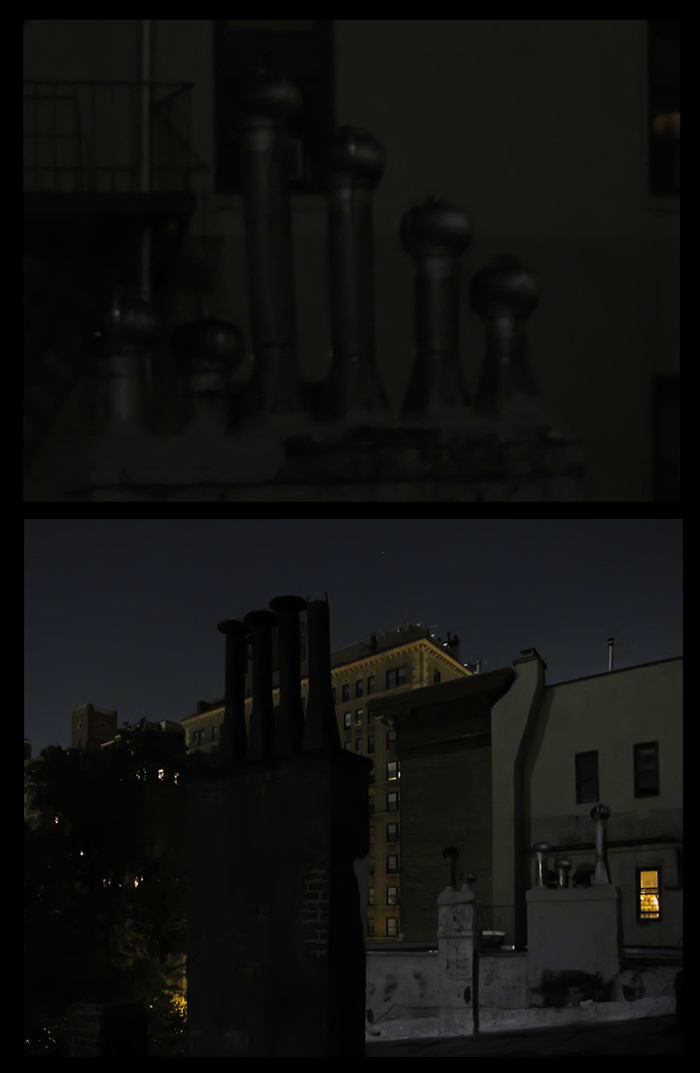
    I have been to some of those places so dark at night that you can not see your own hand. I don’t like those places. I will confess that after living in New York City most of my life, I am somewhat afraid of the dark because I don’t really know what it is anymore. A case of Fear of the Unknown.

    I have read about the health benefits of sleeping in total darkness. I am sure it is healthier, but I find greater comfort with light. I can sleep in well-lit rooms, a bedroom at night without shades drawn, at the beach, or on park benches during the day. It’s much easier to see anyone sneaking up on you, and vampires hate the light.

    Although there are conveniences of living in a place where it is well lit at night, this plethora of illumination is light pollution, and it is a well-documented problem worldwide, particularly in urban areas like New York City. The Dark-Sky Association (IDA) defines light pollution as any adverse effect of artificial light, including sky glow, glare, light trespass, light clutter, decreased visibility at night, and energy waste.

    Links have been found between light pollution and cancer, increase in blood pressure, alertness, and mood. Sleep and circadian disruption, along with melatonin suppression, may have long-term health risks. In a larger sphere, ecosystems are disrupted. On March 26th, 2009, I wrote of the effect on our fine feathered friends in Birds Sing at Night.

    We grow accustomed to the everlasting light of the city. In most areas, it is easy to read at any hour of the night in the parks or on the streets. Bill Hayes, a writer for the New York Times, in a piece called “Insomniac City,” describes a phenomenon he discovered – people who took to the parks on summer nights to read all manner of printed materials – books, newspapers, novels, and poetry.

    On summer trips when I have vacationed in rural areas, I found a flashlight a necessary tool to carry at night. In the city, I use my flashlight during the day to find that lost item that has rolled under a desk and rarely to illuminate my way at night.

    In a city that never sleeps, and where everything is illuminated, birds sing and we read at night…

    Posted on by Brian Dubé

  • All Is Not Lost

    Posted on by Brian Dubé

    Much of the art and music world in New York City has disappeared, but all is not lost. In the East Village and the outer boroughs, the arts live on, the product of tenacity and resourcefulness. If you are looking for arts on a smaller scale than the major museums, or for music on a smaller scale than Lincoln Center, then you will have to look a little harder and concentrate your efforts in neighborhoods such as DUMBO and Williamsburg in Brooklyn and the East Village and Lower East Side in Manhattan.

    The East Village still has a substantial number of community gardens, art galleries, music clubs, and other small venues. I have featured a number of community gardens here, and more recently, the Nuyorican Poets Cafe. These types of places are virtually nonexistent elsewhere in the city.

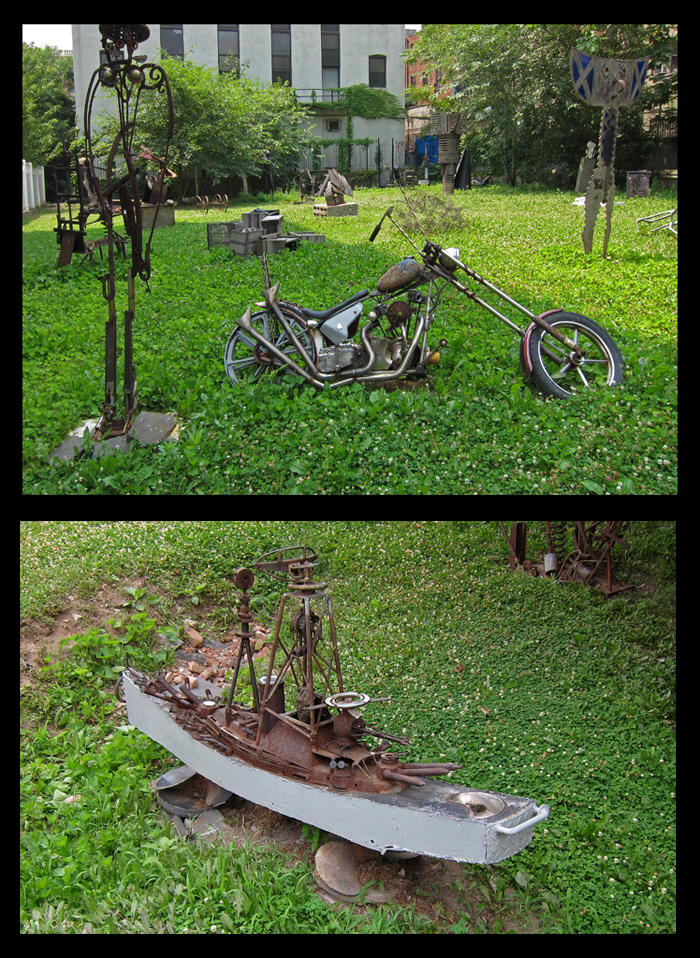
    The KenKeleba House Sculpture Garden spans an entire city block from East 2nd and 3rd Streets.

    Kenkeleba House Garden has an extraordinary mix of large African sculptures as well as local sculptures made out of scrap, or bricolage, a specialty of the Lower East Side art scene since the 1970s. Situated in a large plot, the net effect is that of viewing an outdoor museum with both permanent and temporary pieces on exhibit. Some of the outdoor pieces on loan are from local artists who used to belong to the much beloved Rivington Street Sculpture Garden, which had two incarnations in the neighborhood before it was pushed out by a new apartment building.

    Double back to Avenue B, continue south for one block, and turn left onto to East 2nd Street. Since the whole garden runs from East 3rd to East 2nd between Avenue B and Avenue C, closer to Avenue B, it needs to be approached from both sides. The separate planted garden area, can be accessed from the East 2nd Street side entering during the designated posted hours when the garden gate is open. At other times, take a look around to see if anyone is in the gallery at 219 East 2nd Street who could open the garden for you. It is worth trying to gain entry to the planted garden, particularly since this also allows entry to the sculpture garden.

    All is not lost…

    Posted on by Brian Dubé

  • Dave

    Posted on by Brian Dubé

    I want to tell you about a man named Dave. He was a New Yorker, and for a time, I and a number of friends would see him daily in Washington Square Park. He was a gentle person and one of the most considerate individuals I have ever met. His concern was always for others, and at one point, when I was going through a trying time, he consoled me daily, always asking for a update the moment he saw me.

    He had a comforting aura about him. At a surface level, Dave looked quite ragtag, very poor, and eccentric. His wardrobe was very limited, and he wore threadbare shirts and torn belts. He was always overdressed, often with sweaters and a down jacket, even in warm weather. He carried old and worn plastic shopping bags that were stuffed – I have no idea what he was carrying. At times, he could be mistaken for someone homeless.

    He had a job, although he never spoke of his work or home. One of our group of friends said that he was told by Dave that he was a clerical worker in a hospital. He lived alone, had no family and, other than his park forays, was a recluse.

    I introduced him to the New York Times crossword puzzle, and we sometimes did them together. Although he was not a native English speaker, he did well. It became very clear to me over time that this man was very intelligent and well-read. I just had a gut feeling that there was much more to this man than met the eye.

    Over time I began to learn a few details of his life. He was a Russian Jew and had served in the Israeli army. On another occasion, while discussing classical music, he told me that he had studied music formally for seven years. Discussing specific pieces such as the Chopin Etudes, e.g., it was clear that these claims were not likely to be fabrications, and I hoped to hear him play some time.

    One day, we learned that he had a stroke. He was never to be the same again. Speaking to him on the phone was quite upsetting, as he was barely able to converse at all. Soon after, we were told that he had a brain tumor. Our belief was that he had known about this for some time yet carried the burden silently.

    A friend told us that he had learned the most astounding thing. While visiting Dave in the hospital, he met two of his coworkers, who informed him that Dave was much more than a clerical worker. In fact, Dave was a research scientist with two PhDs in Pharmacology. The last time I saw him was in his room at Mt. Sinai, when I went to visit him with a friend. It was particularly sad seeing him with a shaved head and surgical scars everywhere. He was unable to say anything other than yes or no to questions asked. I asked him if it was true that he had two doctoral degrees. He said yes.

    Dave died on November 4, 2009. I attended his memorial service. One story followed another from his coworkers about his selflessness and humility. I also learned that in addition to his research work, his interest in music was not casual at all – he performed as a concert pianist. He may have had no family or close personal friends here, but he is missed and loved by all whose lives he touched…

    Note about the photo: Mount Sinai Hospital was founded in 1852 and is one of the oldest and largest teaching hospitals in the United States. In 2009, it was ranked as one of the best hospitals in the United States by U.S. News & World Report in 11 specialties.

    Posted on by Brian Dubé

  • Micronations

    Posted on by Brian Dubé

    I purchased a book some time ago called Micronations. I was very intrigued yet disappointed. The book was entertaining but somehow did not fulfill the dreams I had as an armchair traveler. Perhaps I needed to look closer to home.

    The newsstand in today’s photo, taken in Bay Ridge, Brooklyn, is not an uncommon sight in New York City, particularly in the boroughs such as Brooklyn or Queens, where there are large concentrations of ethnic groups. Bay Ridge has a population which is 11% Arab and 5% Greek.

    On May 12, 2009, I wrote Salad Bowl about the failure of the metaphor of New York City as a melting pot to accurately describe the discreet ethnic groups. There are many people in New York who get along speaking virtually no English who are so prevalent here. Chinatown is a good example of a very insular neighborhood, with so many services and products catering to the Chinese community that many residents never have to leave or learn another language.

    These ethnic enclaves have places of worship, books, periodicals, schools, parades, festivals, restaurants, markets, and foods and products imported from their homeland. Doctors, lawyers, accountants, and other professionals have established businesses in these communities, providing services and working in the native languages of the residents. There are often tiny pockets of immigrants of ethnicities rarely seen in the United States. No need to leave the Big Apple when looking for Micro Nations 🙂

    Posted on by Brian Dubé

  • At Least It’s Water

    Posted on by Brian Dubé

    In Back to Our Main Feature, I wrote that “the gifts nature bestows and the power she wields often feel secondary in a city like New York.” Often, however, does not mean always, and even in the Big Apple, Mother Nature can show a dominant hand and deal a heavy blow – particularly, summer heat. As with other areas of the country, this summer has set all-time records. Nothing is more oppressive than summer in the city – ambition to do anything withers in the blistering heat.

    I had a friend who went to school in Miami, Florida. I asked how anyone could tolerate summers there. He assured me that no one spends time or walks outdoors – all human movement is from one air conditioned environment to another – car, store, home, etc. The problem in New York City is that everything you do involves some walking. Even getting a taxi means standing in the street, sometimes with no success.

    Subway platforms, although underground, offer no respite. They are subterranean infernos. The asphalt streets are like beds of lava, conducting heat to all who dare to stand on them. Tree shaded streets are few, and we walk in the shadows of buildings if the time of day is right.

    Virtually everyone I have spoken to has had the same solution – stay in during the day, go out in the evening (if at all), and wait the heat wave out. Even in this fast-paced city, where residents are undaunted by virtually anything, summer heat is suffocating and its effects visible everywhere and affecting virtually everything – shopping habits, work, and recreation.

    For those who do not leave the city, heading for water is one solution, but New York City has few options. Sprinklers are sometimes mounted on fire hydrants for children. The beaches of Coney Island, Brighton Beach, Jacob Riis Park, and Rockaway are popular. For those who do not live nearby, you could travel there, given that you are willing to make the long journey and be accompanied by (literally) a million other relief seekers. Buses are also available to places such as Jones Beach.

    In Washington Square Park, the newly renovated fountain has been a water park both day and night for adults and children, with spectators sitting around the fountain’s edge, watching the aquatic antics, and cooled by overspray.

    Lincoln Center’s fountain (in today’s photo) lures people in all year, and although immersion is not an option here, no matter how real or illusory its cooling effect is, at times like this, at least it’s water

    Other Fountain Posts: Water Sprites, Bethesda Fountain, Signs of Summer, Bad Hair Day, Trapped in Paradise, Remembering, Double Your Pleasure, Verdant Oasis, Gallivanting, Shag Carpeting, Cup Runneth Over

    Posted on by Brian Dubé

  • Paint by Number

    Posted on by Brian Dubé

    There is nothing that seems to make an artist bristle more than paint by number* or anything remotely resembling it. It is useful to know what is best left to subjective human judgement. However, it is also good to know what is best done by using numbers, as well as where using numbers is more efficient and does not degrade the human experience.

    I recall a documentary on the illy coffee company of Italy. What really impressed me was the balance between the subjective and objective in their coffee production process. There are things better done using science and technology and things better done by the human senses, and the illy family knows when to use what.

    Numbers lie behind most things, and ultimately, given fine enough resolution, many analog things can be reduced to a digital file with satisfying results. Music is a good example. Most musicians have embraced digital recordings. Whether or not they are absolutely identical to an analog recording and whether there are any audible differences are moot points for most – the digital files communicate well the feelings intended by the composer and performers, the primary feature being the ability for flawless reproduction.

    There are things that appear to resist reduction to digital reproduction and are controversial. Stradavarius, Guarneri, and Amati violins are a good example – these instruments are highly coveted by violinists. However, tests have been done using antique and new instruments, with mixed results as to the ability of some of the world’s greatest musicians and experts to distinguish the old from the new by listening alone.

    Along with music, imaging and photography have been most greatly impacted by the digital process. The fact that a scene like that in today’s photo can be effectively communicated with a digital file is remarkable. I stumbled upon this exquisite little gingerbread cottage while driving through the Lighthouse Hill neighborhood in Staten Island. The home, at 298 Lighthouse Avenue, neighbors the Tibetan Museum and shares the same hillside and vistas (see second photo here). Built in 1899, the house is only 968 square feet. Its diminutive size and idyllic charm is communicated easily, whether you take photos, brush by instinct, or paint by number 🙂

    *About Paint by Number: The 1950s in America saw a rise in prosperity and leisure time. “For critics, the paint-by-number phenomenon provided ample evidence of the mindless conformity gripping national life and culture. The making of the fad is attributed to Max S. Klein, owner of the Palmer Paint Company of Detroit, Michigan, and to artist Dan Robbins, who conceived the idea and created many of the initial paintings. Palmer Paint began distributing paint-by-number kits under the Craft Master label in 1951. By 1954, Palmer had sold some twelve million kits. Popular subjects ranged from landscapes, seascapes, and pets to Leonardo da Vinci’s The Last Supper. Paint-kit box tops proclaimed, ‘Every man a Rembrandt!’ ” Read more here.

    Posted on by Brian Dubé

  • The Redeemer

    Posted on by Brian Dubé

    I played accordion for approximately seven years and practiced every day for exactly one hour. By exactly one hour, I don’t mean 61 minutes – a clock was always nearby to ensure that I played for the time required – never more, never less. I never wanted to play the accordion but was corralled into it – I had a childhood best friend who played the instrument, so I was destined to follow suit.

    My joyless experience was fueled by my instructor, who groomed me in a repertoire of the grim and joyless. I worked diligently on songs like the Marine Corps Hymn, the Beer Barrel Polka, and Song of the Volga Boatmen. I still recall the illustration on the music of a man along side a river, pulling a boat – an apt metaphor for my musical experience.

    Lawrence Welk did nothing to endear me to the instrument. His schmaltzy polka extravaganzas only further cemented the feelings I had, adding to the perspective of the accordion as an instrument of torture and embarrassment for all.

    At family gatherings, somehow it became de rigueur for me to play, even for an entire afternoon. No one really listened, and only when I stopped did someone bark, “Don’t stop, Brian, keep playing.” I never understood why. Recently, my cousin caught me off guard by chiding, “Hey Brian, take out your accordion.” A good laugh for both of us, but I still felt a twang of pain on a raw nerve.

    Later, things began to change. In my first cello lesson as an adult, my instructor asked if I had ever played a musical instrument. I replied, yes, kind of, but it was an instrument that did not really count. Rather annoyed, she asked, “What instrument would that be?” When I told her the accordion, she said that it was a fine instrument and spoke of the world of serious players and organizations. My mind opened briefly, only to be closed again by the famous Farside cartoon.*
    As time passed, my exposure to the instrument in New York City was invariably positive. Innovative styles and players and traditional music all began to sound better and better.

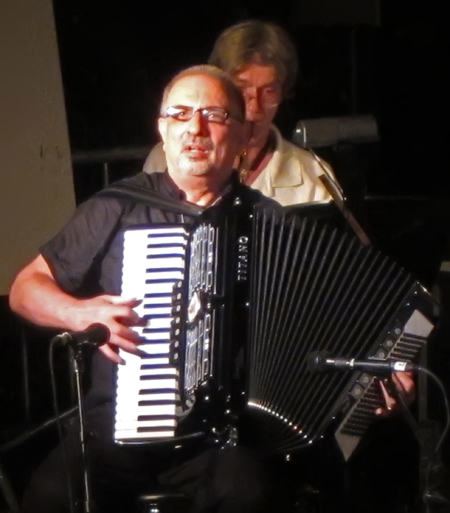
    This was the 3rd performance of this summer’s Washington Square Music Festival, in its 52nd year (their website here). The repertoire for this festival ranges widely (typically classical), and not knowing what to expect, I was surprised to find that every piece on the program included accordionist William Schimmel.

    I was riveted from the first piece. It was everything that great music should be. I later learned in my reading that Schimmel, a New Yorker, is a major heavyweight in the world of accordion. With a doctorate from Juilliard School of Music, Schimmel is credited as being one of the principal architects in the resurgence of the accordion. Regarded as the world’s greatest accordionist by National Public Radio, he has performed with virtually every major symphony orchestra in America (and the Kirov). Schimmel is a virtuoso accordionist, author, philosopher, teacher, and composer. The accolades for his playing are seemingly endless. You can visit his website here.

    I do not typically enjoy music that bills itself as inventive or innovative. But I found William Schimmel’s interpretations and quirky style not only refreshing but also purely enjoyable.

    I need no further evangelical exposure to the instrument, because in every sense of the word, when it comes to accordion, I have been saved, and William Schimmel is truly the Redeemer

    *A classic Far Side cartoon shows a split panel, one side showing St. Peter greeting people entering the pearly gates, saying, “Welcome to Heaven, here’s your harp.” On the other panel, the Devil greets at the gates of Hell, saying, “Welcome to Hell, here’s your accordion.”

    Posted on by Brian Dubé


  • dinamic_sidebar 4 none

©2026 New York Daily Photo Entries (RSS) and Comments (RSS)  Raindrops Theme