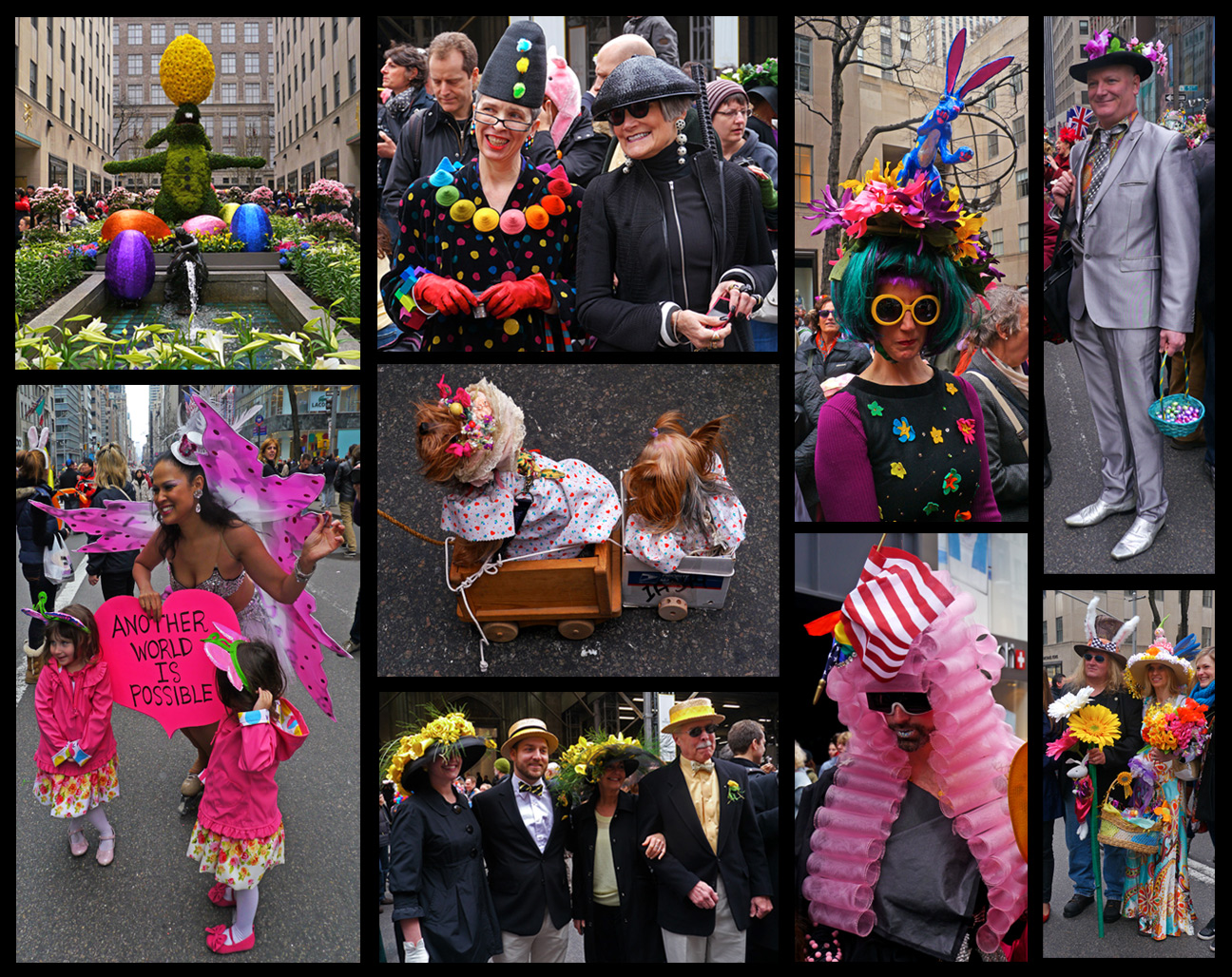
See my complete photo gallery here for the 2013 annual Easter Parade.
See my other Easter stories and photo galleries:
Easter Parade 2006
Easter Parade 2007
Easter Parade 2008
Easter Parade 2009
Easter Parade 2012
See my complete photo gallery here for the 2013 annual Easter Parade.
See my other Easter stories and photo galleries:
Easter Parade 2006
Easter Parade 2007
Easter Parade 2008
Easter Parade 2009
Easter Parade 2012
I was standing in my brother-in-law Alan’s shop in front of his mechanical beast – a drag racing motorcycle capable of over 200 miles per hour speed. Alan was telling me about the details of drag racing – races that only last seconds, engines powered by rocket fuel – nitromethane – and that needed to be rebuilt after every run. I was particularly fascinated when he told me that the roar of engines was so loud that race goers can see their shirts flutter when hammered by shockwaves. All the numbers he was citing were extraordinary and off the charts – horsepower per cylinder, decibel levels, speed, G-force from acceleration, and races won or lost by hundredths of a second. It sounded like an experience worth having at least once, however, I have yet to attend a drag race in person.
When I commented that much of his life seemed defined by speed, he corrected me adding “and power.” In a world where we often feel powerless against Mother Nature and in our feeble efforts to combat her, the quest for power is understandable. I immediately reflected back on my high school acquaintance who had told me that upon graduation he was going to trade school to major in power (as I wrote about in Pork and Power).
Do vehicles sporting tremendous power and speed seem to be a world apart from New York City? Perhaps not. Circle Line Sightseeing Cruises, the company that operates the well-known boat tours around the city, also runs New York’s only jet powered thrill-ride speedboat attraction – The Beast. For $27 you can experience a roller coaster ride atop a neon green, shark-toothed, 70-foot, 140-passenger monster machine traveling at 45 miles per hour to blasting music. The 30-minute ride, replete with 180-degree hairpin turns is guaranteed to get you wet while seeing the sites of New York City from the Hudson River.
For a tamer tour via the city’s waterways, there is kayaking, sailing, or the classic Circle Line tour which circumnavigates the entire isle of Manhattan. There are many ways to see the city as there are modes and methods of transport. For some, it’s a stroll in the park, a walk down Fifth Avenue, a ferry ride to Staten Island, crossing the Brooklyn Bridge by bike, a Water Taxi, flying down the Cyclone, or atop the Wonder Wheel of Coney Island. For others, Power and Speed are necessary components, and whether atop a nitro-powered drag racer or perhaps aboard a jet-powered tour boat, no vehicle will do it short of a mechanical Beast
I’ve been learning a lot lately about disaster relief – insurance adjusters, the Red Cross, FEMA, tree cutters, water mitigation services, professional drying, pumping water. And shoveling mud. As many as 40,000 New Yorkers have been left homeless after Hurricane Sandy. 80,000 have already filed for Federal relief. Gas stations, often supervised by police, still have lines as long as 6 hours. Many are closed for lack of power.
I spent most of the last week in Staten Island, helping friends with a home located in a flood zone. It truly is a DISASTER, with over 20 dead in Staten Island alone and houses entirely swept away. In the worst hit areas, entire contents of homes sit on front yards, one home after the next, waiting for pickup by sanitation. Generators are everywhere, used to pump water from basements. There is the occasional sound of chainsaws as residents cut their way out of this disaster.
Seawater mixed with raw sewage means that for most, little is salvageable. Carpets must be ripped out, floors completely removed, walls cut away, mold remediated, basements pumped, dried, and sanitized. Electrical systems are completely damaged, as well as appliances and, in many cases, furniture. Many families with extensive damage will take what insurance money they may get, if any, and walk away from their homes.
Emergency public services are OVERLOADED – no one responds or answer phones. The most effective road to recovery in all this? Neighbors, volunteerism or, as a fireman suggested to me, pay for things out of pocket and hope to recover the costs from insurance later. Volunteer groups are everywhere. Michael Blyth, a school teacher at Michael Petrides school, was manning the street I was on with student volunteers able and ready for any task. Vehicles with water and every manner of household cleaners and supplies passed through the neighborhood, as did Army jeeps.
I spent the weekend filling 33 gallon trash bags and rummaging through household belongings, sorting the dry and the damp from those articles soaked with seawater and raw sewage in a house without power, light, or heat. Even when power is restored by the utilities, in homes with heavily flooded basements (as my friend’s was), power cannot be turned on without the risk of explosion. Entire panels and electrical systems need to be replaced. On Sunday, clocks were set back to Daylight Savings time, so we raced against an earlier setting sun in the late afternoon, finishing the day’s work by flashlight as temperatures dipped in a cold house. But as bad as this home had been hit, there was still much worse, and at the day’s end, I was lucky to have a warm, dry apartment to return to with my possessions intact. I can’t exactly say it is joyful, because the experience has left an indelible imprint on my mind.
In the morning, it’s easy getting ready for the day’s work ahead. Rubber boots are the only sensible footwear choice. And you might as well just put on Yesterday’s Muddy Pants…
For those wondering what New York City is like in lower Manhattan, try no electricity, no heat, no hot water, no subway, no lights, no Internet for most. No elevators, no cooking for many, no refrigeration. It’s cold, dark, and primitive. It has been days and will be days longer. For now, it’s One Candle Power
There are areas of New York City that go virtually unseen by both residents and visitors. Places like The Hole and Dead Horse Bay are anomalies and perfect for the urban explorer looking for the atypical. The city’s enormous population requires a staggering infrastructure of supporting services – food distribution, wholesale markets, and small manufacturers. These businesses can neither afford prime real estate nor do they need to be in those neighborhoods. So, areas like Hunt’s Point are also found off the beaten path, rarely seen except to those who have specific business there. Or to writers looking to risk arrest for a story about a floating prison.
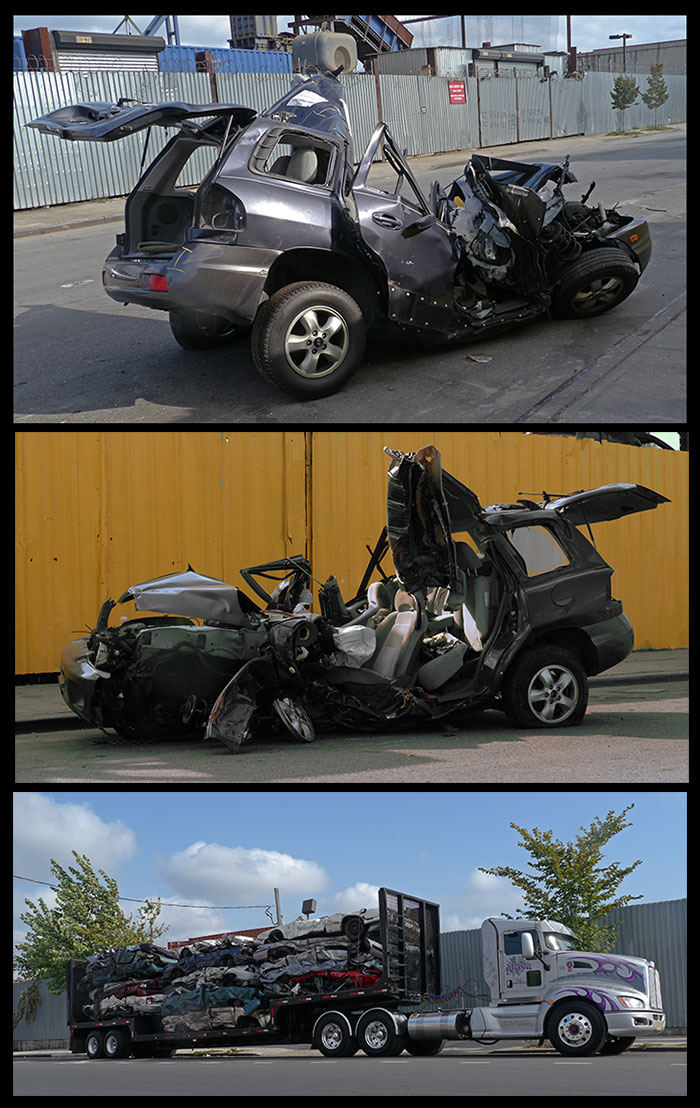
The Bronx is home to many auto service and supply businesses. On my recent excursion to the Vernon C. Bain jail barge, I witnessed the sight in today’s photo. Here, in the South Bronx on Drake Street, surrounded by metal shops and auto wreckers, I spotted this completely wrecked automobile. I was reminded of the song The Wreck on the Highway, recorded by Roy Acuff in 1942*. Although quite morose, the song became a national country hit. Here are the lyrics:
Who did you say it was brother?
Who was it fell by the way?
When whiskey and blood run together
Did you hear anyone pray?
CHORUS
I didn’t hear nobody pray, dear brother
I didn’t hear nobody pray
I heard the crash on the highway
But, I didn’t hear nobody pray.
When I heard the crash on the highway
I knew what it was from the start
I went to the scene of destruction
And a picture was stamped on my heart.
There was whiskey and blood all together
Mixed with glass where they lay
Death played her hand in destruction
But I didn’t hear nobody pray.
I wish I could change this sad story
That I am now telling you
But there is no way I can change it
For somebody’s life is now through.
Their soul has been called by the Master
They died in a crash on the way
And I heard the groans of the dying
But, I didn’t hear nobody pray.
I hope the occupants of this vehicle did not meet a fate as dire as that described by Roy Acuff. Things have changed since Roy’s time in the 1930s-40s – some worse, some better, like safety belts and airbags. Examining the photos, it does appear that airbags were deployed in this Wreck on the Highway…
*The song was actually the subject of a legal dispute. “I Didn’t Hear Anybody Pray”, about a fatal car accident, was written by Dorsey Dixon and recorded by the Dixon brothers in 1938. It was later recorded as “The Wreck on the Highway” by country musician Roy Acuff in 1942. Acuff did not remember where he knew the song from but claimed it as his own. “Wreck on the Highway” became a national country music hit, but Dixon received no royalties. At his family’s insistence, in the mid-1940s, Dixon filed a lawsuit against Acuff, and in 1946 an out-of-court settlement was reached. Dixon was granted ownership of “Wreck on the Highway”, a third of the existing $5,000 royalties, and an “undisclosed percentage” of future royalties. Dixon later adopted Acuff’s title, and “Wreck on the Highway” became his “best-known and arguably his greatest composition.”
I have a nephew who is quite tall. As he was growing up and it was clear that he was going to be very tall, it became the popular subject on my visits home. My mother could not refrain from pointing out how big and tall her grandson was, just beaming with pride, repeating ad nauseum things such as look how tall he is, or he is going to be really big, or he is bigger than his father already, etc. I also grew up in an era where I had to hear about men who were tall, dark, and handsome, like movie star icons or my father. However, being of average height, I did not grow up with any major psychological damage, only occasional lingering curiosity as to the nature of an alternate life had I been very tall.
Apparently, there is merit to all this madness about height. I just finished reading “6 reasons why tall people are better than you,” which includes the facts that tall people earn more money, are considered more attractive, are better athletes, are leaders, and that women prefer tall men. According to a study by the National Bureau of Economic Research, both men and women who are above average height — 5 ft. 10 in. for males, 5 ft. 4 in. for females — report higher levels of happiness than smaller people.
And, of course, the most often cited benefits for taller men is that women choose them because they are seen as more powerful and can better protect them and their children from other males. One study has shown men hit hardest when striking downwards and that the blows of a taller man are more powerful than those of a short man. Scientists have found that our prehistoric ancestors punched hardest when they stood on two legs – it is thought that fighting was the driving force behind the evolution of upright walking and that males would be better at beating and killing each other when competing for females. If taller is better, then perhaps it would explain one of the appeals of stilt walking.
Recently, while sitting with friends in Washington Square Park, a group of stilt walkers appeared unexpectedly. Not the most common of sights, even in New York City. I scurried over to one of the group that I recognized from afar – Michael McGuigan, the managing director of the Bond Street Theatre Coalition. The other members of the group were interns. I asked if he would come say hello to my group of comrades. He happily obliged, as is his nature. Not a surprise for a man who, along with his wife Joanna Sherman, have spent a lifetime in programs of a philanthropic nature. Read more about them and their organization here. I made the introductions and we all chatted briefly, looking up at the very tall man. As Michael rejoined his group, I went with them, capturing a few photos along with a short video you can see below.
It occurred to me today as I wrote this, that perhaps I should have become a stilt walker and put to rest for good any concerns about being tall enough or missing any possible commensurate benefits. What better place to aspire to great heights than New York City, where everything and everyone towers above and looms large?
And my nephew, no longer king of the hill, would have to learn to play second fiddle. I would enter the ranks of the high and mighty, laugh at the world below like Mike McGuigan, and begin to hear something new wherever I roamed – Look How Tall He Is
Want to learn more about what I do for a living? Check out Just Like Them, Shop Class, Smile By Fire, Not Of Them, Please Rub Off On Me, Just Like Steve Mills, On the Road, Supercute!, Viktoria’s Secret, Signature, Spinning, and Juggle This, as well as my websites for my juggling equipment and hoops.
In my favorite film, Bedazzled (1967 starring Peter Cook and Dudley Moore), the Devil, on the first meeting with his victim, convinces him that he is indeed the Devil incarnate by telling him details and facts of his life that no mortal could know. He gives a brief genealogy of the victim, and at one point in the lineage he says:
Your great-great-great grandfather, Ephraim Moon, sailed to Australia in 1782 on a ship of the Line. Set himself up as an apothecary. The business flourished, and by the time he died it was worth something in the region of 2,000 pounds – a large amount in those days.
Your great-great-grandfather, Cedric Moon, by skillful management and careful husbandry, increased that sum a hundredfold.
The Devil, in his devious and duplicitous ways, goes on to tell his victim that, unfortunately, all such wealth was frittered away by his grandfather, leaving the victim in his present plight – “penniless and on the brink of suicide.” The solution is, of course, to avail himself of the Devil’s services by selling his soul for seven wishes.
I have always loved the phrase “skillful management and careful husbandry,” but I find no occasion to use it. After all, who and how many have the character, temperament, tenacity, and have, through their example, made themselves worthy of such a descriptive? Not many. Perhaps some of New York City’s more ambitious can collectors merit such words.
This is a city of extremes – extreme contrasts and people taking things to extremes. Things unfamiliar, infrequently seen, or of a perfunctory nature elsewhere can become enterprises and industries here, like the collection and redemption of bottles and cans for recycling. On February 1, 2010, I wrote Down on His Luck about a can redemption center in Harlem.
On the collection side, bottles must be harvested, bagged, and transported from place to place and eventually to a redemption center. For greater efficiency and productivity, these treasure troves must be guarded and shepherded through the city streets. Accumulations are neatly stacked – these urban armadas and flotillas are relatively common sights in the city. On April 5, 2007, I wrote Caravan of Dreams, and on August 28, 2009, I wrote Trash and Treasure. On September 5, 2008, I witnessed a veritable wagon train and featured it in Property Owner.
Recently, while walking on MacDougal Street, I encountered a can collector who took the enterprise to dizzying heights. Cans and bottles were neatly bagged and precariously stacked, in an enormous cache that could only have been done through Skillful Management and Careful Husbandry
In New Yorkers Gone Wild, I wrote of my high school English teacher, an extremely iconoclastic, outspoken, and controversial figure. He was, in many ways, our version of Dead Poets Society’s John Keating. He made a number of observations and recommended readings, all of which I took to heart, some more poignant and relevant in my life than others. Upon reading the Secret Life of Walter Mitty by James Thurber, he pointed out the value of becoming familiar with the character, telling us that we would encounter references to Walter Mitty later in life.
This turned out to be one of the things of lesser value in my life – I never recall anyone referencing Walter Mitty. I have, however, met many New Yorkers who do have a secret life, an alternate persona, or a cover that does not reflect the book’s contents. These individuals were the inspiration for a series of stories I have written entitled Abandon All Preconceived Notions Ye Who Enter here.
I have attended the annual HOWL! festival for a number of years. You can read more about it in my 2007 posting on the festival. Invariably I find something of interest, whether a band playing live music, a performance, a work of art, or an interesting character.
It was at this year’s festival that I encountered a Mittyesque character exhibiting his work at the festival’s Art Around the Park. Exhibiting is the appropriate word to describe Rolando Vega, an attendee of the festival since its inception. Rolando’s getup was certainly flamboyant, reminiscent of André Johnson, aka André J., a man I wrote about in Out There and Fashion Forward.
Rolando, however, is not in the fashion business, nor does he live an “artsy” lifestyle. He holds a high-level position in the corporate world and is a family man with two children. Rolando told me that he has worked since he was 14 and is a native New Yorker, having grown up in the projects of Red Hook, Brooklyn. Here, in today’s photos, you can see him as his alter ego, Chickinman, aka Walter Mitty
Abandon All Preconceived Notions stories: Mark Birnbaum (Part 1 and Part 2), Gaby Lampkey (Part 1 and Part 2), Jenn Kabacinski (Part 1 and Part 2), Driss Aqil
The outlaw spirit is alive and well in New York City. On my visit to Salerno Service Station on Saturday, April 28, 2012, a small group of bikers convened at the station. I brought it to Mario’s attention, and he informed me that there was a club house for the East Williamsburg chapter of the Unknown Bikers around the corner at 41 Maujer Street. I found them somewhat intimidating, but Mario assured me that the bikers had posed no problem to them at all over the years.
As I sauntered over to Maujer Street, I noticed that the street had been closed off with traffic cones to all but the motorcyclists. My timing was perfect – within seconds of my arrival, the street was filled with bikes and bikers.
Others were taking photos and filming, and I followed suit. I am always careful around bikers, not knowing what type of reaction I might get taking photos. I was scrutinized by numerous members, but it appeared that I had some type of tacit approval.
Certainly bikers come from all walks of life and, to some extent, are like the rest of us. But there has to be an element of iconoclasm for someone to ride a Harley, join a motorcycle club, and wear a jacket proclaiming membership. There is a defiance, a renegade outlaw free spirit that has surrounded motorcycles since their origins, and belonging to a motorcycle club and wearing a jacket certainly makes that statement.
It was clear that some type of event was underway. I asked the nature of the gathering, and I was introduced to the organizer who informed me that this was a charity effort, the 4th Annual Alie Run of Bikers Against Childhood Cancer Foundation. The final destination of the bikers would be the Brooklyn Hospital. Salerno Service Station is one of the sponsors of the event.
The organizer assured me that the members were regular people just like everyone else. Admittedly, I was surprised that the nature of the meeting was a children’s charity event. Actually, motorcycle charity rides are common throughout the United States. I imagine some cynics may feel that these efforts are only bad boys trying to ingratiate themselves with the public. I will give them the benefit of the doubt. Here, in East Williamsburg, Brooklyn, it looks to me like goodwill, courtesy of the Unknown Bikers
Going Fetal (see Part 1 here)
Everyone assumed that this was a magnanimous marriage proposal. However, what I learned by talking to one of their friends is that these were two NYU students who had been in a relationship and broken up. The boy wanted to rejoin with the girl and decided to surprise her with an extraordinary public proposal to reunite.
Things did not go well. The girl made no eye contact at all with her courter for much of the time and spoke to him very little. She never did accept the rose he held and offered her. He had a microphone which he offered, but she essentially refused to speak. She smiled some and cried some. But mostly she stood stoically or cowered silently. It was an embarrassment for all and, to me, an inappropriate attempt to strong-arm a woman via the pressure of public display and make rejection much more difficult. But she stood her ground. If she does not want him, then good for her. I don’t see this kind of persuasion as an effective tactic for the success of a long-term relationship.
A large portion of my accompanying video for today’s story was shot by Hellen Osgood. When initially viewing it, I was disappointed that the running commentary by her husband Harvey was audible through most of the footage. However, on reviewing it and listening to what he had to say, I found his insightful thinking to be the best part of the event and much more interesting than watching the courted stonewalling her courter. His commentary was unintentionally very funny, offering much needed comic relief to a rather tragic affair. Below are some of Harvey’s pithy remarks. Please be reminded that at the time he made them, we all thought this was a marriage proposal.
What’s she going to do, have a nervous breakdown? Brilliant, brilliant. [sarcastically]
How do you say “no” in Japanese? This is nuts. You don’t go through this. You say, “Give me five minutes.” You gotta cut it short. How long can she stand there?
She can call a lifeline, can’t ya? Can’t you ask for help?
He doesn’t understand, this is her life, her destiny, right? And they’re playing music.
Nice. She’s doing the right thing… she’s going in the fetal position. That’s what I would do under the circumstances, definitely. Go fetal on him. See what he can do about that. He he he he.
Oh nice, if she throws up, do you think he will get the hint? What if she just absolutely throws up, right there? That’s considered to be a very passive-aggressive action when someone proposes marriage to you and you throw up.
Is this strictly being done for her benefit and nobody else, like a Bob Dylan concert?
This is heavy-duty stuff.
Don’t shoot the piano player. He’s just an innocent bystander.
Sadly, this embarrassing affair could have easily been avoided by heeding the age-old admonition which was simply stated and sung by the Beatles in 1964: (money) Can’t Buy Me Love. But it sure can buy the Very Awkward ![]()
More on romance and couples: Big, Big Mistake (Part 1, Part 2, and Part 3), Happy Valentine’s Day, Foolish World of the Fiscally Frivolous, The Perfect Gift, Get a Room, Be My Valentine, PDA, War…and Peace
As any experienced man knows, flowers are the way to a woman’s heart. Experts have even done a number of studies corroborating what we knew all along. In my case, I had to relearn this lesson in the most painful way. I hope my lesson helped others avoid the mistake I made.
Yesterday, photographer friend Bill Shatto, always on the lookout for photo-worthy subjects, sent me a text with an image of a massive flower arrangement. When we spoke on the phone, he said that the whole affair might be blog-worthy. Bill is not one inclined to superlatives, and when he makes any kind of recommendation, it typically is a main event. So, reluctant to run out and shoot in the rain, nonetheless, I grabbed my camera and umbrella and made my way to Washington Square Arch.
The scene looked like the type of event requiring a permit. From a distance, I could make out a large truck standing by the arch. Someone was making a monumental statement. When I finally arrived, a small ensemble was playing music under the arch. A baby grand piano had been moved in, along with a full drum set. The centerpiece of the extravaganza was a huge number of roses clustered and arranged into a large heart. A small number of friends were on hand, as were a number of passersby. It appeared that someone was making a marriage proposal.
Coincidentally, on the scene were friends and neighborhood residents Hellen and Harvey Osgood, subjects of a previous story. Hellen had been filming the event, and the impression she had gathered was that things were not going as well as planned. I approached the couple involved, and the facts were somewhat different yet. Tomorrow, I will feature photos of the couple, video of the proposal, and why I believe the best phrase to describe the whole thing to be Very Awkward…
Not everyone is blessed with the depth and breadth of the Renaissance man. Often, a person may only have a singular talent, skill, idea, or gimmick which is clever but, like the one-tricky pony of early America, is not enough to build a world around. A circus needs more than one act.
However, in New York City, with careful husbandry and aggressive marketing, one can cultivate even the most singular ideas and make a splash. In some cases, entire careers can be built around one trick, like the Naked Cowboy. Others, who are less ambitious, more interested in casual fun, or just want to enjoy the occasional limelight and ego boost can enjoy a degree of notoriety. Characters often frequent regular events or become neighborhood institutions - the proverbial big fish in the small pond. People like Spike or André, for example, are household names in the Village.
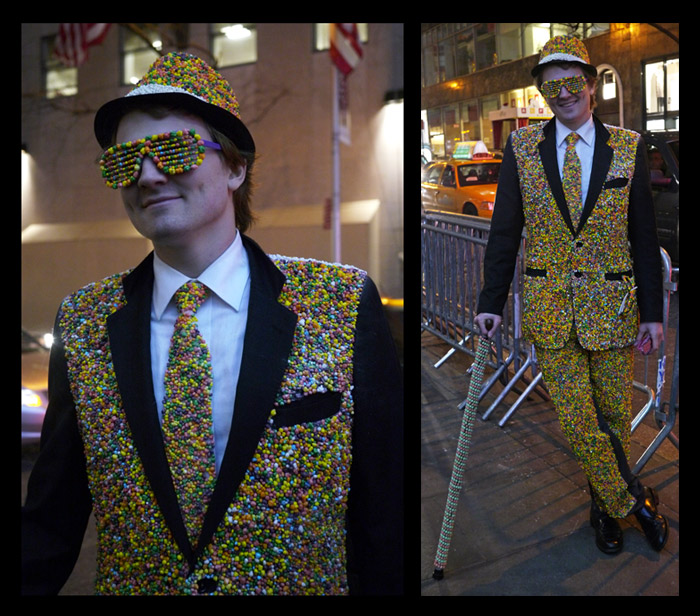
Recently, after my annual pilgrimage to Fifth Avenue to visit the holiday window displays, I caroused Rockefeller Center, with its skating rink and the Christmas tree. Before leaving, I encountered the Candy Man, completely outfitted in a wardrobe decorated in Nerds candies, including sunglasses. He, like many others I have spoken to (such as Mark Birnbaum), cite the pleasure and happiness they bring others as one of the primary reasons they make public appearances.
In a Christmas season with commercialism and gift-giving gone wild, what better gift to give others than a moment of joy, even if that of the One-Trick Pony
Related Posts: King of Accordion, Swaggertist in Blue
My fifth year at the annual Village Halloween Parade. A spectacular event. See my previous postings for photos and information about the parade: Halloween Parade 2010, Halloween Parade 2009, Halloween Parade 2008 Part 1 and Part 2, Village Halloween Parade 2007 #1 and #2, Village Parade 2007 Preview, Village Halloween Parade 2006 , Halloween Parade 2006 Preview
Barry does not ask for much. He only wants to be known as the King of Accordion. But the media attention he has received spins him the way it wants, so to the media, he is the King of whatever works best to suit their needs, including the front man to a recent Occupy Wall Street march. A little spin or artistic license often makes a story more enjoyable to read – I have been guilty of that myself. My writing has evolved from the fact-reporting style of the news journalist to one that is highly personal, weaving in connections from my life experience that are triggered by the place, person, or thing which I write about.
Nonetheless, I do like to feel that I have neither misunderstood nor miscommunicated the feelings and thoughts of an individual subject. It is for this reason that on personal profiles, I often email a biographical inquiry and use excerpts so that you can read the subject’s own words, not my translation. I have also frequently recorded long meetings/interviews. I make these available as well.
Barry Hamadyk, currently a Brooklyn resident, hails from New Jersey. Barry has played accordion since he was 5, and it is this love that he endeavors to communicate by attracting people with his regal garb. He can be found in the parks of New York City and is a habitue of Washington Square Park, sitting on a bench for passersby while recordings of accordion music play continuously. His preferred repertoire are waltzes and rhumbas. At one time he played organ for roller skating rinks.
Barry found that as his wardrobe became more outlandish (along with his Nordic look), the more attention he got. Once a crown was added, response went through the royal roof. This organic transformation has evolved over the last 5 years. Although, at a surface level, one may see Barry as someone akin to our friend Mark Birnbaum (with a shared passion for music), the motivations for the flamboyant dress are actually quite different, as are the men and their backgrounds.
Being referred to as the King of New York rather than the King of Accordion is not Barry’s only dismay with a news article recently written. It also was reported that “he gets a lot of money, too, without much effort.” However, Barry neither really solicits money nor collects it.
I spoke with Barry for quite some time and found him extremely forthcoming and congenial. If you meet Barry in the parks of New York, say Hi and remember, he is the King of Accordion
Related Posts: The Conductor
I don’t relish the job of creating a name for a rock group. In the world of naming, much like the perennial complaint of women about available men, it often feels like “all the good ones are taken.” Some group names are enigmatic. Others, such as Leftöver Crack and Transgendered Jesus, give a strong impression, and seeing them in person confirms any preconceived notions that WYTIWYG – what you thought is what you get. Why do I say that?
Meet cofounder of Transgendered Jesus, Anne Hanavan, a recovered East Village drug addict and prostitute. Hanavan hails from Buffalo, New York, and came to NYC in the 1980s to attend Fashion Institute of Technology. However, a cocaine habit was followed by heroin addiction. Her career as prostitute began at the downtown strip club, Pussycat Lounge, where she was originally employed as a bartender, then went on to dancing and turning tricks. This eventually evolved to streetwalking on East 12th St. and Allen St. for 8 years.
Anne cleaned up her drug habits and built her life back up, worked various jobs, and later made a foray into short films, taking film classes at NYU. The films deal with themes of growing up Irish Catholic, sex work, drug addiction, and punk rock, and are often sexually explicit.
The group name, Transgendered Jesus, is certainly provocative. In an interview in Artvoice, Anne says:
A transgendered friend of mine had posted a crazy link on Facebook to some transgendered Jesus site, and I thought it was fantastic. It summed up everything I’m about: making your own choices, believing whatever you want to believe, and that nothing has to be black and white.
I did peruse a few websites, and it was clarified that the concept of a transgendered Jesus is not to be associated with sexual orientation, only disposition. I came across statements such as:
Jesus’s feminist politics worked in tandem with his transgendered disposition.
Jesus’s Transgendered Disposition Always in Plain View!
In flesh, Jesus was the Son of Man but, in spirit, the Daughter of Mary.
The group’s shows have elements of performance art, reflecting Anne’s background as an artist and filmmaker. The show I saw was in Tompkins Square Park – the outdoor environment was not conducive to the full range of performance elements, including custom video projections, etc. that I understand often accompany their shows. But the music was loud, brash, angry, and not for mainstream tastes. But neither is the image of a Transgendered Jesus
Related Posts: WYSIWYG, False Assumptions, Piercing Al Fresco