• The Book With the Hole In It, Part 1.

    Posted on by Brian Dubé

    In the early 1970s, I worked as a freelance carpenter. At the time, numerous small agencies existed for small jobs – some only requiring a day or even several hours of work. Jobs were immediate and plentiful. Virtually no experience was necessary. Of course, better skills, feedback from clients, and reliability all factored into getting more and better jobs from the agencies.

    Those who were ambitious could parlay their experience and get affluent clients, repeat work and even very long assignments with great perks. One friend managed to get a position for months at a time as handyman at the Connecticut country home of a New York City resident. His employment included living at their country home for what essentially amounted to an all-expense-paid summer vacation with added pay. Affluent clients were typically quite generous and appreciative of those willing to do skilled and unskilled labor and indulge their whims and fancies.

    There was no screening of clients beyond a job description and the ability to pay. One burly gentleman had me build a loft bed with a staircase. He was particularly impressed with his own physical prowess, and he repeatedly asked me for assurance that the staircase would be wide enough for him to climb and that my construction would support the vigorous sexual activity of a heavy, powerful man and would not collapse. I used extra bolts.

    However, I was to learn that when exposed to a populace as large as New York City, clients like the burly man were really nothing extraordinary. To do this kind of work was to enter the homes and personal lives of New Yorkers. Many were unabashed, revealing their habits, lifestyle and needs.

    Nothing, however, could prepare me for one assignment so bizarre that it strains credulity. Trust me – this real New York City tale is 100% true and is an adventure I like to call The Book With the Hole In It

    See Part 2 here.

    Other Related Post: Never Cut a Board

    Posted on by Brian Dubé

  • War for Your Mind

    Posted on by Brian Dubé


    I can’t imagine a subject deeper, thornier, more impassioned, more complex, and more contentious in New York City than anything involving Judaism or Israel.

    So, if you want to INFLAME some New Yorkers, set up in Times Square and claim to be the only authentic descendants of the ancient Israelites.
    Then, bring a chart showing a correlation between the Biblical 12 tribes of Israel and various groups in the Americas:

    Judah — Black Americans
    Benjamin — West Indians
    Levi — Haitians
    Simeon — Dominicans
    Zebulun — Guatemalans, Panamanians
    Ephraim — Puerto Ricans
    Manasseh — Cubans
    Gad — Native American Indians
    Reuben — Seminole Indians
    Asher — Colombians, Uruguayans
    Naphtali — Argentines, Chileans
    Issachar — Mexicans

    Most New Yorkers have encountered groups of Black Hebrew Israelites, have written them off as extremists, and are unfettered by their presence as well as unwilling to waste time engaged in verbal war with them. Others, perhaps neophytes like a woman I saw there, were infuriated – she was asking everyone she could find to define Jewish and if any of these individuals fit the definition.

    In New York City, whether you encounter those who Got Religion, see a Street Revival or someone Mad as Hell (see here and here), everywhere you turn, someone wants you to share their passion or their fury. There’s a war on the streets of New York and it’s a War for Your Mind…

    Other Related Posts: Christ is Risen, I Must Confess, With All Due Respect

    Posted on by Brian Dubé

  • Crusties are People Too?

    Posted on by Brian Dubé

    Part 2 (see Part 1 here)

    I had hoped to learn a little more about Morgan and her background. In a way, one could say I had made her acquaintance. When I approached her lying in the grass on Sunday, greeting her with “Morgan Maginnis,” she jumped and ran as if she had seen the devil incarnate. It took some conversation and persuasion to convince her that I was the man who had photographed her only a few days earlier.

    She told me a little about her past – that she was from Los Angeles and that her parents had died from a combination of alcohol and an auto crash. She said that she was a college graduate with two degrees and has a job in demolition. I was told that she had just been featured in Vice Magazine and that this was her big break. Her pet rat had already died.

    I told her that I had written part one of a crustie story, that I was featuring her and that I had referred to her as “cuddly and disgusting.” I hoped she was not insulted, but it was my honest reaction to having her arms encircle me from behind while correcting an email address. She was charming, cute and filthy all together.
    She and her friends laughed and found it an apt description. One said that they were all disgusting. Perhaps, in her world, cuddly, even with a qualifier, was quite a complement, because she seemed rather pleased, repeating the phrase several times to her friends.

    On Sunday, however, things took a turn for the worse. I looked for Morgan to speak to her and glean a few more details of her life. When I found her, she was crying and recounting her day. Trying to get more drugs to supplement her methadone. Food stolen, as well as other incidents common to the homeless. Morgan is clearly angry and frustrated.

    A confrontation with a black man spun out of control. She grabbed his bag, throwing it at him as well as away from them. She accused him of being like other blacks who had raped her. The ranting, vulgarity and drama escalated. She was running through the park, screaming and throwing things. Bystanders were running scattershot in fear of being a victim. I was wary myself. Although the acting out was largely drama, Morgan is not incapable of inflicting bodily harm and I learned that she has been arrested numerous times.

    Like those who naively believe they can domesticate a wild animal, I left feeling a little foolish, thinking that a relationship approaching normalcy could be had with a drug addicted crust punk. I had descended to the bottom, and I am saddened by what I see there. Drugs are unforgiving, and their allure is a cruel mirage. It’s a world of false promises of peer respect and the charm of nihilism and anarchy.

    The future is dim for these individuals, and their lives will likely be quite short. No one wants to invest time in fanning dying embers. They are the trash of contemporary society and the only talk I hear is where to relocate them. They are filthy, disgusting, and violent, so get them away from here. Only the sanctity of human life and the 5th/6th Commandment prevents many from suggesting the simplest solution while asking the rhetorical, Crusties are People Too?

    Other Related Posts: Jenn Kabacinski Part 2, Jenn Kabacinski Part 1, Misfits, Stephanie, Police Riot Concert

    Posted on by Brian Dubé

  • Crusties are People Too, Part 1

    Posted on by Brian Dubé

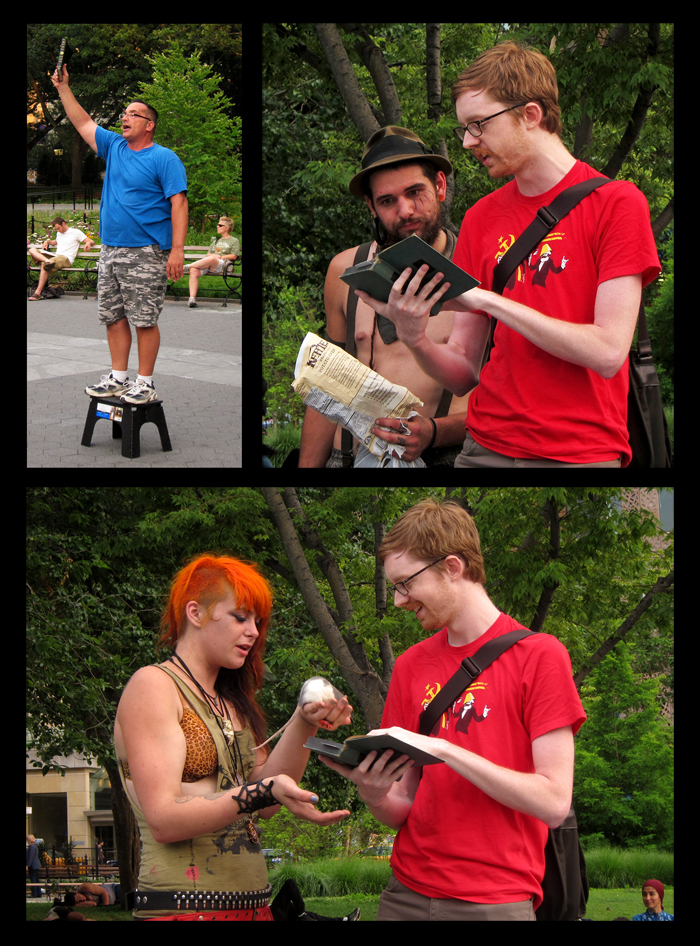
    Christian Meets Chaucer and Crusties


    Let’s create an impossible scenario. Start with a Bible-thumping preacher standing on a small stool, screaming scripture aloud in a park using amplification. The police arrive after a noise complaint by a hostile man with a long white beard and hair – the incarnation of Mr. Natural ala R. Crumb. He also complains that he does not believe the preaching is biblically accurate (not an arrestable offense). The preacher informs the police that there is case law that says preaching with amplification is not illegal and that only volume can be regulated. He looks for the court ruling on his iPhone and will fax it to the police precinct. The police back off.

    Another preacher begins, his voice volume greater than that generated by the small amplifier used previously. Simultaneously, a young man is reading loudly from a text, directed at the preacher. I cannot recognize the language – I assume it is a religious text, perhaps in Hebrew and ask him about it. He is an English literature student and is reading the Canterbury Tales in the original Middle English at full volume. It’s a war of words…

    A crust punk eating potato chips takes an interest in the Canterbury Tales and stands near the student, following the reading. Another crusty in bright orange hair joins them and eagerly introduces her newly acquired pet rat to the student. Christian meet Chaucer with crusties. It is like a family reunion.

    I become too friendly with the crusties, particularly the one with orange hair. I ask if she minds if we take photos. She grants my wish, and my photographer friend Bill and I go into overdrive, shooting away. I learn that the woman’s name is Morgan Maginnis. She is very nice, as is her friend, Hays. I ask her a few questions and I videotape her. They give me their email addresses. I am both warmed and disgusted when she wraps her arms around me from behind and takes my pen to clarify one letter in the email address. She is cute, cuddly and very dirty.

    Late that night, I run across Morgan, Hays and a group of their friends several blocks from the park behind a luxury highrise apartment building. They recognize me. I stop, say hello and chat. One has an iPhone and asks me to take group photos of them. I take photos with my own camera and assure them that I will email them photos. I ask them direct questions about sex and drugs. They give me direct answers. Are we becoming friends now?

    Crusties have been a big problem in the parks. They have been unruly, troublesome, belligerent, drug addicted, homeless, typically jobless and leave garbage strewn everywhere with a virtual campsite in Washington Square Park. You’re not supposed to like them. But I learn that Crusties are People Too

    Note: In Part 2, we get a little closer to Morgan through text and video.

    Related Posts: Jenn Kabacinski Part 2, Jenn Kabacinski Part 1, Misfits, Cosmetics, Crustie, Stephanie, Police Riot Concert

    Posted on by Brian Dubé

  • Drooling and Slobbering

    Posted on by Brian Dubé


    Emotive forces play a large part in our lives, often trumping the “sensible.” We eat too much or the wrong foods, date the wrong people, choose careers with dim prospects, buy things we don’t need. New York City has its own brand of impractical indulgences – driving in SUVs and living with huge dogs in small apartments.

    Seeing a New Yorker with a Great Dane, Mastiff, Great Pyrenees or Irish Wolfhound is not as rare an occurrence as one might expect. New Yorkers like to think big, and dogs are no exception. However, everything about these critters is big – size, weight, smell, hair, food consumed, excretions and slobbering. Many weigh more than their owners, as I imagine is the case in today’s photo. A large dog dominates an apartment space. Many describe the experience as living with a roommate.

    In 2004, the New York Times ran a story, Rooming With the Big Dogs; 140-Pound City Pets and the People Who Love Them. Parts of the story were incredible, others bordering on the hysterical. The Times story tells of a married couple, Barry Kellman, his wife Shane, and their English mastiff, Brutus. During her pregnancy, Shane threw the dog out. Determined to keep him, Barry began boarding him. As costs mounted, he rented an apartment for Brutus at $1800 per month. From the article:

    To meet Brutus is to appreciate the challenge of living with him. He slurps water from his bowl like a horse at a trough. He urinates with considerable force and stamina. ”This goes for about 15 minutes,” said Paul D’Amato, the doorman of his building. ”He’s a tank.”

    Brutus also drools constantly: when he walks, saliva swings like a pendulum. When he shakes his head, it flies onto the walls, the front door, Mr. Kellman’s clothes (the dry cleaning bill is about $400 a month), and in places not to be believed.

    ”Every now and then you’ll see something hanging from the ceiling,” said Mr. Kellman. He once found it in his shoes. But Brutus’s charm is undeniable. His trusting eyes and massive head bring to mind E.T., the extra-terrestrial.

    When his marriage ended, Kellman moved into Brutus’s apartment. It must be a case of love and marriage, because I just could not deal with all that Drooling and Slobbering 🙂

    Related Posts: That Should Cover It, Blessing of the Animals, Water 4 Dogs, Pet Pride Parade, à la Chien, Zoomies, Robin Kovary Run for Small Dogs, Dachshund Octoberfest, Wolfdog, Dog Dating, Dog Run

    Posted on by Brian Dubé

  • Chutzpah, Part 2

    Posted on by Brian Dubé

    (see Part 1 here)

    “In New York City, one’s net worth of social currency is based not so much on who you know, but how you can get seated in the most important restaurants.” – Myra Smolev

    In this tale of unmitigated nerve, Myra tells of how she got a table at the River Cafe for friends arriving from Milan who had heard that this was the place to eat. However, at the time, typical of popular restaurants, it was IMPOSSIBLE to get a reservation.

    But Myra, a New York City born aggressive and successful Jewish woman, succeeds with a little drama, creative thinking and classic Chutzpah 🙂

    Related Posts: Just Click Here, Myra’s Isle, Ride to Hell, Eternal Vigilance and Tenacity, Toches ahfen tish!, New Yawk Style, Shalom, Bagels

    Posted on by Brian Dubé

  • Chutzpah

    Posted on by Brian Dubé

    Part 1


    I have written before about the prominent role of Yiddish in New York City (see here). One word that well describes a character trait often needed for success here is chutzpah. Chutzpah derives from the Hebrew ?u?pâ (????????), meaning audacity – someone who has overstepped the line of acceptable behavior with no shame. In Yiddish, the word has broadened in meaning and now has a more positive connotation, i.e. a gutsy attitude which serves admirably to achieve an end. If you live here, you will hear it often.

    Leo Rosten in The Joys of Yiddish defines Chutzpah as “gall, brazen nerve, effrontery, incredible ‘guts,’ presumption plus arrogance such as no other word and no other language can do justice to.” The word has been used over 200 times in legal opinions, including a US Supreme Court case.

    Recently, at a friend’s home, Myra Smolev told a tale of chutzpah so outrageous, that I asked if she would retell it, allow me to video tape it, audio record it for podcast and post it as a story here. She agreed and on the 4th of July, at a small party at her home, Myra told her story of Chutzpah. It will be revealed tomorrow 🙂

    See Part 2 here, complete with video.

    Related Posts: Just Click Here, Myra’s Isle, Ride to Hell, Eternal Vigilance and Tenacity, Toches ahfen tish!, New Yawk Style, Shalom, Bagels

    Posted on by Brian Dubé

  • Mike Fontana

    Posted on by Brian Dubé

    Part 2 – Surrender to the Music (see Part 1 here)


    Immersion took on a new meaning for me when virtual reality technologies were developed and became surrounded by media buzz. The operative phrase became total immersion experience. For something to truly feel real, input to all five senses must reach a level where the user perceives them to be real.

    In on our non-virtual world, I believe we have an analogous situation. When we reach sensory overload and the stimuli are positive, we feel euphoria, exhilaration, or pure joy. We lose the ability to intellectualize, analyze and stand outside the experience as observer. You are fully IN the experience.

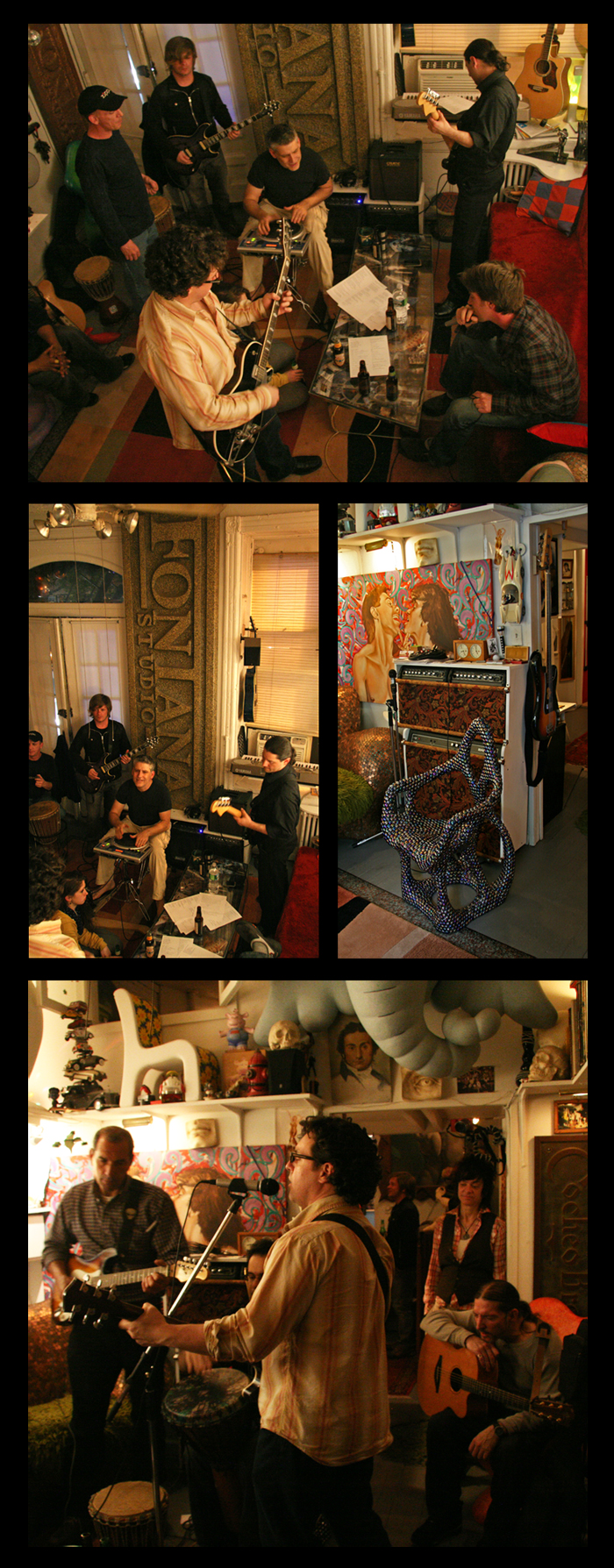
    My first meeting with Mike Fontana was short but exciting. Here was a working artist on St. Marks Place between 2nd and 3rd Avenue, the historical nexus of the East Village. A brief moment standing on his 2nd floor balcony connected me with that past. While there, friends dropped in, seemingly unannounced, reminiscent of my childhood, where making rounds visiting relatives (often unannounced) was de rigueur. I was informed by the friend who made the introduction that Mike hosted regular music jams and every first Wednesday of the month, there was a open megajam.

    On Wednesday May 4, 2011, I went to Mike Fontana’s, armed with cameras and camcorder. Mike is disarmingly cordial, convivial and generous. His home is your home. There is an openness rarely found in New York City. He welcomed me to make use of his loft bed which had a windowed opening through a wall, permitting a treehouse view of the living room which was filled with musicians. Many of the photos for part 1 of this story were taken from this aerie.

    In short order, the entire apartment was teaming with musicians. This was a full-fledged rock and roll extravaganza, the likes of which I have never seen in a private home:

    Mike assured me that the neighbors were not always as pleased as the jam participants. The living room is well outfitted with amplifiers – guitarists only need to bring their axes and plug in. Mike was busy on his drum pads with all the enthusiasm of a boy who just unwrapped his first set at Christmas.

    It is easy to get caught up in an urban life filled with agendas and completely lose touch with your own humanity. As I wrote in Duffy , when life’s routines begin to take over, it’s time to recharge your batteries. Grab a surfboard and jump in. Immerse and lose yourself. Take off your armor. Fall in love, head over heels. Find a music jam, sing out and surrender to the music

    Note: You can find Mike Fontana’s website here.

    Related Posts: I Got Caught, New York Is Bluegrass Country, Pockets of Joy, The Conductor Paddy Reilly’s, Park Night

    Posted on by Brian Dubé

  • Mike Fontana

    Posted on by Brian Dubé

    Part 1


    In May, I was asked by a friend if I would be willing to guest host a local access TV program which he will be producing using the facilities at MNN, a local access cable television network based in New York City. This is an exciting opportunity and I readily agreed.

    The show is being put together as a final project for my friend’s training at the network. His plan is a 28 minute program consisting of 2 interviews with two artists. One of those men is Mike Fontana. We agreed to visit Mike together for a preliminary meeting. Mike lives in one those unlikely locations – a street so well known for its shops that the prospect of an artist living on St. Marks Place between 2nd and 3rd Avenue is hard to imagine.

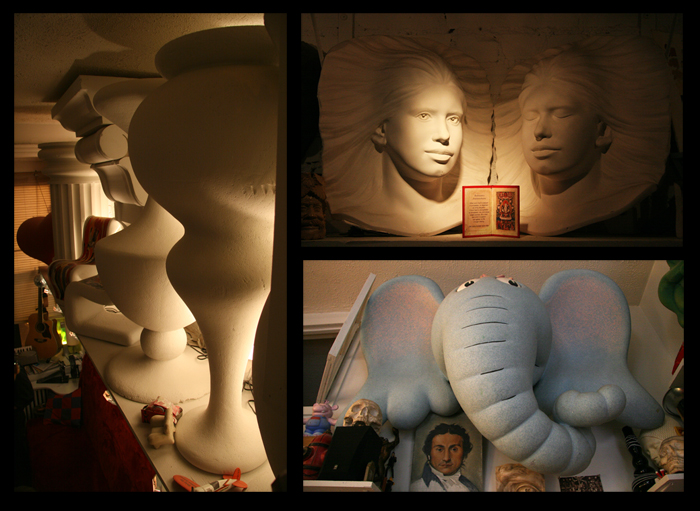
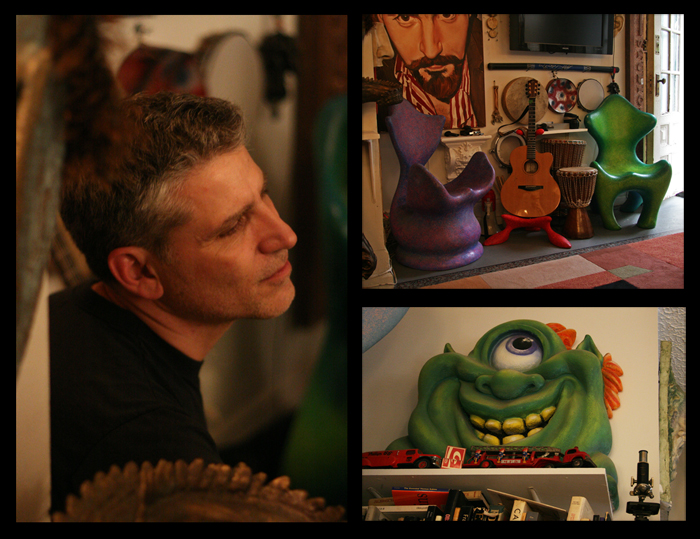
    Mike’s home is a shrine to his sculptural work – every wall, corner, shelf, room, piece of furniture. A small balcony a the front of the building overlooks St. Marks from the second floor.
    Mike is a native New Yorker, born here in 1961. As I typically do with my profiles, I corresponded with Mike by email to learn more about him and his background. Mike spent a semester at SVA and a year and a half at Art Student’s league. There, he was a drawing and anatomy major. Mike says:

    I dropped out of high school to work with my families photographic retouching studio. I’d spent some years in construction, mostly as a carpenter, building houses, apartments, renovation etc… All the while making paintings. Found work with Macy’s Thanksgiving Parade Studio where I ended up becoming Chief Sculptor and Associate designer. Many long stories there. I stayed 12 years. Since then I’ve pursued all kinds of sculpting and design endeavors from props and display to major historical monuments, museum figures, fabrication for major artists ( “I don’t have to finger paint any more.”) and, my own stuff.

    I was amazed to learn about Mike’s family background:

    Father: Illustrious family origin, aristocracy, 700 year old name. Grand father: famous opera star early 20th century. Caruso was my dad’s step father. Dad’s mom: Spanish Countess. Title originally conferred on family by King Ferdinand. That and half a sawbuck gets me on the subway.
    Mother: East European peasant stock but, her mom’s rise to the American dream is quite extraordinary.

    Mike speaks of his interests and the importance of his daughter in his life:

    Interests: Painting, Sculpture, Design, Illustration, Photography, Industrial design and architecture, Music, Film, Animation, Rapid prototyping. It goes on and on. I think that my biggest achievement is the relationship that I have with my daughter. Strip away everything else and she is the center of my everything. I’ve never known a comparable love. Of all of the interesting and or beautiful things that I’ve had my hand in creating, all pales before her. She is my angel.

    But there is another fascinating side to Mike’s life that I had the opportunity to participate in. We will see that in part 2…

    Related Posts: Penny’s From Heaven, I’m Really Good at Paper Mache, Horticulture, traPt, Bovine Love, Koons Balloons, Tower of Toys, Yaffa Cafe, Astor Place Cube, Gem Spa

    Other Interesting Individuals: Mark Birnbaum (see here and here), Ferris Butler (see here and here), Nicole Dubuc (see here and here), Professor Robert Gurland (see here and here), Bex Burton, Gaby Lampkey (see here and here), Jenn Kabacinski (see here and here), Driss Aqil, Walid Soroor

    Posted on by Brian Dubé

  • It’s a Package Deal

    Posted on by Brian Dubé


    “France would be great without the French.” To which I replied, “France would not be France without the French.” The man that said this to me was a performer who had traveled extensively worldwide and was familiar with most major countries. I decided not to get into a debate when he contrasted France to Italy and remarked how Italy was “the best.” When I asked why, he said because they have the best food and best people.

    You cannot extract essential elements that you don’t like from a package that you do like and expect to be left with the same package. The French are proud, with good reason. And they can be quite particular. This is why they have excelled in so many areas – food, wine, film, architecture, art, music, philosophy, science, culture – and why France still tops the list of tourist destinations.

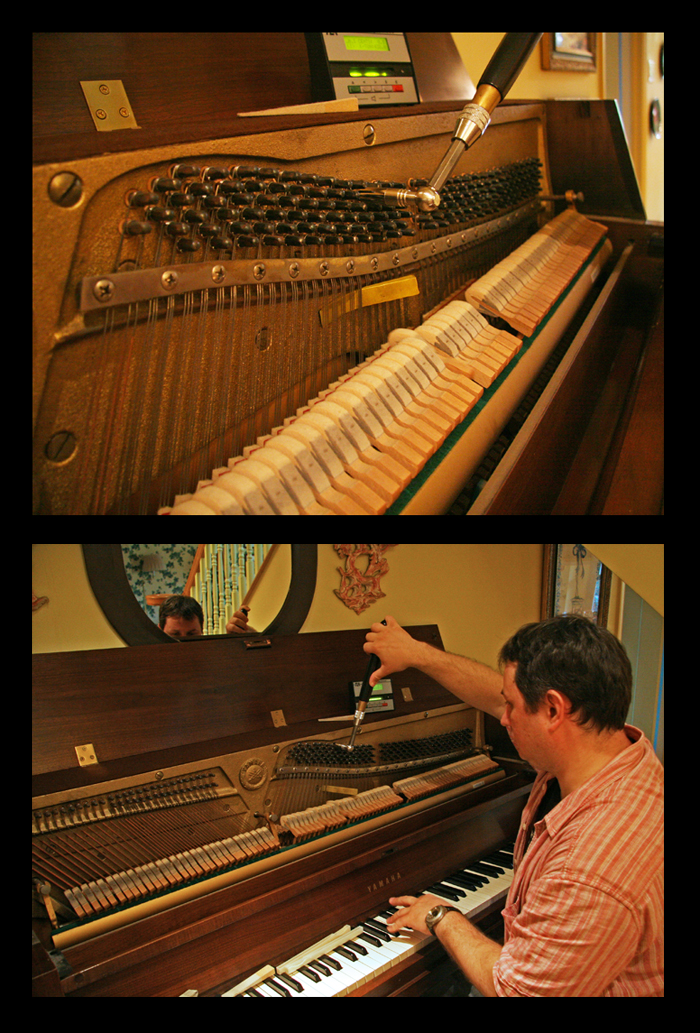
    These things do not come by accident or from a laissez-faire attitude. High quality products require exacting standards. The French are often much less willing than others to compromise quality. There are many other cultures and people who share the same drive for quality, and the world of music is one place to look. When I learned that a friend was having her piano tuned, I asked if I could drop in to observe.

    When I met Arpad Maklary, I was reminded of a woman who was once asked why she would eat at Le Cirque (a very expensive restaurant) every night and spend so much money. I heard that she had responded,”It’s the only place in town where you can get a decent meal.” When I spoke to Arpad, he asked if I had played piano. I replied that I had not studied piano, but that I had dabbled with accordion, guitar, cello and violin. I expressed the difficulty in playing an unfretted stringed instrument and how long it takes just to locate the notes. He replied that one of the real problems learning cello was that you would have to spend at least $30,000 to get a decent instrument. When I asked what he thought of digital pianos, he said they were fine, but they were not pianos.

    I began to see a man who was serious, particular and uncompromising. But if you are being paid to tune a musical instrument with 220 strings, a compromising individual may not be the best for the job.

    Arpad hails from Hungary, where he learned his craft at the Hungarian Musical Instrument School. He has worked twenty years as a piano rebuilder, tuner and technician. He also plays. I spoke to him at length about a number of subjects – he encouraged me to read about Léon Theremin, Jean-Henri Pape and an early instrument, the monochord. I quickly learned that, like many trades people trained in a European tradition, this man’s knowledge was very thorough.

    I was unaware that a piano has between 220 and 240 strings (the treble is in groups of three, the tenor and part of the bass in pairs and one string in the very low bass.) When I showed surprise that treble strings were in groups of three, he told me that this was to match the amplitude of the bass strings and that the increase in volume is the square root of three or about 1.7. I speculated that perhaps few tuners knew the science of music at this level and he assured me that most did not.

    I watched Arpad work his craft, using a wrench, digital tuner and his ears. This is exacting and painstaking work. The piano was badly out of tune and many strings needed to be retuned. I was told that replacing all the strings in a piano is a two day job. I found Arpad to be polite and professional. Like the French, he was quite particular and perhaps even a little persnickety. But if you want well made things or things made well, things fine tuned or things tuned finely, usually it’s a package deal 🙂

    Related Posts: It’s Perfect, Anywhere You Go, Heard It Through the Grapevine, So Where’s David?, Whet Their Appetites, Cello Class

    Posted on by Brian Dubé

  • It’s Perfect

    Posted on by Brian Dubé


    I was once led to visit an artist on Broadway, only a few blocks from my office. Not knowing whether my destination would be of interest, I paid no mind to exactly where I was going or who I was visiting. I have no idea what her name was to this day, but we had a conversation that left an indelible imprint in my mind.

    Her work was quite unique – furniture as art. What particularly struck me was her use of machinist’s tools and equipment. Her work was impeccable – I had never seen anything crafted so perfectly and I told her so. She did not take the complement but instead corrected my choice of words. Precision, she said, not Perfection.

    Touché. A distinction very well made. We had a conversation about it, but she was preaching to the choir. I have reflected on her comment a myriad of times – often when I work or whenever the word “perfect” is used emphatically in praise of a product well made.

    When it comes to man-made articles, it is quite true. Perfection does not exist, only tolerances and precision. Given measuring devices accurate enough, anything manufactured will vary from its specifications. Certainly the eye or hand will be unable to perceive variations within tolerances in a finely crafted article, but the lack of perfection is there nonetheless.

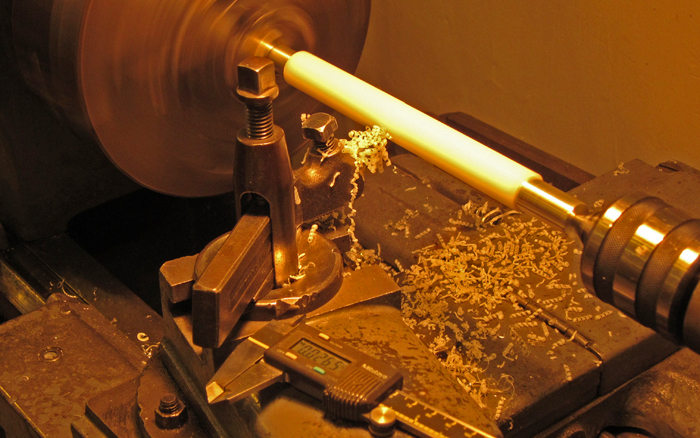
    I’m not sure what surprises people most – what I do for a living or that I do it in Manhattan in a prime SoHo location. I do maintain a machine shop on Broadway. In the photo, I am machining a part on a 1951 LeBlond lathe. The machine is a real workhorse, made at a time when American machinery was built to last. This machine will likely outlive me.

    I often wonder how many lathes are left in New York City, particularly Manhattan. I only know of a couple of machine shops. In the 1990s, there was a small machinist who occupied an entire one story building on Crosby Street around the corner from me. At one time, numerous other small manufacturers dotted the area, even entire buildings were occupied. I never appreciated the luxury of strolling to a machine shop and in minutes discussing a project, leaving drawings and picking up parts in hours or a day. The place is now a carpet shop.

    My lathe was purchased at Grand Machinery Exchange on Lafayette Street in an area once known as machine shop row. There were 40 machinery dealers in the area north of Canal Street. Grand Machinery was the last of these dealers and relocated to Long Island in 2006. I very much would have loved to do a story on them, however, I only learned of their closing a few days after their move. My visit there was only to press my face against dirty windows and peer into an empty industrial ground floor space.

    I do love machining a metal part. It is so satisfying to produce something with a high level of precision in a world of the unpredictable, uncertain or mutable and riddled with poorly made articles. When I take a beautiful gleaming metal part off that lathe, check it with my Mitutoyo digital caliper and find that the diameter is exactly what I wanted, there are no thoughts about that artist on Broadway and the nuances of perfection versus precision. It’s perfect.

    Related Posts: Brawling Over Brands, In Industry, Because I’m the Best Part 2, Because I’m the Best Part 1, Released From Captivity, Space Surplus Metals, Canal Rubber

    Posted on by Brian Dubé

  • I’m Throwing Them Away

    Posted on by Brian Dubé


    I was a little disappointed to learn that according to a 2007 British Study of walking in 32 cities around the world, New York did not top the list of fastest walkers. Singapore bested the list, New York came in at number eight. Nonetheless, we got some fast walkers and we did come in fastest in the USA.

    New York City is a fascinating smorgasbord of things to see and walking is a joy. However, I have walked daily to my current office location for 21 years. So at times I do get a bit bored and my mind wanders. I have always liked numbers and playing with them, so inevitably, I ponder the numbers associated with streets, blocks and walking.

    I have often timed my walking. In Manhattan, there are 20 north-south blocks to the mile. A brisk pace is about 45 seconds per block. Do the math and that is a 15-minute miles or about 4 miles per hour. The pace of some New Yorkers is astounding. On a stroll last night, following a much shorter woman, I tried to match her pace. It was quite an effort and I am sure she was walking in excess of 4 miles per hour.

    I have to walk through or around Washington Square Park to go to work. Having been a lover of mathematics, the prospect of not taking the diagonal is anathema. But how much distance and time do we save? I have about 15 minute walk to work, which has given me ample time over many years to do a myriad of calculations related to walking distances and times in the city. Doing these in your head is tedious and much longer than using aids but the time does pass more rapidly.

    Washington Square Park is about .5 miles around. So the distance around the park (one length and one width) walking to my destination is half the circumference or .25 miles. The park is about twice as long as it is wide. So if A is the short side, 2A is the long. The total distance around is 6A. A is therefore .50/6 or 1/12 mile.

    Now Pythagoras says: a2 + b2= c2. So now we have one side as 2A and one as A, so(1/12)2+ (2* 1/12)2 = c2. Solving this is rather simple – 1/12 2 is approx. .0069. 2/12 2 is approx. .0278. so c2= .0069 + .0278 = .0347. So, c= ? 0.0347 . or .187 miles.* So we save: .25 miles – .187 miles = .063 miles, or a little more than one standard north-south Manhattan block. So we save about 1/16 of a mile or one minute walking.

    In Sirens of Convenience, I told about a fictional New York City character created by a friend who throws money away. At times, in a similar spirit of reckless abandon, I flaunt time and distance. Perhaps I stroll leisurely, enjoy the walk and just let that woman move ahead of me. With disdain for the diagonal, I’ll just walk around the park. Distance? Time? I don’t care about distance or time. I throw them away. In fact, here’s 1/16 of a mile and one minute. I’m throwing them away 🙂

    *Square roots can be done in one’s head, but it is extremely tedious and requires good memory. Just start with a guess and through an iteration process, you can come quite close fairly quickly. Just don’t get hit in traffic doing the calculations.

    Related Posts: Steaming Masses of New York, Number 1, got math?, Sirens of Convenience, Keuffel and Esser, Urban Road Warrior, Babies, Winter Walks, Dead Man Walking, Math Midway, 1560, Huddled Masses

    Posted on by Brian Dubé

  • Extra! Extra! Read All About It

    Posted on by Brian Dubé


    I fell asleep at my computer on Friday night. At 1:30 AM, I was awakened with cheering on the streets. I heard someone say something about gay marriage. I flipped open my laptop and hit the bookmark for the New York Times. There it was – live front page news- an all-caps, six-column headline: NEW YORK PASSES SAME-SEX MARRIAGE, BECOMING LARGEST STATE TO PASS LAW.

    Wow. That really is big news. This late Friday night passing of this law is a watershed event. That evening, there was late night celebration at the Stonewall Inn at 53 Christopher Street. On Sunday, the annual Gay Pride parade was held. The timing of the passing of the same-sex marriage law with the annual parade was perfect – the march became a celebration of this historic event for the gay community. Paraders held signs proclaiming “Thanks Governor Cuomo,” “Promise Kept,” “Marriage Now,” “I DO support marriage equality,” and “Our Next March Down the Aisle.”

    An opinion piece from the New York Times says:

    New York State has made a powerful and principled choice by giving all couples the right to wed and enjoy the legal rights of marriage. It is a proud moment for New Yorkers, thousands of whom took to the streets on Sunday to celebrate this step forward. But this moment does not erase the bigotry against gays and lesbians enshrined in the federal Defense of Marriage Act, which denies federal recognition of same-sex marriages and allows any state to refuse to recognize another state’s unions.

    There are many gay couples who have long term committed relationships. They have, however, had to settle for living in the margins and alcoves of society. I have had family members, employees and friends who were gay, as I am sure many of you have. Most speak of the tremendous stress and pressure of living a lifestyle which requires secrecy and obfuscation. Even in New York City, complete openness about being gay is limited to times and places. You will only on rare occasion see gay couples walking hand in hand. And there still is opposition to gay marriage. Most major religious institutions do not sanction homosexuality.

    Same-sex marriage is legally recognized nationwide in 10 countries: Argentina, Belgium, Canada, Iceland, the Netherlands, Norway, Portugal, South Africa, Spain, and Sweden. In the United States, couples can marry in six states (Connecticut, Iowa, Massachusetts, New Hampshire, Vermont, New York) and Washington, DC.

    The New York State Marriage Equality Act became law on June 24, 2011 and will take effect in 30 days – July 24. The New York law has no residency requirement. New York also recognizes same-sex marriages performed in other states and countries where same-sex marriage is legal.

    There is a business side to this also. According to Bloomberg News:

    New York City Mayor Michael Bloomberg plans to unveil a campaign to sell the most populous U.S. city as a gay-wedding destination after thousands marched to celebrate the state’s legalization of such marriages. The “NYC I Do” campaign “will create millions of dollars in additional economic impact to the city’s $31 billion tourism industry,” Kimberly Spell, a spokeswoman for New York & Company, the city’s marketing office, said yesterday in an email. Bloomberg will unveil more details in coming days, she said.

    On Friday night, June 24, 2011, it certainly was Extra! Extra! Read All About It.

    Related Posts: They Are a-Changin’, No Red Faces, Time Has Come, Buddies, Steal the Show, Pride March, Dyke March, Gay Liberation Monument, Gay Pride Parade

    Posted on by Brian Dubé

  • Shortly Before Execution

    Posted on by Brian Dubé


    I was once in a restaurant with a friend in Park Slope, Brooklyn, where a family of four was finishing their dinner. The two children were playing with food and every condiment on the table. Sugar packets had been opened and the contents were everywhere. Salt, pepper, uneaten rice, dirty utensils – all had become playthings. Food was everywhere and the floor (carpeted unfortunately) was covered in food debris. The parents made no effort whatsoever to stop the activity. There was a sense that these were children and that is what children do.

    Where I grew up, that is what children do, shortly before execution.

    This is the parents’ fault, of course, and in many instances in the city, I have seen extraordinary examples of parents indulging children in grossly inappropriate behavior. No one says anything, lest they be perceived as child haters or interfering with other people’s business.

    I am intrigued by etiquette. So seemingly quaint and outdated, yet I am fascinated by the thinking and history behind what often appears to be arbitrary or whimsical rules of conduct. And in any world or society, particularly one so complex as where we are now, there is a huge appeal for doctrine, dogma and customs. Life so much easier with a rule book.

    I expressed this interest in codes of behavior some years ago and was gifted a copy of Emily Post’s Etiquette. I was surprised to see it was still published – the classic tome is now in its 17th edition.* A guide to every aspect of social behavior is covered, even including how to eat bing cherries. There are also sections on the etiquette of things that new technology has ushered in – cellphones, email, use of iPods, etc. and changing progressive mores – sex, dating, relationships, gay lifestyle.

    There is also urban etiquette, covering things specific to the city life – crowded sidewalks and streets, subways, taxis, umbrellas, doormen, apartment life. Urban issues provide plenty of raw material for comedy writing – many of the minutiae of urban living which beg for some form of urban etiquette have been the subject of classic moments in TV shows like Seinfeld, Curb Your Enthusiasm, Frasier et. al. Although some plot themes appeared to be farcical and hyper exaggerated, like Covenant of the Keys, they were in reality issues that are often very important in city life.

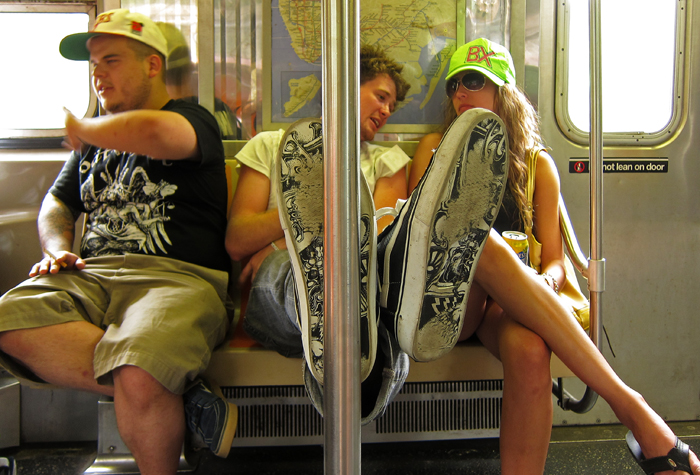
    The New York City subway is heavily used and the perfect environment for observing every manner of manners. Some see it no differently than the great outdoors. It can be dog eat dog and every man for himself. Others try to maintain a sense of decorum, following rules of urban etiquette.

    The photo was taken on the D train to Coney Island for the Mermaid Parade. As I approached my destination, my fellow riders appeared to become more casual – one had a cigarette and the other had his feet up on a pole. Where I’m from, there’s no problem with that, shortly before execution 🙂

    *Emily Post died in New York City in 1960. The Emily Post institute still survives and is headed by Peggy Post, Emily Post’s great-granddaughter-in-law.
    Related Posts: Follow the Crowd, Teleportation, Aspiring Rebel, Random Acts of Consideration, Twinship, The Curse of Trade, Just Don’t Stick, Flailing and Hailing, Covenant of the Keys, Sardines, Get a Room, World of Gray, No Salga Afuera, PDA, The Subway

    Posted on by Brian Dubé

  • Follow the Crowd

    Posted on by Brian Dubé


    The best things about having driven a taxi in New York City are 1) street cred and 2) the stories. The stories, because if you drive long enough in a big city and pick up an average of 30 passengers per work shift, eventually you will have experiences worth telling. Such is the fodder that prompted the award winning HBO TV documentary series, Taxicab Confessions, which originated in New York City.

    As regular readers here already know, I did a stint of about one and a half years as a taxi driver in the early 1970s, a very rough time in the city. Picking up the severely drunk passengers was one big problematic scenario. It can have entertainment value, but most likely, the ugly side of drunkenness will reveal its head sooner or later – typically not later than the end of the ride.
    Often friends will stuff a drunk friend in a taxi, thereby transferring responsibility and care taking to a taxi diver, with a sigh of relief, I am sure.

    As one reader pointed out in my story, Flailing and Hailing, there are downsides to taxi travel outside Manhattan. A rider should know how to get to their destination. Many drivers are severely deficient in their knowledge of the boroughs, don’t carry maps or use GPS. Taxis are expensive and you don’t want a driver to be learning NYC geography at your expense.

    However, there is risk to the driver too. Although the passenger is paying for distance traveled, the most money is not made by wandering aimlessly in hopes that the passenger will at last remember how to get home or where they live. More money is earned in a given time period by getting passengers to their destination as quickly as possible, not crawling around unknown neighborhoods.

    On one night, I picked up a passenger who was visibly inebriated. He did not have an address, but assured me that he could navigate to his home. As we approached the first fork in a roadway and I asked “left or right?”, he responded “follow the crowd.” This became the refrain at every juncture, where conveniently it appeared that our destination was in the direction of the greater traffic flow.

    Until there was no crowd.

    I realized I was in trouble when at one junction with no cars in front of us, I was again told to follow the crowd. This was time to turn around completely and interrogate. Did he or did he not know where he was going? I was in the middle of nowhere, no people around, no clear address, and only his assurance that he could direct me to his home.

    I don’t recall where I left him, only that I ordered him out of my taxi right there, which took some doing. At this point in my life, I would do more. Perhaps drive to a populated area and look for a police car or ask for a police station to drop him off. But I was young, intolerant, frustrated and broke. Time is money for the taxi driver. You need to know where you are going, not heed the directions of a drunk man whose directions consist solely of “follow the crowd.” 🙂

    Related Posts: Leave the Driving to Us, Nice Move, Kid, The Point of Impact, Flailing and Hailing, Sittin’ on Top of the World, What numba Kissena?

    Posted on by Brian Dubé


  • dinamic_sidebar 4 none

©2026 New York Daily Photo Entries (RSS) and Comments (RSS)  Raindrops Theme