• They’ll Go Broke

    My mother had called very alarmed that a member of our extended family would go broke. He had been on a shopping spree. She accused him of being reckless with his money – he had purchased Calvin Klein sheets for his entire house. She did not understand the math behind the assets of the extremely wealthy. I went over some numbers with her and estimated the monthly return on the money that I guessed he might have. I showed her how he could likely buy a new house every few months with interest alone. In awe, she repeated this information to my father. However, she then just went on to show concern that this family member might still go broke.
    More recently, an incident echoed the same type of lunacy. A friend told me of a mutual friend’s concern that she was witnessing a myriad of NYU students charging every manner of food or small purchase and that surely they’ll go broke. This was more ludicrous than my mother’s comment since this woman was college educated and surely should understand the underlying economics. NYU now costs a small fortune and parents are typically funding educations and giving their children credit cards for everyday expenses. How are even hundreds of $5 coffees going to break the bank of a family spending $40,000 per year for tuition alone? They’ll go broke has become a private joke with the friend who told me this tale.

    New York City is awash in money, so much so that it befuddles the mind of the average wage earner. There are people who seemingly have access to an endless fountain of money. For them, the cost of things is completely irrelevant. Budget is not part of their vocabulary. Purchasing decisions are only based on what they want, not what they can afford. Even in a poor economy, expensive restaurants are packed.

    There is no better example of the wealth of city residents than Manhattan real estate. In July 2012, an apartment went on the market in Manhattan that had the highest asking price in history – $100 million. A townhouse here typically fetches at least $10 million. A two-bedroom apartment can run $2 million plus.
    Tuesday night I was strolling only a few blocks from my home in NoHo on the cobbled Bond Street when I discovered an very imposing building with an extremely ornate skeletal front. It was the ultimate in gleaming glitz with an enormous door. I noted the address – 40 Bond Street.

    The developer was no other than the legendary Ian Schrager, co-founder of Studio 54. Schrager lives in the property itself in a penthouse valued at least $50 million. Everything about the condo development with its signature Coke bottle-green glass exterior screams luxury – 11-foot ceilings, dual gas and wood-burning fireplaces, wide plank oak floors, top of the line everything, and concierge services provided by the Gramercy Park Hotel on 24-hour call.
    A cast aluminum gate – 140 feet long by 22 feet high – is graffiti-inspired. Apart from the 27 loft-style apartments, the building has five, three-story townhouses with 22-foot-high living rooms, front yards behind the gate along, and private gardens at the rear of the building. The 11-story property was designed by the renowned architectural firm and Pritzker Prize-winning Swiss duo Herzog & de Meuron in their first ever project in New York City. Opinions vary dramatically, as would be expected. Everything from positives to expletives. A block resident since 1958 called it “Frank Lloyd Wrong.”

    All this conspicuous consumption, flagrant displays of wealth, ostentatious trappings, and arrogance that often accompanies the rich New Yorker is what gives many a distaste for this city and everything and everyone in it.  An understandable feeling that in New York, it’s all about money. For these, there will be little concern whether the residents of 40 Bond Street are living within their means or They’ll Go Broke 🙂


  • You’re Not Gonna Find in Bristol

    ‘Tis a bit unfair, but among close friends, the town where I grew up, Bristol, CT, has become the butt of a private joke – a metaphor for all things boring, a place devoid of culture and nightlife. Whenever I see something particularly unusual, crowded (as I wrote in 212 and 2:12), or abuzz, I sometimes remark that it is certainly something you’re not gonna find in Bristol.
    In this town of 60,000, there is little to do but visit strip malls and eat fast food. My family never ate in Bristol, opting instead to travel for our infrequent restaurant outings. Although it does have a surprising number of claims to fame – Lake Compounce (the oldest amusement park in continuous operation in the US), national headquarters for ESPN, home of Little League New England, a Clock Museum ( one of a very few museums in the United States dedicated solely to horology), the New England Carousel Museum, and the Otis Elevator Company test  tower – the largest in the United States. Nonetheless, these are things of little import on a day-to-day basis, and most residents will only partake of these places once or twice in a lifetime, if at all. But for culture or shopping quality merchandise, most residents will find themselves traveling. My high school English teacher, a rebel, advised us not to read the local paper, something he found tantamount to trash. He recommended that we leave Bristol altogether. There are staunch supporters of my hometown, I am sure. In my lifetime, I have seen Bristol alternately on lists of best and worst places to live in America. But I yearned to live in New York City and, in 1969, undeterred by my guidance counselor (as I wrote about in Jungle Lovers), I came to the big city.

    In the 7 years that I have written for the pages of this website, I have featured many unusual and remarkable people, places, and things – people such as Mark Birnbaum or pianist Colin Huggins, who performs with a baby grand in Washington Square Park. But, as typifies the New Yorker, I have become inured to the lunacy of a man assembling and disassembling a baby grand piano daily, hauling it many city blocks to and from storage, setting it up, and playing for hours, even in the most inhospitable weather. Most recently, Colin upped the ante considerably by performing during the winter months in frigid weather. Neither biting cold nor a slim audience deters him from his daily grind.

    As I traversed the park on the morning of Friday, February 15, the bar for novelty in New York City was raised again – a piano turner wearing roller blades was busy tuning Colin’s baby grand piano, with banks of snow as backdrop. It was decidedly a scene uniquely New York and certainly something You’re Not Gonna Find in Bristol 🙂


  • Beast

    I was standing in my brother-in-law Alan’s shop in front of his mechanical beast – a drag racing motorcycle capable of over 200 miles per hour speed. Alan was telling me about the details of drag racing – races that only last seconds, engines powered by rocket fuel – nitromethane – and that needed to be rebuilt after every run. I was particularly fascinated when he told me that the roar of engines was so loud that race goers can see their shirts flutter when hammered by shockwaves. All the numbers he was citing were extraordinary and off the charts – horsepower per cylinder, decibel levels, speed, G-force from acceleration,  and races won or lost by hundredths of a second. It sounded like an experience worth having at least once, however, I have yet to attend a drag race in person.
    When I commented that much of his life seemed defined by speed, he corrected me adding “and power.” In a world where we often feel powerless against Mother Nature and in our feeble efforts to combat her, the quest for power is understandable. I immediately reflected back on my high school acquaintance who had told me that upon graduation he was going to trade school to major in power (as I wrote about in Pork and Power).

    Do vehicles sporting tremendous power and speed seem to be a world apart from New York City? Perhaps not. Circle Line Sightseeing Cruises, the company that operates the well-known boat tours around the city, also runs New York’s only jet powered thrill-ride speedboat attraction – The Beast. For $27 you can experience a roller coaster ride atop a neon green, shark-toothed, 70-foot, 140-passenger monster machine traveling at 45 miles per hour to blasting music. The 30-minute ride, replete with 180-degree hairpin turns is guaranteed to get you wet while seeing the sites of New York City from the Hudson River.

    For a tamer tour via the city’s waterways, there is kayaking, sailing, or the classic Circle Line tour which circumnavigates the entire isle of Manhattan. There are many ways to see the city as there are modes and methods of transport. For some, it’s a stroll in the park, a walk down Fifth Avenue, a ferry ride to Staten Island, crossing the Brooklyn Bridge by bike, a Water Taxi, flying down the Cyclone, or atop the Wonder Wheel of Coney Island. For others, Power and Speed are necessary components, and whether atop a nitro-powered drag racer or perhaps aboard a jet-powered tour boat, no vehicle will do it short of a mechanical Beast 🙂


  • The Tipping Point

    It was a year ago or so that a friend recommended The Tipping Point by Malcolm Gladwell. I had long ruminated and been very perplexed as to the reason that certain phenomenon, trends, etc, suddenly and inexplicably hit critical mass and really took off. Things such as the hula hoop – invented in 1957 and a fad by 1958. Then, interest lay relatively dormant for over 40 years. In the last few years, there has been a renaissance in hooping, but now with a much more serious interest for exercise and dance. Yet, it is difficult to ferret out any particular reasons to explain the resurgence in interest now. One may cit interest in exercise, material availability, etc., yet all these elements have been in place for decades.
    Gladwell seeks to explain such mysterious sociological agents of change that mark everyday life with his three rules of epidemics: The Law of the Few, the stickiness factor, and the power of context. Gladwell’s thinking is also based on the 1967 Six Degrees of Separation study by social psychologist Stanley Milgram. However, despite the books popularity and Gladwell’s financial success (over $1 million dollar advance for the book and subsequent speaking at $40,000 per lecture), the scientific community is not in full agreement as to the validity of Gladwell’s analyses and for many, the reasons for a tipping point in social phenomena still remains a mystery.

    I see this tipping point concept in my business as well as the innumerable trends I have witnessed in the last 44 years I have lived in New York City. Frozen yogurt shops, gelato, and most recently, aerial arts – a relatively difficult and somewhat dangerous activity to gain an audience with the general populace. Until recently, such interest in things like trapeze, wire walking, lyra, and silks has been limited to circus professionals. People such as Hovey Burgess have been steadfast in training a small number of those with a passion for flying high.

    On Sunday, January 13, 2013, I had been wandering the streets of Williamsburg, Brooklyn, on a trip to visit the Domino Sugar refinery. I was intrigued by a one-story industrial building with a colorfully painted door with the words The Muse Performance Center brandished across its face, the huge Domino Sugar building in the distance looming over the place. I wondered what may lie behind this door when I heard my name called. I am recognized on occasion by a customer from the large number of contacts I have made over the last 38 years in business. But nonetheless, it is quite infrequent and certainly unexpected on a Sunday afternoon on a deserted street in an industrial area of Williamsburg, Brooklyn.
    I did not recognize the individual, but he was in fact a customer and informed me that he had just been to my place of business in the last week. He was, quite conveniently, associated with The Muse. I asked if it would be possible to enter the space and take photos, to which he said yes. He introduced himself as Ryan and gave me his card: Ryan Shinji Murray, it said, along with the words: pleasure to meet you. let’s keep in touch. I learned that Ryan is a very talented working professional and was leaving for a 3-month tour that week – I was fortunate to have met him just before leaving.
    I entered the small industrial space and saw that it was, in fact, one of a number of spaces I had heard of that was used for the training and teaching of aerial arts. In the last few years, there has been a renaissance in interest in all manner of aerial circus arts. Studios in inauspicious locations around New York City provide space for such activity. In the five boroughs of New York City, you will find STREB, The Trapeze School of New York, Circus Warehouse, Skybody System, Aerial Arts NYC, Helium Aerial Dance, Kiebpoli’s Aerial Class,The Sky Box, Body and Pole, the Manhattan Movement & Arts Center, and The Muse, located at 32D South First Street in Williamsburg, Brooklyn. STREB, one of the most well known, is only two blocks away from The Muse.

    I thank Ryan and the cordial staff of The Muse for letting me take photos of their space. And I will let others explain why now, among the other particular current trends and fashions of New York City, that aerial arts has reached The Tipping Point 🙂


  • Giraffes in a Canoe

    There are places that are decidedly the other side of the tracks, and Grand Street in SoHo has been one of those places. As SoHo gentrified, Grand Street, only a block from the honky tonk Canal Street, retained a frontier feeling. Rents remained much lower than Prince and Spring streets – prime SoHo. It was here that Broadway Panhandler relocated when their prime SoHo rent became too onerous.
    Even today, Grand Street retains vestiges of a former time and businesses that service the working class and industry. At the corner of Thompson Street, one can still find John De Lorenzo & Bro., Iron and Sheet Metal Contractor.  Across from the French Culinary Institute at 458 Broadway was the previous site of the Singer sewing machine company’s first headquarters and showroom, built 1857. At 175 Lafayette and the corner of Grand Street was a supplier that I once frequented often: Rudolph Bass Woodworking Machinery & Supplies, founded 1918. At 183 Grand is the John Jovino Gun Shop, a sole survivor of the gun district near the Centre Street police headquarters. At 176 Grand is the home of Lendy Electric, a classic hard-core New York-style contractor’s supply house.

    The street bridges a variety of neighborhoods – SoHo, Little Italy, Chinatown, and the Lower East Side. The street is home to Ferrara’s Bakery and Kamwo Pharmacy. Heading east through Chinatown, there are numerous Chinese and Vietnamese supply shops and restaurants. Further east, once will find Kossar’s Bialys and the Doughnut Plant. The merchants are a smorgasbord – a worthwhile excursion for any urban explorer. For a virtual walk down Grand Street and as a guide, I recommend NY Songlines.

    Tuesday night, a group of us discovered Loopy Mango at 78 Grand Street, strictly by happenstance. This quirky, eclectic retailer came as a very pleasant surprise. The shop sells home goods, furniture, antiques, textiles, clothing, gift, specialty yarns, and knitting and crocheting supplies. The owners, Waejong Kim and Anna Pulvermakher, met in a fabric painting class at New York’s Fashion Institute of Technology. Loopy Mango was founded in 2004 in a tiny storefront on Avenue B in the East Village. They moved to DUMBO and in 2010, they moved back to Manhattan to their current 2000-square foot shop at 78 Grand Street.

    Original 1880 Victorian shutters enclose four dressing rooms and are complemented by a tin ceiling detail. Continuing through the boutique to the backroom, one is greeted by a 15-foot skylight and purpose-built partition encased by replica ionic Roman columns. The interior of the space was designed and built by Waejong and her husband, Eric Schultz, an antiques dealer from Massachusetts. The shop also offers knitting classes and workshops.

    For an urban jungle safari, take a long walk down Grand Street. After all, where else do you find a place called Loopy Mango with seven Giraffes in a Canoe?


  • The Domino Effect

    I am willing to take risks, however, I am not interested in being arrested or going to jail. Unfortunately, this means it is unlikely that I will get firsthand the types of photos had by trespassers who visited the abandoned Domino Sugar Refinery in Williamsburg as reported by the Gothamist. The series of illicit photos can be seen in their article. A 2010 media tour did NOT include access to the refinery interior. According to the insurance companies, as reported by the Gothamist,

    “the majority of the buildings are filled with large machinery, much of which spans multiple floors. Also, the majority of the buildings do not have solid floors, and instead, machinery is connected to walls and pillars with cat-walks and metal flooring.”

    This type of environment is a dream for many a photographer, what some are calling “ruin porn.” I recently toured the area and photographed the property street side, keeping to the outside of the chain link fence.
    Incredibly, this massive sugar refinery was in operation for over 150 years and only closed as recently as 2004. The plant was built in 1856, and by 1870 it was processing more than 50% of the sugar used in the United States. Who would fancy that this 11 acre, 5 block, industrial site with its iconic Domino Sugar sign would sit along the East River all in plain view from Manhattan? A large mixed-use residential and retail development is planned for the property. The Community Preservation Corporation (CPC) sold the property to Two Trees for $185 million in 2012.

    The image of sugar has been tainted for some time. On the one hand, sugar is synonymous with sinfully sweet goodness; on the other hand, it has over the last decades been pointed to for many health-related ills. Diabetes, obesity, tooth decay, etc. Whether by William Duffy, author of Sugar Blues, published in 1975, Gary Taubes of the New York Times’ article “Is Sugar Toxic,” or by Mayor Bloomberg with his recent ban on large sugary drinks (over 16 ounces) in New York City, the white crystalline substance has been likened by many to a poison.
    As I toured the Brooklyn property, I came across a large sign with the classic Domino packaging. The words “Pure Cane Granulated Sugar” brought back memories of the pure white ingredient of candies and confections, not poison. The complex of industrial properties in Williamsburg, like sugar itself, is likely here to stay. That’s the enduring power of The Domino Effect 🙂


  • Vacancy

    Given the real estate values in New York City, it is completely baffling to see properties unoccupied for years. Perhaps some of the best examples in Manhattan are properties in the estate of Bill Gottlieb. I had the privilege of meeting this eccentric man in the 1980s when I was looking for commercial space for my business. I had been enamored with the prospect of renting a small one-story garage and was intrigued that all of them bore the name of Bill Gottlieb as agent/owner. I met him and toured a number of properties in his signature old station wagon with cracked windows taped together. Little did I know that this man’s estate was valued in the hundreds of millions.

    Recently, I read about the Spook House of Williamsburg on the Forgotten New York website. So, curious to see the place for myself, I took an excursion to 539 Driggs Avenue in Williamsburg, Brooklyn. The storefront appears to have been abandoned for some time and is framed with a weathered wood exterior. A flag graces the front door and venetian blinds cover all the windows. Little seems to be known about the property, and most online searches trace back to the Forgotten New York website, where information is sketchy. It’s another mysterious case in New York City real estate of unexplained Vacancy


  • Makin’ Glass

    As a child, I had once inserted house keys into a power outlet, as I wrote in Electrical Outlets. When I was a bit older, I had upped the ante and was being hit with a stick on my butt for blowing a fuse, the first and only time I received that kind of punishment. I don’t recall any real serious pain, only humiliation at being a little too old to be whooped.

    This time, I was trying to make glass. It was another failed experiment. I had found instructions on building a arc furnace using carbon rods from dry cell batteries, a clay flowerpot as a crucible, and a train transformer as a power source. Unfortunately, I knew nothing of the proper power requirements, and my only result was a blown fuse and a bruised butt.

    The fact that common sand could be melted in a homemade arc furnace to make glass was nothing less than amazing to me. It still is. Later in life, I built a stained glass Tiffany-styled lamp from a kit. However, I never did venture into glass making, forming, or blowing.
    I love glass. I respect plastic, which I work with every day in the manufacture of products. However, glass is virtually antithetical to plastic which, in spite of all the remarkable manmade resins, remains a metaphor for all things cheap. Everything about glass is extraordinary – its amorphous non-crystalline structure, its ability to refract, reflect, and transmit light, its chemical resistance, cleanability, and its tremendous versatility.

    Last night, after a very good meal on Indian row in the East Village, a friend and I happened upon a mecca for colored glass. A brand new shop, Mosaic Lamps at 208 East 6th Street, features an array of handblown glass lamps decorated with mosaics. The lamps are imported from Turkey, where centuries of tradition go into the making of these beautiful works. I met the owner, Melissa Benovic, who with her boyfriend Ilker Arslan, were inspired by the grand bazaar in Istanbul where Ilker once worked.

    To my surprise, although these lamps are common in Turkey, they are virtually non-existent in New York City, until the opening of Mosaic Lamps. I wish them the best of luck. I’m pleased to see that somewhere in Istanbul, rather than blow fuses, someone is good at Makin’ Glass 🙂


  • Views From Governor’s Island


  • Premium

    There is great comfort in the familiar – the worn shoe, the daily routines. Here in New York, creature comforts provide a balm, soothing the scratches from a city that can be jarring and stressful. For the resident, there are many comforting icons of the familiar, whether it be a neighborhood diner like the Waverly, or those things recognized around the world, like the Macy’s Thanksgiving Day Parade or the Christmas tree in Rockefeller Center.
    I find great comfort in these enduring icons, particularly after living in this city for over four decades, a place where change is ever present – sometimes welcome but also often the enemy. As Professor Gurland once said in a lecture at NYU, people are driven to look for stability in a world of change. At another time, a close friend who knew me well, suggested that I needed a country home, not to seek country in the city. Certainly both individuals made good points – my ability to survive in this city has been enabled by seeking peace, tranquility, comfort, the durable, and the classic. Finding secluded spots, such as community gardens or Dead Horse Bay, is what I seek here, not the over-animated urban environments of clubs, bars, or other scenes.

    Certainly I must not be alone. How else to explain, at least partially, the success of a restaurant like the Meatball Shop? There you will find many reasons for a thriving business, not the least of which is a cuisine that revolves around an American comfort food, meatballs. For me, the deepest and most profound comforts are those which draw on connections to places, experiences, and things of my childhood.

    My father was one of the most dependable, predictable people I have ever known. He had a creative side, but essentially he was a man who lived by habit and routine. He loved pastries, crackers, and breadstuffs. At many meals, a box of saltine crackers appeared. But not just any box – a metal can sporting the Nabisco logo in one corner and proclaiming Premium in large type in the center with smaller type below it, Saltine Crackers. Newly purchased boxes of saltines were opened and the four sleeves of crackers were slid into that tin, keeping them fresh. We stored our crackers in that can for decades.

    Driven by my family’s obsession to modernize, minimize, and sanitize, that can is no longer. Apparently they neither had interest in keeping nor found charm in an old can. I recall once advising my folks that they should consider keeping such a container, that perhaps it may be of value some day. My instincts were right – these Nabisco tins have become collectible, and recently while at the indoor flea market at One Hanson Place, I spotted one – the word Premium leaped out from a table of goods.

    It was only recently that I learned that the Nabisco conglomerate was formed in New York City and occupied what is now the Chelsea Market building. I am sure that these cans evoke different things to its numerous collectors, but to me, that tin is a link between New York City, home of the National Biscuit Company (later Nabisco), and meals in New England with my father as I sat ruminating and fixated on that word Premium 🙂


  • Soba

    I was born and my parents grew up in an area where cheese type was identified by color. One color. If you doubt me or do not understand, read The Yellow Kind, I Guess here. Eating out was mostly about value and portion size. One of my uncles and his wife ate virtually nothing but starches – dinner consisted of potatoes, macaroni, and a stack of white bread with, perhaps, a token pot of boiled carrots.

    It was the very olden days, a time before the Internet or cable TV. I had never had any ethnic cuisine, not even Chinese food. I had never heard of bagels or delis. Fortunately, my mother was a good cook and she maximized the potential of traditional foods from northern New England. She baked. We had very little packaged or prepared foods. We occasionally had pancakes made from buckwheat – a flour I would encounter years later. Nonetheless, I really knew next to nothing about food and ethnic cuisine.
    So, when I arrived in New York City in 1969, it was nothing less than incredible, thrust in the midst of one of the most diverse cities in the world with all the representative cuisines. Here, I learned virtually everything I would ever know about food. It has been an extraordinary culinary adventure and, like for many New Yorkers, eating out is one of my primary activities.

    Shortly after moving here, I became a vegetarian. Natural foods had not yet permeated the American landscape, so living in the Village was particularly special. Outside the city, it was virtually impossible to find restaurants catering to the vegetarian. But here, one could find a plethora of health food stores and restaurants. One of those was East West on 9th Street. East West was a cut above the others, somewhat more expensive, so I did not eat there as frequently as I would have liked.
    It was at East West that I first became acquainted with two of my favorite food items, both in one dish – pesto and Soba noodles. Since that time, most of my Soba noodle experience has been in home cooking in soup. Most Japanese restaurants favor noodle dishes and soups with ramen and udon. But I love the coarser, earthier texture and flavor of Soba, which is made from buckwheat flour. Until recently, Soba noodles were much more difficult to make and more expensive. Now they are made by machine and can be more easily found in markets.

    I recently had a hankering for Soba noodles, and rather than hope to find a place serving them by sheer happenstance, I decided to become more proactive. Perhaps surprising, but there are a handful of restaurants in New York specializing in Soba – one is soba-ya Japanese Noodle Restaurant at 229 East 9th Street. I had my first meal there Sunday night.
    It was immediately apparent that this was a serious establishment, evidenced by the large Japanese clientele and the woodsy ambiance with a decor featuring traditional elements. It was a warm and cozy place on a cold winter night for a hot bowl of soup. With Soba 🙂


  • The Special is More Special


    One of the special things about New York City is its architecture – a visual treat, particularly in a young nation defined largely by suburban sprawl. Wonders abound in the city, however, since 9/11, security has become much tighter, and buildings with extraordinary interiors, such as the Woolworth Building, are often, sadly, off-limits to the visitor. Sometimes, events are held in such a space or the building serves a public function, affording the attendee with a special treat – seeing the interior while going about one’s business. Places like Grand Central Station or the New York Public Library, both of which are worthy of a visit just for admiring the architecture.

    On October 20, 2010, I wrote Brooklyn’s Got Magic about the Williamsburgh Savings Bank Tower at 1 Hanson Place (and its conversion in 2008 to luxury condominium apartments). It is one of the borough’s architectural icons and can be seen from afar. I have used it as a landmark for as long as I have lived in New York. It was once the tallest building in the borough – 37 stories and 512 feet tall. The clock faces, 17 feet in diameter, were the world’s largest when they were installed and remain among the tallest four-sided clock towers in the world.

    Although the structure itself and exterior warrants accolades and superlatives, it is the interior that really shines. And, remarkably, until a week ago, I had never been inside. While in Brooklyn, a friend suggested that we drop in to visit the Brooklyn Flea Market, which has occupied the lobby of the building for the last few years. I was astounded. Apart from perusing the merchandise, attending the market affords a rare glimpse of an amazing interior space. Everyone is aglow at the opportunity to visit. Here is what the New York Times had to say:

    One of the great urban experiences New York offered this winter was the Brooklyn Flea in exile. When the weather turned cold, the market moved indoors to One Hanson Place, bringing along its motley host of antiques dealers, artists, designers, vintage-workboot purveyors and–let’s get to the point here–food vendors.
    One Hanson Place is an almost deliriously lavish setting for a flea market. Shoppers trying on old Borsalinos and inspecting new art prints huddle beneath spectacularly rich mosaic ceilings in a crazy, echt-New-York mishmash of Byzantine, Romanesque, Art Deco and who knows what else. … The food now is found downstairs in the vaults, behind the kind of enormous heavy doors banks had when robbers still stole things like cash and bars of gold.

    Who knows the accessibility of such a space in the future? The savvy visitor or resident who loves architecture will put places like this on their must-see list because now, more than ever, The Special is More Special.


  • I’ll Take Care of You

    Have you been in a restaurant where any special request, no matter how small, is met with hesitation or a negative? And where it is particularly irritating because you know that your request can be easily met? Don’t you already have plenty to do and worry about? When you are a customer of a service establishment, shouldn’t they shoulder the burden, troubles, and responsibilities? Why should you feel uneasy or worried that your needs and requests will go unmet and worse, that you may have to help solve the problem that you are paying them for? In short, why should you be doing their job?

    Early Saturday morning, I lay awake in bed and reflected on the unpleasant chore of going to have my car inspected. In New York City, something as simple as inspecting your automobile can be very troublesome. Often an appointment in advance is necessary, there are long waiting periods, or a service station is out of inspection stickers. Many times I have spent hours trying to get my car inspected, only to return home defeated, having to try again another day.

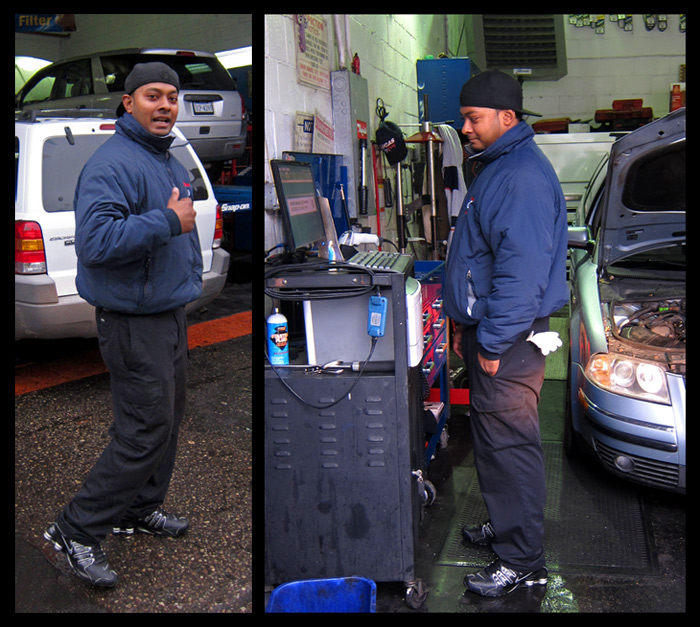
    I called Salerno Service Station and asked for Ryan, the general manager – a man who had forever changed my attitude towards the auto repair business and led me to write an extensive two-part story – Jacked. It was Ryan who had answered the phone. I asked if they could do an auto inspection that morning. He said, Don’t worry. Just come in. I’ll take care of you. That is when it hit me hard. He had given me the key to ultimate customer service when he said I’ll take care of you. It was the reason why Salerno had hundreds of five star reviews online.

    HE HAD SHIFTED THE RESPONSIBILITY FROM ME TO THEM. All of the responsibility. Completely. 100%.

    That was the key, because in that way and only that way can a customer fully relax while the service provider does their job. Even with good customer service, there is often a nagging worry that something may go wrong. In auto repair, so many things can and do go wrong – a bigger problem will be discovered, a part will be unavailable, there will be no time today for the repair, the cost will be too great, you will be cheated or lied to, you will be sold something you do not need, etc. But with great customer service, at a place like Salerno Service Station,  you will be insulated from any hassles servicing your car because they are taking care of you. You can relax. Like my first visit when I was told by Ryan to go have a nice breakfast at the Willburg Cafe while he took care of my muffler job.

    It is like the days of old, when people spoke of being in the doctor’s care. There was great comfort in those words because it meant that someone competent was going to take care of you. People love to be taken care of. This complete taking over of responsibility from the customer or patient is characteristic of the Italian culture and their approach to service. Now I saw how it was at the core of the No Problema attitude that I wrote about.

    Over many decades of owning a car in the city, I have grown to despise the auto inspection ordeal. However, now, for the first time in my life, in the hands of Ryan and the Avallone family, Mario and Salvatore, I actually looked forward to this year’s inspection. In a harsh environment like New York City where comforts have to be actively sought out, there are no sweeter words than I’ll Take Care of You 🙂


  • Arson

    On August 30, 2011, I confessed to starting a fire as a young boy. I had been playing with a friend in a vacant lot across from my home. My friend encouraged and cajoled me to make those flames grow until the fire was beyond our control. We ran, lest we get implicated. I was terrified of the consequences of both the fire itself and, as we liked to say at the time, “getting killed” by my parents.
    A firetruck appeared, and I watched the small blaze get extinguished from the porch of my home with my unsuspecting mother. It was my first and last involvement with setting fires and was a lesson learned, fortunately at no one’s expense, less a few minutes’ time of a handful of firefighters.
    In my business, I manufacture and sell fire props to performers. Unlike my boyish recklessness, however, the professionals I have known, such as Chris Flambeaux, take fire seriously and understand the dangers and responsibilities. They are accountable and answer to fire marshals and theater regulations.

    Yesterday evening, at 7:49PM, I was called by one of my staff. An enormous fire was in progress only a short distance from our office. It was not clear that the fire would pose any danger to the building where my business was located, so, I made my way back to my office’s neighborhood. A fire had been started at 41 Spring Street in NoLita. From the New York Times:

    After arguing with the mother of his child, a man set a fire in the second-floor hallway of his Manhattan apartment building on Thursday night, igniting a rapidly spreading, five-alarm blaze that killed one person and injured at least nine, the authorities said.

    It took nearly 200 firefighters two and a half hours to bring the fire under control, fire officials said; the building has a Pinkberry shop on the ground floor and apartments above.
    “We had an extraordinary amount of fire,” said James Esposito, chief of operations for the Fire Department. It burned upward to the roof, destroying the interior staircases, so firefighters had to use fire escapes and ladders.

    “It was an extremely intense operation,” Chief Esposito said. “The fire encompassed all the walls, all the floors,” he said. “We have a partial collapse inside the building right now. It’s essentially destroyed.”

    The 45-year old suspect was arrested and is now in custody. Arson.


  • Pass In The Night

    In the 1960s, I worked one summer at North and Judd Manufacturing, one of the oldest companies in Connecticut. Begun in 1812 with the manufacture of wire hooks, eyes, and other small metal items, North & Judd added the manufacture of saddlery hardware in the 1830’s and grew into a company that produced over 40,000 items.
    The history is interesting, but working there was not. As an entry level employee, I was given the least desirable work, tapping thousands of the identical part every day, working for minimum wage. It was grueling and a good look into the engine of the industrial world and the toil and sweat that keeps it oiled and running.

    North and Judd and places like it across the land are shrines to the unsung soldier, the worker performing the thankless task. But it was also there, amidst the grit and grime of one of America’s oldest factories, that I found extraordinary people. Unlike Professor Robert Gurland, however, the glimmer of these individuals does not shine far, and only a handful of those around them will ever know of their extraordinary character or talents. And, of course, any close friend or associate who may champion their talents will be dismissed as merely patronizing.

    I met a woman in that factory who had manufactured the same part for over 30 years. I think of her from time to time when performing repetitive tasks. Some cynics may write her off as nothing but a drone, someone akin to a robot. I, however, prefer to celebrate such an individual. Certainly, working 30 years at one job demonstrates something, if nothing more than extraordinary tenacity. Our setup man in that factory was also extraordinary, tending to the needs of dozens of pieceworkers, troubleshooting setups, and machinery, always resourceful and under extreme time pressure. I have long desired to travel cross country on a sabbatical, ferreting out such people and gathering stories for a book, Ordinary Lives of Extraordinary People.

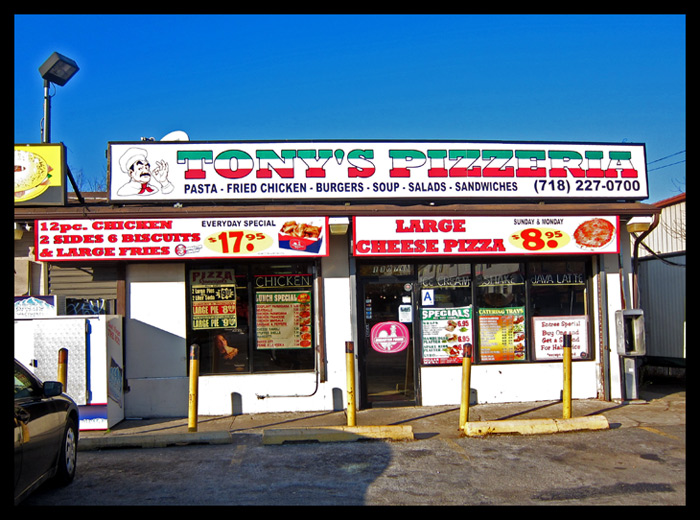
    Recently, I was traveling in the hinterlands of Staten Island. It was mid-afternoon and hunger had come upon me. It was too early for dinner, but I needed something. I had no interest in doing online research, so I chose a place at whim, Tony’s Pizzeria on Arthur Kill Road. The place looked rather unappealing, but I entered nonetheless, expecting a New York-style dirty and rundown interior behind its garish exterior.
    It was immaculate.
    I was immediately greeted by the counter person, who seemed genuinely concerned about my every need. Much like my experience with the Italians in the South of France, where everything was No Problema, here, too, no request presented any problem but, to the contrary, was heartily embraced. When I later asked for a cup of ice, he responded, “of course.” My dining companion concurred that this individual was the most attentive and accommodating wait person we had ever encountered. I got neither his name nor a photo.
    It is unlikely that I will be there again and equally unlikely that you will visit Tony’s Pizzeria yourself. He will, like so many extraordinary individuals, go largely unnoticed, and our chance encounter will be little more than Two Ships That Pass In The Night 🙂


  • dinamic_sidebar 4 none

©2026 New York Daily Photo Entries (RSS) and Comments (RSS)  Raindrops Theme